How to Read a GHK-Cu COA: HPLC Data Explained

Last updated: July 2026
A GHK-Cu COA is a document that records the test results for a batch of GHK-Cu peptide. COA stands for Certificate of Analysis (a batch-specific test record issued by the testing laboratory). According to Pickart L et al. (2015) (PMID 25893651), GHK-Cu is a copper-binding tripeptide studied for collagen gene markers and cell migration in skin and wound cell models. All cited data come from cell and animal studies.
Next Level Pharm is a US-based supplier of research-grade GHK-Cu. Every lot is tested by HPLC and mass spec. A COA with lot number is issued per batch. The average purity across the last 100 batches is 99.4%.
Researchers use COA data to confirm a peptide is what the supplier says it is. This is the first step in any research protocol.
Key Takeaways
- A COA Records Batch-Specific Results: A COA is not a certificate for all stock. It is specific to one lot. The lot number on the vial must match the lot number on the COA.
- HPLC Confirms Purity: High-performance liquid chromatography (HPLC) separates the peptide from impurities. The chromatogram shows the peak area. The target compound peak should be ≥99% of total area.
- Mass Spec Confirms Identity: Mass spectrometry (MS) confirms the molecular weight of the main compound. The expected GHK-Cu MW is approximately 340.38 daltons as free acid, or ~403 daltons as the copper complex.
- The Lot Number Is the Traceability Key: Every COA has a lot number. It links the document to one specific production batch. This number should be recorded in every research protocol.
- Third-Party Testing Adds Independence: COAs from independent labs (not in-house only) give an unbiased purity result. The testing lab name and date should appear on the document.
Researchers who understand COA data can confirm they are using the correct compound for their protocol. This reduces error and improves reproducibility.
What Is a Peptide COA?
A COA (Certificate of Analysis) is a document from the testing lab. It states what compound was tested, which lot it came from, what tests were run, and what the results were. For research peptides, the two main tests are HPLC and mass spectrometry.
A COA is not a certificate for an entire product category. It covers one batch only. If a supplier provides one COA for all GHK-Cu stock, that is a red flag. Batch-specific COAs are the standard for research-grade compounds.
The COA should show the lab name, date of testing, lot number, compound name, purity result, and a chromatogram or spectrum image. Some COAs also include endotoxin test results and moisture content data.
What Does HPLC Show on a GHK-Cu COA?
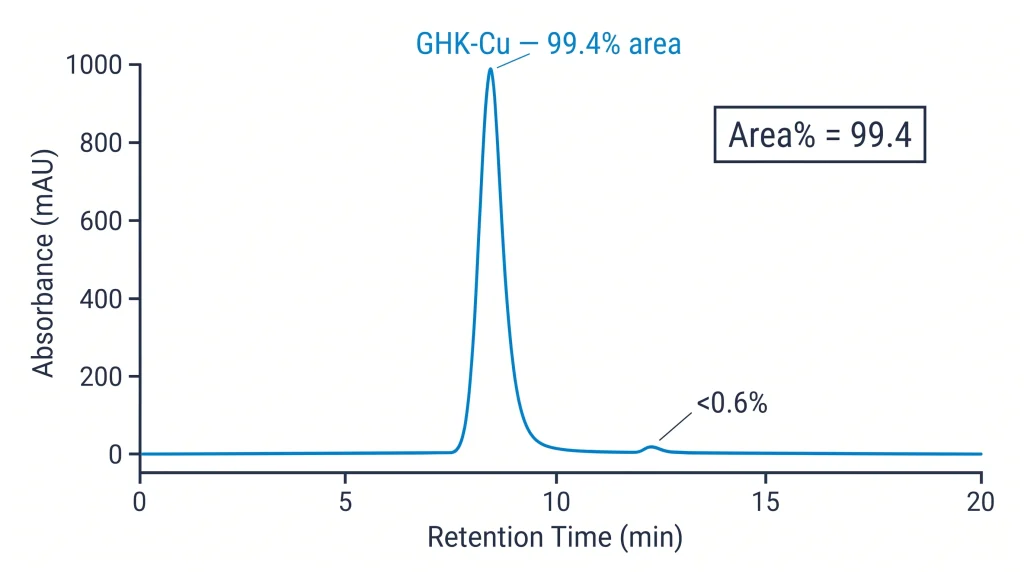
HPLC (high-performance liquid chromatography, a method that separates molecules by size and polarity as they pass through a column) separates the GHK-Cu compound from impurities. The result is a chromatogram, which is a graph showing peaks over time.
Each peak is a compound that came off the column at a set time. The target compound (GHK-Cu) comes off at a known retention time. The peak area for that compound is measured. Purity is calculated as (target peak area divided by total area) times 100.
Research-grade compounds show ≥99% purity at the target peak. An HPLC chromatogram should be included in the COA or available on request. The chromatogram lets the researcher confirm the result visually.
What Does Mass Spec Confirm?
Mass spectrometry (a method that measures the mass-to-charge ratio of ionized molecules) confirms the identity of the compound. The mass spec result shows the molecular weight of the main compound in the sample.
For GHK-Cu, the expected molecular weight is approximately 340.38 daltons for the free tripeptide (Gly-His-Lys). The copper-bound complex adds about 63 daltons, giving a total near 403 daltons, depending on the salt form. The COA should state which form was tested.
According to Pickart L (2008) (PMID 18561291), GHK-Cu stimulates collagen and fibronectin gene expression in human fibroblast cell models. Confirming correct compound identity via mass spec is essential before using any compound in cell assays. These are in vitro findings only.
GHK-Cu is available at Next Level Pharm as a COA-verified research compound. Every lot ships with HPLC chromatogram and mass spec data.
![Two-panel COA data layout: left panel = HPLC peak table with columns Retention Time | Peak Area | Area% — one main row for GHK-Cu (99.4%) and one for total impurities (<0.6%); right panel = mass spectrum with x-axis m/z 300-400, dominant peak at m/z 341.1 labeled "[M+H]+ GHK-Cu" in electric blue, isotope cluster visible. Both panels in navy/blue, white background, minimal grid, annotation arrows.](https://nextlevelpharm.com/wp-content/uploads/2026/07/ghk-cu-hplc-table-mass-spec-coa-data-300x167.webp)
What Is the Lot Number on a COA?
A lot number (also called a batch number) is a unique identifier for one specific production run. Every vial produced in that run has the same lot number. The COA for that batch also carries the same number.
When a researcher receives a shipment, they should check that the lot number on the vial label matches the lot number on the COA. If they differ, the COA does not apply to that vial.
In research protocols, the lot number is recorded in the methods section. This lets other researchers know exactly which batch was used. If results differ between studies, lot-to-lot variation can be tracked back to specific batches.
Shop research peptides. Every order includes a COA with a lot number and HPLC and mass spec data.
What Purity Level Should a COA Show?
For research-grade GHK-Cu, the accepted standard is ≥99% HPLC purity. This means 99% or more of the detected area in the HPLC chromatogram belongs to the target compound.
Compounds with lower purity may have unknown impurities. These can interfere with cell assay results. A purity below 95% is generally not accepted for cell research. Most reliable suppliers test to ≥99%.
According to Pickart L et al. (2018), GHK-Cu is studied in multiple cell models for skin and tissue gene marker changes. Purity confirmation is a prerequisite for attributing any cell response to the compound itself. These are in vitro findings only.
How Does Third-Party Testing Work?
Third-party testing means an independent lab (not the manufacturer) runs the HPLC and mass spec tests. The lab has no financial incentive to change the result. This makes third-party data more reliable than in-house only data.
A COA from a third-party lab should include the lab name, address, and test date. Some COAs include a digital signature or QR code that links to the original test record on the lab’s system. This makes the data harder to alter.
Suppliers that use both in-house and third-party testing provide two data points for purity. This reduces the chance of a single-lab error. In research, having both sets of data on file is good practice.
Frequently Asked Questions
What Does COA Stand For?
COA stands for Certificate of Analysis. It is a document from the testing lab that records the results of analytical tests run on a specific batch of compound. For research peptides, the COA typically includes HPLC purity data, mass spectrometry molecular weight, lot number, test date, and lab name. Some COAs also include endotoxin test results, residual solvent data, and water content. The COA is batch-specific. One COA applies to one lot only, not to all stock of a given compound.
How Do I Find the Purity on a COA?
The purity is expressed as a percentage. Look for a line that reads “Purity by HPLC” or “HPLC Purity” followed by a percentage. Research-grade GHK-Cu should show ≥99%. Some COAs also include a chromatogram image. In the chromatogram, look for the main peak (GHK-Cu) compared to any smaller peaks. The ratio of the main peak area to total area gives the purity. A well-formatted COA will include both the percentage and the chromatogram.
What Is the Molecular Weight of GHK-Cu?
The GHK tripeptide (Gly-His-Lys) has a molecular weight of approximately 340.38 daltons as the free acid. When copper (II) ion is bound, the complex adds about 63 daltons. The total molecular weight of the GHK-Cu complex is approximately 403 daltons, depending on the specific salt form. The mass spec result on the COA should match this expected value. A different molecular weight indicates either a wrong compound or a contaminated sample.
What Is a Lot Number and Why Does It Matter?
A lot number (also called a batch number) is a unique identifier assigned to one production run of a compound. Every vial from that run carries the same lot number. The COA for that batch also carries the same number. Matching the vial lot number to the COA lot number confirms that the test data apply to the vial in hand. In research protocols, the lot number is recorded in the methods section for reproducibility tracking.
What Is the Difference Between HPLC and Mass Spec?
HPLC separates the compound from impurities and measures the relative amount of each component by peak area. Mass spec confirms the molecular weight of the compound. HPLC tells you how much of the compound is present relative to impurities. Mass spec tells you what the compound is. Both tests together provide both purity and identity confirmation. A COA with only one test is less complete than one with both.
Can I Use GHK-Cu in a Cell Assay Without a COA?
Using a compound without a COA in a cell assay is not accepted research practice. The COA confirms that the compound is what the supplier says it is and that purity is ≥99%. Unknown impurities in a low-purity compound can cause cell responses that are wrongly attributed to GHK-Cu. A COA with HPLC and mass spec data is the minimum standard. Lot number traceability is also required for reproducible protocols.
What Is Retention Time on an HPLC Chromatogram?
Retention time is the time it takes for a specific compound to travel through the HPLC column and reach the detector. Each compound has a known retention time under standard conditions. The target compound (GHK-Cu) elutes at a consistent retention time. If the main peak appears at an unexpected retention time, this may indicate a different compound. Retention time is used together with peak area to confirm both identity and purity on the chromatogram.
What Is a Third-Party COA?
A third-party COA comes from an independent analytical lab that has no relationship with the manufacturer. The lab receives a blinded sample and runs its own HPLC and mass spec tests. The result is unbiased. Third-party COAs are considered more reliable than in-house COAs alone. Suppliers that provide third-party COAs alongside in-house data give researchers two independent data points. The third-party lab name and contact should appear on the document.
What Is Endotoxin Testing on a COA?
Endotoxin testing (using the LAL assay) checks for bacterial endotoxins in the sample. Endotoxins are cell wall fragments from gram-negative bacteria. They can cause strong immune responses in cell assays, masking the true effect of the compound. The LAL (Limulus Amebocyte Lysate) assay is the standard method. An endotoxin level of less than 1 EU/mg is the common research standard. Some COAs include this result as an additional quality check.
Are All COAs the Same Format?
No. COA format varies by supplier and lab. However, all research-grade COAs should include the compound name, lot number, test date, HPLC purity, and mass spec molecular weight. Chromatograms and spectra may be on the same page or as an attachment. Some COAs are digital with QR codes linking to the original test record. The key data points are the same across formats. Researchers should confirm all these fields are present before accepting a COA.
Summary
A GHK-Cu COA records three key data points: HPLC purity (≥99%), mass spec molecular weight (~403 daltons for the copper complex), and a lot number. Researchers use the COA to confirm the compound is correctly identified and pure enough for cell assay use. The lot number traces the result back to a specific batch.
Third-party testing adds an independent check on purity. Matching the vial lot number to the COA lot number is the first step in any protocol. All GHK-Cu findings cited here come from cell and animal models only. The compound is for lab research use only.
What Should You Do Next?
Request a COA before starting any GHK-Cu research protocol. Confirm HPLC purity is ≥99% and mass spec MW matches the expected compound. The lot number on the COA must match the lot number on the vial. Record the lot number in the methods section of every protocol.
Shop research peptides. GHK-Cu is available with HPLC and mass spec COA data on every batch.
People Also Read
- What Is a Peptide COA? Testing Standards Explained
- GHK-Cu Research Explained: What Peer-Reviewed Studies Show
About the Author
Next Level Pharm Research Team
Alex M covers peer-reviewed findings in peptide science for Next Level Pharm, a US-based supplier of research-grade peptides verified to ≥99% purity via HPLC and mass spectrometry on every batch.
Disclaimer: The information provided on this page is for educational and research purposes only. Next Level Pharm products are intended for laboratory research use only. They are not intended for human consumption, diagnostic, therapeutic, or medicinal purposes. This content does not constitute medical advice. Always consult a licensed healthcare professional before making any health-related decisions.