Oxytocin Research: Neuropeptide Mechanisms and Studies

Last updated: May 2026
Oxytocin is a nine-amino-acid peptide made in two brain regions: the PVN and SON. The pituitary gland releases it into the blood and it also works as a brain signal via OXTR. According to a brain research review (2006), oxytocin has been studied in many animal tests. These tests cover social acts, stress responses, and body function in rodent models.
Next Level Pharm stocks research-grade oxytocin at 99% purity or higher on every batch. HPLC and mass spec confirm purity, and a COA (Certificate of Analysis) ships with each lot.
The sections below cover structure, OXTR signals, HPA axis data, rodent tests, and sourcing standards.
Key Takeaways
- What It Is: Oxytocin is a nine-amino-acid peptide made in the brain and released by the pituitary gland into the blood.
- Receptor Class: OXTR is a Gq-coupled GPCR expressed in the brain, uterus, breast, and heart tissue.
- HPA Axis Link: Oxytocin neurons sit near CRH neurons in the PVN, creating a direct link between the two systems.
- Rodent Tests: Oxytocin has been studied in social ID tests, partner choice tests, and fear loss models.
- Structural Precision: The Cys1-Cys6 sulfur bridge is needed for OXTR binding, so lab synthesis must preserve the ring shape.
- Sourcing Standard: Research-grade oxytocin needs HPLC purity above 99%, with mass spec confirming mass near 1007 daltons.
The sections below look at each topic in detail, drawing on peer-reviewed research from science journals.
What Is the Molecular Structure of Oxytocin?
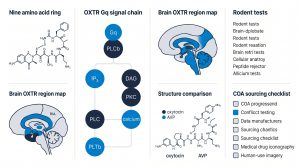
Oxytocin has nine amino acids in the sequence Cys-Tyr-Ile-Gln-Asn-Cys-Pro-Leu-Gly-NH2. Its mass is near 1007 daltons in the free base form. A sulfur bridge links Cys1 to Cys6, forming a six-unit ring. A short three-unit tail hangs off the ring end. AVP (vasopressin) has the same ring-and-tail shape. AVP differs from oxytocin by only two amino acids at spots 3 and 8.
The ring shape is needed for OXTR binding. Open-chain forms that lack the bridge bind with far less strength. Published binding studies confirm that the intact bridge is required for full receptor activity. Lab synthesis keeps the sulfur bridge in place through controlled folding steps. Mass spec near 1007 daltons confirms the bridge is present. Any bond break shifts the mass by 2 daltons and is easy to detect.
How Does the Oxytocin Receptor Signal Inside Cells?
OXTR is a Gq-coupled GPCR that turns on PLCb when oxytocin binds. PLCb splits PIP2 into two cell signals: IP3 and DAG. IP3 pulls calcium from the ER (endoplasmic reticulum) into the cell. DAG turns on PKC enzymes in the same cell. According to a receptor study (2013), OXTR can also link to Gi in some cell types. This shifts the signal effect based on which tissue is involved.
In the brain, OXTR sits in key regions: the amygdala, brain base, nucleus accumbens, and hippocampus. Brain stem nuclei also carry the receptor and play a role in body function. Receptor blocker studies map which circuits are most active. These tests show where oxytocin signals have the biggest effect on each rodent behavior.
What Do HPA Axis Studies Show for Oxytocin Signaling?
The HPA axis (hypothalamic-pituitary-adrenal axis) controls how the body reacts to stress. It starts with CRH release from the PVN, which triggers the full stress response chain. Oxytocin neurons sit next to CRH neurons in the PVN, giving the two systems a close link. According to a stress hormone study (2011), oxytocin in rat models has been studied for CRH output and ACTH levels. These are measured as stress markers in HPA axis research.
Published rat studies have looked at how ICV oxytocin affects stress hormone output and CRH mRNA in the PVN. These results frame oxytocin as a research probe for how peptides link to stress systems. No drug claims are made, and all findings are based on animal model research.
- CRH neurons and oxytocin neurons sit side by side in the PVN, creating a direct link.
- OXTR in brain stem nuclei connects oxytocin to heart stress models in rodent research.
- GC (glucocorticoid) receptors co-express with OXTR in stress brain regions, forming a cross-talk point.
Research teams can browse the recovery peptide category at Next Level Pharm for COA-confirmed compounds with full lot documentation.
What Behavioral Models Use Oxytocin as a Research Tool?
Oxytocin has been studied in several rodent tests: social ID tests, partner choice tests, and fear loss models. The partner choice test in prairie voles is widely cited in social circuit research. These voles have high OXTR in the nucleus accumbens, linking pair bond acts to the dopamine reward circuit. Receptor blocker studies help narrow down which circuits drive each test outcome.
Fear tests have used central oxytocin to examine whether OXTR in the amygdala speeds up fear loss. Published studies show gaps in speed between treated and control groups. These results frame oxytocin as a research probe for amygdala circuit studies, not a clinical treatment. All findings are based on animal models.
- Social ID test: checks whether rodents can tell new from known cage mates after oxytocin or blocker.
- Partner choice test: links high nucleus accumbens OXTR to pair bond acts in prairie voles.
- Fear loss test: maps the amygdala OXTR role in how fast fear memory fades in rodents.
How Does Oxytocin Compare to AVP in Research?
Oxytocin and AVP (vasopressin) share a common ancestor peptide with a Cys1-Cys6 sulfur bridge. Both have nine amino acids, differing only at spots 3 and 8 of the chain. AVP has Phe at spot 3 and Arg at spot 8, while oxytocin has Ile and Leu there. These two swaps change which receptor each peptide binds with higher affinity.
| Feature | Oxytocin | AVP (vasopressin) |
| Chain length | 9 amino acids | 9 amino acids |
| Mass | ~1007 daltons | ~1084 daltons |
| Primary receptor | OXTR (Gq-coupled) | V1a, V1b, V2 |
| Spot 3 amino acid | Ile | Phe |
| Spot 8 amino acid | Leu | Arg |
| Research context | Social acts, HPA axis | Fluid balance, stress |
| CNS sites | Amygdala, accumbens, hippocampus | Lateral septum, amygdala |
| Sulfur bridge | Cys1-Cys6 | Cys1-Cys6 |
The two peptides cross-react at lab levels, so selective blockers are needed to tell their effects apart. Published studies pair V1a blockers with OXTR blockers to map each peptide’s role. This method gives a clearer view of which peptide drives each outcome in the test.
What Quality Standards Apply to Research-Grade Oxytocin?
Research-grade oxytocin needs HPLC purity above 99% to cut out short-chain and wrong-bridge forms. These impurities would skew assay results if present in the batch. HPLC splits them by hold time and gives each as a percent of total peak area.
Mass spec confirms the intact mass near 1007 daltons. A sulfur bridge shifts mass by 2 daltons vs. the open-chain form, proving the bridge is there. A lot-specific COA records HPLC purity, mass data, lot number, and cold storage notes for every batch. Lyophilized oxytocin is stable at -20C under dry conditions, the standard for lab storage of research peptides.
Frequently Asked Questions
What is oxytocin and why is it studied as a research compound?
Oxytocin is a nine-amino-acid peptide made in the brain by the PVN and SON. The pituitary gland releases it into the blood, and it also works as a brain signal via OXTR. OXTR is found in the brain and many body tissues. Labs use it in rodent tests to study social acts, stress, and fear memory. It is a widely used research tool across many brain science fields, not a drug.
What is the molecular structure of oxytocin?
Oxytocin has nine amino acids with a sulfur bridge linking spots 1 and 6, forming a ring with a short tail. Its mass is near 1007 daltons, and the ring shape is needed for OXTR binding. Without the intact bridge, the peptide binds poorly to OXTR. Mass spec near 1007 daltons is used to confirm the bridge is intact before lab use.
How does the oxytocin receptor signal inside cells?
OXTR is a Gq-coupled GPCR that turns on PLCb when oxytocin binds. PLCb makes IP3 and DAG, which are two key cell signals in this pathway. IP3 pulls calcium from the ER, while DAG turns on PKC enzymes. In some cell types OXTR also links to Gi, shifting the effect by tissue type. Research has mapped both signal paths in published lab studies.
What brain regions express the oxytocin receptor?
OXTR sits in the amygdala, brain base, nucleus accumbens, hippocampus, and frontal lobe. Brain stem nuclei also carry OXTR and control many body functions. OXTR levels vary between species, and prairie voles have very high levels in the nucleus accumbens. This makes them a useful model for social bond circuit research. Montane voles have low OXTR there and show weaker pair bonds.
What do HPA axis studies show for oxytocin signaling?
Rat studies show oxytocin neurons sit next to CRH neurons in the PVN, creating a close link. ICV oxytocin was given to rats in some tests, with stress hormone output and CRH mRNA as key markers. These results frame oxytocin as a research probe for stress systems. No drug claims are drawn from these rat model results. All findings are framed in terms of rodent circuit interactions in the HPA axis.
How do behavioral models use oxytocin as a research tool?
Lab tests use central oxytocin or OXTR blockers to study brain circuits that drive social acts and fear. The social ID test checks whether rats can tell new from known cage mates. The partner choice test looks at pair bond acts in prairie voles. Fear loss tests check amygdala function after OXTR changes in the circuit. Blocker studies sort out oxytocin effects from AVP effects in the same brain circuit.
How does oxytocin differ from AVP structurally and functionally?
Oxytocin and AVP are both nine-amino-acid peptides with a Cys1-Cys6 sulfur bridge. They differ only at spots 3 and 8 of the chain. These two swaps shift receptor affinity so oxytocin binds OXTR preferentially. AVP binds V1a, V1b, and V2 receptors with higher affinity than oxytocin does. Both peptides cross-react at lab levels, so selective blockers are needed to tell their effects apart.
What quality standards apply to research-grade oxytocin?
Research-grade oxytocin needs HPLC purity above 99% to cut out short-chain and wrong-bridge forms. These impurities could skew assay data if present in the batch. Mass spec confirms intact mass near 1007 daltons, with a 2-dalton shift proving the sulfur bridge is there. A lot of COA records purity, mass data, lot number, and cold store notes for lab procurement records.
Is research-grade oxytocin intended for human use?
Research-grade oxytocin is made for lab use only and is not intended for human administration. It has no drug approval in this form, and all studies cited used rats or cell lines. This compound must stay in a licensed research lab at all times. Researchers must follow their site safety protocols when working with this material.
Where does research-grade oxytocin ship from?
Research-grade oxytocin ships to all 50 US states from Next Level Pharm in about 48 hours. A COA with HPLC data, mass spec results, and a traceable lot number ships with each order. This supports lab records and procurement documentation for research teams. Free shipping applies to orders over $150.
Summary
Oxytocin is a nine-amino-acid peptide made in the brain and released by the pituitary gland. It signals through OXTR, a Gq-coupled GPCR found in the limbic system, brain base, and brain stem. Published research has placed OXTR in social act models, HPA axis studies, and fear memory tests. These studies used rodent systems with selective blockers and central peptide delivery. Its close structural link to AVP requires paired blocker studies in lab research designs. Research-grade sourcing requires HPLC purity above 99%, mass spec near 1007 daltons, and a lot-specific COA.
What Should You Do Next?
Research teams studying brain peptides can find COA-verified, HPLC-tested research-grade oxytocin at the Next Level Pharm shop. Full mass spec and purity data come with every batch.
People Also Read
- Kisspeptin-10 Research: Neuropeptide Signaling and Reproductive Biology Studies
- PT-141 Research: Bremelanotide Neuropeptide and Receptor Signaling Studies
About the Author
Next Level Pharm Research Team
Alex M covers peer-reviewed findings in peptide science for Next Level Pharm, a US-based supplier of research-grade peptides verified to >=99% purity via HPLC and mass spectrometry on every batch.
Disclaimer: The information provided on this page is for educational and research purposes only. Next Level Pharm’s products are intended for laboratory research use only. They are not intended for human consumption, diagnostic, therapeutic, or medicinal purposes. This content does not constitute medical advice. Always consult a licensed healthcare professional before making any health-related decisions