
IGF-1 LR3 Research: What Studies Show About This Growth Factor Analog

Last updated: May 2026
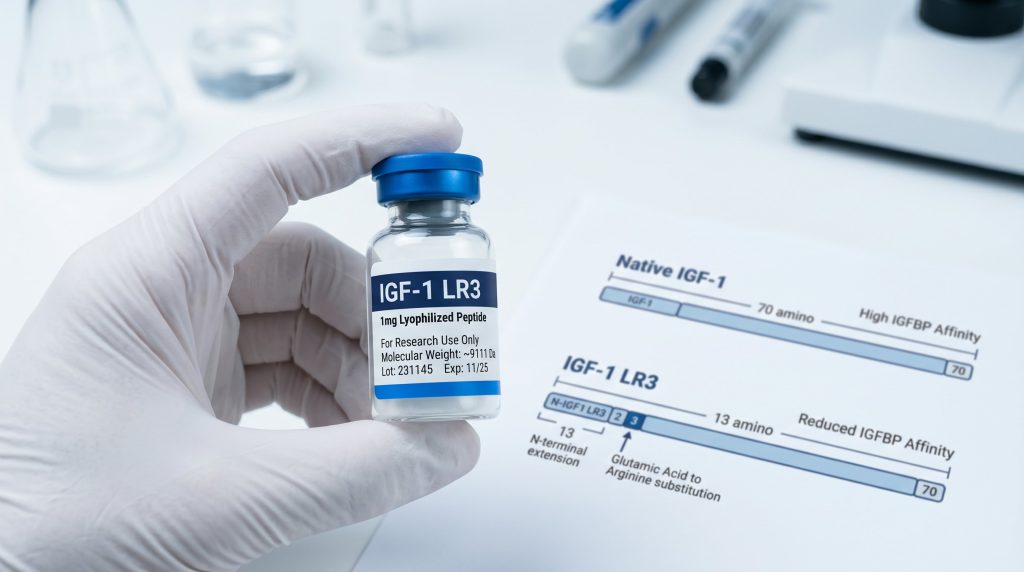
An IGF-1 LR3 research compound is an 83-amino-acid analog of human IGF-1. It has two key changes to its structure. These extend its half-life from minutes to about 20-30 hours in preclinical models. Since the early 1990s, IGF-1 LR3 has appeared in hundreds of published studies. These look at cell growth signals, receptor binding, and growth factor pathway effects in lab and animal models.
Next Level Pharm supplies IGF-1 LR3 as a lyophilized research peptide verified to >=99% purity via HPLC and mass spectrometry on every batch. Each vial ships with a lot-specific COA for lab checks. All stock is USA-stored for fast dispatch.
Researchers who study the IGF axis need well-tested analogs. They need tools that keep receptor-level effects apart from binding protein noise. IGF-1 LR3 was built for that purpose.
Key Takeaways
- Structural Changes: IGF-1 LR3 has a 13-amino-acid N-terminal extension and an arginine at position 3. These cut IGFBP binding by more than 1,000-fold versus native IGF-1.
- Extended Half-Life: Preclinical studies report a half-life of 20-30 hours for IGF-1 LR3. Native IGF-1 clears in under 10 minutes.
- Receptor Binding: IGF-1 LR3 binds the IGF-1 receptor (IGF-1R) at levels close to native IGF-1. This keeps its value as a receptor-level research tool.
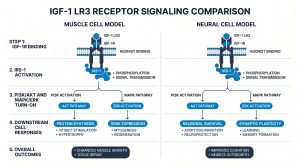
- Cell Pathways: In cell culture, IGF-1 LR3 turns on PI3K/Akt and MAPK/ERK pathways. These are the same cascades fired by native IGF-1R binding.
- Research Use: Published studies have used IGF-1 LR3 in muscle, neural, and connective tissue cell models. These look at IGF-1R signals free of binding protein noise.
- Purity Standard: Research-grade IGF-1 LR3 needs HPLC purity at 99% or higher. Mass spectrometry must confirm the correct sequence per lot.
The design of IGF-1 LR3 reflects a clear goal. It gives researchers a tool with stable receptor behavior. Knowing its structure is key to reading published IGF-1 LR3 data well.
What Structural Changes Define IGF-1 LR3?
IGF-1 LR3 differs from native IGF-1 in two ways. First, it has a 13-amino-acid extension at the N-terminal end. Second, the glutamate at position 3 is replaced by arginine. This gives the compound its “R3” name. These two changes cut its binding to IGFBPs, a family of six carrier proteins. IGFBPs set IGF-1 levels in living systems.
According to a study in Growth Factors (1994), these changes cut IGFBP binding by more than 1,000-fold versus native IGF-1. At the same time, IGF-1R binding stayed at a close level. This split between IGFBP binding and receptor binding is the core feature that makes IGF-1 LR3 useful in research. Researchers can study receptor-level signals without IGFBP noise skewing the free peptide level.
How Does IGF-1 LR3 Bind to Its Receptor?
IGF-1 LR3 binds the IGF-1 receptor (IGF-1R) through the same domain as native IGF-1. IGF-1R is a cell surface receptor found on many cell types. These include muscle, neural, liver, and connective tissue cells. When a ligand binds, the receptor fires and starts a chain of signals inside the cell.
According to a study in the Journal of Endocrinology (1992), IGF-1 LR3 showed close receptor binding to native IGF-1 in human cell line assays. The N-terminal extension and R3 change did not break the binding domain shape needed for IGF-1R contact. This means IGF-1 LR3 fires IGF-1R signals based on receptor binding alone, not on IGFBP levels.
What Cell Pathways Does IGF-1 LR3 Activate?
IGF-1 LR3 binding to IGF-1R fires two main pathways in cell culture models. The first is PI3K/Akt, linked to cell survival, protein synthesis, and glucose signals. The second is MAPK/ERK, tied to cell growth and maturing in various tissue models. Both are well-known targets of IGF-1R and are studied widely in growth factor research.
Researchers can view research-grade IGF-1 LR3 with lot-specific COA data at the Next Level Pharm IGF-1 LR3 product page. In published cell studies, PI3K/Akt and MAPK/ERK patterns from IGF-1 LR3 matched native IGF-1 responses. This supports its use as a receptor-level tool in signaling research.
- PI3K/Akt: cell survival, protein synthesis, and metabolic signals.
- MAPK/ERK: cell growth and maturing signals in tissue models.
- mTORC1: protein translation start in muscle cell studies.
How Does IGF-1 LR3 Compare to Native IGF-1?
The main gap in research models is IGFBP avoidance. In serum-containing cell culture, native IGF-1 is quickly locked up by IGFBPs. This cuts its free level and limits receptor contact. IGF-1 LR3’s low IGFBP binding lets more of the applied peptide reach IGF-1R on the cell surface. This makes dose-response links more stable in lab assays.
According to a study in Molecular and Cellular Biology (2004), IGF-1 LR3 showed more lasting Akt firing in serum culture. It beat equal amounts of native IGF-1 in that measure. Many growth factor labs prefer IGF-1 LR3 as the IGF-1R agonist in serum-containing systems. Its longer half-life must be noted in washout and time-course designs.
| Property | Native IGF-1 | IGF-1 LR3 |
| Amino acid length | 70 | 83 |
| IGFBP binding | High | Over 1,000-fold lower |
| IGF-1R binding | Reference | Close to native IGF-1 |
| Half-life (preclinical) | Under 10 minutes | 20-30 hours |
| Insulin receptor cross-binding | Low | Lower than native |
| Preferred research use | Binding protein studies | Receptor-level signaling |
What Do Muscle Cell Studies Show?
Muscle cell models make up a large share of published IGF-1 LR3 research. In satellite cell and muscle cell culture, IGF-1 LR3 has been shown to raise IRS-1 signals, Akt firing, and mTORC1 steps versus vehicle controls. These are the same signal nodes linked to protein synthesis and muscle cell maturing in skeletal muscle biology.
Researchers in muscle cell systems have used IGF-1 LR3 to study the link between IGF-1R firing and muscle-specific factors. These include MyoD and myogenin in maturing assays. All work is done in isolated cell and animal tissue models. It does not show any performance or body outcome in humans. This compound is a lab research tool only.
- C2C12 murine muscle cells: most common model for IGF-1 LR3 growth studies.
- Primary satellite cells: used in maturing and fusion assays.
- Human skeletal muscle cell lines: receptor profiling and kinase firing studies.
What Purity Standards Apply to IGF-1 LR3?
IGF-1 LR3 is an 83-amino-acid peptide with a set bond pattern and a three-part shape. Sequence errors, short fragments, or oxidation products can skew receptor binding and signaling data. Research-grade IGF-1 LR3 needs HPLC purity at 99% or higher. Mass spectrometry must confirm the correct mass and sequence per lot. A lot-specific COA is needed for assay tracking.
Researchers should check COA data before ordering any IGF-1 LR3 lot. Key data points to verify: HPLC purity percent, mass spec mass check, and lot number for audit use. Lyophilized format is best for shipping and long-term storage at -20 degrees Celsius before lab use.
- Minimum purity: 99% by HPLC (area percent method).
- Identity: mass spectrometry mass check per lot.
- Format: lyophilized powder for ambient-stable shipping.
- Storage: -20 degrees Celsius long-term after receipt.
Frequently Asked Questions
What is IGF-1 LR3?
IGF-1 LR3 is an 83-amino-acid synthetic analog of human IGF-1. It has two structural changes: a 13-amino-acid N-terminal extension and an arginine at position 3. These cut IGFBP binding by over 1,000-fold while keeping IGF-1R binding at a close level. It is used as a research tool for studying IGF-1R signals in cell and tissue models. It is a lab research compound only.
How does IGF-1 LR3 differ from native IGF-1?
Native IGF-1 is a 70-amino-acid peptide with high IGFBP binding. IGFBPs lock it up fast in living systems and cut its half-life to under 10 minutes. IGF-1 LR3 has far lower IGFBP binding due to its N-terminal extension and R3 change. This extends its half-life in preclinical models to about 20-30 hours. It is more stable as a receptor-level tool in serum-containing lab assays.
What receptor does IGF-1 LR3 bind to?
IGF-1 LR3 binds mainly to the IGF-1 receptor (IGF-1R), a cell surface receptor found on many cell types. These include muscle, neural, and liver cells. It also has some binding to the insulin receptor, though this is lower than its IGF-1R binding. Binding to IGF-1R fires the receptor and starts PI3K/Akt and MAPK/ERK signals in cell culture models.
What does the LR3 designation mean?
The LR3 name reflects two key features. The L refers to the long form. This comes from the 13-amino-acid N-terminal extension added to the native 70-residue sequence. The R3 refers to the arginine (R) at position 3, replacing the native glutamate (E3). This single amino acid swap is part of what cuts IGFBP binding by over 1,000-fold. Together, these two features define the compound’s research profile versus native IGF-1.
Why is IGF-1 LR3 used instead of native IGF-1?
In serum-containing cell culture, IGFBPs lock up native IGF-1 fast. This makes the free level and receptor binding hard to control. IGF-1 LR3’s very low IGFBP binding lets more of the peptide reach IGF-1R. This gives more stable dose-response links in lab assays. Researchers use it when studying IGF-1R signals apart from IGFBP effects.
What signaling pathways does IGF-1 LR3 activate?
In published cell studies, IGF-1 LR3 binding to IGF-1R turns on IRS-1 signaling. This recruits PI3K and starts Akt firing. Active Akt then signals to mTORC1, a key step in protein synthesis. Parallel signaling through the Ras/Raf/MAPK/ERK path has also been noted. These pathways are tied to cell survival, growth, and metabolic signals in the cell types studied. They do not point to clinical outcomes.
What purity level is required for research-grade IGF-1 LR3?
Research-grade IGF-1 LR3 needs HPLC purity at 99% or higher. Mass spectrometry must confirm the correct 83-amino-acid sequence and mass per lot. Lower purity lots may have short fragments or altered variants. These can skew receptor binding or signaling data and cut assay value. Each lot must include a COA with these data points for tracking and audit use.
How should IGF-1 LR3 be stored in a laboratory?
IGF-1 LR3 is supplied in lyophilized form for shipping. On receipt, store the dry peptide at -20 degrees Celsius in a dry space to stop moisture damage. Once prepared for assay use, keep aliquots at -80 degrees Celsius and use them fast. This limits freeze-thaw cycling, which can cut structural integrity and receptor binding in sensitive assays. Label each vial with lot number and prep date for assay tracking.
What cell models are used in IGF-1 LR3 research?
Published IGF-1 LR3 studies use many cell models. C2C12 murine muscle cells and primary satellite cells are common for muscle signaling work. PC12 cells and primary cortical neurons are used in neural signaling research. Liver cell and fat cell models have been used in metabolic pathway studies. Each model gives different signaling context. Findings from one cell type may not apply to another or to in vivo conditions.
Where can researchers source IGF-1 LR3 with documented purity?
Researchers should source IGF-1 LR3 from suppliers that provide lot-specific COA data with HPLC purity percent and mass spectrometry mass check per lot. Every batch is third-party tested.. Lyophilized format with USA-based stock and fast dispatch is best for domestic research use.
Summary
IGF-1 LR3 is an 83-amino-acid IGF-1 analog built to cut IGFBP binding by over 1,000-fold while keeping IGF-1R binding at a close level. Its longer half-life and stable receptor binding make it a useful lab tool for studying IGF-1R signals in serum-containing assays.
Published studies in muscle, neural, and connective tissue cell models have used IGF-1 LR3 to map PI3K/Akt and MAPK/ERK pathway steps. These are in vitro data points from isolated cell systems. They do not support any conclusion about outcomes in living subjects.
For lab use, IGF-1 LR3 needs HPLC purity at 99% or higher and mass spectrometry sequence check on every lot. This is needed for assay integrity and stable results across runs.
What Should You Do Next?
Researchers planning IGF-1 LR3 studies should verify three things before sourcing. These are: HPLC purity at 99% per lot, mass spectrometry mass check, and a lot-specific COA with online lookup.
Research-grade IGF-1 LR3 and related growth factor peptides are available with full batch data from the fitness and GH peptide category.
- View IGF-1 LR3 product specs and COA data.
- Browse fitness and GH research peptides.
- Shop the full research peptide catalog.
People Also Read
- HGH Fragment 176-191 Research: Lipolytic Peptide Studies and Findings
- Sermorelin vs CJC-1295: How These GHRH Analogs Differ in Research
About the Author
Next Level Pharm Research Team
Alex M covers peer-reviewed findings in peptide science for Next Level Pharm, a US-based supplier of research-grade peptides verified to >=99% purity via HPLC and mass spectrometry on every batch.
Disclaimer: The information provided on this page is for educational and research purposes only. Next Level Pharm’s products are intended for laboratory research use only. They are not intended for human consumption, diagnostic, therapeutic, or medicinal purposes. This content does not constitute medical advice. Always consult a licensed healthcare professional before making any health-related decisions.