
Urocortin Peptide Research: CRF Type 2 Receptor

Last updated: October 2026
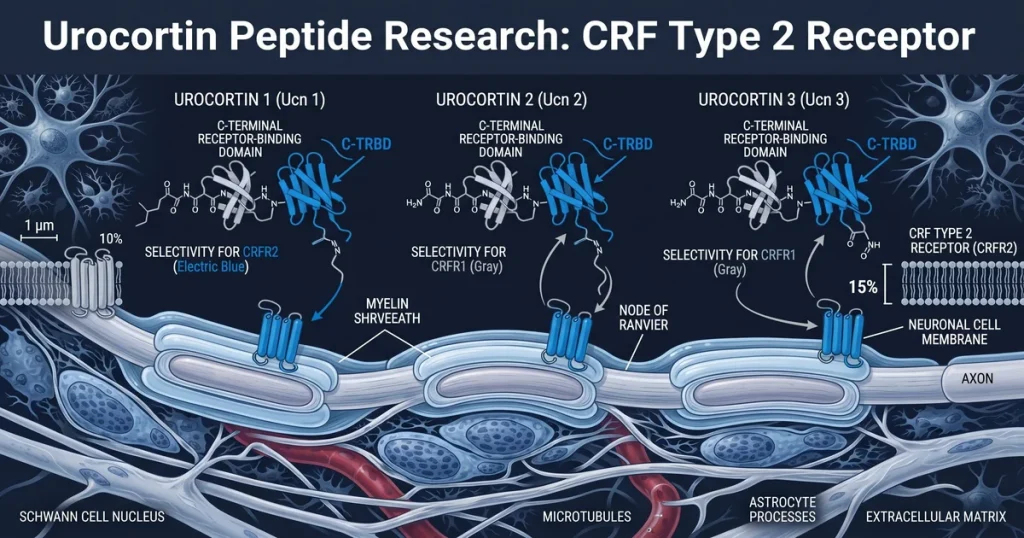
A urocortin peptide is an endogenous neuropeptide from the CRF family. CRF stands for corticotropin-releasing factor. Three forms exist: urocortin 1, 2, and 3. Each binds CRF receptors with its own subtype profile. According to PubMed (1995), urocortin 1 was first isolated from rodent brain tissue. Urocortins 2 and 3 bind only the CRF type 2 receptor, or CRFR2. This makes the family useful in stress and autonomic signaling research. Lab studies of CRFR2 rely on high-purity peptide material to get clean binding data.
Next Level Pharm stocks research-grade urocortin peptides at 99.4% average purity. Each batch is tested by HPLC and mass spec. A COA ships with every vial. Lot numbers are traceable online. Peptides arrive as lyophilized powder. They are stable at room temp during shipping. Store at minus 20 C for long-term use. Third-party testing is part of every batch run, and results appear on the COA alongside in-house data.
Urocortin peptides bind CRF receptors; CRFR2-selective forms help isolate stress-signaling in lab studies.
CRFR2 research covers three core areas: receptor binding, cell signaling, and model selection. Each area depends on peptide purity and proper testing methods. Poor purity can shift binding data by a factor of two or more, which makes high-grade material a lab priority. The Key Takeaways below outline the main concepts before each area gets its own section.
Key Takeaways
- Receptor Selectivity: Ucn1 binds CRFR1 and CRFR2; Ucn2 and Ucn3 bind only CRFR2.
- Signaling Cascade: CRFR2 starts the Gs and AC pathway, raising cAMP inside the cell.
- Structural Basis: C-terminal sequence changes between the three urocortins drive subtype binding.
- In Vitro Tools: HEK293 cells and primary neuronal cultures are standard models for CRFR2 work.
- Binding Methods: Radioligand displacement and SPR give Ki and KD values for receptor affinity.
- Purity Standard: 99.4% purity is the minimum for reliable receptor assay data.
Beyond receptor types, urocortin research informs studies of heart control and immune signaling. Each area relies on COA-verified peptide material to get good data.
What Is the CRF Type 2 Receptor in Urocortin Research?
CRFR2 is a class B G-protein-coupled receptor, or GPCR. It couples to Gs proteins. This starts adenylate cyclase, or AC. AC raises cyclic AMP, or cAMP, in the cell. In urocortin work, CRFR2 is the main target for Ucn2 and Ucn3. Ucn1 also binds CRFR2, but with less focus. Recombinant CRFR2 cell lines are used to study binding in lab settings. Isolating CRFR2 from CRFR1 in studies helps researchers understand each receptor role.
According to PNAS (2001), CRFR2 is found in the heart, skeletal muscle, and gut. It also appears in parts of the brain, like the lateral septum. This spread links CRFR2 to both stress and body control. In HEK293 cells with recombinant CRFR2, Ucn2 binding raises cAMP. HTRF or ELISA kits measure this rise. Next Level Pharm supplies Ucn2 and Ucn3 at 99.4% purity for this type of work.
How Does Urocortin 1 Differ from Urocortin 2 and 3?
Urocortin 1 binds both CRFR1 and CRFR2 with high affinity. Urocortin 2 and urocortin 3 bind only CRFR2. This comes from changes in the C-terminal amino acid sequence. The C-terminus controls which receptor the peptide contacts. Researchers choose Ucn2 or Ucn3 to isolate CRFR2 without activating CRFR1. This keeps CRFR1 activity out of the data. Knowing which subtype is active helps researchers select the right assay format and ligand pair.
According to NCBI PMC (2002), Ucn2 and Ucn3 do not displace CRFR1-selective radioligands at normal lab levels. This confirms their CRFR2 selectivity. Ucn1 stays the preferred tool when both receptors are targets. It is also used when CRFR1 shutdown is part of the design. All three urocortins share an N-terminal helix that anchors them to the receptor. This shared part governs first contact before the C-terminus determines subtype.
What Signaling Does CRFR2 Activation Trigger?
CRFR2 starts the Gs and AC pathway, which raises cAMP inside the cell. cAMP then activates PKA, or protein kinase A, and PKA switches on CREB and other cell targets. A second arm runs through beta-arrestin, which turns on ERK via MAPK. The ERK arm builds more slowly than the initial cAMP peak, and both arms serve as readouts in CRFR2 studies.
According to Frontiers in Pharmacology (2023), ERK at CRFR2 depends on beta-arrestin. This points to biased agonism at this receptor. Researchers track ERK and PKA using phospho-specific antibodies and kinase kits. For cAMP, HTRF and ELISA kits are standard tools. Purity matters here. A 5% impurity can shift EC50 by a factor of two. This is why 99.4% purity is the baseline for CRFR2 studies.
Browse Brain research peptides at Next Level Pharm for COA-verified neuropeptides used in receptor work.
How Is Urocortin Receptor Binding Affinity Measured?
Two main methods measure urocortin binding: radioligand displacement and SPR. Radioligand assays use a labeled tracer against the unlabeled peptide. This gives a Ki value for each receptor. SPR measures binding in real time on a sensor chip. It gives on-rate and off-rate constants. These combine into a KD value. A third method, TR-FRET, avoids radioactive materials and fits high-throughput screens.
According to PubMed (2024), SPR-derived KD values for Ucn1 at CRFR2 range from 0.3 to 1.2 nM. This range depends on receptor prep and chip density. All three methods need high-purity peptide. A 5% impurity shifts KD by twofold. Impure fractions may act as partial agonists. They compete with the test peptide and skew the data. HPLC-verified material is the standard for any CRF receptor binding study.
| Method | Throughput | Output | Radioactive? |
|---|---|---|---|
| Radioligand displacement | Medium | Ki | Yes |
| Surface plasmon resonance | Low | kon, koff, KD | No |
| TR-FRET | High | IC50, KD | No |
| cAMP functional assay | High | EC50 | No |
In practice, most CRFR2 labs begin with the cAMP assay and then move to SPR for KD confirmation. The cAMP assay runs fast and scales to a 96-well format, which saves time at the screening stage. SPR gives kinetic data but needs more prep time and a biosensor chip. Researchers often run both methods to build a complete binding profile before moving to cell models.
What In Vitro Models Are Used for Urocortin Studies?
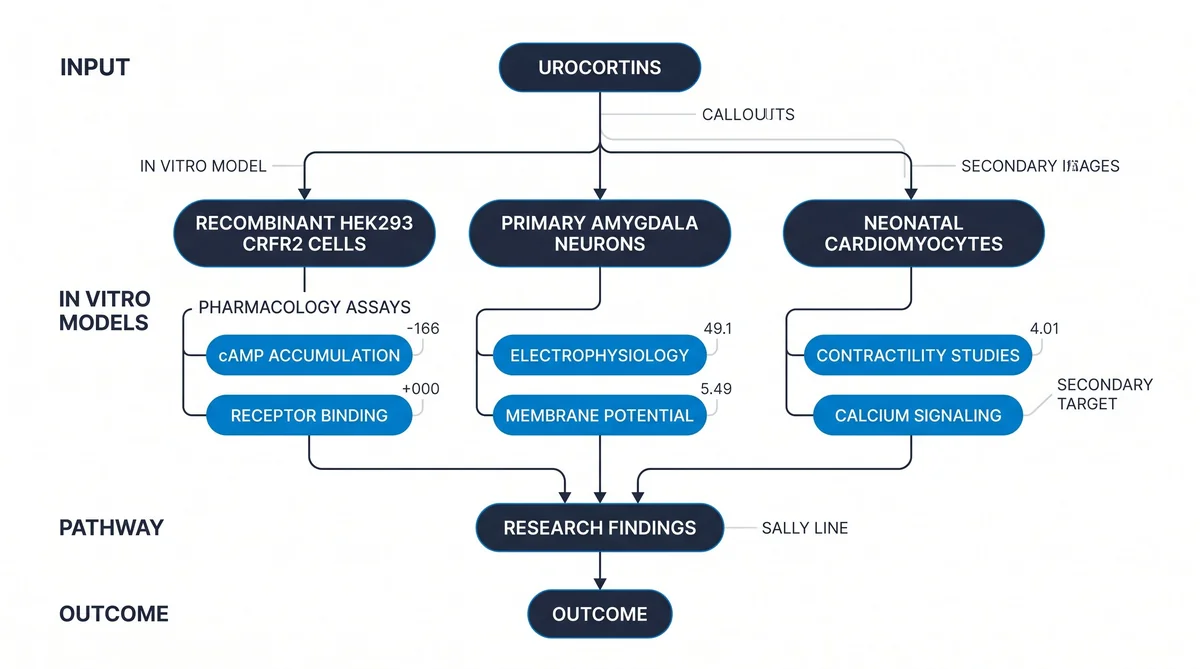
Three main in vitro systems appear in urocortin research: recombinant CRFR2 HEK293 or CHO cells, primary rat neuronal cultures, and neonatal rat heart cell preparations. Recombinant lines provide defined receptor density and consistent batch results. They are the first choice for binding assays and functional cAMP studies.
Primary cultures add endogenous receptor context. This gives a more realistic setting but raises batch variability. According to Frontiers in Neuroscience (2022), primary amygdala cultures express both CRFR1 and CRFR2. This lets researchers study subtype effects using Ucn2 or Ucn3 over a CRF background. Heart cell preparations are used in CRFR2-related contractility and energy studies. Brain peptides such as Semax and PE-22-28 are used alongside urocortins in wider receptor panel work.
How Are Urocortin Peptides Verified for Research Use?
Research-grade urocortin peptides are tested by HPLC and ESI-MS before dispatch. HPLC confirms the purity profile by measuring the main peak area against the total area. ESI-MS verifies the correct molecular mass and screens for truncated forms or oxidized residues. Both data sets appear in full on the COA for each lot and are available to researchers online.
The USP states that research peptide identity testing should include HPLC retention time and mass ion data. These standards are applied to every product in the catalog. The average purity across the last 100 batches is 99.4%, with each lot assigned a unique traceable lot number. Researchers can verify their lot number online before or at the time of order. Lyophilized urocortin peptides are stable at room temperature during transit and should be stored at minus 20 C on receipt for long-term stability.
Frequently Asked Questions
What is the CRF type 2 receptor in urocortin research?
CRFR2 is a class B GPCR. It is the main target for Ucn2 and Ucn3 in lab work. Activation raises cAMP through the Gs and AC pathway. Recombinant CRFR2 cell lines, such as HEK293 or CHO, are standard tools for measuring receptor activation. The cAMP rise is the main functional readout. Researchers use HTRF or ELISA kits to quantify it. This gives a reproducible readout across batches.
How does urocortin 1 differ from urocortin 2 and 3?
Urocortin 1 binds both CRFR1 and CRFR2 with high affinity. Urocortin 2 and urocortin 3 bind only CRFR2. This selectivity comes from changes in the C-terminal amino acid sequence. Researchers choose Ucn2 or Ucn3 to isolate CRFR2 effects without activating CRFR1. Ucn1 is used when both receptors are targets or when CRFR1 shutdown is part of the planned study design.
What signaling does CRFR2 activation trigger?
CRFR2 starts the Gs and AC pathway, raising cAMP levels inside the cell. This activates PKA, which switches on CREB and other cell targets. A second arm runs through beta-arrestin, which turns on ERK via MAPK. The ERK response builds more slowly than the fast cAMP peak. Both arms are tracked with kinase kits and phospho-specific antibodies in functional studies.
How is urocortin receptor binding affinity measured?
Binding affinity is measured by radioligand displacement, SPR, or TR-FRET. Radioligand assays use a labeled tracer to derive a Ki at each receptor. SPR measures on-rate and off-rate constants in real time to give KD values. TR-FRET avoids radioactive materials and fits high-throughput formats. All three methods need high-purity peptide. An impurity level above two to three percent can shift KD values by a factor of two or more.
What in vitro models are used for urocortin studies?
The main models are recombinant HEK293 or CHO cells with CRFR2, primary neuronal cultures from rat brain, and neonatal rat heart cell preparations. Recombinant lines give defined receptor density and consistent results. Primary cultures add endogenous receptor context but vary more between batches. Heart cell preparations are used in studies of CRFR2-related energy and contractility. Each model needs high-purity peptide to avoid off-target effects from synthesis impurities.
What is the molecular weight of urocortin 1?
Urocortin 1 has a mass of about 4,703 daltons for the 40-amino-acid human form. It is a white to off-white lyophilized powder. For lab work, it is typically reconstituted in sterile PBS or dilute acetic acid. Mass spec confirmation of the correct molecular ion is part of the COA process. The molecular ion data appears on the certificate that ships with every lot in the catalog.
Why is peptide purity important for CRF receptor research?
Purity affects the accuracy of binding and functional assay data. A sample with 5% impurity can shift IC50 or Ki values by a factor of two. This happens because truncated or oxidized peptide fragments may act as partial agonists at CRFR2. These fragments compete with the test peptide and skew the assay curve. HPLC-verified 99.4% purity material is the standard for reliable CRFR2 pharmacology data.
How are urocortin peptides stored after receipt?
Urocortin peptides in lyophilized form are stable at room temp during shipping. On receipt, store at minus 20 C in a dry, dark spot. Aliquot working stock solutions into single-use portions to avoid freeze-thaw cycles. Long-term storage beyond six months calls for minus 80 C. Each COA includes storage guidance specific to the lot. Avoid opening the vial in humid conditions to prevent moisture pickup. Follow these steps to keep the sample stable and active throughout the study.
What is the HPA axis and how do urocortins relate to it?
The HPA axis, or hypothalamic-pituitary-adrenal axis, is the main stress circuit in mammals. It regulates cortisol release in response to stress. Urocortins interact with this system through CRF receptors on pituitary cells and in the limbic brain. Ucn1 activates CRFR1 on anterior pituitary cells, which has been studied in ACTH release models. Ucn2 and Ucn3 modulate HPA responses through CRFR2.
How do researchers confirm urocortin identity in a received sample?
Identity is confirmed by comparing the HPLC retention time to a known reference standard and verifying the correct molecular ion by ESI-MS. Both data sets appear on the COA for each lot. Researchers can match the lot number on the COA to their vial using the online lookup tool. This dual-method verification meets USP guidance for research peptide identity testing.
Summary
Urocortin CRF receptor peptide research centers on three endogenous neuropeptides with distinct receptor selectivity. Ucn1 activates both CRFR1 and CRFR2. Ucn2 and Ucn3 are selective CRFR2 ligands. This makes the family useful for isolating receptor subtype roles in cAMP, PKA, and MAPK signaling in defined lab models.
Binding affinity is quantified by radioligand displacement, SPR, and TR-FRET. Each method requires high-purity peptide to give clean, reproducible data. Research-grade urocortin peptides at 99.4% purity, confirmed by HPLC and mass spec, are the standard for reliable receptor data. Researchers often combine cAMP functional assays with SPR kinetics to build a complete binding profile.
What Should You Do Next?
- Review the COA for the specific urocortin variant relevant to your CRFR subtype design.
- Select the right in vitro model: recombinant CRFR2 cells for binding or primary neuronal cultures for signaling work.
- Confirm peptide purity and identity meet HPLC and ESI-MS standards before starting binding assay experiments.
Shop research peptides for COA-verified urocortin peptides with full lot traceability.
People Also Read
- What Makes a Peptide Research Grade? Standards and Testing Explained
- BPC-157 vs TB-500: A Detailed Research Comparison Guide
About the Author
Next Level Pharm Research Team
The Next Level Pharm research team is composed of biochemists and laboratory scientists dedicated to providing researchers with the highest-purity, COA-verified research peptides available. Every batch is HPLC and mass spec verified before dispatch.
Disclaimer: The information provided on this page is for educational and research purposes only. Next Level Pharm’s products are intended for laboratory research use only. They are not intended for human consumption, diagnostic, therapeutic, or medicinal purposes. This content does not constitute medical advice. Always consult a licensed healthcare professional before making any health-related decisions.