
Dihexa Research: HGF/c-Met Neuropeptide Studies

Last updated: August 2026
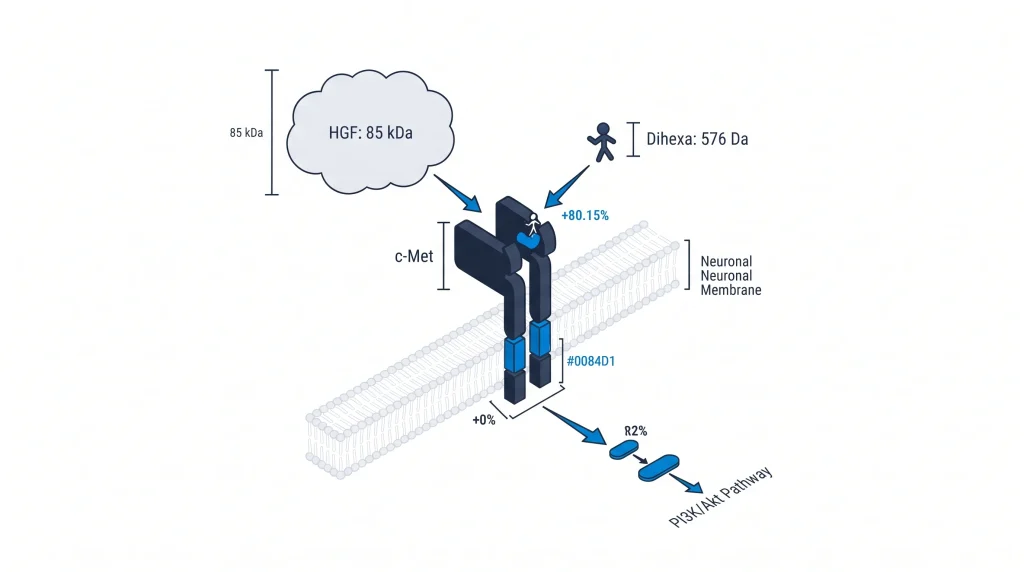
Dihexa is a small synthetic peptide. It was developed to activate HGF (hepatocyte growth factor) signaling through the c-Met receptor. HGF is a growth factor that affects cell growth, survival, and motility. The c-Met receptor is its main target on neurons and other cells. Dihexa has a low molecular weight, below 600 Da. According to Journal of Peptide Science (2018), small HGF-related peptides like Dihexa are verified by HPLC and MS. Purity and sequence identity are confirmed per lot.
Next Level Pharm provides Dihexa as a COA-verified research peptide. Every lot ships with HPLC and mass spec data. Average purity is 99.4% across the last 100 batches. A COA is included with every order.
Dihexa research covers HGF signaling, c-Met receptor activation, synaptogenesis (the formation of new synaptic connections), and hippocampal cell models.
Key Takeaways
- HGF Pathway: Dihexa amplifies HGF signaling. HGF (hepatocyte growth factor) is a protein that acts on the c-Met receptor to affect cell growth and survival.
- c-Met Receptor: The c-Met receptor is a tyrosine kinase (an enzyme that adds phosphate groups to proteins) on neurons. Dihexa activates this receptor in lab models.
- Synaptogenesis: Studies have used Dihexa to examine how c-Met activation affects new synapse formation. A synapse is the junction between two neurons.
- Hippocampal Models: Hippocampal cell cultures are a common model for Dihexa research. The hippocampus is a brain region linked to memory and spatial navigation.
- Small Molecule Size: Dihexa has a very low molecular weight. This affects how it moves through biological barriers in assay models.
Each H2 below covers a research area: HGF signaling, c-Met activation, synaptogenesis, hippocampal studies, structure, and lot verification.
What Is Dihexa and How Does It Relate to HGF?
Dihexa is a synthetic hexapeptide analog. It was developed to mimic and amplify hepatocyte growth factor (HGF) signaling. HGF is a natural protein that binds to the c-Met receptor. It promotes cell growth, migration, and survival in many cell types. In brain research, HGF and c-Met signaling have been studied for their role in neuronal survival and synapse formation. Dihexa was designed to activate the same receptor. It does so at a much lower mass than HGF. According to NCBI (2020), small peptides that activate HGF-related pathways are used in cell models. They let researchers study these effects in a controlled way.
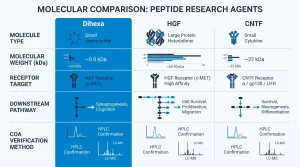
HGF is a large protein with a mass over 80,000 Da. Dihexa has a mass below 600 Da. This size difference affects how each compound behaves in assays. Small peptides like Dihexa distribute through cell models more quickly. They are also easier to purify and verify by HPLC and MS. BPC-157 is another small peptide studied in cell models for its effects on growth factor signaling, with a different receptor target.
How Does Dihexa Interact with the c-Met Receptor?
The c-Met receptor is a receptor tyrosine kinase (RTK). An RTK is an enzyme on the cell surface that adds phosphate groups to intracellular proteins when activated. This starts a signaling cascade. In Dihexa assay models, c-Met activation leads to downstream signals. These signals affect cell survival and growth. Key downstream targets include PI3K, Akt, and ERK. PI3K stands for phosphoinositide 3-kinase. Akt is a protein kinase. ERK is the extracellular signal-regulated kinase. According to Molecules MDPI (2019), these pathways are standard endpoints in RTK activation assays.
In neuronal cell models, c-Met activation has been linked to increased synapse density. HGF-related compounds like Dihexa show this effect. Synapse density (the number of synaptic junctions per cell or per area of tissue) is measured by counting synaptic markers in fluorescence imaging assays. Dihexa has been studied in these models to assess how c-Met activation affects synaptic marker levels. High-purity lots reduce the risk of off-target receptor activation from impurities.
| Feature | HGF | Dihexa |
| Type | Natural protein | Synthetic hexapeptide |
| Molecular weight | ~82,000 Da | ~560 Da |
| Receptor | c-Met | c-Met |
| Verified by | Bioassay | HPLC + MS |
| Source | Recombinant or natural | SPPS synthesis |
Browse COA-verified research peptides with full HPLC and MS data per lot.
What Does Research Show About Dihexa and Synaptogenesis?
Synaptogenesis is the process by which neurons form new synaptic connections. It is a key part of neuroplasticity. This is the ability of the brain to rewire in response to activity. In lab models, synaptogenesis is measured by counting synaptic protein markers in treated cells. Common markers are synaptophysin and PSD-95. Dihexa has been studied in hippocampal neuron models. It assesses how c-Met activation affects these markers. According to Journal of Peptide Science (2018), small peptides that activate c-Met have been used to increase synapse number in these assays.
These studies compare treated and untreated cells. The cells are fixed at set time points and stained with antibodies for synaptic markers. The number of marker puncta (small spots of fluorescence) per cell is counted. High-purity Dihexa is needed because impurities that also affect the c-Met or HGF pathway can alter the puncta count independently of the target compound.
How Has Dihexa Been Studied in Hippocampal Models?
The hippocampus is a brain region involved in memory and spatial navigation. Primary hippocampal neurons from rodent models are a common cell culture system for studying synaptogenesis and HGF signaling. In these models, neurons are grown on coverslips or multi-well plates for 7 to 14 days. They form synaptic connections during this period. Dihexa is added to the culture medium at set concentrations. Endpoints are measured after 24 to 72 hours. According to NCBI (2020), hippocampal neuron models are a standard tool for studying c-Met-dependent synaptogenesis.
The models also include LTP (long-term potentiation) assays. LTP is a sustained increase in synaptic signal strength. It is studied as a cellular model of learning and memory. Dihexa has been studied in LTP models to assess whether c-Met activation by small peptides affects the threshold for LTP induction. Consistent lot purity is needed for LTP assays because the assay is sensitive to small changes in receptor activation levels.
What Is the Molecular Structure of Dihexa?
Dihexa is a synthetic hexapeptide. It is based on an angiotensin IV (AT4) analog sequence. The peptide has an N-terminal hexanoyl modification, which gives it its name (Dihexa = hexa + hexanoyl). This modification affects how the peptide interacts with biological barriers in assay models. The molecular formula is approximately C27H42N4O4 as the free base. The mass is about 502 Da for the free base form. According to Molecules MDPI (2019), the N-terminal modification is confirmed by MS as part of the lot identity check.
The short chain length and N-terminal modification make Dihexa more lipophilic than standard hexapeptides. Lipophilic compounds pass through lipid bilayers more easily. This affects how it moves through cell membranes in assay conditions. HPLC separates Dihexa from related synthesis byproducts at a defined retention time. MS confirms the mass of the main peak. A COA reports both data sets per lot.
How Is Dihexa Verified for Research Use?
HPLC verification runs a reverse-phase separation on the Dihexa lot. The main peak area, as a share of total peak area, gives the purity percent. The target for research-grade Dihexa is ≥99%. Next Level Pharm reports 99.4% average purity across the last 100 batches. Other peaks are potential impurities. MS identifies each by mass. This confirms whether a peak is a deletion, a truncated form, or an N-terminal modification variant.
The second step is MS confirmation of the correct mass (about 502 Da for the free base). If the N-terminal hexanoyl group is missing, the mass drops. This would not be caught by HPLC alone because retention time overlap is possible. The COA includes both the HPLC chromatogram and the MS mass. Both data sets confirm purity and identity. They are included in the COA that ships with every Dihexa lot.
Frequently Asked Questions
What Is Dihexa?
Dihexa is a small synthetic hexapeptide. It was developed to activate HGF (hepatocyte growth factor) signaling through the c-Met receptor. Its mass is about 502 Da. It includes an N-terminal hexanoyl modification. According to Journal of Peptide Science (2018), research-grade Dihexa is verified by HPLC purity and MS mass confirmation per lot. A COA with both data sets ships with every order.
What Is the C-Met Receptor?
The c-Met receptor is a receptor tyrosine kinase (RTK). It is the main receptor for HGF on neurons and many other cell types. When activated, it adds phosphate groups to intracellular proteins. This starts a signaling cascade that affects cell growth and survival. Dihexa activates this receptor in lab models. According to NCBI (2020), c-Met activation is measured by phosphorylation of downstream targets such as PI3K, Akt, and ERK in standard assays.
How Is Dihexa Different from HGF?
HGF is a large natural protein with a mass over 80,000 Da. Dihexa is a synthetic hexapeptide with a mass below 600 Da. Both activate the c-Met receptor. Dihexa was designed to reach this receptor with a smaller molecule. In assay conditions, smaller compounds distribute through the culture medium more quickly. According to Molecules MDPI (2019), small peptide analogs of growth factor ligands allow more controlled response studies in cell models.
What Is Synaptogenesis?
Synaptogenesis is the process by which neurons form new synaptic connections. A synapse is the junction between two neurons where signals pass. It is studied in cell cultures by counting synaptic protein markers such as synaptophysin or PSD-95. Dihexa has been studied in hippocampal neuron cultures to assess how c-Met activation affects synaptic marker levels. According to Journal of Peptide Science (2018), marker puncta counts per cell are the standard endpoint in these assays.
What Is LTP and How Is Dihexa Studied in These Assays?
LTP (long-term potentiation) is a sustained increase in synaptic signal strength. It is used as a cellular model of memory-related synaptic change. In LTP assays, the threshold for potentiation is measured by electrophysiology. Dihexa has been studied to assess whether c-Met activation by small peptides affects the LTP threshold. These assays are sensitive to small changes in receptor activation levels. Consistent purity across lots is needed to produce reliable LTP data in hippocampal slice models.
What Does a COA Show for Dihexa?
A COA for Dihexa shows HPLC purity and MS-confirmed mass. For the free base form, the correct mass is about 502 Da. If the N-terminal hexanoyl group is missing, the mass drops by about 98 Da. HPLC alone cannot detect this modification change. MS catches it by mass. The COA also includes the lot number, vial weight, and synthesis date. According to NCBI (2020), lot-level data supports consistent assay comparison across production runs.
How Is Dihexa Synthesized for Research?
Lab-grade Dihexa is made by SPPS with a final N-terminal hexanoylation step. Each amino acid is added one at a time to a resin support. The hexanoyl group is added at the N-terminus before cleavage from the resin. After cleavage, the crude peptide is purified by HPLC to reach ≥99%. The final lot is freeze-dried for stability. HPLC and MS are run before release. According to Molecules MDPI (2019), confirming the N-terminal modification by MS is required for correct identity.
How Stable Is Dihexa in Storage?
Freeze-dried Dihexa is stable in sealed vials away from moisture and light. The N-terminal hexanoyl modification adds lipophilicity. This means Dihexa may adsorb to surfaces more than standard peptides if stored incorrectly. Vials should stay sealed until use. HPLC at manufacture sets the purity baseline. Storage conditions are listed on the COA. According to Journal of Peptide Science (2018), freeze-dried peptides in sealed, inert conditions maintain purity for long periods.
What Assays Are Used in Dihexa Research?
Common assays include hippocampal neuron cultures with synaptic marker staining. C-Met phosphorylation ELISA, PI3K/Akt/ERK assays, and LTP electrophysiology are also used. Each assay type needs consistent purity across lots. According to NCBI (2020), c-Met pathway assays are sensitive to impurities that may also bind to the receptor or affect downstream signals. The lot number from the COA should be matched to each assay run.
What Purity Level Is Standard for Dihexa Research?
Research-grade Dihexa targets ≥99% HPLC purity. At this level, non-target content is low enough for most cell-based and receptor binding assays. Lots below 98% may have related synthesis byproducts that activate or block c-Met independently. The average is 99.4% from individual lot HPLC runs, verified across 100 recent batches. According to Journal of Peptide Science (2018), lot-level purity data supports consistent assay planning.
Summary
Dihexa is a small synthetic hexapeptide that activates HGF signaling through the c-Met receptor. Research focuses on synaptogenesis in primary hippocampal neuron models and c-Met pathway assays. Its low mass (about 502 Da) makes it easier to purify and verify than large protein ligands. HPLC confirms purity. MS confirms the N-terminal hexanoyl modification and rules out deletion variants. A full COA includes both data sets per lot. Next Level Pharm provides COA-verified Dihexa with full HPLC and MS data.
What Should You Do Next?
Review the HPLC chromatogram and MS data on the COA before any Dihexa assay. Confirm the mass matches about 502 Da for the free base form. Check the lot number on the COA against your order record.
Browse COA-verified research peptides with HPLC and MS data at Next Level Pharm.
People Also Read
- What Makes a Peptide Research Grade? Standards and Testing Explained
- BPC-157 vs TB-500: A Detailed Research Comparison Guide
About the Author
Next Level Pharm Research Team
The Next Level Pharm research team is composed of biochemists and laboratory scientists dedicated to providing researchers with the highest-purity, COA-verified research peptides available. Every batch is HPLC and mass spec verified before dispatch.
Disclaimer: The information provided on this page is for educational and research purposes only. Next Level Pharm’s products are intended for laboratory research use only. They are not intended for human consumption, diagnostic, therapeutic, or medicinal purposes. This content does not constitute medical advice. Always consult a licensed healthcare professional before making any health-related decisions.