
Thymosin Alpha-1 Research: Immune Peptide Studies

Last updated: August 2026
Thymosin Alpha-1 (TA-1) is a 28-amino acid peptide. It comes from prothymosin alpha, a precursor protein made in the thymus. Its mass is about 3,108 Da. According to Journal of Peptide Science (2018), lab-made TA-1 matches the natural sequence. It meets identity standards by HPLC and mass spec. Studies use TA-1 to examine immune cell signaling, T-cell growth, and toll-like receptor activity.
Next Level Pharm provides TA-1 as a COA-verified research peptide. Every lot ships with HPLC and mass spec data. Average purity is 99.4% across the last 100 batches. A COA is included with every order.
TA-1 research covers immune signaling, T-cell biology, and dendritic cell response. Each study area uses distinct assay types and relies on verified purity.
Key Takeaways
- Origin: Thymosin Alpha-1 is a 28-amino acid peptide. It comes from prothymosin alpha, a precursor protein made in the thymus gland.
- TLR Signaling: Research shows TA-1 interacts with TLRs (toll-like receptors). TLR2 and TLR9 are the two main receptors studied in macrophage and dendritic cell models.
- T-Cell Growth: Lab studies look at how TA-1 affects T-cell growth stages. Naive T-cells develop into active immune cell types through this process.
- Dendritic Cells: Studies also examine TA-1 effects on dendritic cells. These are the antigen-presenting cells that link early and late immune response stages.
- Short Plasma Half-Life: Natural TA-1 clears from plasma quickly. Lab-made TA-1 must match the exact sequence to replicate this property in assay models.
Each H2 section below covers a key area of TA-1 research, from structure to lab verification.
What Is Thymosin Alpha-1 and Where Does It Come From?
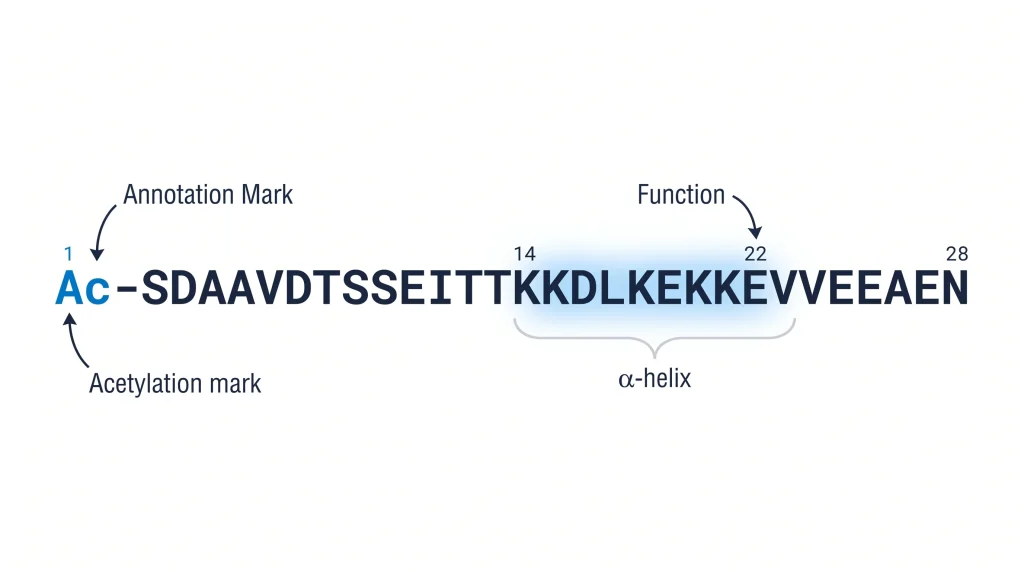
Thymosin Alpha-1 is a 28-amino acid peptide. It was first isolated from thymosin fraction 5, a bovine thymus extract. The natural peptide forms from prothymosin alpha (ProTα), a larger precursor found in thymic and non-thymic tissues. Its mass is about 3,108 Da. The N-terminus is acetylated (Ac-). This is a key structural feature. According to NCBI (2020), lab-made TA-1 built by SPPS (solid-phase peptide synthesis) reproduces the full sequence, including this modification.
TA-1 is produced mainly in the thymus. It also appears in the spleen, lymph nodes, and blood cell tissues. Lab-grade TA-1 is a freeze-dried powder. Each lot is tested by HPLC to confirm purity. Mass spec confirms the correct mass. TB-500 is another thymosin-family peptide. It has a different sequence and a different research focus.
How Does Thymosin Alpha-1 Interact with Toll-Like Receptors?
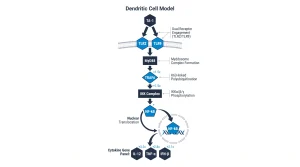
Toll-like receptors (TLRs) are pattern-recognition proteins on immune cells. They detect molecular patterns and trigger early immune cell responses. TLR2 recognizes lipoproteins and related structures. TLR9 recognizes unmethylated DNA sequences. According to Molecules MDPI (2019), TA-1 has been shown to signal through TLR2 and TLR9 in macrophage and dendritic cell models. The signal cascade starts at the receptor. It leads to downstream transcription factor activity.
In dendritic cell models, TLR2 and TLR9 activation by TA-1 links to shifts in cytokine output. A cytokine profile is the set of proteins a cell releases. It varies with the receptor activated and the amount used in the assay. HPLC purity affects these results. Impurities can block or mimic receptor binding. A lot with ≥99% purity gives more consistent data.
| Receptor | Type | Key Function in TA-1 Research |
| TLR2 | Pattern recognition | Lipoprotein detection; tested with TA-1 in monocyte models |
| TLR9 | Pattern recognition | Unmethylated DNA detection; TA-1 signaling studied in PBMC assays |
| MyD88 | Adapter protein | Downstream signal relay from TLR2/TLR9 activation |
| NF-κB | Transcription factor | End-point marker of TLR activation in TA-1 assays |
Browse COA-verified research peptides with full HPLC and MS data per lot.
What Does Research Show About T-Cell Maturation?
T-cell maturation is the process by which naive T-cells develop into active types. This happens mainly in the thymus. Maturing cells pass through selection stages. Self-reactive cells are removed in this process. TA-1 has been studied in thymic organ culture models. It has also been studied in isolated T-cell precursor assays. According to Journal of Peptide Science (2018), lab-made TA-1 affected CD4 and CD8 surface marker levels. These studies used ex vivo thymic cultures.
The models look at TA-1 binding to receptors on thymocytes. Thymocytes are the immature T-cells in the thymus. TA-1 affects how fast they move through growth stages. The measured endpoint is usually the CD4+/CD8+ ratio shift. Purity matters here. Impurities that share features with TA-1 can produce off-target effects on marker expression.
How Have Dendritic Cells Been Studied with Thymosin Alpha-1?
Dendritic cells (DCs) are antigen-presenting cells. They link the early and late arms of the immune response. They capture antigen, migrate to lymph nodes, and activate T-cells. TA-1 has been studied in DC models to assess how it affects DC maturation markers and cytokine output. In plasmacytoid DC (pDC) models, TA-1 has been shown to affect type I interferon output. According to NCBI (2020), the signaling involves TLR9 on pDCs and leads to IFN-alpha shifts.
Myeloid DC (mDC) studies use different assay conditions. In mDC assays, TA-1 has been studied for its effect on IL-12 and IL-10 output. These two cytokines have opposing roles in T-cell activation. The ratio of these cytokines is an indicator of the model’s response profile. These assays need high-purity TA-1. Impurities can change receptor binding at the DC surface and skew the results.
What Is the Molecular Structure of Thymosin Alpha-1?
Thymosin Alpha-1 has 28 amino acids. The sequence starts with Ac-Ser-Asp-Ala-Ala-Val at the N-terminus. The N-terminal serine is acetylated. This is key to correct identity. Without this modification, the compound is different. Mass spec (MS) is needed to confirm the acetyl group. HPLC alone cannot confirm this chemical change. According to Molecules MDPI (2019), checking the N-terminal acetyl group is a standard identity step in TA-1 lot release.
The peptide carries a net negative charge. It has a high content of aspartate and glutamate residues. This charge affects how it moves on an HPLC column. It also affects buffer conditions and receptor interactions in assays. A COA for TA-1 should show HPLC purity and MS confirmation of mass. For the acetylated form, the correct mass is about 3,108 Da. The MS data verifies the acetylation is present.
How Is Thymosin Alpha-1 Verified for Research Use?
TA-1 verification starts with HPLC. A reverse-phase run separates the sample by how well it sticks to the column. The main peak area, as a share of total area, gives the purity percent. The target for research-grade TA-1 is ≥99%. Next Level Pharm reports 99.4% average purity across the last 100 batches. Any other peak is a potential impurity. MS identifies each peak by mass. This confirms whether it is a deletion, truncated variant, or oxidized form.
The second step is MS confirmation of the acetylated N-terminus. A lot missing the acetyl group has a mass 42 Da lower than the correct form. HPLC cannot detect this difference. The retention time is too close to the target. Only MS catches the mass gap. A COA that includes both HPLC chromatogram and MS data covers purity and identity. Both data sets are in the COA that ships with every TA-1 lot.
Frequently Asked Questions
What Is Thymosin Alpha-1?
Thymosin Alpha-1 (TA-1) is a 28-amino acid peptide from prothymosin alpha, a precursor protein in the thymus. Its mass is about 3,108 Da. The N-terminus is acetylated, which is a key structural feature. Lab-made TA-1 is built by SPPS and must match this exact sequence and modification to be considered correct. According to Journal of Peptide Science (2018), HPLC and MS data together confirm both purity and identity. A COA includes both data sets with every lot.
Where Is Thymosin Alpha-1 Found Naturally?
Natural TA-1 is produced in the thymus, spleen, lymph nodes, and peripheral blood cells. It forms through cleavage of prothymosin alpha (ProTα). The peptide is released at low concentrations in blood. Lab-grade TA-1 is made by chemical synthesis rather than tissue extraction. This gives higher purity and allows lot-specific verification by HPLC and MS. Synthetic lots avoid the variability that comes from tissue-derived material. According to NCBI (2020), SPPS allows consistent sequence replication across production runs.
How Is Thymosin Alpha-1 Different from Thymosin Beta-4?
TA-1 and Thymosin Beta-4 (TB-500) are both thymosin-family peptides. They share no sequence or function. TA-1 is 28 amino acids with a focus on immune cell signaling. TB-4 is 43 amino acids, studied for actin binding and tissue repair. They come from different precursor proteins and interact with different receptor types. According to NCBI (2020), the two peptides have distinct research profiles and are not interchangeable in immune or repair assay models.
What Toll-Like Receptors Has Thymosin Alpha-1 Been Studied With?
TA-1 has been studied with TLR2 and TLR9. TLR2 recognizes lipoproteins and bacterial cell wall structures. TLR9 recognizes unmethylated CpG DNA sequences. In macrophage and dendritic cell assays, TA-1 has been shown to affect signaling through both receptors. The adapter protein MyD88 relays signals downstream of both TLR2 and TLR9. According to Molecules MDPI (2019), these pathways converge on NF-κB, a transcription factor used as an assay endpoint.
How Is Thymosin Alpha-1 Synthesized for Research?
Lab-grade TA-1 is made by SPPS. Each of the 28 amino acids is added one at a time to a resin support. The N-terminal serine is then acetylated to complete the correct structure. After cleavage from the resin, the crude peptide is purified by HPLC to reach ≥99%. The final lot is freeze-dried for stability. HPLC and MS are run on the final lot before release. SPPS with HPLC purification produces research-grade TA-1.
What Does a COA Show for Thymosin Alpha-1?
A COA for TA-1 shows two types of data. First, HPLC purity confirms how much of the sample is the target compound as a percent of total peak area. Second, MS data confirms the molecular weight. For acetylated TA-1, this is about 3,108 Da. Without MS, a lot missing the acetyl group cannot be caught by HPLC alone. The COA should also include the lot number, vial weight, and synthesis date. Lot-level traceability supports consistent data comparison across runs.
How Stable Is Thymosin Alpha-1 in Storage?
Freeze-dried TA-1 is stable when sealed away from moisture and light. Its high charged-residue content makes it sensitive to humidity. Vials should stay sealed until use. According to Journal of Peptide Science (2018), freeze-dried peptides kept in inert, sealed conditions maintain their purity profile for long periods. HPLC at the time of manufacture sets the purity baseline for later comparison. Storage notes on the COA give the recommended conditions for each lot.
What Assays Are Used in Thymosin Alpha-1 Research?
Common assays include DC maturation assays, PBMC stimulation assays, and T-cell surface marker studies. Cytokine output profiling (IL-12, IL-10, IFN-alpha) is a standard endpoint in DC models. Flow cytometry measures surface marker shifts on T-cell populations. ELISA measures cytokine levels in culture fluid. Each assay type needs consistent purity. According to NCBI (2020), lots with consistent purity profiles give lower inter-assay variance in cell-based models.
Can Thymosin Alpha-1 Be Combined with Other Peptides in Research?
Combining peptides in one well can create interaction effects. Most researchers run each peptide alone first, then in combination, with separate controls. COA data for each lot must be confirmed before any combined assay. Individual COAs per lot allow lot numbers to be matched to specific assay runs. Purity data for each compound can then be compared across studies. According to Molecules MDPI (2019), clear lot records reduce ambiguity in multi-peptide study designs.
What Purity Level Is Standard for Thymosin Alpha-1 Research?
Research-grade TA-1 targets ≥99% HPLC purity. At this level, non-target content is low enough for most cell-based and binding assays. Lots below 98% may contain deletion sequences or oxidized variants that affect sensitive assays. The average is 99.4% from individual lot HPLC runs, not batch averages. According to Journal of Peptide Science (2018), lot-level purity data supports consistent assay planning.
Summary
Thymosin Alpha-1 is a 28-amino acid peptide from prothymosin alpha. Its N-terminal acetylation is confirmed by MS. Research covers TLR2 and TLR9 signaling in macrophage and DC models. T-cell growth studies use thymic culture assays. Cytokine profiling uses PBMC models. HPLC confirms purity. MS confirms identity. A full COA includes both data sets with the lot number. Next Level Pharm provides COA-verified TA-1 with full HPLC and MS data per lot.
What Should You Do Next?
Review the HPLC chromatogram and MS data on the COA before running any TA-1 assay. Confirm the molecular weight matches about 3,108 Da for the acetylated form. Check the lot number on the COA against your order record.
Browse COA-verified research peptides with HPLC and MS data at Next Level Pharm.
People Also Read
- What Makes a Peptide Research Grade? Standards and Testing Explained
- BPC-157 vs TB-500: A Detailed Research Comparison Guide
About the Author
Next Level Pharm Research Team
The Next Level Pharm research team is composed of biochemists and laboratory scientists dedicated to providing researchers with the highest-purity, COA-verified research peptides available. Every batch is HPLC and mass spec verified before dispatch.
Disclaimer: The information provided on this page is for educational and research purposes only. Next Level Pharm’s products are intended for laboratory research use only. They are not intended for human consumption, diagnostic, therapeutic, or medicinal purposes. This content does not constitute medical advice. Always consult a licensed healthcare professional before making any health-related decisions.