How to Spot a Fake Peptide COA: Lab Verification Guide

Last updated: July 2026
A fake peptide COA is a document that fakes the purity, ID, or concentration of a research peptide. These documents circulate when suppliers skip objective lab testing. Researchers rely on accurate data to confirm the mass and structure of their materials. A fake COA can invalidate an entire study. According to NCBI (2020), accurate purity records are needed for repeatable results in peptide research.
Next Level Pharm runs HPLC and mass spec on every vial. Average purity holds at 99.4% across the last 100 batches. Every batch is third-party tested.. Each vial is sealed under an inert atmosphere and stored in lyophilized form for stability.
Knowing what a genuine COA looks like makes it easier to spot a fake one. The sections below cover the key features, common red flags, and key checks.
Key Takeaways
- COA Purpose: A Certificate of Analysis (COA) confirms a peptide’s lot-specific purity and identity. It is the primary document for verifying any research material before use.
- Common Red Flags: Fake COAs often show round purity numbers (exactly 99.0% every batch) and missing lab contact details. Reused chromatogram images across different lot numbers are a clear sign of forgery.
- Verification Methods: Researchers can confirm COA data by contacting the testing lab directly or checking for ISO 17025 cert. Every batch is third-party tested..
- Data Falsification: Forgery typically involves altered chromatogram peaks or fake mass spec values. These changes hide contaminants or swap the correct compound.
- Third-Party Testing: Suppliers that use both in-house and independent labs provide stronger quality assurance. Dual testing reduces the risk of biased results from a single source.
The sections below explain how to read each element of a COA and what signals reveal a forged document.
What Is a Certificate of Analysis (COA)?
A Certificate of Analysis (COA) is a lab document that verifies a specific batch of research peptides. It confirms the ID, purity, and concentration of the material. Each document serves as proof that the peptide meets defined standards for research use. Without this record, researchers cannot verify the contents of their materials before starting an experiment.
HPLC measures purity by separating sample components and calculating area-percent values. Mass spec (MS) confirms molecular ID by matching the measured m/z to the expected molecular weight. Each lot number links the physical vial to its test results. A real COA includes the testing lab’s name and contact details. It shows the analysis date and lot number. It also lists the HPLC purity and mass spec m/z value. According to Journal of Peptide Science (2018), lot-specific HPLC purity data is the standard for synthetic peptide batch release. Each batch must have its own test record.
BPC-157 COAs include the lot number, HPLC chromatogram, area-percent purity, and mass spec m/z for every batch.
Why Is COA Forgery a Problem in Research?
COA forgery is a problem because it hides the true composition of research materials. When a supplier fakes a COA, they hide flaws or swap the target compound. Researchers work with tainted or wrong samples. These errors pollute data and lead to results that cannot be repeated.
Fabricated data also fuels the replication crisis in science. When researchers cannot trust purity data, their methods fail to produce stable results across studies. Low-cost production creates pressure to skip testing. By skipping tests, suppliers hide flaws. Standard checks cannot catch these gaps.
According to Molecules MDPI (2020), undetected peptide ID errors at the COA stage are a known source of failed research. These errors produce results that cannot be repeated.
TB-500 COA data is posted for every lot with HPLC and mass spec verification.
What Are Common Signs of a Fake COA?
Common signs of a fake COA include generic purity values and missing lab details. Fraudulent reports often show the same round number (exactly 99.0%) for every batch. They lack contact information for the testing lab. They also lack cert data or accreditation proof.
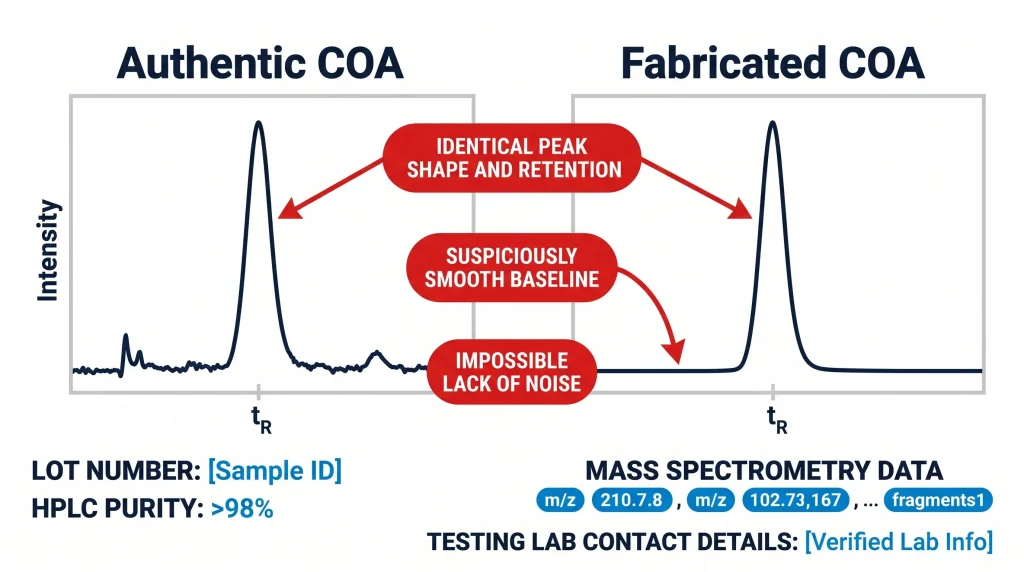
Reused chromatogram images are the clearest visual sign of forgery. If the baseline noise pattern is the same across separate lot numbers, the images are reused. Vendors reuse images to avoid test costs. Each batch must produce its own chromatogram. A real chromatogram has a unique noise pattern from the actual instrument run.
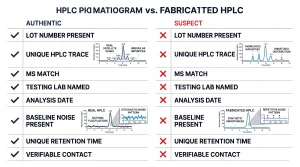
The comparison table below shows the differences between authentic and fake COA features.
| Feature | Authentic COA | Fake COA |
| Lot number | Unique per batch, linked to vial | Generic, reused, or missing |
| Purity value | Varies batch to batch (e.g. 99.1%, 99.6%) | Round number, identical across lots |
| Chromatogram | Unique baseline noise per lot | Identical image reused across lots |
| Lab contact | Named lab, verifiable address and phone | Generic or missing lab details |
| Mass spec m/z | Specific measured vs expected values | Absent or fabricated values |
| Accreditation | ISO/IEC 17025 or equivalent | None listed or unverifiable |
How Is HPLC and Mass Spec Data Faked?
HPLC and mass spec data are faked by altering reports. Some suppliers create results without running any test. When integration reports are altered, purity values appear artificially high. These changes target baseline noise or impurity peaks to make the batch look cleaner.
Labs sometimes practice dry-labbing. This means creating fake molecular weight data without testing the sample. The report shows data that matches the target peptide. The actual material may be completely different. The m/z value is never checked. Because the report appears complete, it creates a false sense of confidence about the substance.
How Can You Verify a Peptide COA?
Researchers check a COA by contacting the testing lab directly. A valid COA links to a real test report from a certified lab. The researcher contacts the lab listed on the document. The lab can confirm if that report was issued for the batch. Reputable third-party labs keep records and can verify a document.
Labs with ISO 17025 cert provide strong reliability. This global standard confirms the facility keeps calibrated tools and sound steps. Every batch is third-party tested.. Running an outside test on a sample remains the most reliable check. Browse COA-verified research peptides at Next Level Pharm with lot-specific HPLC and mass spec data on every order.
What Does an Authentic COA Include?
An authentic COA includes the lab name and contact details, a unique lot number, the analysis date, and test results for purity and identity. These fields confirm that a specific batch was tested. The report states the testing method and the parameters used. When reviewing a COA, confirm the lot number matches the vial label and that the analysis date is current.
Each data point plays a role. The retention time shows how long the peptide takes to move through the HPLC column. It is compared to a reference standard to confirm the compound’s ID. The peak area percentage shows the share of total signal that comes from the main compound. Mass spec m/z confirms molecular weight. All three are needed for full verification. According to NCBI (2020), combined HPLC and mass spec data is the standard for confirming peptide ID and purity. This applies to all synthetic peptide research lots.
Frequently Asked Questions
What does an authentic COA contain?
An authentic COA includes the laboratory name, contact details, testing date, and a unique lot number. It lists the methods used, typically HPLC and mass spec, to check the peptide. The HPLC section shows the chromatogram and area-percent purity. The mass spec section shows the measured m/z and the theoretical value for the target sequence. According to USP (2023), these data points provide the necessary evidence to confirm the purity of finished peptide materials.
Which COA fields are most often fabricated?
Fields most often fabricated include the purity percentage, the testing date, and the product lot number. Bad actors sometimes copy chromatogram images from other reports and paste them under a new header. Gaps between the listed purity and the corresponding mass spec data are a clear sign of fabrication. Researchers should check that the peak area percentage in the text matches the visual chromatogram provided.
How can lab accreditation be checked?
A lab’s cert can be cross-checked in official cert databases. Most real labs hold ISO 17025 cert. This standard sets strict quality steps for testing. Locate the accreditation body listed on the COA and search their directory for that lab’s name. A missing or expired cert is a sign the lab may not follow verified testing steps. Always confirm before ordering.
Why do reused chromatograms appear across lots?
Reused chromatograms appear when a vendor skips batch-specific testing. Instead of testing each lot, some providers copy existing files to create the look of quality control. The same baseline noise across different lot numbers shows the data is not unique. Genuine suppliers generate a unique chromatogram for each batch to maintain lot traceability. This is a basic standard for research-grade materials.
How can a COA be independently confirmed?
Outside confirmation requires contacting the testing lab directly. The researcher requests confirmation of the certificate number or lot data shown on the report. Many labs maintain a portal where a certificate code can be entered to access the original file. If no portal exists, a direct inquiry by phone or email can confirm whether the lab ran the analysis. This removes the risk of relying on forged documents.
Is a 100% purity result on a peptide COA a red flag?
A reported purity of 100% is statistically unlikely in peptide synthesis and warrants scrutiny. Chemical synthesis typically produces trace amounts of side products or residual solvents. Even high-grade materials show small detectable signals representing impurities or sequence truncation. A claim of absolute purity often means the lab ignored background noise or processed the raw data incorrectly. Realistic purity values are in the 98%–99.8% range.
What is a dry-labbed COA?
A dry-labbed COA is documentation created without physically testing the material. The paperwork is fabricated to convince a buyer of a product’s quality. These documents often look polished but contain data mismatches or missing lab details. Because no physical testing occurs, the reported purity values have no basis in reality. They do not reflect the actual composition of the research material.
What is ISO 17025 cert and why does it matter?
ISO 17025 is a global standard for testing labs. The cert confirms the facility uses standard, repeatable steps and accurate records. For research peptides, this standard gives outside assurance of test quality. When a lab holds this cert, its tools, staff, and methods meet verified benchmarks. Accredited lab results are accepted in peer-reviewed research contexts. This matters for any research that demands documented quality.
Summary
A fake peptide COA misrepresents identity, purity, or concentration. Common signs include round purity numbers, missing lab details, and reused chromatogram images. Contact the testing lab to check any COA. Look for ISO 17025 cert. Review lot-specific HPLC and mass spec data. Authentic COAs include a unique lot number, a specific chromatogram, and a confirmed mass spec m/z. The m/z should match the expected weight of the target peptide.
What Should You Do Next?
When a new research peptide arrives, locate the COA. Check the lot number against the vial label. Confirm purity is non-round (e.g. 99.4%). Verify the chromatogram is unique to this lot. Confirm the mass spec m/z matches the expected value. If the COA lacks any of these, contact the supplier. Request the full test report before use. Every batch is third-party tested..
People Also Read
- What Makes a Peptide Research Grade? Standards and Testing Explained
- BPC-157 vs TB-500: A Detailed Research Comparison Guide
About the Author
Next Level Pharm Research Team
The Next Level Pharm research team is composed of biochemists and laboratory scientists dedicated to providing researchers with the highest-purity, COA-verified research peptides available. Every batch is HPLC and mass spec verified before dispatch.
Disclaimer: The information provided on this page is for educational and research purposes only. Next Level Pharm’s products are intended for laboratory research use only. They are not intended for human consumption, diagnostic, therapeutic, or medicinal purposes. This content does not constitute medical advice. Always consult a licensed healthcare professional before making any health-related decisions.