
Underdosed Peptides: How Concentration Is Verified

Last updated: July 2026
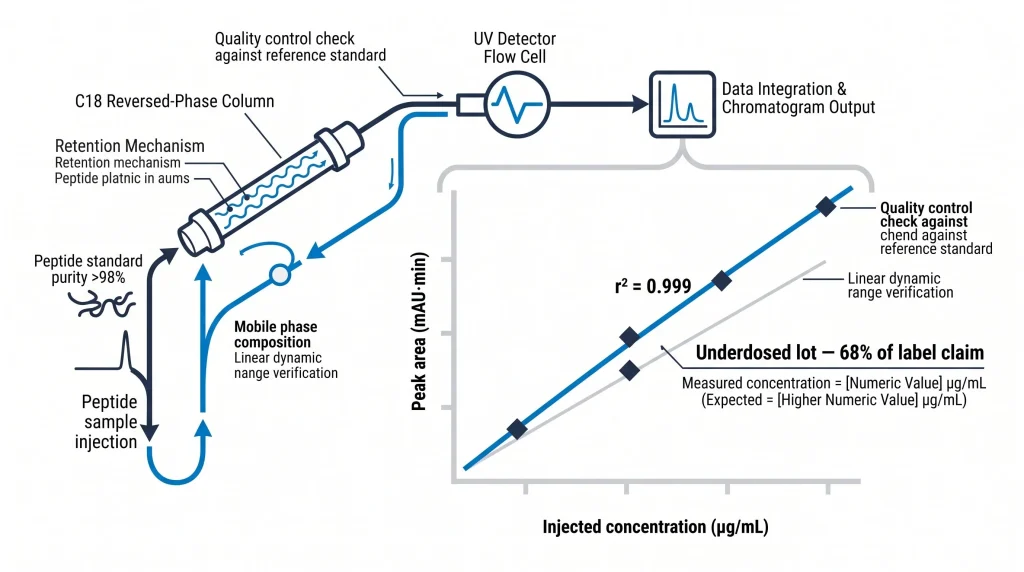
An underdosed peptide is a vial where the labeled mass does not match the actual active peptide content. A vial may pass HPLC purity testing at 99%. Yet it may contain only 4 mg of active material when labeled as 5 mg. Purity and concentration are separate metrics. Neither measure replaces the other. Both must appear on a lot-specific COA. This confirms a research sample is fit for use. According to NCBI (2020), fill-weight error is one of the most common causes of quantitative discrepancy in synthetic peptide lots.
Next Level Pharm runs dual HPLC and mass spec verification on every vial. A COA ships with each order, and lot-specific results are available via an online lookup. Average purity holds at 99.4% across the last 100 batches. Each freeze-dried vial is weighed before and after fill to confirm the net peptide mass matches the label claim.
Understanding what purity and concentration each measure helps researchers read COA data correctly. The sections below explain how each metric is calculated and verified.
Key Takeaways
- Purity vs. Concentration: Purity measures the peptide percentage of all detected material. Concentration measures the total active mass in the vial. Both are required on a valid COA.
- HPLC Role: HPLC separates sample components and calculates the area-percent purity. It does not confirm absolute mass without a calibrated reference standard.
- Mass Spec Role: Mass spectrometry (MS) confirms molecular identity by measuring the mass-to-charge ratio. It confirms the main HPLC peak is the correct peptide, not a co-eluting impurity.
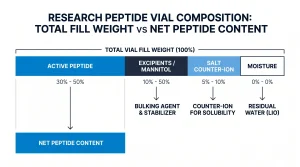
- Excipients Add Mass: Mannitol and other bulking agents increase total vial weight without contributing to active peptide content. Net peptide weight on the COA shows the true active amount.
- COA Is the Source of Truth: A complete COA reports three values: purity percent, mass spec m/z, and net peptide weight. All three are required to verify a research lot.
These five points are the framework for reading any COA. The sections below cover each variable in detail.
What Is the Difference Between Purity and Concentration?
Purity is a relative measure. It shows what percentage of all detectable material in a sample is the target peptide. Concentration is an absolute measure. It shows the total mass of active peptide in a specific volume or vial.
A sample can show 99% purity but still be underdosed. If a 5 mg vial was filled with only 4 mg of total material, the purity percentage reflects that 4 mg. The label claim is unmet. The remaining 1% of detected material is synthesis impurities or salts. The label claim of 5 mg is unmet even though the purity is high. Researchers must check both values on the COA. Purity confirms material quality. Fill weight confirms quantity.
The table below shows how the two metrics differ. Researchers need both figures from the COA.
| Parameter | Purity (%) | Concentration (mg) |
| What it measures | % of target vs all detected material | Absolute active mass per vial |
| Can be 99%+ and still wrong | Yes (if fill volume is under) | Not independently |
| Affected by excipients | No (relative measure) | Yes (adds to total weight) |
| Found on COA | Yes (area percent) | Yes (net peptide weight) |
| Verified by | HPLC | Gravimetric + reference standard |
What Is HPLC and How Does It Test Peptides?
HPLC is a method that separates individual components in a peptide sample. A liquid solvent, the mobile phase, carries the sample through a column packed with a stationary phase. The column runs under high pressure to force separation. Each component moves at its own rate. This depends on its chemical properties. The detector records each component as it exits the column. It plots the signal as a chromatogram.
The area under the main peak, divided by the total area of all peaks, gives the purity percentage. This is the area-percent method. It gives a relative purity result. HPLC does not confirm the absolute mass of the peptide alone. A certified reference standard is needed for calibration. A reference standard is a known, high-purity sample of the same peptide. It is run under the same conditions as the test sample. The lab compares the test sample’s signal to the reference signal. This allows calculation of the actual mass present. According to NCBI (2020), HPLC area-percent purity is the standard for synthetic peptide lot release. This applies across research settings.
BPC-157 HPLC data is included on the COA for every lot, showing the chromatogram, area-percent purity, and retention time.
How Does Mass Spec Verify Peptide Identity?
Mass spec (MS) confirms peptide identity by ionizing the sample and measuring the mass-to-charge ratio (m/z) of the resulting ions. The measured m/z is compared to the theoretical molecular weight of the target. A match confirms the compound is the intended sequence. A match within accepted tolerance confirms the compound is the intended peptide. This rules out a co-eluting impurity.
Tandem HPLC-MS combines both methods in one session. HPLC separates the sample. It gives the purity data. The integrated MS unit confirms the identity of the main HPLC peak. A peptide can show 99% HPLC purity but be the wrong sequence. This happens when a synthesis error produces a compound with the same retention time. Mass spec closes this gap. According to Molecules MDPI (2020), tandem HPLC-MS is preferred for purity and identity confirmation in one run. This is the standard in synthetic peptide testing.
Tirzepatide lot-specific COAs include both HPLC purity and mass spec m/z data.
What Is Quantitative Analysis for Peptides?
Exact amount analysis determines the absolute mass of a peptide in a sample. This is the key difference from purity testing. This is distinct from qualitative analysis. Qualitative analysis only confirms presence or absence. Quantitation gives the number: how many milligrams of active peptide are in a given vial or volume.
Exact-mass HPLC requires a certified reference standard. The lab creates a calibration curve. It runs known amounts of the standard and records the signal response. This curve maps substance mass to signal output. An unknown sample’s signal is matched to the curve. This gives the actual mass present. Without a reference standard, HPLC gives only a purity percentage. It cannot give an absolute mass. According to Journal of Peptide Science (2018), calibration against a certified reference standard is required for accurate mass measurement. This is standard practice for synthetic peptide lots.
Browse research peptides at Next Level Pharm with COA, lot number, and net peptide weight on every order.
How Do Excipients Affect Peptide Concentration?
Excipients are non-active substances added to peptide vials during manufacturing. In freeze-drying (freeze-drying), bulking agents such as mannitol or glycine are added to the solution before freezing. They support a stable, uniform freeze-dried cake. They also protect the peptide structure during the freeze-drying process.
These excipients add physical mass to the vial. They do not contribute to the active peptide content. A vial labeled 5 mg total may contain 4.5 mg active peptide and 0.5 mg mannitol. The total vial weight is the sum of active peptide plus all excipients. The net peptide weight is what remains after those additives are excluded. This is the active mass available for research. Researchers must use the net peptide weight from the COA, not the total labeled weight. This gives the correct active amount for any research protocol.
How Is Net Peptide Content Verified Before Research?
Net peptide content is verified through two steps: precision weighing and COA review. Gravimetric testing uses precision precision balances to weigh each vial before and after the fill step. The difference confirms the total mass deposited. The COA records the net peptide weight: the active mass after excluding excipients, salts, and water.
A COA must document both HPLC purity and mass spec identity to be complete. The purity percentage confirms the material is the target compound. It also confirms minimal impurities are present. The mass spec m/z confirms the correct sequence. The net peptide weight confirms the actual active amount per vial. All three are required. Only then can an underdosed lot be ruled out. Every batch is third-party tested.. Browse the research peptide catalog to access COA-verified lots with net peptide weight documentation.
Frequently Asked Questions
What is peptide quantitation?
Peptide quantitation is the process of measuring the exact active mass of a peptide in a sample. This differs from purity, which shows only the percentage of total material that matches the target molecule. Quantitation methods determine the actual mass, not just the relative proportion. Accurate quantitation is required to confirm a vial holds the labeled amount of active peptide for research use.
How does purity differ from concentration?
Purity measures the ratio of target peptide to all other detected material, expressed as a percentage. Concentration measures the absolute quantity of the peptide per unit (milligrams per vial, for example). A sample can have high purity but low concentration if the initial fill weight was inaccurate. Both metrics are distinct quality indicators, and researchers must review both on the COA.
Which assays measure actual peptide amount?
Amino acid analysis and exact-mass nuclear magnetic resonance (NMR) (qNMR) are used to measure absolute peptide mass. Standard HPLC measures relative purity but requires calibration against a reference standard for absolute mass. According to Journal of Peptide Science (2018), rigorous calibration standards are needed to report values that represent true peptide content in a research sample. This is why reference standard calibration is the industry standard for peptide research.
Why can a pure peptide still be underdosed?
A pure peptide can be underdosed if the total mass transferred into the vial is below the target. Purity indicates that the material present is the correct molecule, not how much of that molecule exists in the vial. A fill error during manufacturing can reduce total mass while leaving the purity percentage unchanged. The purity remains high; the milligram count is low.
How is fill weight verified?
Fill weight is verified with precision precision balances before and after the filling step. This confirms the total mass deposited matches the target for that lot. Comparing weights across multiple vials shows whether the fill process is consistent. The COA records the net peptide weight for each lot, which is the key figure for research accuracy. This three-step approach confirms each vial meets the labeled amount.
Does HPLC alone confirm peptide mass?
HPLC alone does not confirm absolute concentration. It gives a relative purity percentage based on peak areas. Without a calibrated reference standard, it does not calculate the actual mass of the peptide present. Mass spectrometry and precision weighing are needed alongside HPLC to confirm both identity and quantity. HPLC plus mass spec plus precision testing is the complete approach. All three together detect underdosed peptides.
What is a peptide reference standard?
A reference standard is a well-characterized, high-purity sample of the target peptide used to calibrate instruments. Labs compare unknown sample signals to the reference to calculate concentration with accuracy. The reference establishes the baseline for equipment performance. According to USP (2023), reference standards are essential for keeping test results reliable across test runs. Without a reference, there is no way to confirm that the instrument was performing accurately at the time of the test.
How does mass spec verify peptide identity?
Mass spec identifies peptides by measuring the mass-to-charge ratio of molecular ions. Each peptide has a unique theoretical m/z value based on its amino acid sequence. This creates a molecular fingerprint for identity confirmation. According to Molecules MDPI (2020), high-resolution MS data allows detection of even minor deviations in molecular weight. Matching the measured m/z to the theoretical weight confirms the compound is the intended sequence.
What does net peptide weight mean on a COA?
Net peptide weight is the mass of the active peptide molecule, excluding salts, water, and excipients. The COA lists this value to show how much active material is available for research. The total vial weight is higher than net peptide weight because it includes all additives. Net peptide weight is the correct figure to use when calculating research ratios. It is the key figure for determining how much active compound is available for research use.
How do excipients like mannitol affect total vial weight?
Excipients are non-active substances added during freeze-drying to protect the peptide structure. Mannitol, a common bulking agent, increases the total dry weight of the vial without adding active peptide. Its mass is included in the total labeled weight. The active peptide mass is lower than the label suggests. Researchers must subtract the excipient mass from the total to find the true active peptide weight, which the COA lists as net peptide weight.
Summary
An underdosed peptide vial is one where the labeled mass does not match the actual active content. Purity percentage alone does not confirm this. A vial can be 99% pure and still be underdosed. A vial can be 99% pure. It can still hold only 4 mg when labeled as 5 mg. Net peptide content is confirmed using the net peptide weight from the COA. This is confirmed through precision weighing and reference-standard HPLC. Mass spec identity confirmation completes the quality record. Full lot traceability backs it up.
What Should You Do Next?
When reviewing a research peptide COA, look for three data points: area-percent HPLC purity, mass spec m/z value, and net peptide weight. All three are needed to confirm a lot is both pure and correctly filled. If the COA lists only total weight or purity, that is incomplete. Request the net peptide weight before use. Browse COA-verified research peptides at Next Level Pharm with HPLC, mass spec, and net peptide weight on every lot.
People Also Read
- What Makes a Peptide Research Grade? Standards and Testing Explained
- BPC-157 Mechanism of Action: What Research Shows
About the Author
Next Level Pharm Research Team
The Next Level Pharm research team is composed of biochemists and laboratory scientists dedicated to providing researchers with the highest-purity, COA-verified research peptides available. Every batch is HPLC and mass spec verified before dispatch.
Disclaimer: The information provided on this page is for educational and research purposes only. Next Level Pharm’s products are intended for laboratory research use only. They are not intended for human consumption, diagnostic, therapeutic, or medicinal purposes. This content does not constitute medical advice. Always consult a licensed healthcare professional before making any health-related decisions.