Sublingual Peptide Absorption: What Studies Show

Last updated: July 2026
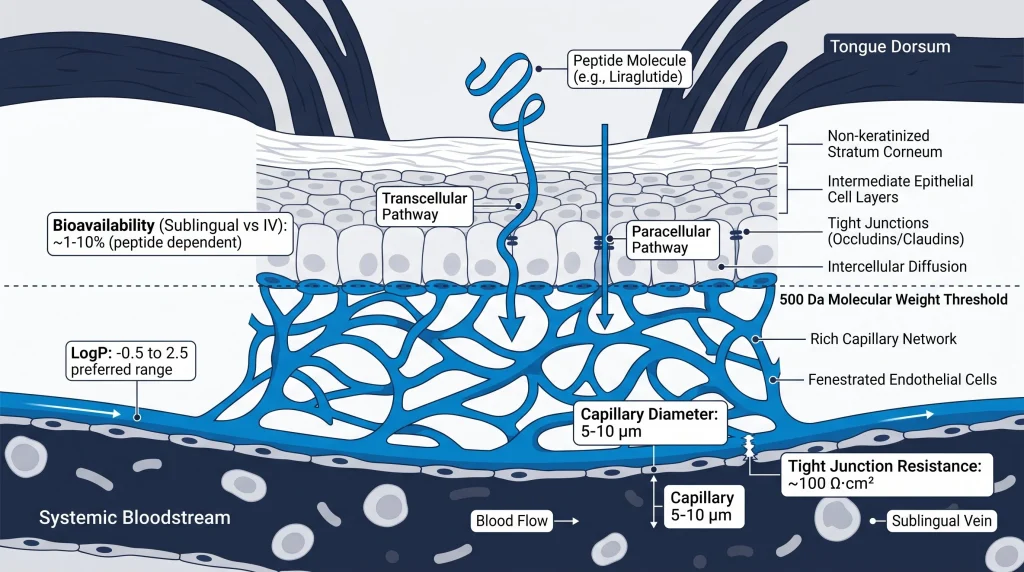
Sublingual peptide research is the scientific investigation of how peptides are absorbed into the bloodstream through the mucous membranes under the tongue. This non-invasive pathway bypasses the digestive system. It helps researchers keep the lab structure of a compound intact during the study. For passive diffusion across mucosal membranes, an atomic weight of under 500 Daltons is often considered a critical threshold for effective absorption.
Next Level Pharm gives these research items with a focus on high purity. Transparency. Each batch keeps an average purity of 99.4% across the last 100 batches. The team performs dual-method testing using HPLC and mass spectrometry on each single vial. These compounds arrive in a lyophilized state. Ensures stability at room temperature during transit. They also ship from USA-stored inventory with an average dispatch time of about 48 hours.
This approach ensures. Each lot meets high investigative standards for academic or lab study. Clear test records assists in the alignment of item quality with set project requirements. Every batch is third-party tested.. These protocols help keep the health of data collected during peptide exploration.
Key Takeaways
- Bypassing First-Pass breakdown: Sublingual transport allows peptides to enter the bloodstream directly. This avoids breakdown by stomach acid and the liver.
- Atomic Weight Is Critical: Studies show peptides under 500 Daltons absorb better through passive diffusion. Research shows size matters for mucosal membrane entry.
- Common Research Compounds: Small nootropics like Semax and Selank receive frequent study. Their low atomic weight makes them primary candidates for oral mucosal transport.
- Factor Absorption: Sublingual transport remains less efficient than injection. However, it displays higher absorption than basic oral transport in lab model trials.
- Key Research Challenges: Salivary enzymes and limited surface area hinder uptake. Researchers focus on formulation strategies to keep and improve peptide stability.
These takeaways highlight the factors influencing how research models integrate sublingual transport for peptide study. The next sections study the set lab factors, procedural challenges. Testing protocols labs use to define the scope of their sublingual trials. These details assist researchers in designing internal protocols that ensure consistency. Reproducibility across their research models.
What is sublingual peptide delivery?
Sublingual peptide transport is a method. Involves placing a peptide mix under the tongue for direct absorption. This area contains a thin layer. Highly vascularized layer of tissue known as the sublingual mucosa. By holding the compound here. The peptide can diffuse across the mucosal membrane and enter the body. This process moves the compound directly into the rich capillary network located just beneath the surface. From these small blood vessels. The peptide enters the whole-body bloodstream without needing to pass through the digestive system.
This route well bypasses the digestive tract and first-pass breakdown in the liver. When items are ingested, stomach acids. Liver enzymes often break down delicate peptide chains before they reach the bloodstream. By avoiding the liver, this method limits the rapid breakdown. Occurs with oral transport. This preservation helps keep the core health of the peptide during entry into the venous system. BPC-157 is ready as a COA-checked research peptide. each lot is checked by HPLC and mass spec.
How does molecular weight affect absorption?
How does atomic weight affect absorption?
Atomic weight serves as a primary factor limiting the rate of sublingual absorption for large peptide chains. Research shows. Smaller peptides often show higher leaks across mucosal membranes than larger, more complex structures. The widely cited 500 Dalton (Da) rule suggests. Compounds exceeding this mass struggle to pass through cell walls via passive diffusion. When a compound grows beyond this weight. Its power to move through the mucosal lining drops greatly.
Passive diffusion through cell tight junctions remains an inefficient pathway for larger compounds. These junctions form narrow gaps. These gaps prevent the entry of bulky compounds. Lack the capacity to force a move. Most larger peptides need set transporters. Are often absent or inactive in the sublingual space. Researchers note that peptides under 500 Da benefit from these normal pathways. BPC-157 is ready as a COA-checked research peptide. Each lot is checked by HPLC and mass spec. Proper dissolving. Atomic size must be documented. Confirm how a set agent interacts with these pathways. According to the Journal of Peptide Science (2016).
Which peptides are studied sublingually?
Sublingual research focuses on short-chain nootropic peptides like Semax and Selank. Well as set dipeptides and tripeptides. Due to their low atomic weight and rapid uptake possible. These compounds pass through the thin, vascularized mucous membranes located under the tongue. Research on this route targets the power of these small chains. Avoid the breakdown often caused by acidic stomach settings. By entering the whole-body bloodstream directly, these research compounds skip the first-pass breakdown process. Occurs in the liver. According to the Journal of Peptide Science (2018). Low atomic mass acts as a primary predictor for the absorption of such chains through mucosal walls.
researchers study these small-chain compounds in the Brain Peptides category. Their stability remains high under test sublingual settings. Dipeptides and tripeptides consist of only two or three amino acids. Their size is small enough to cross thin membranes. Semax and Selank are each ready as COA-checked research peptides. Each lot is checked by HPLC and mass spec. Studies often monitor how these set structures interact with whole-body receptors after bypassing the digestive tract. This research framing helps give data on whether these sublingual pathways improve the consistency of peptide uptake compared. Other non-invasive research methods.
Each vial includes batch-set test records to ensure consistency in your academic studies.
How is sublingual absorption measured?
Sublingual absorption is found by comparing measured plasma amount levels from oral mucosa absorption against those found after intravenous (IV) transport. staff use controlled lab model models. Track how much of a peptide enters the whole-body bloodstream through the sublingual route. This process involves serial blood sampling. Plot the amount of the compound over a set duration.
researchers use liquid chromatography-mass spectrometry to attain high sensitivity. Detecting peptide levels in blood plasma. By analyzing these data points, they can construct a drug amount curve. This curve helps calculate the total area under the curve. Estimate the rate of absorption. BPC-157 is ready as a COA-checked research peptide. Each lot is checked by HPLC and mass spec. This contrast against the IV gold standard confirms the absolute absorption percentage in the study model. Researchers then find factors that might limit or improve the uptake process.
What factors limit sublingual peptide delivery?
What factors limit sublingual peptide transport?
Sublingual peptide transport is often limited by the biochemical setting of the mouth. The restricted physical area ready for absorption. The oral cavity contains active salivary enzymes. Can cleave peptide bonds before the compound passes into the whole-body bloodstream. Additionally, the small surface area under the tongue. The rapid turnover of saliva reduce the total contact time needed for efficient uptake. Poor peptide stability in the aqueous mix of the mouth further decreases the total amount of item. Can cross the mucosal wall successfully. These cell walls need careful study. Designing experiments to ensure that the compound remains functional. ready during the testing period.
The presence of digestive enzymes in the saliva serves as a primary hurdle for maintaining atomic health. When a peptide enters the mix, these salivary proteins may start enzyme-based breakdown. Alters the core configuration of the research item. The restricted surface area also means. Only a small portion of the administered peptide can contact the membrane. Help passive diffusion. researchers must check how the dissolving of the compound affects its overall peptide stability within the salivary setting. If the compound does not remain in a contact-ready state. The rate of penetration drops. Complicates the collection of uniform data.
How does formulation influence absorption?
Formulation strategies affect absorption by modifying the physical setting of the sublingual mucosa. Favor peptide uptake. Labs study how these added components alter the movement of compounds into the capillary network. These methods aim to bypass the normal cell walls that limit passive diffusion. Researchers adjust these factors to monitor possible shifts in item availability within controlled settings.
move enhancers function by temporarily disrupting the lipid architecture of the mucosal membrane. Increase pores. Mucoadhesive polymers extend the time a compound remains in contact with the tissue surface. pH modifiers balance the ionization state of the peptide. Keep the compound in its most permeable form. By increasing the contact time between the compound and the mucosa. These additives assist in the study of more complex peptide chains. Semax is ready as a COA-checked research peptide. Each lot is checked by HPLC and mass spec. Using these formulation tools helps define the settings necessary for steady compound entry.
According to PubMed (2025), sublingual tissue leakiness varies with peptide chain length and fat content in ex vivo models. According to PubMed (2001), oral tissue has a distinct uptake rate for small peptides compared to nasal or gut routes. According to PubMed (1992), diffusion across tissue layers follows passive flow for low-weight peptides.
Frequently Asked Questions
How Does Sublingual Absorption Work?
Sublingual absorption occurs through the thin, highly vascularized mucous membrane beneath the tongue. Peptides in a mixed state pass through the lipid bilayers of the gut-lining cells or migrate between these cells via paracellular transport. This process introduces the item directly into the whole-body venous bloodstream. By entering the capillaries under the tongue. The compound avoids the acidic setting of the stomach. The rapid enzyme-based breakdown in the liver, according to compounds (MDPI) (2013).
Which Peptides Are Studied Sublingually?
Research often focuses on short-chain peptides that exhibit favorable dissolving and low atomic mass. Common subjects include dipeptides and tripeptides. As well as nootropic chains like Semax and Selank. These set structures are selected for study. Their size allows for higher rates of passive diffusion across mucosal walls compared. Larger chains. researchers favor these compounds. Attempting to avoid traditional enzyme-based breakdown pathways linked to the digestive tract. According to Journal of Peptide Science (2018).
Why Does Molecular Weight Limit Absorption?
atomic weight serves as a primary constraint for passive diffusion through cell membranes. Larger peptides face major resistance. Attempting to navigate the tight junctions between gut-lining cells. Research shows. Compounds exceeding 500 Daltons often struggle. Penetrate the mucosal layer well without specialized transport mechanisms. Smaller structures avoid this wall and reach the capillary network with greater efficiency. Makes them the primary focus for sublingual test protocols.
How Does Sublingual Compare With Intranasal?
Intranasal transport targets the olfactory. Trigeminal nerve pathways to reach the brain while avoiding whole-body clearance mechanisms. In contrast, sublingual transport emphasizes entry into the general bloodstream via the sublingual mucosa. Sublingual transport gives a larger surface area than the nasal cavity. It is more susceptible to dilution by salivary flow. Staff choose between these routes based on whether the research goal is whole-body spread or direct central nervous system access.
What Do Absorption Studies Report?
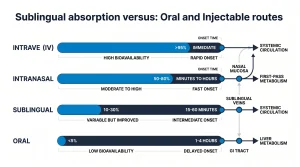
Absorption research measures the proportion of a peptide that enters the whole-body bloodstream unchanged. Studies steadily report. Sublingual transport gives greatly higher absorption than oral ingestion due. The absence of first-pass breakdown. However, these figures remain lower than those found with intravenous or subcutaneous injection. researchers use these compared data points. Calibrate their expectations about the total amount of items reaching the target tissues during active trial phases.
Can large peptides like BPC-157 be absorbed sublingually in research settings?
The absorption of larger polypeptides like BPC-157 presents lab challenges in sublingual research due. The size of the compound. Because these markers frequently exceed the 500 Dalton threshold for passive diffusion. Their uptake through the mucosa is often limited. While test formulations attempt to minimize this, researchers see. Larger chains need non-traditional carrier systems to increase leaks. Studies focus on whether these compounds remain stable. Intact after passing through the gut-lining layer into the bloodstream.
What role does saliva play in sublingual peptide research?
Saliva plays a dual role by acting as a solvent for the peptide. A possible source of breakdown. High rates of salivary flow can wash away the compound before it crosses the mucosal wall. Also, enzymes present in the oral cavity may interact with the peptide chain. Possibly altering its structure before it reaches the bloodstream. Researchers account for these outside factors by managing the timing. Placement of the peptide mix within the mouth.
How is peptide stability managed in sublingual research?
Stability management focuses on preventing breakdown and enzyme-based breakdown before complete absorption occurs. Maintaining the peptide in a lyophilized state until the moment of dilution stops early breakdown. Formulations often incorporate buffering agents to keep the pH at a level. Limits enzyme action. Simultaneously favoring the ionized or non-ionized state of the compound for better membrane crossing. These steps ensure. The lab profile remains steady throughout the duration of the test protocol.
Does lipophilicity affect sublingual peptide absorption?
Lipophilicity is a critical determinant of how well a peptide crosses the lipid-rich membranes in the mouth. Highly lipophilic compounds diffuse through cell membranes more well than hydrophilic alternatives. Because the oral mucosa is composed of lipids, research suggests. Modifying a peptide chain. Increasing its fat-soluble traits can greatly improve its rate of entry into the capillary system. staff monitor these lab properties. Predict how each compound will behave in whole-body models.
How does pH influence sublingual peptide delivery?
The pH of the sublingual setting directly affects the ionization state of the peptide. Controls its power to move across cell membranes. If a compound stays in a charged state, it often faces higher resistance. Trying to penetrate the hydrophobic walls of the tissue. Researchers adjust the pH of the transport vehicle. Ensure most the peptide exists in a neutral form. This setting supports optimal absorption and minimizes the wall effects of the oral mucosa.
What Should You Do Next?
Review your current lab protocols to confirm the purity requirements, molar amounts. Vehicle mixing for your set research model. test the unique lot number against the online records. Ensure your test factors remain steady during each trial. Schedule a consultation with the support team to clarify lab specifications or. Get more test data for your project.
Next Level Pharm gives researchers with checked items to support these investigative goals. Researchers sourcing high-purity peptides can browse the catalog at Shop.
People Also Read
- What Is Selank? GABA Pathways, Mechanisms, and Study Findings
- Semax Research Review: BDNF, Dopamine, and Brain protection Studies
About the Author
Next Level Pharm Research Team
The Next Level Pharm research team is composed of biochemists and lab scientists dedicated to providing researchers with the highest-purity, COA-verified research peptides available. Every batch is HPLC and mass spec verified before dispatch.
Disclaimer: The information provided on this page is for educational and research purposes only. Next Level Pharm’s products are intended for lab research use only. They are not intended for human consumption, diagnostic, therapeutic, or medicinal purposes. This content does not constitute medical advice. Always consult a licensed healthcare professional before making any health-related decisions.