Research Peptide Shelf Life: What Science Shows

Last updated: July 2026
A research peptide shelf life study is a controlled stability test that measures how long a peptide stays intact under set storage conditions. Peptides can break down due to heat, moisture, light, and oxygen exposure. The form of the peptide (freeze-dried or reconstituted) is the single largest factor in shelf life. Lyophilized (freeze-dried) peptides are stable for 12 to 24 months under proper storage. Peptides in solution degrade within days to weeks. According to PubMed (2018), freeze-drying is the standard method for extending peptide stability in research supply chains.
Next Level Pharm ships all peptides in freeze-dried form. This keeps peptides stable at room temp during transit. For long-term storage after receipt, refrigeration at 2 to 8 degrees Celsius is needed. Each vial is HPLC-tested before shipment and ships with a COA linked to the lot number.
Shelf life research matters because degraded peptides produce wrong data. A peptide that has lost activity may give results that differ from a fresh batch. Labs that track storage and lot numbers can spot shelf life data drift early.
Key Takeaways
- Freeze-Drying Extends Shelf Life: Freeze-drying removes water from the peptide under vacuum. Removing water slows all major breakdown reactions. Freeze-dried peptides are the standard form for research supply.
- Temperature Is the Main Storage Variable: Heat speeds up peptide breakdown. Freeze-dried peptides stored at room temp during shipping are stable short-term. For long-term storage, 2 to 8 degrees Celsius is the research standard.
- Moisture Is the Key Degradation Trigger: Even small amounts of water can start hydrolysis, the main peptide breakdown reaction. Freeze-dried peptides must be kept dry. Desiccant packs and sealed vials reduce moisture exposure.
- Reconstituted Peptides Degrade Fast: Once a freeze-dried peptide is dissolved in a solvent, it begins to degrade. Reconstituted peptides should be used within the time specified in each peptide’s lab protocol.
- Freeze-Thaw Cycles Damage Peptides: Repeated freezing and thawing of a peptide in solution breaks down the compound faster. Labs that need to store dissolved peptides should aliquot (split) them into single-use vials before freezing.
- COA and Lot Numbers Track Shelf Life: A COA (certificate of analysis) records the test date and purity for each batch. The lot number links the vial to that record. Labs that record lot numbers can trace any data changes to specific batches and storage periods.
These six points define the shelf life research landscape covered below.
What Is Peptide Shelf Life in Research?
Peptide shelf life is the time period during which a peptide remains within its stated purity and activity range under specific storage conditions. It is measured by re-testing a peptide sample at set time points and comparing the results to the original COA values. If purity falls below 95% or the molecular weight shifts, the peptide is degraded.
Shelf life is not a single fixed value. It depends on the peptide’s chemical structure, its storage form (freeze-dried or in solution), the storage temp, and the exposure to light and oxygen. Short, simple peptides tend to have longer shelf lives. Long, complex peptides degrade faster. Those with cysteine or methionine are most at risk. Labs that document storage conditions alongside their research data can account for shelf life effects in their results.
How Does Freeze-drying Extend Peptide Shelf Life?
Freeze-drying is the key process. The peptide is first dissolved in water, then frozen at very low temperatures. The frozen water is then removed by applying a vacuum. This pulls the water out of the frozen sample as vapor, leaving behind the dry peptide powder. The entire process happens without the peptide ever going through liquid water again.
Removing water is important because water is the main factor in hydrolysis, the chemical reaction that breaks peptide bonds. When peptide bonds break, the chain splits and activity is lost. Without water, hydrolysis slows to nearly zero. According to PubMed (2020), freeze-drying extends peptide stability by removing the water needed for hydrolysis and oxidation reactions. Browse Epithalon research vials for freeze-dried, COA-verified lab supply.
What Factors Degrade Research Peptides Over Time?
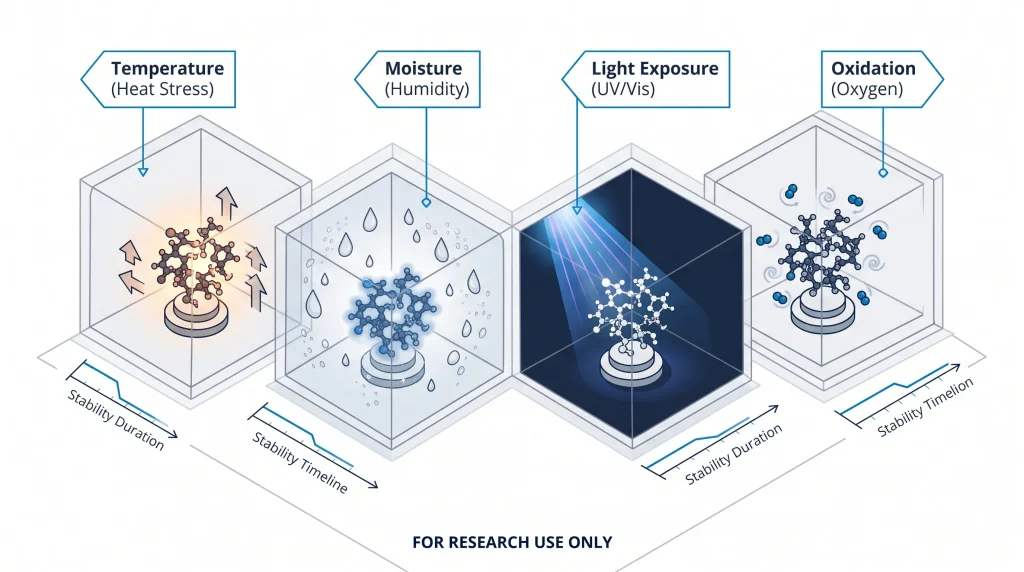
Four main factors degrade research peptides: heat, moisture, light, and oxygen. Each acts through a different chemical reaction.
Heat speeds up all chemical reactions, including hydrolysis and oxidation. A peptide stored at 37 degrees Celsius will degrade far faster than one stored at 4 degrees. Light, especially UV light, can break certain amino acid side chains. Tryptophan and tyrosine are most sensitive to UV damage. Oxygen causes oxidation, which changes the structure of amino acids like cysteine and methionine. Moisture starts hydrolysis, which splits peptide bonds at their weakest points.
According to PubMed (2015), heat and moisture are the two most significant factors in peptide breakdown in research storage settings. Browse GHK-Cu research vials for freeze-dried, sealed vials with COA-verified purity at time of shipment.
How Should Freeze-dried Peptides Be Stored?
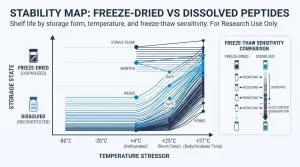
Freeze-dried peptides should be stored in sealed, opaque vials away from heat and moisture. Standard storage for freeze-dried research peptides is 2 to 8 degrees Celsius (fridge) for short-term use. For long-term storage, below minus 20 degrees Celsius (freezer) is the standard. During shipping, freeze-dried peptides are stable at room temp for several days.
When a vial arrives, it should be allowed to reach room temp before opening. This limits condensation on the peptide. Condensation introduces water directly to the dry powder, which can start hydrolysis immediately. Once cooled to lab temperature, the vial can be opened, aliquoted if needed, and stored at the correct temperature.
Browse BPC-157 research vials at Next Level Pharm for freeze-dried vials that are stable at room temp during transit.
Research labs can shop research peptides for fully freeze-dried, HPLC-verified, COA-backed peptide supply for long-term lab use.
What Happens When a Research Peptide Degrades?
When a peptide degrades, it loses part of its original chemical structure. The specific damage depends on which degradation path was active. Hydrolysis splits the peptide chain into two shorter fragments. Oxidation changes amino acid side chains, often altering how the peptide binds to receptors. Aggregation causes multiple peptide chains to clump together, forming large complexes that are inactive.
In research assays, a degraded peptide may appear less active, produce a weak signal, or produce no signal at all. If the degraded peptide still binds to a receptor, it may act as a partial blocker, which can confound assay results. Labs that track purity via regular re-testing or by recording batch dates and storage conditions can flag potential degradation before a study run is complete. Browse SS-31 research vials for COA-verified, freshly batch-tested supply.
How Do Storage Conditions Compare for Peptides?
Labs choose storage conditions based on peptide form, intended use timeline, and sensitivity. Here is how the main storage options compare:
| Form | Storage Temp | Stable Duration | Key Notes |
| Freeze-dried | 2 to 8 C (fridge) | 12 to 24 months | Seal vial, avoid moisture |
| Freeze-dried | Below minus 20 C (freezer) | 24 months or more | Suited to long-term storage |
| Reconstituted | 4 C (fridge) | Days to 2 weeks | Use soon after mixing |
| Reconstituted | Below minus 20 C | Weeks to months | Aliquot before freezing |
Labs should always check the specific peptide’s data sheet for storage guidance. Peptides with sensitive amino acids (cysteine, methionine, tryptophan) may need lower temperatures or nitrogen-filled vials to limit oxidation during storage.
Frequently Asked Questions
What is research peptide shelf life and why does it matter?
Research peptide shelf life is the time a peptide stays chemically intact and active under specific storage conditions. It matters because degraded peptides give unreliable results in cell assays, binding tests, and cytokine studies. A peptide that has lost purity may appear less active or produce false signals. Labs that track storage conditions, lot numbers, and batch dates can spot shelf life data changes before they affect study outcomes.
What is freeze-drying and why is it used for research peptides?
Freeze-drying removes water from a peptide by freezing it, then pulling the water out under vacuum. Removing water slows hydrolysis, the main reaction that breaks peptide bonds. Freeze-dried peptides are stable for 12 to 24 months under proper storage. This makes them the standard form for research supply. According to PubMed (2020), freeze-drying extends peptide stability by removing water from the system.
What temperature should freeze-dried research peptides be stored at?
Freeze-dried peptides should be stored at 2 to 8 degrees Celsius for short-term use (up to 12 months). For long-term storage beyond 12 months, below minus 20 degrees Celsius is the standard. During transit, freeze-dried peptides are stable at room temp for several days. When receiving a vial, allow it to reach room temp before opening to stop condensation from forming on the dry peptide powder.
How long can a peptide in solution be stored before it degrades?
Peptides dissolved in a solvent degrade faster than freeze-dried peptides. Most short research peptides are stable in solution for 1 to 14 days at 4 degrees Celsius. Longer or more sensitive peptides may degrade faster. Freezing at minus 20 degrees Celsius can extend storage time, but repeated freeze-thaw cycles speed up degradation. Labs should aliquot dissolved peptides into single-use volumes before freezing to avoid repeat thawing.
What is hydrolysis and how does it affect peptide shelf life?
Hydrolysis is the chemical reaction that breaks peptide bonds by adding water across the bond. When water reacts with a peptide bond, the chain splits into two shorter fragments. These fragments may have no activity or different activity than the full-length peptide. Hydrolysis is the main degradation reaction for peptides in solution. Freeze-drying removes water from the system, so hydrolysis almost stops. This is why freeze-dried peptides last far longer than reconstituted ones.
What are freeze-thaw cycles and why do labs avoid them?
A freeze-thaw cycle is one complete round of freezing and then thawing a sample. Each cycle stresses the peptide because ice crystals form during freezing and mechanical forces act on the peptide as water changes phase. Repeated cycles increase clumping and breaking. Labs avoid them by aliquoting dissolved peptides into small single-use vials before the first freeze. According to PubMed (2018), minimizing freeze-thaw cycles is a standard step in peptide stability protocols.
Which amino acids make a peptide more sensitive to degradation?
Cysteine, methionine, tryptophan, and asparagine are the amino acids most sensitive to degradation. Cysteine and methionine are prone to oxidation. Tryptophan is sensitive to UV light. Asparagine is prone to deamidation (a chemical change) under heat and moisture. Peptides that contain these residues degrade faster. Labs working with these peptides should use lower storage temps, opaque vials, and nitrogen-filled headspaces to limit degradation.
How does moisture affect freeze-dried peptide stability?
Even small amounts of moisture can start hydrolysis in a freeze-dried peptide. If a vial is opened in high-humidity conditions, water from the air can enter the vial. Once moisture contacts the dry peptide powder, bond-breaking reactions begin. To limit moisture exposure, freeze-dried peptides should be stored in sealed vials with desiccant packs. Vials should be opened quickly, under low-humidity conditions when possible, and resealed after each use.
What is peptide clumping and how does it affect research results?
Peptide clumping is when multiple peptide chains clump together into larger complexes. These complexes are usually inactive because they cannot bind to receptors or enter cells. Aggregation can happen when peptides are stored at the wrong temp. It also occurs after repeated freeze-thaw cycles or when the storage solvent does not match how the peptide dissolves. In assay settings, a peptide that has aggregated will appear less active. Labs can detect clumping by re-testing purity via HPLC before a study run.
How should labs document peptide shelf life in their research protocols?
Labs should record the lot number, batch date, COA purity, storage location, and date of first use for each vial. If the peptide is reconstituted, the mixing date and solvent used should also be recorded. This data allows researchers to trace any unusual assay results back to a specific batch and storage period. Journals increasingly require reagent lot numbers and storage details in methods sections for repeat results.
Summary
Research peptide shelf life depends on storage form, temperature, moisture, light, and oxygen exposure. Freeze-dried peptides stay stable for 12 to 24 months when stored at 2 to 8 degrees Celsius. Reconstituted peptides degrade within days to weeks. Freeze-thaw cycles speed up degradation and should be avoided by aliquoting single-use volumes before freezing.
Labs that track lot numbers, batch dates, and storage conditions can connect data changes to specific shelf-life events. Consistent records supports repeat results and helps labs detect degradation before it affects study results.
What Should You Do Next?
Researchers should review storage conditions and confirm that sealed lyophilized vials remain protected from heat, light, and moisture. Record storage dates and lot numbers in the lab log. Compare current sample condition with the COA and stability plan before each study run. Researchers sourcing these lab peptides can shop research peptides with full COA and lot traceability.
People Also Read
- Epithalon Research Peptide: Freeze-dried Storage and Lab Studies
- GHK-Cu Research Peptide: Stability, Storage, and Collagen Studies
About the Author
Next Level Pharm Research Team
Alex M covers peer-reviewed findings in peptide science for Next Level Pharm, a US-based supplier of research-grade peptides verified to ≥99% purity via HPLC and mass spectrometry on every batch.
Disclaimer: For research purposes only. Not intended for human consumption. Next Level Pharm products are not intended for diagnostic, therapeutic, or medicinal use. This content does not constitute medical advice. Always consult a licensed healthcare professional before making any health-related decisions.