CJC-1295 No DAC vs With DAC: Research Comparison

Last updated: July 2026
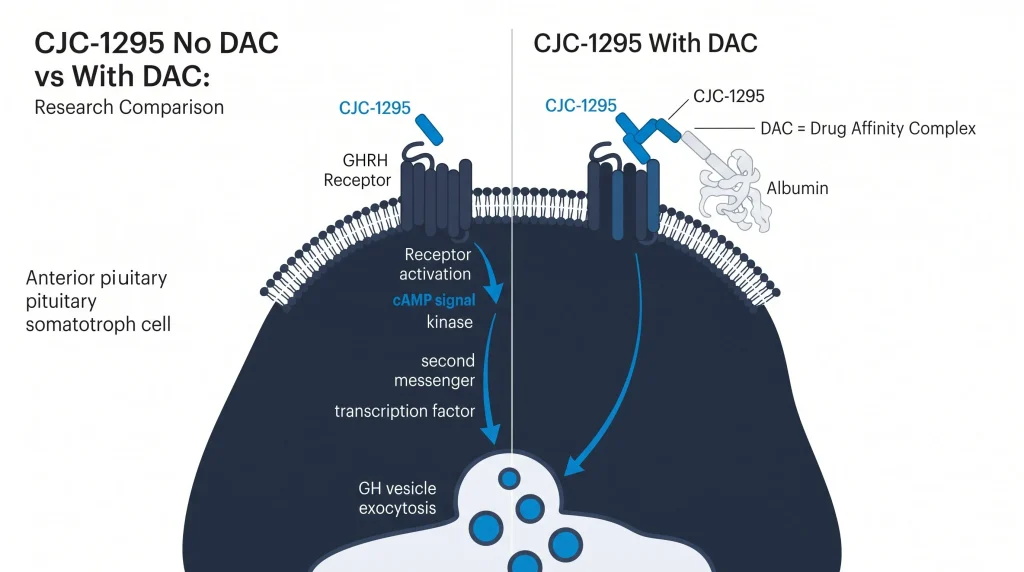
A CJC-1295 No DAC vs with DAC comparison centers on one key difference. That difference is the Drug Affinity Complex (DAC). CJC-1295 is a synthetic analogue of growth hormone-releasing hormone (GHRH). GHRH is the peptide that triggers growth hormone (GH) release from the pituitary gland. The DAC modification extends the half-life to roughly 6 to 8 days. Without DAC, the half-life is about 30 minutes. Both forms are GHRH analogs studied in laboratory models.
Next Level Pharm supplies research-grade CJC-1295 with DAC and CJC-1295 No DAC. Each lot ships with a COA. The COA includes HPLC purity data and mass spectrometry identity. Purity is verified to at least 99% on every batch.
Understanding the difference between these two forms matters in lab work. The DAC modification changes the active duration of the peptide. It also changes the GH release pattern seen in research models. These factors shape which form is chosen for a given study design.
Key Takeaways
- Half-Life Gap: CJC-1295 with DAC has a half-life of about 6 to 8 days. CJC-1295 No DAC has a half-life of about 30 minutes.
- Same Core Mechanism: Both forms bind the GHRH receptor on the anterior pituitary. Both trigger GH release through the same pathway.
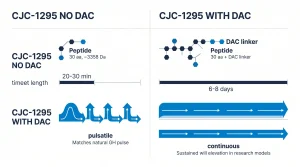
- Pulsatile vs Sustained Release: CJC-1295 No DAC mimics natural episodic GH secretion. CJC-1295 with DAC creates sustained GH elevation in research models.
- Albumin Binding: The DAC modification forms a covalent bond with serum albumin. This bond is what extends the half-life of the DAC form.
- Combination Research: CJC-1295 No DAC has been studied alongside ipamorelin. This combination activates both the GHRH receptor and the GH secretagogue receptor (GHSR).
These five points reflect the core findings from published GHRH analog research. The sections below cover each in more detail. Citations from peer-reviewed sources are included where available.
What Is CJC-1295’s Main Mechanism of Action?
CJC-1295 is a modified GHRH analog. It binds the GHRH receptor (GHRHr) on the anterior pituitary gland. Binding triggers growth hormone (GH) release into circulation. The peptide has four modified amino acid positions. These modifications resist enzyme cleavage. They extend the active window beyond native GHRH(1-29).
In research models, CJC-1295 produces a concentration-related rise in circulating GH. The rise occurs through GHRHr activation only. No direct action on the GH secretagogue receptor (GHSR) has been observed. This makes CJC-1295 distinct from GHRPs such as ipamorelin. GHRPs act on GHSR, not GHRHr. Combining CJC-1295 No DAC with a GHRP amplifies the GH pulse in research models.
What Does the Drug Affinity Complex (DAC) Do?
The DAC modification adds a chemical handle to the CJC-1295 peptide. This handle reacts with cysteine-34 (Cys-34) on serum albumin. It forms a covalent bond after administration in research subjects. According to Journal of Peptide Science (2005), this covalent bond extends the half-life. It reaches roughly 6 to 8 days in research models.
Serum albumin has a natural half-life of about 19 to 21 days. When CJC-1295 binds albumin, it borrows this long half-life. Albumin carries the peptide through circulation. It shields the peptide from enzyme cleavage and renal clearance. Active CJC-1295 releases slowly from the albumin depot over days. This creates sustained GH elevation in DAC form research models. The effect has been described as a “GH bleed” in some published literature.
How Does CJC-1295 No DAC Differ in Action?
CJC-1295 No DAC is also called Mod GRF 1-29. It lacks the DAC chemical handle. Without albumin binding, it clears from circulation in about 30 minutes. This short clearance produces a brief, sharp GH spike. The spike mimics the natural episodic pattern of GH secretion.
According to Journal of Peptide Science (2006), Mod GRF 1-29 retains full GHRHr binding affinity. The four amino acid modifications resist enzyme cleavage at known proteolytic sites. This keeps the peptide active long enough to reach the pituitary. But the lack of albumin binding limits the active window to about 30 minutes. The short clearance makes the No DAC form easy to combine with other peptides. This is useful in multi-compound research protocols.
Which Variant Studies Pulsatile GH Release?
CJC-1295 No DAC is the form studied for pulsatile GH release. Its half-life of about 30 minutes produces transient GH spikes. Each spike corresponds to one administration in the research protocol. Natural GH secretion from the pituitary is not continuous. It occurs in discrete pulses, especially during sleep and fasting states.
Studies using CJC-1295 No DAC replicate this pulsatile pattern in controlled lab conditions. The short half-life makes blood sampling straightforward. CJC-1295 with DAC does not produce pulsatile spikes. It creates continuous GH elevation. The two forms are complementary in research design, not interchangeable. The table below shows the key differences.
| Feature | CJC-1295 with DAC | CJC-1295 No DAC |
| Also known as | CJC-1295 DAC | Mod GRF 1-29 |
| Half-life | ~6 to 8 days | ~30 minutes |
| GH release pattern | Sustained (steady-state) | Pulsatile (episodic) |
| Study frequency | Once weekly | Multiple per day |
| Albumin binding | Yes (covalent, Cys-34) | No |
For lab sourcing, shop research peptides.
Why Combine CJC-1295 No DAC with Ipamorelin?
CJC-1295 No DAC activates the GHRH receptor (GHRHr). Ipamorelin activates the GH secretagogue receptor (GHSR). These are two separate receptor pathways. Both lead to GH release from the pituitary. When both are activated at the same time, the GH pulse is amplified.
According to Peptides (2014), dual-pathway stimulation has been studied in animal models. The combined GH pulse is larger than either compound produces alone. Next Level Pharm offers CJC-1295 No DAC and ipamorelin as separate research lots. A pre-made blend is also available for protocols requiring both.
What Are the Key Research Considerations?
The main consideration is the GH release pattern needed for the study. CJC-1295 with DAC suits protocols requiring stable, sustained GH elevation. Its long half-life allows less frequent administration. Once-weekly administration is typical in published animal model research for the DAC form. CJC-1295 No DAC suits protocols studying pulsatile GH dynamics. Multiple administrations per day are common in No DAC protocols.
CJC-1295 with DAC creates a broad, flat GH profile over several days. This suits studies looking at sustained GH effects on downstream markers. CJC-1295 No DAC creates sharp, narrow GH spikes. This suits pulse-dependent GH signaling studies. Both forms are available as COA-verified research lots. HPLC purity and mass spec identity are confirmed on every batch.
Frequently Asked Questions
What Is the Difference Between CJC-1295 with DAC and Without DAC?
CJC-1295 with DAC has a chemical handle that binds serum albumin. This extends the half-life to about 6 to 8 days. CJC-1295 No DAC (Mod GRF 1-29) lacks this modification. Its half-life is about 30 minutes. The DAC form creates sustained GH elevation over days. The No DAC form creates short, pulsatile GH spikes. These differences make each form suited to different research protocols.
What Does DAC (Drug Affinity Complex) Do to CJC-1295’s Half-Life?
The DAC modification adds a reactive chemical handle to CJC-1295. This handle forms a covalent bond with cysteine-34 (Cys-34) on serum albumin. Albumin acts as a slow-release carrier. It protects the peptide from enzyme cleavage and renal clearance. This mechanism extends the half-life to about 6 to 8 days. Without the DAC modification, CJC-1295 clears in about 30 minutes. Albumin binding is the sole source of the extended half-life.
How Does CJC-1295 No DAC Mimic Natural Pulsatile GH Release in Research?
CJC-1295 No DAC has a half-life of about 30 minutes. This produces a transient GH spike after each administration. Natural GH secretion from the pituitary gland is episodic. It occurs in discrete pulses, not as continuous release. Short-acting GHRH analogs like Mod GRF 1-29 replicate this episodic pattern in laboratory models. Researchers use this property to study GH pulse dynamics. Blood samples are timed around the predictable, brief GH spike.
Can CJC-1295 No DAC and Ipamorelin Be Combined in the Same Research Protocol?
Yes. CJC-1295 No DAC and ipamorelin target different receptors. CJC-1295 No DAC acts on the GHRH receptor (GHRHr). Ipamorelin acts on the GH secretagogue receptor (GHSR). Combining them activates both pathways at once. This has been studied for amplified GH pulses in animal models. The dual-pathway approach is a common design in comparative GH research. Both compounds are for laboratory research purposes only.
What Is the Pharmacokinetic Profile Difference Between CJC-1295 DAC and No DAC?
The main difference between the two forms is half-life. CJC-1295 with DAC has a half-life of about 6 to 8 days. CJC-1295 No DAC has a half-life of about 30 minutes. The DAC form creates a broad, flat GH elevation profile over several days. The No DAC form creates narrow, pulsatile GH spikes. These profiles reflect different albumin binding properties. The DAC form binds albumin covalently. The No DAC form does not bind albumin.
Is Mod GRF 1-29 the Same as CJC-1295 No DAC?
Yes. Mod GRF 1-29 and CJC-1295 No DAC refer to the same compound. Both names describe the modified growth hormone-releasing factor with four amino acid substitutions. The substitutions resist enzyme cleavage. The compound lacks the DAC modification. The name CJC-1295 No DAC is used to distinguish it from the DAC-modified version. Both names appear in published literature. Researchers should confirm which form is meant when reviewing study protocols.
What Is a GH Bleed in the Context of CJC-1295 with DAC?
A GH bleed refers to a slow, continuous release of GH over time. It is associated with CJC-1295 with DAC. The albumin-bound peptide releases CJC-1295 slowly from the albumin depot. This creates sustained GH elevation over several days. It marks the DAC form’s steady GH profile versus the No DAC form’s pulsatile spikes. It is a descriptive term from published research literature. It is not a clinical term.
How Does Administration Frequency Differ in Research for CJC-1295 with and Without DAC?
CJC-1295 with DAC has a half-life of about 6 to 8 days. Research protocols typically use once-weekly administration. CJC-1295 No DAC has a half-life of about 30 minutes. Protocols using the No DAC form may administer it multiple times per day. The frequency depends on the GH release pattern being studied. For pulsatile GH dynamics, multiple daily administrations are common. For sustained GH elevation studies, once-weekly administration is standard.
Does CJC-1295 Require Reconstitution for Laboratory Use?
All lyophilized peptides require reconstitution with a sterile research-grade solvent before use in laboratory assays. The solvent used depends on the protocol. Reconstituted solutions should be used promptly or stored under conditions specified in the research protocol. Lyophilized CJC-1295, in both DAC and No DAC forms, is stable at room temperature during shipping. Long-term storage of lyophilized peptides is typically at minus 20 degrees Celsius.
What Is the Role of Serum Albumin in Extending the Action of CJC-1295 with DAC?
Serum albumin is the most abundant protein in blood plasma. It has a natural half-life of about 19 to 21 days. The DAC modification allows CJC-1295 to bind albumin covalently at cysteine-34 (Cys-34). Albumin carries the peptide through circulation. It protects the peptide from enzyme cleavage and renal clearance. The peptide releases from albumin slowly over days. This is the source of the extended half-life of CJC-1295 with DAC.
Summary
CJC-1295 is a synthetic GHRH analog. It exists in two forms. The DAC form binds serum albumin via a covalent bond. This extends the half-life to about 6 to 8 days. The No DAC form (Mod GRF 1-29) has a half-life of about 30 minutes. It produces short, pulsatile GH spikes.
Both forms bind the GHRH receptor and trigger GH release. The key difference is duration and release pattern. CJC-1295 No DAC is also studied with ipamorelin for dual-pathway GH stimulation. Research protocols choose between these forms based on the GH dynamics being studied.
What Should You Do Next?
When sourcing CJC-1295 for laboratory use, confirm the form required by the protocol. Request a COA with HPLC purity and mass spec identity for each lot. Record the lot number in all protocol files before beginning assays.
Shop research peptides at Next Level Pharm. CJC-1295 No DAC and CJC-1295 with DAC are both available with full COA documentation. Each batch is verified to at least 99% purity by HPLC and mass spectrometry. A lot number ships with every order.
People Also Read
- Sermorelin vs CJC-1295: What Research Shows About Each GHRH Analog
- What Is Ipamorelin: Mechanism of Action and Research Overview
About the Author
Next Level Pharm Research Team
Alex M covers peer-reviewed findings in peptide science for Next Level Pharm, a US-based supplier of research-grade peptides verified to ≥99% purity via HPLC and mass spectrometry on every batch.
Disclaimer: The information provided on this page is for educational and research purposes only. Next Level Pharm’s products are intended for laboratory research use only. They are not intended for human consumption, diagnostic, therapeutic, or medicinal purposes. This content does not constitute medical advice. Always consult a licensed healthcare professional before making any health-related decisions.