CJC-1295 With DAC: Drug Affinity Complex GH Research

Last updated: June 2026
CJC-1295 with DAC is a modified GHRH (growth hormone releasing hormone) analog with an attached drug affinity complex (DAC). The DAC is a reactive lysine linker that binds albumin in plasma. This albumin binding extends the half-life of CJC-1295 from about 30 minutes (without DAC) to 7-8 days in animal models. It has been studied as a long-acting GHRH receptor agonist in pituitary cell and animal research.
Next Level Pharm is a US supplier of research-grade peptides. CJC-1295 with DAC is COA-verified and batch-tested to ≥99% purity by HPLC and mass spec. The average purity across the last 100 batches is 99.4%. Researchers can view lot-specific results before any study use.
GHRH analogs are used in research to study GH pulse biology. The pituitary responds to GHRH pulses by releasing GH in bursts. Long-acting GHRH analogs like CJC-1295 DAC allow researchers to study sustained GHRHR activation in animal models without frequent dosing.
Key Takeaways
- CJC-1295 DAC Has a 7-8 Day Half-Life in Animal Models: The DAC linker binds albumin. This extends the half-life from about 30 minutes (no DAC) to 7-8 days. This makes it suitable for long-duration GHRH receptor studies.
- The DAC Is a Covalent Albumin Binder: The drug affinity complex (DAC) is a lysine residue with a reactive group. It forms a stable bond with albumin in plasma. This bond is not easily reversed.
- CJC-1295 DAC Still Allows GH Pulses in Animal Models: Even with sustained GHRH receptor stimulation, animal models still show pulsatile GH release. The DAC version does not flatten the GH pulse pattern.
- GHRH Receptor Activation Uses cAMP-PKA Signaling: In pituitary GH cells (somatotrophs), GHRH binds GHRHR, triggers Gs protein, and raises cAMP. PKA then triggers transcription factors that drive GH gene output.
- CJC-1295 With DAC Is a Research Tool, Not an Approved Drug: All findings below are from cell and animal research models. It is not FDA-approved for any use.
The DAC technology was designed to create peptide drugs with very long half-lives without using PEGylation. Albumin binding through a covalent DAC is one of the most studied approaches to extending peptide half-life in research.
What Is the Drug Affinity Complex (DAC)?
The drug affinity complex (DAC) is a chemical change attached to the C-terminus of CJC-1295. It consists of a lysine residue linked to a maleimido acetic acid group. This group reacts with a cysteine-34 of albumin in plasma to form a stable covalent bond.
Albumin has a half-life of about 20 days in plasma. When CJC-1295 is covalently bound to albumin, it takes on albumin’s long half-life. This gives CJC-1295 DAC a plasma half-life of 7-8 days in animal models. The bond is stable under physiological conditions.
According to a study in J Clin Endocrinol Metab (2006), CJC-1295 with DAC has been studied in animal models. The DAC change gave the peptide a half-life of 6-8 days versus 30 minutes for the unmodified form. GH and IGF-1 levels were tracked in these rodent studies. These are animal model findings.
How Does GHRH Receptor Signaling Work?
The GHRH receptor (GHRHR) is a G-protein-coupled receptor on pituitary somatotrophs (GH cells). When GHRH or an analog like CJC-1295 DAC binds the GHRHR, it triggers the Gs protein. Gs triggers adenylyl cyclase. Adenylyl cyclase converts ATP to cAMP.
Raised cAMP triggers PKA (protein kinase A). PKA enters the nucleus and triggers CREB (cAMP response element-binding protein). CREB turns on the GH gene. GH is then made and stored in secretory granules. A second signal (usually a calcium rise) triggers the granules to release GH into the bloodstream. This is the cell-level signaling model.
According to a review in Amino Acids (2018), GHRH receptor activation in pituitary somatotrophs raises cAMP and triggers PKA in cell models. CREB phosphorylation and GH gene output were confirmed in these assays. These are in-vitro cell model findings.
What Do GH Pulse Studies Show With CJC-1295 DAC?
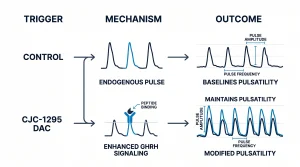
In rodent studies, GH is released in pulses. Each pulse has a peak and a trough. GHRH drives the peak and somatostatin suppresses GH between peaks. A long-acting GHRH analog could in theory flatten this pattern by holding the GHRHR in a constant ON state.
Animal studies with CJC-1295 DAC found that pulsatile GH release was preserved even with sustained GHRH receptor coverage. The pulse pattern in treated animals showed higher amplitude and more frequent pulses compared to controls. These are rodent model findings and are not clinical data.
| Feature | CJC-1295 (no DAC) | CJC-1295 with DAC |
| Plasma half-life | ~30 minutes | ~7-8 days (animal models) |
| Albumin binding | None | Covalent via DAC |
| Dosing frequency in studies | Frequent | Infrequent |
| GHRHR activation | Pulsatile | Sustained |
| GH pulse pattern | Maintained | Maintained (higher amplitude) |
| Research use | Short-duration GHRH studies | Long-duration GH studies |
How Is CJC-1295 DAC Different From Sermorelin?
Sermorelin is GHRH(1-29), the native 29-amino-acid active fragment of GHRH. CJC-1295 is also based on GHRH(1-29) but has four amino acid substitutions that improve stability. The DAC version adds the albumin-binding linker on top of those changes.
Sermorelin has a very short half-life (less than 15 minutes in plasma). CJC-1295 without DAC has a half-life of about 30 minutes. CJC-1295 with DAC has about 7-8 days. Each is a different research tool suited to different study timelines. All three are GHRH receptor agonists.
According to a study in J Clin Endocrinol Metab (2007), CJC-1295 with DAC showed sustained plasma GH and IGF-1 elevation in animal model studies. The calculated half-life was about 6-8 days in those models. The compound maintained GHRHR occupancy over the study period. These are animal model data.
Shop CJC-1295 with DAC at Next Level Pharm. COA-verified on every batch.
How Is IGF-1 Tracked in CJC-1295 DAC Animal Studies?
IGF-1 (insulin-like growth factor 1) is the main downstream marker tracked in GHRH analog research. GH acts on the liver to stimulate IGF-1 production. In animal models, IGF-1 plasma levels are a standard read-out for GH axis activity.
In rodent studies with CJC-1295 DAC, IGF-1 levels were tracked over 7-28 day periods. The data showed high IGF-1 levels compared to controls throughout the study periods. These are animal model findings and are not clinical data.
Researchers use IGF-1 as a proxy for GH output because GH pulses are short and hard to measure continuously. IGF-1 provides a stable time-averaged signal. All IGF-1 data in CJC-1295 DAC studies cited here are from rodent model research only.
Frequently Asked Questions
What Is CJC-1295 With DAC?
CJC-1295 with DAC is a modified GHRH analog with a drug affinity complex (DAC) that allows covalent binding to albumin in plasma. The albumin binding extends the half-life to 7-8 days in animal models. It is used in research as a long-acting GHRH receptor agonist.
What Is the Drug Affinity Complex (DAC)?
The DAC is a chemical group attached to the C-terminus of CJC-1295. It reacts with cysteine-34 of albumin in plasma to form a stable covalent bond. This bond gives CJC-1295 DAC a half-life of 7-8 days in animal models by linking the peptide to albumin, a long-lived plasma protein.
What Is the Difference Between CJC-1295 With and Without DAC?
CJC-1295 without DAC has a half-life of about 30 minutes. CJC-1295 with DAC has about 7-8 days. The difference is the lysine-DAC linker that binds albumin in CJC-1295 DAC. Both bind the GHRH receptor (GHRHR). The DAC version is used for long-duration studies where frequent dosing is not practical.
How Does CJC-1295 DAC Maintain GH Pulses?
GH pulses in animal models require both GHRH stimulation and somatostatin suppression to cycle. Somatostatin periodically blocks GH release even when GHRHR is occupied. This is why sustained GHRHR activation (from CJC-1295 DAC) does not block the pulse pattern. Somatostatin still suppresses GH between pulses in animal studies.
What Is GHRHR Signaling?
GHRHR (growth hormone releasing hormone receptor) is a G-protein-coupled receptor. When GHRH or an analog binds GHRHR, it triggers Gs, raises cAMP, and triggers PKA. PKA triggers CREB, which turns on the GH gene in pituitary somatotrophs. This is the cell-level GHRH signaling cascade studied in research.
How Is CJC-1295 DAC Purity Confirmed?
Each batch of CJC-1295 with DAC at Next Level Pharm is tested by HPLC and mass spec. HPLC confirms purity as a percentage of peak area. Mass spec confirms the molecular weight and presence of the DAC change. A COA is issued for every lot with both results on record.
What Is Sermorelin and How Does It Differ?
Sermorelin is GHRH(1-29), the native 29-amino-acid active fragment of GHRH. It has a half-life of under 15 minutes. CJC-1295 is GHRH(1-29) with four stabilizing substitutions. The DAC version adds albumin binding. Sermorelin, CJC-1295, and CJC-1295 DAC are all GHRH receptor agonists but differ in half-life.
What Is Somatostatin’s Role in GH Pulse Research?
Somatostatin is the hormone that suppresses GH release from pituitary somatotrophs. It acts in opposition to GHRH. In animal models, GH pulses occur when GHRH dominates and somatostatin drops. Even with sustained GHRHR activation from CJC-1295 DAC, somatostatin still cycles and creates the pulse pattern seen in rodent studies.
Is CJC-1295 With DAC FDA-Approved?
No. CJC-1295 with DAC is not FDA-approved for any use. It is a research compound studied in animal and cell models. All data referenced in this overview are from lab research models.
Summary
CJC-1295 with DAC is a long-acting GHRH analog. The DAC linker binds albumin and extends the half-life to 7-8 days in animal models. GHRHR signaling in pituitary somatotrophs proceeds via cAMP-PKA-CREB and drives GH gene output. Animal studies showed maintained pulsatile GH release with higher amplitude in CJC-1295 DAC-treated rodents.
All findings cited are from cell and animal research models. They are not clinical outcomes. For research purposes only.
What Should You Do Next?
Researchers sourcing CJC-1295 with DAC should verify HPLC purity and DAC change confirmation by mass spec on the COA before any study use.
Shop research peptides. Every batch is COA-verified with HPLC and mass spec data.
People Also Read
- Retatrutide Research: Triple Receptor Agonist Mechanisms
- AOD-9604 Research: What Studies Show About This HGH Fragment
About the Author
Next Level Pharm Research Team
Alex M covers peer-reviewed findings in peptide science for Next Level Pharm, a US-based supplier of research-grade peptides verified to ≥99% purity via HPLC and mass spectrometry on every batch.
Disclaimer: The information provided on this page is for educational and research purposes only. Next Level Pharm products are intended for lab research use only. They are not intended for human consumption, diagnostic, therapeutic, or medicinal purposes. This content does not constitute medical advice. Always consult a licensed healthcare professional before making any health-related decisions.