What Does Peptide Purity Mean in Research?

Last updated: July 2026
A peptide purity research standard is a set of lab tests that measures target compound content against impurities. Purity is measured as a percentage of the total sample mass. A 99% pure peptide means that 99% of the sample is the correct compound. The other 1% may include residual solvents, synthesis byproducts, or truncated peptide chains. According to PubMed (2020), HPLC is the standard method for measuring peptide purity in research settings.
Next Level Pharm tests every batch using HPLC and mass spectrometry. Average purity across recent batches is 99.4%. Each vial ships with a COA (certificate of analysis) that links to the lot number and test results.
Purity matters because research data is only valid if the peptide used matches the one being studied. A low-purity peptide can produce misleading results in cell assays, cytokine studies, or binding tests. Knowing what purity means helps labs choose the right supply for their work.
Key Takeaways
- Purity Is a Percentage: Peptide purity is the fraction of the sample that is the correct target compound. A 99% pure peptide contains 1% or less of other compounds, which may include solvents, salts, or synthesis byproducts.
- HPLC Is the Primary Test: HPLC (high-performance liquid chromatography) separates the peptide from impurities by size and charge. The resulting peak chart shows the purity percentage as the area of the target peak.
- Mass Spectrometry Confirms Identity: Mass spec measures the molecular weight of the main compound. It confirms that the compound in the vial is the correct peptide, not a byproduct or contaminant.
- The COA Links Test Data to the Vial: A COA (certificate of analysis) records purity, molecular weight, lot number, and test date for each batch. It links the vial to its test results.
- Impurities Can Skew Research Results: Synthesis byproducts and residual solvents can trigger false signals in cell culture assays. Low-purity peptides may confound cytokine assays, receptor binding tests, and cell survival studies.
- 99% Is the Research-Grade Standard: Research-grade peptides are defined as 99% pure or higher. This standard is needed to ensure that cell culture and in vitro assay results reflect the peptide’s true biology, not contaminant effects.
These six points define the purity research landscape covered below.
What Is Peptide Purity and Why Does It Matter?
Peptide purity is the measure of how much of a sample is the target compound. It is expressed as a percentage. A 99% pure sample means that for every 100 mg of peptide, 99 mg is the target compound. The remaining 1 mg is other material. This other material may include deletion sequences (chains that are missing an amino acid), truncated chains, or residual synthesis reagents.
In cell culture research, even small impurities can change results. Some synthesis byproducts bind receptors or trigger cytokine release. This means a low-purity peptide may produce results that reflect the impurity, not the peptide. For reliable data, research labs use peptides at 99% purity or higher. HPLC and mass spec are the two standard methods used to verify purity before a batch is released for lab use.
How Does HPLC Test Measure Peptide Purity?
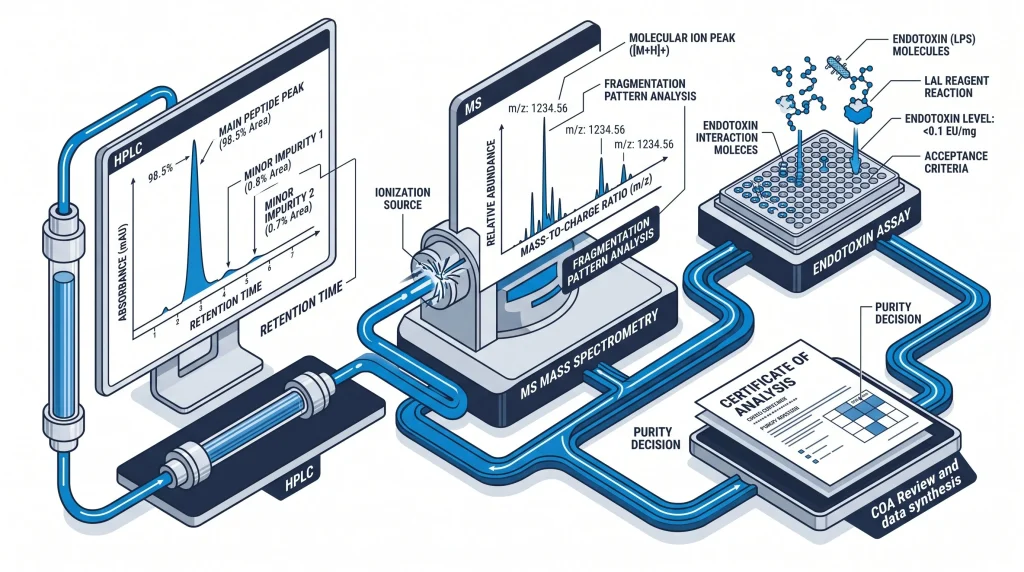
HPLC (high-performance liquid chromatography) is the standard method for measuring peptide purity. In HPLC, the peptide sample is dissolved in a solvent. It is then pushed through a column packed with small particles. Each compound moves through the column at a different speed. Size, charge, and column affinity all control that speed.
The output of an HPLC run is a peak chart: a graph that shows peaks at different time points. Each peak represents a compound in the sample. The largest peak is the target peptide. The area under each peak shows how much of that compound is present. Purity is calculated as the area of the target peak divided by the total peak area. A 99% result means 99% of the total area belongs to the target compound.
What Does Mass Spectrometry Confirm in Peptides?
Mass spec measures the molecular weight of compounds in a sample. Peptides have a specific target molecular weight based on their amino acid sequence. If the measured weight matches the theoretical weight, the compound is confirmed as the correct peptide. If the weight is off, the compound may be a byproduct, a degraded chain, or a different compound entirely.
Mass spec is used alongside HPLC. HPLC shows that the compound is present at a high percentage. Mass spec confirms that the main compound has the right identity. Together, these two tests give a full picture of a peptide’s purity and identity. According to PubMed (2018), mass spec is a standard tool for peptide identity confirmation in research settings. Browse BPC-157 research vials for HPLC and mass spec verified supply.
What Is a COA and How Do Labs Use It?
A COA (certificate of analysis) is a document that records the test results for a specific peptide batch. It includes the lot number, purity percentage, molecular weight, test date, and the methods used to test the batch (HPLC, mass spec). The lot number links the document to a specific vial or set of vials. If a lab knows the lot number, it can trace the vial back to its test record.
Labs use the COA to verify purity before starting an assay. Some journals and research protocols require COA records as part of the methods section. A COA also allows researchers to match their reagent details to their published data. Next Level Pharm provides a COA with every order. Lot numbers are printed on the vial label for easy lookup. Browse GHK-Cu research vials for COA-verified, batch-tested supply.
Research labs can shop research peptides for full COA records, HPLC and mass spec testing, and lot-traceable supply.
What Impurities Affect Peptide Research Results?
Several types of impurities can appear in a peptide batch. Deletion sequences are peptide chains that are missing one or more amino acids from the target sequence. They are produced when the synthesis step for one amino acid does not complete. Truncated chains are shorter chains that stop early. Residual solvents are chemicals used in the synthesis process that were not fully removed.
Each of these impurities can affect research results in different ways. Deletion sequences may bind to the same receptor as the target peptide but with different strength. Truncated chains may have partial activity. Residual solvents can be toxic to cells at high levels. According to PubMed (2015), impurity control is a key factor in research-grade peptide quality standards. Browse Epithalon research vials for HPLC-verified, low-impurity supply.
How Do Purity Standards Compare by Method?
Research labs choose purity testing methods based on what they need to verify. HPLC gives the purity percentage. Mass spec gives the molecular identity. Endotoxin testing checks for bacterial toxins. Each method is used for a different part of the quality check.
| Test Method | What It Measures | Pass Standard | Output |
| HPLC | Purity percentage | 99% or higher | Chromatogram with peak areas |
| Mass spectrometry | Molecular identity | Correct molecular weight | Mass spectrum |
| Endotoxin test | Bacterial toxin level | Below 1 EU per mg | Test result value |
| Water content | Residual moisture | Below 10% | Karl Fischer result |
HPLC and mass spec together form the standard two-test check used for research-grade peptides. The COA documents all results and links them to the lot number for traceability. Browse SS-31 research vials at Next Level Pharm for two-test verified, COA-backed supply.
Frequently Asked Questions
What does peptide purity mean in research?
Peptide purity is the percentage of a sample that is the target compound. A 99% pure peptide contains 1% or less of other material. That material may include synthesis byproducts, residual solvents, or truncated peptide chains. For research use, purity of 99% or higher is the standard. This ensures cell assay results reflect the peptide’s true biology. It removes impurity effects from the data. HPLC and mass spectrometry are used to verify purity before batch release.
What is HPLC and how is it used to test peptide purity?
HPLC (high-performance liquid chromatography) separates peptide compounds by pushing a dissolved sample through a column. Each compound moves through the column at a different speed. The output is a peak chart showing peaks for each compound. The area under the main peak equals the purity percentage. A 99% HPLC result means 99% of the total peak area belongs to the target compound. HPLC is the standard purity test for research-grade peptides.
What does mass spectrometry confirm in a peptide batch?
Mass spectrometry measures the molecular weight of the main compound in a peptide sample. Each peptide has a set target molecular weight. This is based on its amino acid sequence. If the measured weight matches, the compound is the correct peptide. If not, the compound may be a byproduct or a different sequence. Mass spec is used alongside HPLC to confirm both purity percentage and compound identity. According to PubMed (2018), mass spec is standard for peptide identity confirmation.
What is a COA and why do research labs need it?
A COA (certificate of analysis) is a document that records the purity, molecular weight, lot number, test date, and test methods for a specific batch. Labs use the COA to verify batch quality before starting an assay. It also serves as records for research protocols and journal methods sections. The lot number on the COA links the document to a specific vial. According to PubMed (2020), COA records are a key element of research-grade peptide supply chains.
What are deletion sequences and why do they matter?
Deletion sequences are peptide chains that are missing one or more amino acids from the target sequence. They are produced when a synthesis step does not complete for a specific amino acid position. Deletion sequences may bind to the same receptor as the target peptide but with weaker or different activity. If a batch contains a high percentage of deletion sequences, the true activity of the target peptide may be masked or altered. HPLC can detect deletion sequences because they have a different retention time than the target compound.
How does peptide purity affect cell culture assay results?
In cell culture assays, impurities can trigger false signals. Synthesis byproducts may bind to cell surface receptors and produce a response. Residual solvents may be toxic to cells at high amounts. These effects can make the peptide appear more active, less active, or active in ways unrelated to its true biology. Labs using 99% or higher purity peptides reduce the chance of impurity effects. HPLC and mass spec testing before each assay run helps ensure data reflects the peptide’s true effects.
What is an endotoxin and why is it tested in peptide batches?
An endotoxin is a toxin found in the outer membrane of certain bacteria. It is released when bacterial cells are destroyed. Endotoxins at high levels trigger immune responses in cell cultures, including cytokine release. In immune and cytokine assays, endotoxin toxin content can produce false-positive results. Peptide batches for immune research are tested for endotoxin levels. The pass standard is below 1 EU (endotoxin unit) per mg of peptide. This is measured using the LAL (limulus amebocyte lysate) assay.
What is the difference between synthesis purity and test purity?
Synthesis purity refers to how well the peptide synthesis process produces the target sequence. It is controlled by the quality of amino acid reagents and the efficiency of each coupling step. Analytical purity refers to the purity result measured by HPLC after synthesis is complete. A high-quality synthesis process produces fewer byproducts, making it easier to reach test purity of 99% or higher. Research labs should check the test purity on the COA, not just the stated synthesis quality.
Can a peptide fail HPLC but pass mass spectrometry?
Yes. HPLC measures purity percentage. A peptide can pass mass spec but still have a low purity score. This happens when the batch contains many impurities at lower levels. In this case, the main compound is the correct peptide, but it is mixed with byproducts. A batch can also fail mass spec if the main peak has the wrong molecular weight, even if the HPLC purity looks high. Both tests are needed to verify that a batch is both pure and correctly identified.
What does 99.4% average purity mean for research supply?
A 99.4% average purity means that across all batches tested, the average HPLC purity result is 99.4%. This is above the 99% research-grade standard. Individual batches may vary slightly above or below this average, but all batches that ship meet the 99% minimum. The COA for each batch records the exact purity for that lot. A 99.4% average means the supply chain maintains consistent quality across many production runs, which supports reproducible research results.
Summary
Peptide purity research defines how labs verify that a peptide batch contains the right compound at a high enough level for reliable research use. HPLC measures the purity percentage by separating compounds in the sample. Mass spec confirms the molecular identity of the main compound. The COA documents both results and links them to a specific lot number.
Purity of 99% or higher is the research-grade standard. At this level, impurity effects in cell assays are minimized, and research results can be attributed to the peptide rather than byproducts or contaminants.
What Should You Do Next?
Researchers should review the COA before using any peptide batch in an assay. Check the HPLC purity result, mass spec identity, and lot number against the vial label. Record those details in the protocol and reject any lot that does not meet the study standard. Researchers sourcing these lab peptides can shop research peptides with full COA and lot traceability.
People Also Read
- BPC-157 Research Peptide: HPLC-Verified Mucosal Studies
- GHK-Cu Research Peptide: COA-Verified Collagen and Tissue Studies
About the Author
Next Level Pharm Research Team
Alex M covers peer-reviewed findings in peptide science for Next Level Pharm, a US-based supplier of research-grade peptides verified to ≥99% purity via HPLC and mass spectrometry on every batch.
Disclaimer: For research purposes only. Not intended for human consumption. Next Level Pharm products are not intended for diagnostic, therapeutic, or medicinal use. This content does not constitute medical advice. Always consult a licensed healthcare professional before making any health-related decisions.