
What Is Amylin? Pancreatic Peptide Receptor Research

Last updated: July 2026
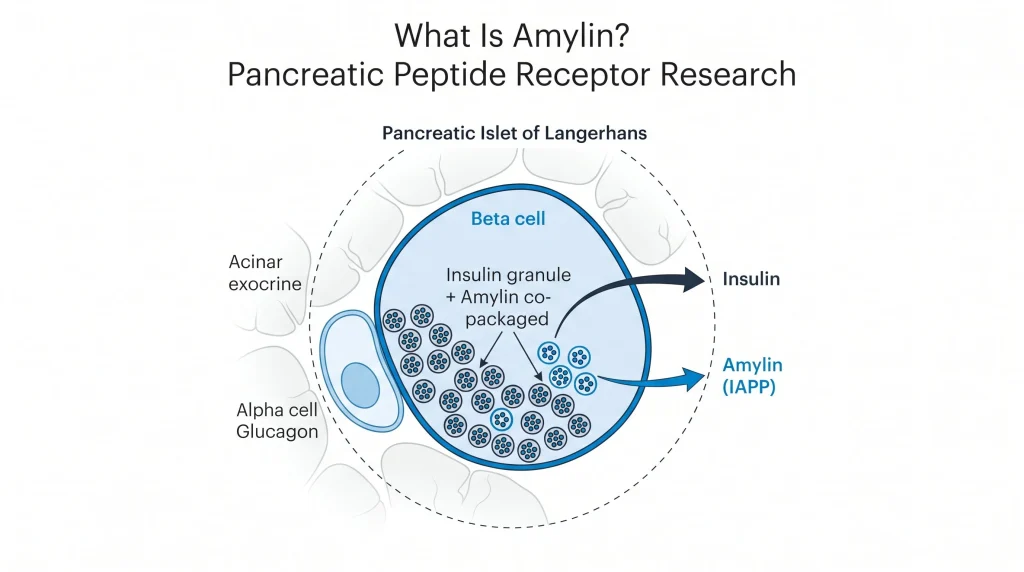
Amylin is a 37-amino acid peptide hormone co-released with insulin from beta cells. Research since the late 1980s has studied amylin’s roles. These include glucose signaling, glucagon suppression, and satiety. In animal models, amylin acts on the area postrema in the brain stem. Studies have also examined how amylin clumps in type 2 diabetes and how stable analogs like cagrilintide address this in lab settings. As of 2020, over 1,000 known studies reference amylin receptor science.
Next Level Pharm is a US-based supplier of research-grade peptides. Every batch is verified to ≥99% purity via HPLC and mass spectrometry. COA-confirmed research compounds are in the metabolic research peptides catalog.
Amylin research has expanded over the past two decades. Studies now cover its receptor targets and analog stability in detail. This article covers the core findings from animal and cell research.
Key Takeaways
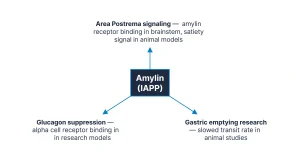
- Glucose Signaling: Amylin has been studied for its role in post-meal glucose signaling. Research shows it may suppress glucagon release from alpha cells. It also slows stomach emptying in animal models.
- Satiety Research: Amylin acts as a fullness signal in the CNS (central nervous system). Preclinical data show it may reduce food consumption in animal models. The area postrema in the brain stem is a key CNS target.
- Disease Research: Amylin deficiency is observed in type 1 diabetes. In type 2 diabetes, amylin clumping is a key area of study. Research has linked it to harmful effects on beta cells.
- Stable Analogs: Native amylin clumps in solution and has a short half-life. Analogs such as pramlintide and cagrilintide offer improved stability. These are used in animal models that require longer study windows.
- Synergistic Research: Combined amylin and GLP-1 analog research is active. The CagriSema combo pairs both classes and has been studied in animal models.
Research interest in amylin has grown alongside work on GLP-1 receptor agonists. Studies examine how amylin roles differ from and complement GLP-1 pathways. Knowing these differences helps refine animal models.
What Are the Primary Functions of Amylin?
Amylin has been studied for three core research roles.
- Post-meal glucose signaling: alongside insulin after feeding.
- Glucagon suppression: from alpha cells in lab assays.
- Gastric motility: slowing nutrient entry into the small intestine.
According to the Journal of Peptide Science (2018), amylin is co-released with insulin. The molar ratio is roughly 1:100 (amylin to insulin). This co-release pattern is seen across multiple species. It is well-noted in cell and animal models.
According to NIH (2012), amylin has been studied for stopping glucagon release from alpha cells. This effect is observed in beta cell assays. Studies use this finding to study how amylin shapes the post-meal glucose signaling environment.
How Does Amylin Affect Gastric Emptying?
Amylin slows stomach emptying in animal models. This mechanism has been studied in the context of post-meal nutrient absorption.
Research shows amylin acts on the vagal nerve pathway. This slows the rate at which nutrients enter the small intestine. The effect is separate from its action on glucagon release.
Studies use amylin analogs to study stomach motility over time. Stable analogs produce longer-lasting effects in assays. This makes them useful for time-course studies in metabolic research. The data are clear and easy to read.
What Is Amylin’s Role in the Brain?
Amylin crosses the blood-brain barrier and acts on specific CNS regions. The area postrema is one primary target. This brain stem region is a key site for fullness research.
According to NCBI (2007), amylin receptor binding in the area postrema reduces food consumption in rodent models. The nucleus accumbens (a brain reward area) is also a secondary target. Both regions are studied together. They map the fullness response in animal models.
CNS-targeted research on amylin is active. Studies use it as a reference peptide to map fullness circuits. Its different receptor targets set it apart. This makes it useful alongside GLP-1 analogs in research.
Researchers studying amylin CNS pathways can browse metabolic research peptides for lab use.
How Are Amylin Analogs Used in Research?
Native amylin clumps in solution. This short life limits its use in long-term assays. Research analogs were developed to address this problem.
Pramlintide is a short-acting analog with three amino acid changes. These changes prevent clumping and improve shelf life. It is used in assays that require brief exposure windows of about 48 minutes.
Cagrilintide is a long-acting amylin analog with a half-life of about seven days. Cagrilintide is on hand from Next Level Pharm as a COA-verified, HPLC-tested research peptide. Researchers studying amylin receptor pathways often select it for multi-day animal models.
What Is the Link Between Amylin and Disease?
Amylin research has focused on two disease states.
- Type 1 diabetes: beta cell loss creates amylin loss.
- Type 2 diabetes: amylin fibril formation harmful to beta cells.
In type 1 diabetes, beta cell destruction removes the source of amylin. This creates a signal loss alongside insulin loss. Studies use amylin analogs to model the missing signal. This work uses both cell and animal tests.
In type 2 diabetes, amylin tends to clump into fibrils. According to Molecules (2020), these misfolded fibrils are harmful to beta cells in culture. This clumping process is a key area of amyloid research in beta cell science.
What Are Amylin Receptor Targets?
Amylin binds to receptors built from two proteins. The first is the calcitonin receptor (CTR). CTR is a binding site on the cell surface. The second is a Receptor Activity Modifying Protein (RAMP).
Three RAMP subtypes pair with CTR. Each creates a different receptor.
- RAMP1 + CTR = AMY1 receptor.
- RAMP2 + CTR = AMY2 receptor.
- RAMP3 + CTR = AMY3 receptor.
Each receptor subtype shows a different binding profile. AMY1 has the highest affinity for amylin. These subtypes are studied in receptor binding assays to map site-specific amylin signaling.
| Feature | Native Amylin | Pramlintide | Cagrilintide |
| Stability | Low (clumps in solution) | High (non-clumping analog) | High (long-acting) |
| Half-life | ~10-15 min | ~48 min | ~7 days |
| Research use | Reference standard | Short-term assays | Long-term animal models |
Frequently Asked Questions
What is the function of amylin in glucose regulation?
Amylin has been studied for its role in post-meal glucose signaling. Research shows it acts alongside insulin after feeding. It suppresses glucagon release and slows stomach emptying in animal models. These effects together are studied for their role in glucose responses after meals. The processes are examined in cell and animal research. This work helps clarify how multiple peptide signals coordinate in glucose regulation studies.
How is amylin co-released with insulin from beta cells?
Amylin and insulin are both stored in beta cell release granules. When blood glucose rises, both peptides are released at the same time. According to the Journal of Peptide Science (2018), the molar ratio is about 1:100 (amylin to insulin). This co-release pattern is well-noted across species. Studies use it as a model for studying paired peptide signaling in animal assays.
What happens when amylin signaling is impaired?
In type 1 diabetes, beta cell destruction removes the source of amylin. This creates a shortage alongside insulin loss in cell models. In type 2 diabetes, amylin tends to clump into fibrils over time. These fibrils have been studied as harmful to beta cells in culture. Studies use amylin analogs to model what happens when this signaling is absent. These findings help map beta cell loss in metabolic research.
How is amylin related to cagrilintide and other research analogs?
Cagrilintide is a long-acting amylin analog. It was developed to solve native amylin’s clumping problem in solution. Its seven-day half-life makes it suited for long-term animal studies. Pramlintide is a shorter-acting analog used in brief assay windows of about 48 minutes. Both are studied as amylin receptor agonists in animal models. COA-verified cagrilintide is on hand for lab research from this supplier.
What role does amylin play in appetite regulation in metabolic research?
Amylin has been studied as a fullness signal in the CNS (central nervous system). According to NCBI (2007), it acts on the area postrema in the brain stem. This region is linked to fullness circuits in rodent models. Preclinical data suggest amylin receptor binding reduces food consumption in animal studies. Studies use this pathway to study how peptide signals shape appetite in animal models. It is distinct from GLP-1 pathways.
What is the difference between amylin and pramlintide?
Amylin is the native 37-amino acid peptide co-released with insulin. It clumps in solution, which limits its use in research assays. Pramlintide is a synthetic analog with three amino acid changes. These changes prevent clumping and improve shelf life in solution. Pramlintide has a half-life of about 48 minutes. Studies use it for short-term receptor binding and signaling assays where native amylin would degrade too quickly.
Is amylin a type of GLP-1 receptor agonist?
No. Amylin and GLP-1 receptor agonists are different peptide classes. They bind to different receptors and act through separate pathways. Amylin binds to calcitonin receptor and RAMP complexes (AMY1, AMY2, AMY3). GLP-1 agonists bind to the GLP-1 receptor on different cell types. Both classes are studied in metabolic research for shared but different processes. The CagriSema combo pairs both classes to study dual-pathway effects in animal models.
How does amylin clumping contribute to beta cell research?
Amylin tends to form fibril clumps (clumps) under certain conditions in solution. According to Molecules (2020), these fibrils are harmful to beta cells in cell culture models. This clumping process is linked to amyloid research in type 2 diabetes. Studies examine how fibril formation disrupts beta cell function over time. They also test research compounds that may slow or prevent this process. It is an active area of peptide science and amyloid study research.
What are the main receptor sites for amylin in the body?
Amylin binds to CTR and RAMP complexes found in several tissues. Key sites include the area postrema in the brain stem, the hypothalamus, and the nucleus accumbens (a brain reward area). The gut and kidney also carry these receptors. The spread across brain and body sites is studied to map amylin’s full signal scope. Studies use labeled amylin in binding assays. This maps receptor density at each body site.
What are Receptor Activity-Modifying Proteins (RAMPs) and Their Role in Amylin Receptors?
RAMPs are single-pass membrane proteins that pair with CTR. This pairing creates functional amylin binding sites. Three subtypes exist: RAMP1, RAMP2, and RAMP3. Each creates a different receptor. These are AMY1, AMY2, and AMY3. Each has a different binding profile. RAMPs also determine which peptides can activate the receptor. Researchers study RAMP subtype expression to learn about why amylin signaling varies across tissues and disease states.
Summary
Amylin is a 37-amino acid peptide co-released with insulin from beta cells. Research has studied its roles in glucose signaling, glucagon suppression, and satiety. These roles make it a useful model peptide in metabolic research.
Native amylin clumps in solution and has a short half-life. Stable analogs like pramlintide and cagrilintide were developed for research use. Cagrilintide’s long half-life makes it suited for multi-day animal studies.
Amylin receptor research focuses on CTR and RAMP complexes across central and peripheral tissues. Understanding these targets helps researchers map how amylin works with GLP-1 and other peptide pathways.
What Should You Do Next?
Researchers studying amylin receptor pathways should start with stable, COA-verified analogs. Cagrilintide offers a seven-day half-life for long-term model work. Native amylin reference standards are useful for baseline receptor binding assays.
Research-grade cagrilintide and amylin analogs are on hand at ≥99% purity, HPLC and mass spectrometry verified, with COA on every order. Shop research peptides or browse metabolic research peptides for cagrilintide and related analogs.
People Also Read
- AOD-9604 Research: What Studies Show About This HGH Fragment
- HGH Fragment 176-191 Research: Adipocyte Biology and Lipid Studies
About the Author
Next Level Pharm Research Team
Alex M covers peer-reviewed findings in peptide science for Next Level Pharm, a US-based supplier of research-grade peptides verified to ≥99% purity via HPLC and mass spectrometry on every batch.
Related Research
Compound family: Eloralintide, Cagrilintide, Cagrisema (2.5mg + 2.5mg)
Browse: Metabolic Research · All Research Peptides
Disclaimer: The information provided on this page is for educational and research purposes only. Next Level Pharm’s products are intended for lab research use only. They are not intended for human consumption, diagnostic, therapeutic, or medicinal purposes. This content does not constitute medical advice. Always consult a licensed healthcare professional before making any health-related decisions.