
How Peptides Stimulate Collagen Synthesis

Last updated: July 2026
A collagen peptide synthesis research study is a lab model of how short amino acid chains signal cells to build structural proteins. Collagen is the most abundant protein in the body. It forms the scaffold for skin, bone, and body tissue. skin cells are the cells that produce collagen from gene-level instructions. According to NCBI (2015), labs study specific peptide sequences to understand how outside the cell signals control collagen gene level in lab models.
Next Level Pharm is a US-based supplier of research-grade peptides, including GHK-Cu and AHK-Cu. Every vial is verified to 99.4% average purity via HPLC and mass spectrometry. Each order ships with a COA (certificate of analysis) for lot-level verification. Peptides are lyophilized for stability during transit.
Collagen signaling research matters because collagen loss is a key change in aging tissue models. Peptides are useful tools here because they are small, stable. And can reach cell receptors at low levels. Understanding how they shift gene level helps labs build better in vitro models.
Key Takeaways
- Collagen as Structural Protein: Collagen is the primary scaffold for body tissue. Type I collagen is found in skin and bone, while Type II is found in cartilage.
- skin cell Synthesis path: skin cells transcribe collagen genes into mRNA. They then build pro-alpha chains that coil into a triple helix before export.
- GHK-Cu Signaling Research: GHK-Cu is a copper peptide studied for its effects on skin cell gene level. Research links it to changes in COL1A1 gene action in cell models.
- pre-collagen Biomarkers: Scientists track pre-collagen peptides (PCPs) to measure new collagen production. These fragments are cleaved from pre-collagen as it converts to mature collagen.
- Research Limitations: In vitro findings often face challenges when moving to in vivo models. Peptide stability and delivery to specific tissue layers remain active research problems.
The sections below cover the biology, the peptides most studied, the lab methods used, and the open questions that remain.
What Is Collagen and Its Cell-level Role?
Collagen is the most abundant protein in the body. It provides the structural scaffold for skin, bone, cartilage, and body tissue. Type I collagen makes up most of the skin and bone mass. Type II collagen is found mainly in cartilage. According to NCBI (2015), the breakdown of collagen networks is a primary change in aging tissue models.
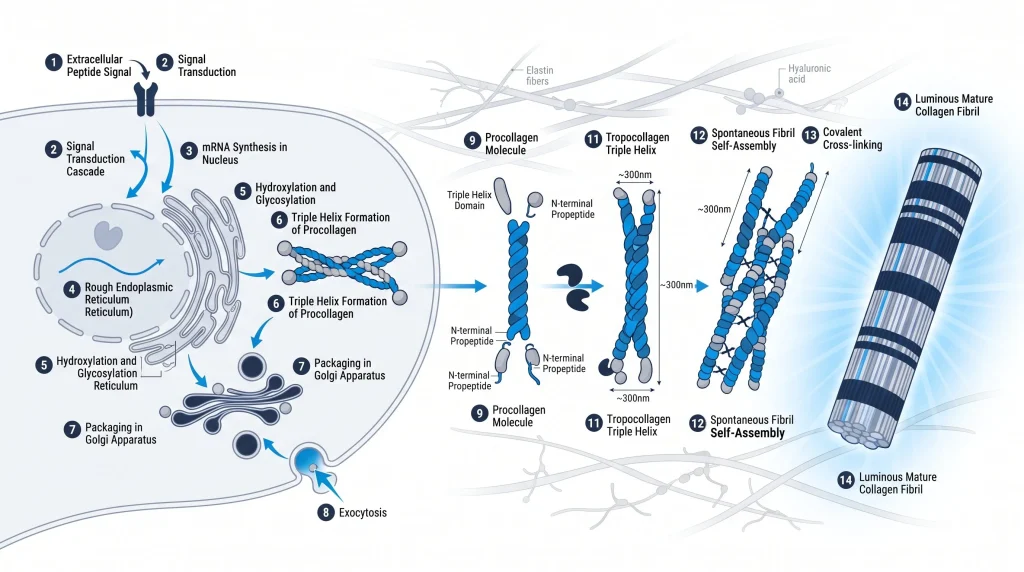
Collagen compounds form a triple helix from three coiled pro-alpha chains. These helices pack into fibrils outside the cell matrix. This is the structural layer outside the cell. Fibril density gives tissues their mechanical properties. In research models, age-linked changes in collagen density are studied by comparing fibril organization in young versus aged cell cultures.
| Collagen Type | Location | Research Focus |
| Type I | Skin, bone, tendons | skin cell signaling, structure strength |
| Type II | Cartilage | Joint tissue models |
| Type III | Blood vessels, skin | Wound healing research |
How Do Cells Produce Collagen Proteins?
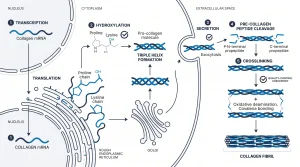
skin cells start collagen production by transcribing collagen genes into mRNA. This mRNA is translated into long pro-alpha chains inside the cell. The chains are then modified with chemical groups and glycan additions. They coil into a triple helix to form pre-collagen. According to NCBI (2015), this change is needed for correct folding and mechanical strength.
After the triple helix forms, pre-collagen is exported from the cell. Enzymes cleave the propeptide extensions at both ends. Mature collagen compounds then self-assemble into fibrils outside the cell matrix. labs study each step to find where peptide signals enter the path. Beauty-category peptides like AHK-Cu are now part of this research. Labs can browse beauty peptides
Which Peptides May Influence Collagen Synthesis?
GHK-Cu is the most studied peptide for collagen signaling in lab models. It binds to cell surface receptors and triggers gene level changes linked to structural protein production. Matrixyl 3000 is another synthetic sequence studied in skin cell cultures. According to PubMed (2020), these peptides act as chemical messengers that bind to receptors and alter COL1A1 gene action.
labs track changes in COL1A1 mRNA level and pre-collagen output in cell culture to confirm these effects. GHK-Cu binds with high affinity and low toxicity in vitro. AHK-Cu is a related copper peptide also studied for collagen-linked gene level. Labs in this area study multiple copper peptide sequences. They compare signaling patterns:
- GHK-Cu: copper peptide studied for COL1A1 gene action in skin cells.
- AHK-Cu: analog copper peptide studied for related structural protein signaling.
- Matrixyl 3000: synthetic dipeptide studied in dermal skin cell models.
- SNAP-8: studied for effects on SNARE complex and skin cell biology.
What Is the Pre-collagen Peptide’s Role?
pre-collagen peptides (PCPs) are fragments cleaved from pre-collagen as it converts to mature collagen outside the cell. They act as measurable biomarkers for active collagen production. Labs track PCP levels to monitor how skin cell action changes in response to peptide treatment. According to PubMed (2020), PCP release is a direct signal of new structural fiber assembly in tissue models.
Labs use ELISA (enzyme-linked antibody-based assay) to detect PCPs in cell culture media. Both the N-terminal propeptide and the C-terminal propeptide are tracked. The timing of cleavage marks the start of fibril growth, the process where mature collagen fibers form. GHK-Cu is available as a COA-verified research peptide for skin cell studies. labs can find full study references at the GHK-Cu research blog.
How Is Peptide-Collagen Binding Studied?
labs apply peptides to skin cell cell cultures at varying levels. They then extract cell material and measure collagen output by ELISA or qPCR (quantitative PCR). ELISA detects collagen protein levels. qPCR measures COL1A1 mRNA level. According to NIH (2021), these methods let scientists observe how peptide treatment shifts gene level and protein output in controlled cell models.
Western blotting is also used to detect pre-collagen bands by size. In vitro models use human dermal skin cell lines. Studies compare treated wells to untreated wells to isolate peptide effects. labs studying copper peptides can browse GHK-Cu and AHK-Cu at Next Level Pharm.
What Are Current Research Limitations?
The biggest gap is between in vitro cell studies and in vivo systems. Results in a dish often differ from those in a living system. Peptide stability in the bloodstream and delivery to specific tissue layers remain unsolved problems. According to NIH (2021), environmental factors in vivo introduce variables that cell cultures cannot replicate.
Enzymes in systemic circulation can degrade peptides before they reach target tissue. Barriers like the skin or gut lining block delivery of larger compounds. MMP (MMP enzyme) action in vivo can counter new collagen production by breaking down fibrils as they form. ClinicalTrials.gov data show these gaps persist in more complex study designs. Key open problems include:
- Enzymatic breakdown in systemic circulation.
- Peptide delivery to deep dermal layers.
- MMP action counteracting new collagen fibrils.
- Translating in vitro gene level data to in vivo outcome measures.
Frequently Asked Questions
How is collagen synthesized from peptide precursors?
Collagen builds inside skin cells through a multi-step process. The cell transcribes collagen genes into mRNA. Pro-alpha chains are built from that mRNA. The chains undergo chemical group addition and sugar linking before coiling into a triple helix. This pre-collagen is exported from the cell. Enzymes then cleave the propeptide, and mature collagen fibrils assemble outside the cell. According to NCBI (2015), this change sequence is needed for correct mechanical strength in lab models.
What peptides stimulate pre-collagen synthesis in skin cell research?
GHK-Cu is the most studied peptide for pre-collagen signaling in skin cell research. It binds to cell surface receptors and triggers COL1A1 gene action. AHK-Cu is a related copper peptide studied for similar structural protein signaling. Matrixyl 3000, a synthetic dipeptide, is also studied in dermal skin cell cultures. According to PubMed (2020), these peptides act as chemical messengers that shift collagen gene action in lab cell models.
Does consuming collagen peptides stimulate synthesis?
Research on this is still mixed. Ingested peptides break down into amino acids and dipeptides before entering the blood. Some fragments may signal skin cells. A few studies show changes in skin cell action after oral intake. But the mechanism is not fully explained. Evidence as of Examine.com (2023) suggests an effect exists but needs more study. All such research is conducted in lab and clinical settings, not as guidance for personal use.
What is the difference between collagen and peptides?
Collagen is a large structural protein made of three coiled chains in a triple helix. It provides physical support to skin, bone, and body tissue. Peptides are short chains of amino acids. They act as signaling compounds that bind to cell receptors and change gene action. Collagen provides structure; peptides send instructions. According to the Journal of Peptide Science (2021), both serve distinct roles in the biology of body tissue in lab models.
Can peptides like GHK-Cu cross the skin barrier in research models?
GHK-Cu has a low size compared to full collagen proteins. This smaller size allows it to reach dermal skin cells in ex vivo skin tissue models. Studies show entry is better than larger compounds, especially with delivery aids. According to compounds (2022), entry depth varies by formulation and model system. These findings are from in vitro and ex vivo lab models only and do not describe effects in living subjects.
How do labs measure increased collagen in cell cultures?
Three main lab methods are used. ELISA detects collagen protein levels using antibodies. qPCR measures COL1A1 mRNA level, showing how active the collagen gene is. Western blotting separates proteins by size and detects pre-collagen bands by size. Each method gives a different data type: protein level, gene action, or band intensity. According to NIH (2021), combining methods gives a fuller picture of collagen synthesis rates in cell culture.
What are MMPs and how do they relate to collagen?
MMPs are enzymes that break down collagen in the outside the cell matrix. They play a key role in tissue remodeling by clearing old collagen fibers. When MMP action is high, new collagen can be degraded as fast as skin cells produce it. This creates a net loss of structural protein. According to NCBI (2015), the balance between skin cell production and MMP-driven breakdown is a central topic in body tissue research.
What is the difference between pre-collagen and mature collagen?
pre-collagen is the precursor form of collagen. It has extra peptide extensions called propeptide at both the N-terminal and C-terminal ends. These extensions keep pre-collagen soluble inside and just outside the cell. Specific enzymes cleave these extensions after export. The result is mature collagen, which then forms insoluble fibrils. According to PubMed (2020), this cleavage step is required for fibril assembly in the outside the cell matrix.
Are in vitro peptide study results directly applicable to living systems?
No. Cell cultures do not replicate the complexity of a whole organism. In a living system, peptides face enzymatic breakdown, barriers to reaching target tissue. And MMP action that can counter new collagen production. According to ClinicalTrials.gov (2024), these gaps persist even in early study protocols. In vitro data provide a starting point. Each finding needs further study in more complex models before conclusions can be drawn.
What role does copper play in GHK-Cu collagen research?
The copper ion in GHK-Cu is needed for its receptor binding action in cell models. Copper is also a cofactor for lysyl oxidase, an enzyme that cross-links collagen fibrils to form stable fibers. This cross-linking step converts loose fibers into load-bearing structures. According to NIH (2021), the copper component in GHK-Cu may contribute to its observed effects on COL1A1 gene action in lab models.
Summary
Collagen is the most abundant structural protein in the body. skin cells build it through a multi-step process: gene transcription, pro-alpha chain assembly, triple helix formation, pre-collagen export, propeptide cleavage, and fibril assembly. Disruptions at any step change collagen output in tissue models.
GHK-Cu and AHK-Cu are the copper peptides most studied for collagen signaling. Both are linked to COL1A1 gene action in skin cell cultures. labs track pre-collagen peptides (PCPs) as biomarkers of new fiber formation. Lab methods include ELISA, qPCR, and Western blotting. Each measures a different part of the synthesis path.
The main research gaps are peptide stability in vivo and delivery to target tissue. MMP action can counter new collagen as fast as cells produce it. Next Level Pharm stocks COA-verified GHK-Cu and AHK-Cu for skin cell and tissue model research. In vitro findings are a starting point. They do not describe outcomes in living subjects.
What Should You Do Next?
Researchers should select the collagen pathway and cell model that match the study question. Pair gene-level and protein-level assays to track COL1A1 output and collagen synthesis. Confirm HPLC purity, mass spec identity, and the lot number before adding a peptide to the model. Researchers sourcing these lab peptides can shop research peptides with full COA and lot traceability.
People Also Read
- GHK-Cu Research Explained: What Peer-Reviewed Studies Show.
- GHK-Cu vs BPC-157: How Two Research Peptides Compare in Studies.
About the Author
Next Level Pharm Research Team
Alex M covers peer-reviewed findings in peptide science for Next Level Pharm, a US-based supplier of research-grade peptides verified to ≥99% purity via HPLC and mass spectrometry on every batch.
Disclaimer: For research purposes only. Not intended for human consumption. Next Level Pharm products are not intended for diagnostic, therapeutic, or medicinal use. This content does not constitute medical advice. Always consult a licensed healthcare professional before making any health-related decisions.