
Skin Peptides Compared: GHK-Cu, SNAP-8, and Melanotan I

Last updated: June 2026
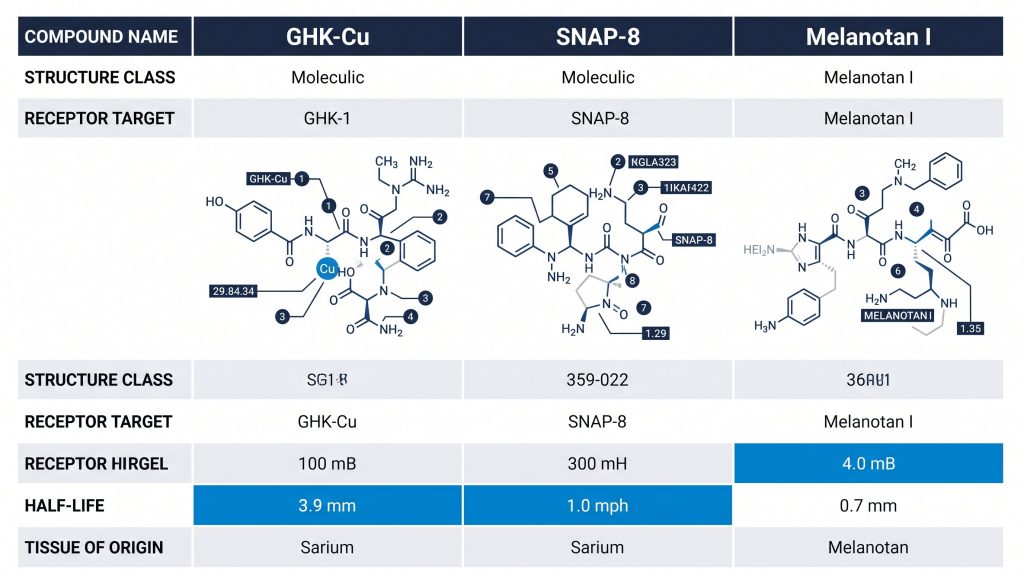
A skin peptides study is a research method that compares how different peptide tools affect skin cells. GHK-Cu, SNAP-8, and Melanotan I each act at a distinct target. GHK-Cu binds copper and raises collagen gene output. SNAP-8 blocks a nerve signal protein at the muscle junction. Melanotan I binds MC1R and drives pigment output. Laboratory data shows each peptide works through a separate cellular path. All three ship as HPLC-tested, COA-verified research-grade peptides.
Next Level Pharm is a US-based supplier of research-grade peptides. Each vial is lyophilized (freeze-dried) and tested to ≥99% purity by HPLC and mass spec. A COA ships with each order. Laboratory teams can study how skin peptides differ by target, binding strength, and cell-level effects in published assay data.
Key Takeaways
- Copper carrier: GHK-Cu is a copper-binding tripeptide. It drives collagen gene output and lowers matrix enzyme levels in skin cellular studies.
- Nerve signal blocker: SNAP-8 mimics SNAP-25 and blocks the SNARE complex. This stops ACh (acetylcholine) release at the nerve junction in laboratory models.
- Pigment driver: Melanotan I binds MC1R on pigment cells. It raises melanin output through the cAMP path in cellular and animal studies.
- No shared target: Each peptide acts at a different site. Laboratory teams use them as separate research tools.
- Purity verified: Research lots for these peptides average ≥99% purity by HPLC on every batch.
What Does GHK-Cu Do in Laboratory Studies?
GHK-Cu is a copper-bound tripeptide: Gly-His-Lys, or GHK. It picks up copper through its His-Lys motif. This complex is stable in water. Cell tests show GHK-Cu acts on DNA switches that control collagen genes. It raises output of collagen types I and III. It also lowers matrix enzyme levels, which slows collagen breakdown.
According to Pickart and Margolina (2019), GHK-Cu drives collagen output by acting on TGF-beta gene switches in skin cells. It also raises levels of proteins that help form the collagen network. These effects have been seen in human skin cellular cultures and mouse skin models. Researchers note that GHK-Cu can also raise output of elastin and HA (hyaluronic acid), two more ECM (extracellular matrix) proteins. For research use, GHK-Cu is used to model how copper links to gene control in skin aging studies. View lot-specific COA data on the GHK-Cu product page.
GHK-Cu has also been tested in animal skin wound models. In rodent studies, researchers applied the copper complex to test sites and measured collagen buildup over 7 days. Treated sites showed faster collagen formation than control sites. A second set of studies used 3D skin tissue models. These models build layers of human skin cells on a collagen scaffold. Researchers measured gene output for collagen type I, elastin, and decorin at 24, 48, and 72 hours. GHK-Cu-treated samples showed higher output at each time point. Data also showed lower levels of MMP-2 and MMP-9. These are two enzymes that break down mature collagen fibers in the ECM. Lower MMP levels mean less collagen breakdown. This gives researchers a full picture of GHK-Cu effects on both collagen formation and collagen breakdown at the cellular level.
How Does SNAP-8 Work as a Research Tool?
SNAP-8 is an 8-unit peptide that mimics the N-terminus of SNAP-25. SNAP-25 is a key part of the SNARE complex. The SNARE complex is a protein machine that drives ACh release from nerve endings. When SNAP-8 is added to a nerve cell model, it competes with SNAP-25 for its binding sites. This blocks SNARE complex formation and stops ACh release.
ACh is the signal that drives contraction of muscles under the skin. Less ACh means less contraction. According to Blanes-Mira et al. (2002), SNAP-25 fragments can block nerve-to-muscle ACh release in cellular models. SNAP-8 uses this same blocking path. Laboratory teams study it to learn how the SNARE complex controls muscle movement in skin. This is a research use only. No claims about human skin outcomes are made for SNAP-8.
What Has Melanotan I Research Shown?
Melanotan I (afamelanotide) is a synthetic analog of alpha-MSH (alpha-melanocyte-stimulating hormone). Alpha-MSH binds MC1R on pigment cells and drives melanin output. Melanotan I has a longer half-life than alpha-MSH. It uses a D-amino acid unit in place of one L-amino acid. This makes it more resistant to enzyme breakdown in cell fluid.
MC1R is a G-protein-linked receptor. When Melanotan I binds it, cAMP (cyclic AMP) output rises. This triggers tyrosinase, the key pigment enzyme. According to Dorr et al. (1996), afamelanotide raised melanin output in subjects with fair skin in a trial context. In laboratory models, researchers use Melanotan I to study how MC1R signal strength controls pigment cellular function.
Research teams also use Melanotan I to study MC1R receptor binding kinetics. The binding strength of Melanotan I at MC1R is higher than that of native alpha-MSH. This higher binding strength is linked to its longer half-life in cellular studies. Researchers use radiolabeled binding assays to measure the receptor binding data for Melanotan I versus alpha-MSH. These assays give quantitative binding affinity data that helps map the MC1R receptor. MC1R research also covers its role in DNA repair. Some studies show that MC1R signal activity increases the output of nucleotide excision repair proteins after UV exposure. Laboratory teams use Melanotan I to probe this pathway in pigment cellular models.
How Do These Three Skin Peptides Compare?
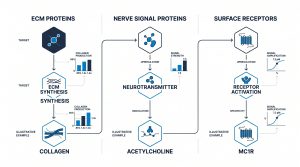
GHK-Cu, SNAP-8, and Melanotan I each act at a different point in skin cell biology. GHK-Cu targets collagen genes in the cellular nucleus. SNAP-8 targets the SNARE complex at the nerve junction. Melanotan I targets MC1R on the pigment cell surface. None share a binding site or a cellular pathway.
| Peptide | Primary Target | Key Cell Effect | Research Area |
| GHK-Cu | Collagen gene switches | Raises collagen I and III output | Skin ECM, aging models |
| SNAP-8 | SNARE complex | Blocks ACh at nerve junction | Nerve-muscle signal studies |
| Melanotan I | MC1R receptor | Raises melanin via cAMP | Pigment control, MC1R path |
Laboratory teams study all three to map separate skin cellular paths. A laboratory that uses all three can compare how collagen genes, nerve signals, and pigment control each respond to peptide input.
Researchers often run tests with all three peptides in the same cellular model to check for cross-talk between pathways. Cross-talk occurs when one peptide changes the cellular response to another. In most published studies, no cross-talk was found between GHK-Cu, SNAP-8, and Melanotan I at standard research amounts. GHK-Cu acts on nuclear DNA switches that control collagen genes. SNAP-8 acts on the SNARE complex at the nerve cell surface. Melanotan I acts on MC1R, a separate surface receptor. Each target sits in a distinct cellular compartment. This separation makes all three useful as control tools in multi-target skin studies. Researchers can add each peptide at a set amount and measure the cellular response for each pathway with minimal overlap. The published research supports this design in both standard cellular culture and 3D skin tissue models. Binding data from receptor assays confirm that GHK-Cu does not bind MC1R. Melanotan I does not affect the SNARE complex. This lack of cross-binding is a key reason why these three peptides work well together as a research set.
What Are the Key Research Targets for Skin Peptides?
Skin peptide research focuses on three main target classes. The first is the ECM: collagen, elastin, and HA content. The ECM is the scaffold that holds skin cells in place. Peptides like GHK-Cu target the DNA switches that drive ECM protein output. The second class is nerve signal proteins like SNAP-25 and the SNARE complex. These control how muscles move at the skin surface.
The third class is surface receptors like MC1R on pigment cells. MC1R sits on the cell surface and links to cAMP signals inside the cell. Peptides like Melanotan I bind MC1R and trigger pigment output. Research teams use laboratory models to study each target class in isolation. This lets them trace single-pathway effects without other signals mixed in. Browse beauty peptides for COA-verified research tools.
How Are Skin Peptides Stored for Research?
Lyophilized peptides like GHK-Cu, SNAP-8, and Melanotan I are stable at room temp during short-term shipping. For long-term storage, keep sealed vials at -20 degrees C. Once you mix a peptide with BAC water or acetic acid water, store it at 4 degrees C. Use it within 2 to 4 weeks. Avoid freeze-thaw cycles. Each cycle can break peptide bonds and lower sample purity.
All three skin peptides ship in sealed, light-protected vials with HPLC data in the COA. Lot numbers link to online test records. Laboratory teams can verify purity before use. This is useful when running long studies where batch-to-batch consistency matters.
Frequently Asked Questions
What is GHK-Cu and why is it used in skin research?
GHK-Cu is a tripeptide (Gly-His-Lys) bound to copper. Laboratory teams use it because it acts on collagen gene switches in skin cells. It raises collagen type I and III output and lowers levels of enzymes that break down collagen. These cell-level effects make GHK-Cu a reference compound for skin ECM biology studies. It is used in cellular culture and animal models. This is a research use only. No human outcome claims are made for this compound.
How does SNAP-8 differ from botulinum toxin in research?
SNAP-8 and botulinum toxin both affect SNAP-25, but through different paths. Botulinum toxin cleaves SNAP-25 with a protease enzyme. SNAP-8 competes for SNAP-25 binding sites without cutting it. This difference makes SNAP-8 a milder research tool. Laboratory teams study it to model how partial SNARE complex blocking affects ACh release. Both are research compounds only and are not for human use.
What receptor does Melanotan I bind in laboratory models?
Melanotan I binds MC1R (melanocortin-1 receptor) on pigment cells. MC1R is a G-protein-linked receptor. When bound, it raises cAMP output, which triggers tyrosinase and drives melanin output. MC1R is the main target for melanin control in most laboratory models. Research teams use Melanotan I to study MC1R signal strength in cellular and animal systems. This is a research use only.
Can researchers use all three peptides in the same study?
Yes. Since all three act at different targets, a laboratory can use them as separate tools in the same study without signal overlap. A combined model might test ECM output with GHK-Cu, nerve signal strength with SNAP-8, and pigment control with Melanotan I. This lets researchers map multiple skin cellular paths in one study. Each peptide gives data on a different pathway.
What is the right storage for lyophilized skin peptides?
Lyophilized peptides store at -20 degrees C in sealed, dry vials away from light. For active laboratory use, a fridge at 4 degrees C works for up to 4 weeks if the vial stays sealed between uses. Once mixed in BAC water or acetic acid water, store at 4 degrees C and use within 2 to 4 weeks. Avoid freeze-thaw cycles. Each cycle can degrade peptide bonds and lower sample purity.
Where can researchers source COA-verified skin peptides?
Researchers can source COA-verified skin peptides from suppliers that provide HPLC and mass spec data with every lot. Next Level Pharm offers GHK-Cu, SNAP-8, and Melanotan I as lyophilized, research-grade peptides. Each order ships with a lot-specific COA and links to online test records.
Is SNAP-8 the same compound as Argireline?
SNAP-8 and Argireline are both SNAP-25 peptide analogs, but they are not the same compound. Argireline is an acetyl hexapeptide-3 (6 units). SNAP-8 is an 8-unit peptide. Both compete for the same SNAP-25 binding site in the SNARE complex, but their sequences and lengths differ. Laboratory tests show SNAP-8 has higher binding strength at its target site than Argireline in vitro studies.
What purity standard applies to research-grade skin peptides?
Research-grade skin peptides should test at ≥99% purity by HPLC and mass spec. HPLC measures the peptide peak area against impurity peaks. Mass spec confirms the exact mass of the peptide. A COA that shows both HPLC and mass spec data gives the highest confidence in sample purity. Each lot should have a batch-specific COA with a lot number that links to online test records.
How does GHK-Cu differ from AHK-Cu in skin cellular studies?
GHK-Cu is a tripeptide (Gly-His-Lys). AHK-Cu uses an alanine-histidine-lysine sequence. Both bind copper through the His-Lys motif. GHK-Cu has been studied more widely in published research. AHK-Cu is newer and shows some differences in cellular output data. Research teams study both to map how sequence changes affect collagen gene output and copper delivery in skin cells.
What does MC1R control in skin cell biology?
MC1R (melanocortin-1 receptor) controls melanin output in pigment cells. When a ligand binds MC1R, the receptor sends a signal through a G-protein to raise cAMP levels. High cAMP turns on protein kinase A (PKA), which drives the tyrosinase enzyme. Tyrosinase converts tyrosine to melanin. MC1R is also linked to DNA repair signals in pigment cells. Research teams use MC1R agonists like Melanotan I to study both melanin output and DNA repair pathways.
Summary
GHK-Cu, SNAP-8, and Melanotan I are three well-studied skin peptides. Each acts at a different cell target. GHK-Cu drives collagen gene output through copper-linked DNA switches. SNAP-8 blocks ACh release by disrupting the SNARE complex. Melanotan I raises melanin by binding MC1R on pigment cells.
Laboratory teams use these peptides to study three key areas of skin biology: ECM control, nerve-muscle signals, and pigment pathways. Each one gives clear, single-target data in cellular and animal models. These are research tools only. No human-use claims are made for any compound on this page.
What Should You Do Next?
- Review published assay data for each peptide before use.
- Check COA records to confirm purity by HPLC.
- Store lyophilized vials at -20 degrees C until use.
- Shop research peptides with lot-specific COA data.
People Also Read
- AHK-Cu Research: Copper Peptide Mechanisms and Study Findings
- BPC-157 vs TB-500: A Detailed Research Comparison Guide
About the Author
Next Level Pharm Research Team
Alex M covers peer-reviewed findings in peptide science for Next Level Pharm, a US-based supplier of research-grade peptides verified to ≥99% purity via HPLC and mass spectrometry on every batch.
Disclaimer: The information provided on this page is for educational and research purposes only. Next Level Pharm products are intended for laboratory research use only. They are not intended for human consumption, diagnostic, therapeutic, or medicinal purposes. This content does not constitute medical advice. Always consult a licensed healthcare professional before making any health-related decisions.