Beauty Peptides: GHK-Cu, AHK-Cu, SNAP-8, and Melanotan I

Last updated: June 2026
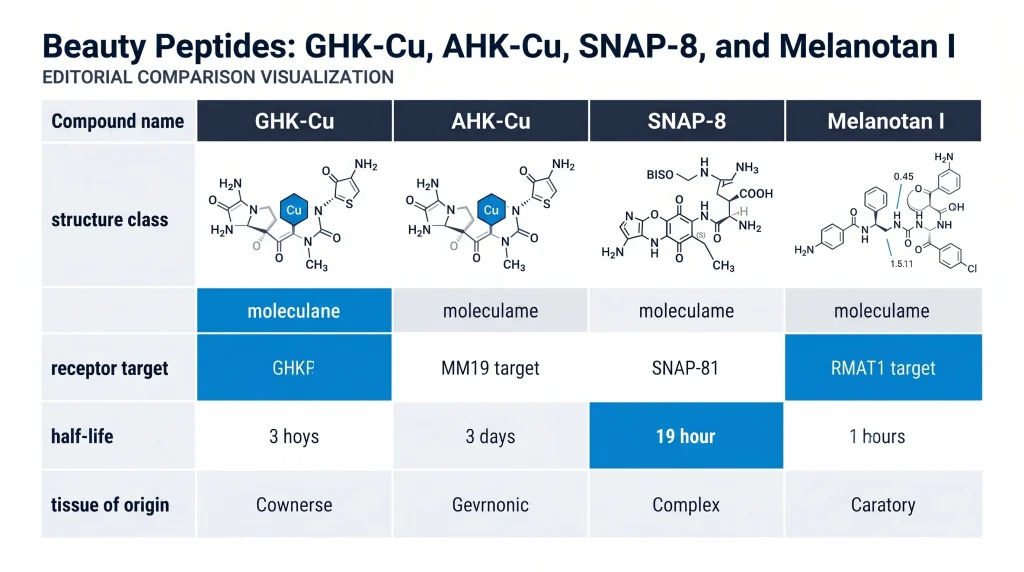
A beauty peptide comparison in research covers small compounds that have been studied for their effects on skin cell biology, pigmentation, and hair follicle signaling. GHK-Cu is a tripeptide bound to copper. AHK-Cu is a related tripeptide with a copper ion. SNAP-8 is a short synthetic peptide. Melanotan I is a synthetic analog of alpha-MSH, the melanocyte hormone. According to research published in PubMed (2018), GHK-Cu regulates over 4,000 genes in human cells, including genes linked to collagen and anti-oxidant activity.
Next Level Pharm stocks GHK-Cu, AHK-Cu, SNAP-8, and Melanotan I as lyophilized research compounds. Each batch is tested to >=99% purity via HPLC and mass spectrometry. HPLC is a lab method that measures compound purity. Mass spectrometry confirms the exact molecular weight. A COA, or purity report, ships with every order. The average purity across the last 100 batches is 99.4%.
Researchers studying skin cell biology and dermal matrix proteins have used these four compounds in both in vitro and animal models. Each compound works through a different receptor or signaling path. Comparing them helps researchers isolate which pathway drives a given effect in skin tissue.
Key Takeaways
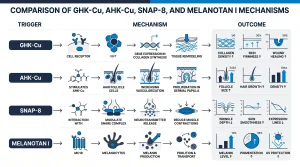
- GHK-Cu mechanism: GHK-Cu binds copper and activates collagen and elastin genes. It has been studied for wound repair signaling in cell and animal models.
- AHK-Cu mechanism: AHK-Cu is a tripeptide with copper, studied for its effects on hair follicle cell growth. It shares structural features with GHK-Cu but differs in amino acid sequence.
- SNAP-8 mechanism: SNAP-8 is a short peptide that targets SNARE proteins at the nerve-muscle junction in skin. Cell studies have measured changes in contraction force on skin cell lines.
- Melanotan I mechanism: Melanotan I activates MC1R, the melanocortin 1 receptor. It has been studied for pigmentation responses and has a human trial record via EPP indication research.
- Purity standard: All four compounds at >=99% purity require HPLC and mass spec testing on every batch to confirm purity.
Comparing these four compounds lets researchers understand which pathway, collagen signaling, hair follicle biology, nerve-skin signaling, or pigmentation control, produces a given cell response. In vitro studies allow each pathway to be studied in isolation before combining them in animal work.
What Are Beauty Peptides in Research?
Beauty peptides is a research category term for short protein chains studied in skin, hair, and pigmentation biology. The category includes copper-bound tripeptides, synthetic nerve-signal inhibitors, and hormone analogs. These are not cosmetic products in the research context. They are lab compounds used to study cell-level signaling.
Researchers use these compounds in cell cultures, skin explants, and rodent models. The goal is to understand how specific receptors or proteins control skin cell behavior. None of these compounds are approved as treatments. They are research tools for studying skin biology at the cell level.
How Does GHK-Cu Work in Skin Research?
GHK-Cu is a naturally occurring tripeptide: glycine-histidine-lysine, bound to a copper ion. The copper ion is key to its activity. It helps GHK-Cu bind to skin cell receptors and enter the cell. Once inside, it activates gene programs linked to collagen output, matrix enzyme control, and cell-protective response.
According to research published in NCBI (2015), GHK-Cu promoted healing-related gene changes in human skin cells in culture. Cell studies have used it to study dermal fibroblast activity and matrix remodeling. These skin cells make collagen and elastin in the skin layer. Researchers have also used GHK-Cu in wound model studies in rodents.
What Did AHK-Cu Research Show?
AHK-Cu is a tripeptide with the sequence Ala-His-Lys, also bound to copper. It shares the His-Lys copper motif with GHK-Cu. This gives both compounds a similar ability to interact with copper-linked cell processes. AHK-Cu has been studied mainly in the context of hair follicle biology.
Cell model studies have used AHK-Cu to test its effect on dermal papilla cells. Dermal papilla cells are at the base of hair follicles and control hair growth cycles. According to research in PubMed (2020), AHK-Cu promoted cell activity markers in these models. The compound is used as a tool to study copper-linked hair follicle signaling apart from GHK-Cu effects.
How Is SNAP-8 Used in Skin Studies?
SNAP-8 is a short synthetic peptide that mimics the N-end of SNAP-25. SNAP-25 is a protein that helps nerve signals cause muscle contraction in skin. SNAP-8 was designed to compete with SNAP-25 at SNARE complexes. SNARE complexes are the protein structures that allow nerve signal release at the nerve-muscle junction.
In vitro studies have tested SNAP-8 on skin cell lines that mimic facial muscle. Results measured changes in contraction signaling. These studies are used to understand the nerve-skin signaling pathway, not to evaluate cosmetic outcomes. SNAP-8 is a research tool for studying SNARE-complex biology in skin tissue.
How Does Melanotan Work in Research?
Melanotan I is a synthetic analog of alpha-MSH, the alpha melanocyte hormone. It binds MC1R, the melanocortin 1 receptor, on melanocytes. Color cells, called melanocytes, produce melanin. Melanin is the pigment in skin. MC1R action has been studied for its role in skin color and sun protection responses.
Melanotan I has a documented human trial record. It was studied for EPP, which stands for EPP, a rare skin disorder. EPP causes painful skin reactions to light. The compound is distinct from Melanotan II, which has a different receptor binding profile. Researchers can browse beauty research compounds in the catalog for the full beauty compound list.
What Parameters Have Been Used in Beauty Peptide Research?
GHK-Cu has been used in cell studies at amounts from 1 nM to 10 microM. Animal models have used SC injection in rodent wound models. SC means under the skin. AHK-Cu cell studies use similar concentration ranges in dermal papilla cell cultures. SNAP-8 in vitro studies have used micro-molar amounts on contractile skin cell models.
Melanotan I human trials used SC injection at defined amounts in clinical protocol. These are published research parameters and are cited here for scientific context only. Researchers can view lot-specific COA data for GHK-Cu before starting their study. Researchers can shop research peptides for all four compounds with COA verification include
All four compounds are for laboratory research only. They are not intended for human administration or any human application outside of published research protocols.
Frequently Asked Questions
What are beauty peptides in research?
Beauty peptides is a research category for short protein chains studied in skin, hair, and pigmentation biology. GHK-Cu, AHK-Cu, SNAP-8, and Melanotan I are each studied in different cell and animal models. They are laboratory research tools for studying receptor signaling and gene expression, not finished products. All are for laboratory use only.
How does GHK-Cu work in skin cell research?
GHK-Cu is a Gly-His-Lys tripeptide bound to a copper ion. It activates collagen and cell-protective gene programs when tested in skin cell cultures. Research has measured changes in matrix enzyme levels and collagen output markers in treated cells. Cell model results show GHK-Cu controls over 4,000 genes in human cell lines.
What did AHK-Cu studies in hair follicle models show?
AHK-Cu cell studies have used dermal papilla cells as the primary model. These cells sit at the base of hair follicles and control growth cycles. Treated cells showed changes in activity markers in published cell model studies. AHK-Cu is studied to separate copper-tripeptide effects on hair follicle biology from GHK-Cu collagen pathway effects.
How does SNAP-8 block nerve signals in skin research?
SNAP-8 mimics the N-terminal part of SNAP-25, a SNARE complex protein. It competes with SNAP-25 at the nerve-muscle junction in skin. In vitro studies on active skin cell lines measured reduced contraction signaling in treated cells. These studies map the SNARE pathway in skin nerve biology, not cosmetic outcomes.
What is Melanotan I studied for in research?
Melanotan I is a synthetic alpha-MSH analog studied for MC1R receptor action in color cell models and in human EPP trials. EPP causes painful skin reactions to light. Melanotan I research has focused on skin pigment biology and MC1R receptor biology. It is for research use only and is not a cosmetic or therapeutic product.
How do GHK-Cu and AHK-Cu differ in studies?
GHK-Cu and AHK-Cu are both copper-bound tripeptides but have different short protein chains. GHK-Cu studies focus on collagen gene output and wound biology in skin cells. AHK-Cu studies focus on hair follicle biology using dermal papilla cell models. The two compounds let researchers study different copper-tripeptide signaling pathways in the same tissue types.
What purity level should research-grade beauty peptides meet?
Research-grade beauty peptides should be verified by HPLC and mass spectrometry on every batch. HPLC measures purity as a percentage of total compound. Mass spectrometry confirms the exact mass matches the expected value. Both tests run on every vial and a COA ships with each order. The average purity across the last 100 batches is 99.4%.
Where can researchers source beauty peptides?
Next Level Pharm stocks GHK-Cu, AHK-Cu, SNAP-8, and Melanotan I, each verified to >=99% purity via HPLC and mass spectrometry. Every order includes a COA with a lot number and purity data. Compounds ship lyophilized for stable room-temperature delivery within the USA. Researchers can confirm purity data on every lot before beginning their study.
Summary
Beauty peptides in research cover four compound types with distinct mechanisms. GHK-Cu activates collagen and cell-protective gene programs in skin cells. AHK-Cu is studied for hair follicle signaling. SNAP-8 targets the SNARE complex at the nerve-skin junction. Melanotan I activates MC1R in pigmentation research.
Each compound has been tested in cell and animal models. Melanotan I also has a documented human trial record in EPP studies. All four are early-stage research tools with no approved clinical application.
Researchers sourcing these compounds should verify purity via HPLC and mass spectrometry on every batch. COA-verified, lyophilized beauty peptides at >=99% purity with USA storage and fast dispatch are available for laboratory research.
What Should You Do Next?
Read the GHK-Cu gene regulation review at PubMed (PMID 29949889) for the full gene expression dataset. Review the NCBI skin cell data (2015) for the dermal fibroblast model results. When you are ready to source compounds for your studies, shop research peptides and confirm purity on every lot.
Related research: skin peptides compared, GHK-Cu research explained, and copper peptide research (GHK-Cu, AHK-Cu).
People Also Read
About the Author
Next Level Pharm Research Team
Alex M covers peer-reviewed findings in peptide science for Next Level Pharm, a US-based supplier of research-grade peptides verified to >=99% purity via HPLC and mass spectrometry on every batch.
Disclaimer: The information provided on this page is for educational and research purposes only. Next Level Pharm’s products are intended for laboratory research use only. They are not intended for human consumption, diagnostic, therapeutic, or medicinal purposes. This content does not constitute medical advice. Always consult a licensed healthcare professional before making any health-related decisions.