
Adipotide Research: FTPP Vascular Targeting Studies

Last updated: June 2026
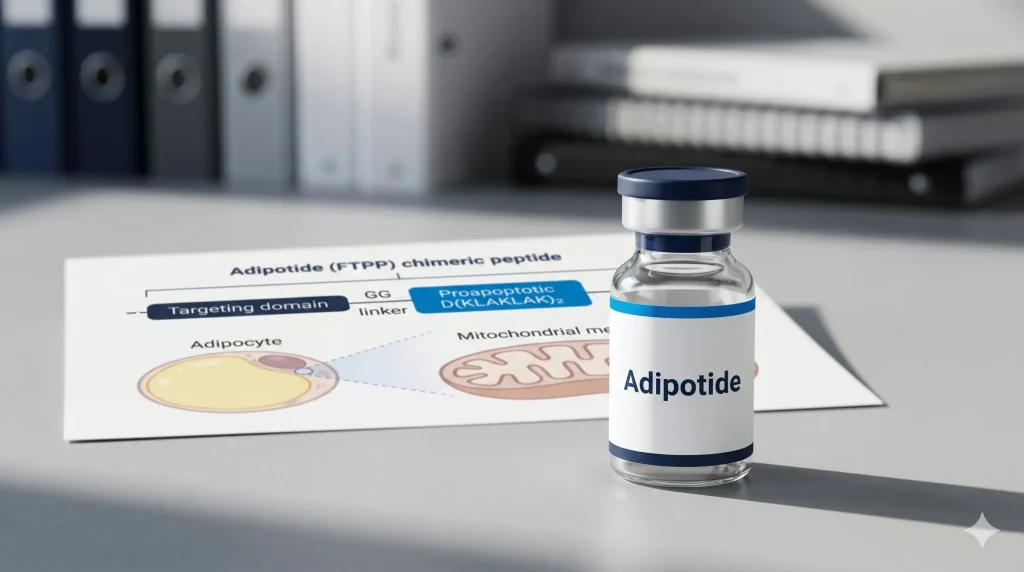
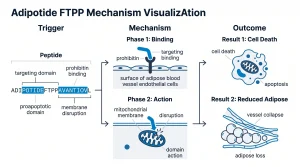
Adipotide (FTPP) is a chimeric research peptide built from two linked functional domains. It has a targeting domain and a proapoptotic domain. The targeting domain binds prohibitin on adipose blood vessels. The proapoptotic domain disrupts cells in the bound vessel. Adipotide has been studied in animal models. Research-grade Adipotide must reach ≥99% purity, confirmed by HPLC and mass spec, before any lab study.
Next Level Pharm is a US-based supplier of research-grade peptides verified to ≥99% purity. Each Adipotide vial ships with a COA (certificate of analysis) that includes the HPLC trace, mass spec result, and lot number.
Adipotide was first described in peer-reviewed literature in the early 2010s. Research has focused on its mechanism rather than clinical use. Knowing how the two domains interact helps researchers evaluate study findings.
Researchers studying GLP-1 receptor mechanisms may also find eloralintide relevant — it is a research-grade GIP/GLP-1 co-agonist analog available as a COA-verified, lyophilized research peptide.
Key Takeaways
- Adipotide Is a Bifunctional Chimeric Peptide: It has two linked domains. One targets prohibition on adipose blood vessels, and the other kills the targeted vessel cells.
- The Targeting Domain Binds Prohibitin: Prohibitin is overexpressed on the blood vessels that supply white adipose tissue. The FTPP targeting domain binds to it selectively.
- The Proapoptotic Domain Disrupts Mitochondria: The D(KLAKLAK)₂ sequence disrupts mitochondrial membranes in the bound cell. This causes cell death (apoptosis) in the targeted vessel.
- Lab Studies Used Primate Models: Animal research has used rhesus monkeys and rodents. These are lab studies only, not human trials.
- Research-Grade FTPP Requires ≥99% Purity: HPLC confirms purity and mass spec confirms the full molecular weight. A COA with both data points is required for valid lab use.
Researchers who source Adipotide for lab use must verify that both domains are intact. A COA with HPLC and mass spec data is the minimum check for a valid research vial.
What Is Adipotide and How Is FTPP Classified?
Adipotide is a synthetic chimeric peptide. Its full lab name is FTPP (fatty acid translocase proapoptotic peptide). The name reflects its two-part design. The targeting domain is derived from fatty acid translocase (CD36) sequence fragments. The proapoptotic domain is D(KLAKLAK)₂, a known cell-death sequence.
Adipotide is classified as a research-grade peptide. It is not an FDA-approved drug. Its use is limited to lab studies.
According to a review in Chemistry & Biology (2013), chimeric peptides combine targeting and proapoptotic domains. Researchers studying adipose tissue biology focus on this design. Adipotide is one example of this class of research compounds.
How Does Adipotide Target Adipose Blood Vessels?
The targeting domain of Adipotide binds prohibitin. Prohibitin is a membrane protein. It is overexpressed on the blood vessels that supply white adipose tissue. This selective expression is the basis for Adipotide vascular targeting.
When the targeting domain binds prohibitin, the full peptide contacts the vessel wall. This keeps the compound near adipose vessels. It reduces off-target contact with other tissue types.
According to a study in PubMed (2016), prohibiting expression on adipose vessel walls has been studied in several animal models. This research supports the basis for FTPP targeting studies. The mechanism requires intact prohibitin expression to function.
What Is the Proapoptotic Domain in Adipotide?
The proapoptotic domain of Adipotide is D(KLAKLAK)₂. This sequence uses D-amino acids. D-amino acids resist protease breakdown more than L-form amino acids. This stability helps the domain stay intact after delivery in animal models.
D(KLAKLAK)targets mitochondrial membranes in the bound cell. It disrupts membrane potential. This triggers cell death (apoptosis) in the affected vessel cell. The effect is local to cells the targeting domain has already bound.
The linker between the two domains is GG (glycine-glycine). This short linker gives each domain space to fold. The full chimeric sequence is CKGGRAKDC-GG-D(KLAKLAK)₂.
What Do Animal Studies Show About Adipotide?
Lab research on Adipotide has used rhesus monkeys and rodent models. Researchers observed changes in white adipose tissue mass in these studies. These findings come from animal models only.
According to a study in Science Translational Medicine (2011), primate studies showed measurable changes in adipose tissue over the study period. The research also noted effects on kidney function in some animals. This highlights the need for careful study design.
No human clinical trials of Adipotide have been published. All data comes from animal models. Researchers should review lab literature before designing any protocol. Next Level Pharm supplies Adipotide at ≥99% purity, COA-verified for research use. View the Adipotide product page.
How Is Adipotide Purity Confirmed for Research?
Adipotide has two distinct domains joined by a GG linker. This makes purity verification more complex than for single-domain peptides. HPLC confirms the percentage of the full chimeric compound. Mass spec confirms the total molecular weight of the complete sequence.
A chimeric peptide with a missing domain has a different mass. Mass spec detects this. Researchers should verify the observed mass matches the expected mass for CKGGRAKDC-GG-D(KLAKLAK)₂.
Each Adipotide batch is verified by HPLC and mass spec before release. The COA includes the chromatogram trace and observed versus expected mass. Researchers can view COA data for metabolic research peptides and other compounds before purchase. Batches below ≥99% purity are rejected.
How Is Research-Grade Adipotide Stored and Shipped?
Research-grade Adipotide ships as a lyophilized (freeze-dried) powder. Lyophilization removes water under vacuum. This leaves a dry, stable powder. The form is stable at room temperature during shipping.
For long-term lab storage, the lyophilized vial should be kept at -20°C. Storage and lab protocol guidance is covered in published lab literature and institution guidelines.
BPC-157 and other research peptides follow the same lyophilization and COA standards as Adipotide. Each vial is lot-numbered and traceable. Shop research peptides to view COA data before purchase.
| Feature | Details |
| Full name | Fatty acid translocase proapoptotic peptide (FTPP) |
| Sequence | CKGGRAKDC-GG-D(KLAKLAK)₂ |
| Target | Prohibition on adipose blood vessels |
| Proapoptotic domain | D(KLAKLAK)₂ |
| Research model | Rodents and non-human primates |
| Purity standard | ≥99% by HPLC and mass spec |
| Form | Lyophilized powder |
| COA data | HPLC trace and mass spec on every batch |
Frequently Asked Questions
What Is Adipotide FTPP in Research?
Adipotide (FTPP) is a synthetic chimeric peptide studied in lab settings. The full name is fatty acid translocase proapoptotic peptide. It has two functional domains. The first is a targeting domain that binds prohibitin on adipose blood vessels. The second is a proapoptotic domain (D(KLAKLAK)₂) that disrupts mitochondrial membranes. Adipotide is not an FDA-approved compound. Its use is limited to basic science lab research.
What Research Has Been Done on Adipotide?
Published Adipotide research includes lab studies in rodents and rhesus monkeys. Researchers examined how the chimeric peptide interacts with adipose blood vessels. They observed changes in white adipose tissue mass and effects on kidney function in some animals. All available peer-reviewed data comes from animal models only. No published human clinical trial data currently exists in the research literature.
What Does Preclinical Adipotide Research Show?
Lab studies in rhesus monkeys showed changes in white adipose tissue after Adipotide treatment over several weeks. Researchers also noted kidney function effects in some animals. These findings come from animal models only. They cannot be applied to human biology without further study. Researchers should access original publications for full methodology, outcome data, and species-specific context.
How Does Adipotide Target the Adipose Blood Vessels?
Adipotide uses its targeting domain to bind prohibition. Prohibitin is overexpressed on the blood vessels that supply white adipose tissue. This binding localizes the compound to those vessels. The proapoptotic domain is then active in the bound cell. The mechanism depends on the difference in prohibiting levels between adipose and non-adipose vessel walls.
What Peptides Are Studied in Metabolic Research?
Several peptide compounds have been studied in metabolic research. AOD-9604 has been studied for fat metabolism effects in rodent models. AICAR has been examined for energy regulation pathways in lab settings. 5-Amino-1MQ is studied for NNMT (nicotinamide N-methyltransferase) inhibition. Adipotide uses a distinct approach. It targets the blood vessels of white adipose tissue rather than hormonal or enzyme pathways.
What Is the Difference Between White and Brown Adipose Tissue?
White adipose tissue (WAT) is the main energy storage form of fat in mammals. It holds lipid droplets and releases fatty acids during energy deficit. Brown adipose tissue (BAT) is thermogenic. It burns energy to produce heat. BAT has mitochondria-rich cells that drive heat production. Adipotide research has focused on WAT blood vessels, not BAT. The two tissue types have distinct vascular and cellular profiles.
What Is the Proapoptotic Mechanism of Adipotide?
The proapoptotic domain of Adipotide is D(KLAKLAK)₂. This sequence uses D-amino acids for protease resistance. When delivered to a bound cell, it disrupts the mitochondrial membrane potential. This disruption triggers cell death (apoptosis) in the affected vessel cell. The effect is local to cells where the targeting domain has already attached via prohibiting binding.
How Is Research-Grade Adipotide Purity Verified?
Research-grade Adipotide is verified by HPLC and mass spectrometry. HPLC confirms the chimeric compound accounts for ≥99% of the batch. Mass spec confirms the molecular weight matches the intact CKGGRAKDC-GG-D(KLAKLAK)₂ sequence. A missing or cleaved domain changes the molecular weight and would be flagged. Both HPLC and mass spec results appear on the COA with every vial.
What Is a COA for Research Peptides?
A COA (certificate of analysis) records test results for a specific peptide batch. For Adipotide, it includes the HPLC purity percentage, mass spec molecular weight data, lot number, and storage conditions. The lot number lets researchers trace any vial back to its specific production run and in-house lab records. A valid COA is the minimum standard for research-grade peptide quality.
How Is Adipotide Shipped for Lab Research?
Adipotide ships as a lyophilized (freeze-dried) powder that stays stable at room temperature during transit. Each vial is sealed under inert conditions to minimize oxidation of the chimeric compound. A COA with HPLC and mass spec data is included with every order. Metabolic research peptides and other research compounds ship under the same lyophilization and lot-numbered traceability standards.
Summary
Adipotide (FTPP) is a chimeric research peptide with two linked domains. The targeting domain binds prohibitin on adipose blood vessels. The proapoptotic domain disrupts mitochondrial membranes in the bound cell. Lab research in rhesus monkeys and rodents has examined the compound. No peer-reviewed human trial data is available.
For lab use, research-grade Adipotide requires ≥99% purity confirmed by both HPLC and mass spec. The COA should show the intact molecular weight of the full chimeric compound.
What Should You Do Next?
Researchers sourcing Adipotide for lab studies should verify three items on every COA. First, confirm HPLC purity is ≥99%. Second, confirm mass spec shows the intact chimeric molecular weight. Third, check that the lot number is traceable to in-house lab records.
Shop research peptides at Next Level Pharm. Every Adipotide batch ships with HPLC and mass spec results and a traceable lot number.
People Also Read
- AOD-9604 Research: What Studies Show About This HGH Fragment
- AICAR Research: AMPK Activation and Metabolic Studies
About the Author
Next Level Pharm Research Team
Alex M covers peer-reviewed findings in peptide science for Next Level Pharm, a US-based supplier of research-grade peptides verified to ≥99% purity via HPLC and mass spectrometry on every batch.
Disclaimer: The information provided on this page is for educational and research purposes only. Next Level Pharm products are intended for laboratory research use only. They are not intended for human consumption, diagnostic, therapeutic, or medicinal purposes. This content does not constitute medical advice. Always consult a licensed healthcare professional before making any health-related decisions.