
Liraglutide vs Semaglutide: GLP-1 Analog Research

Last updated: July 2026
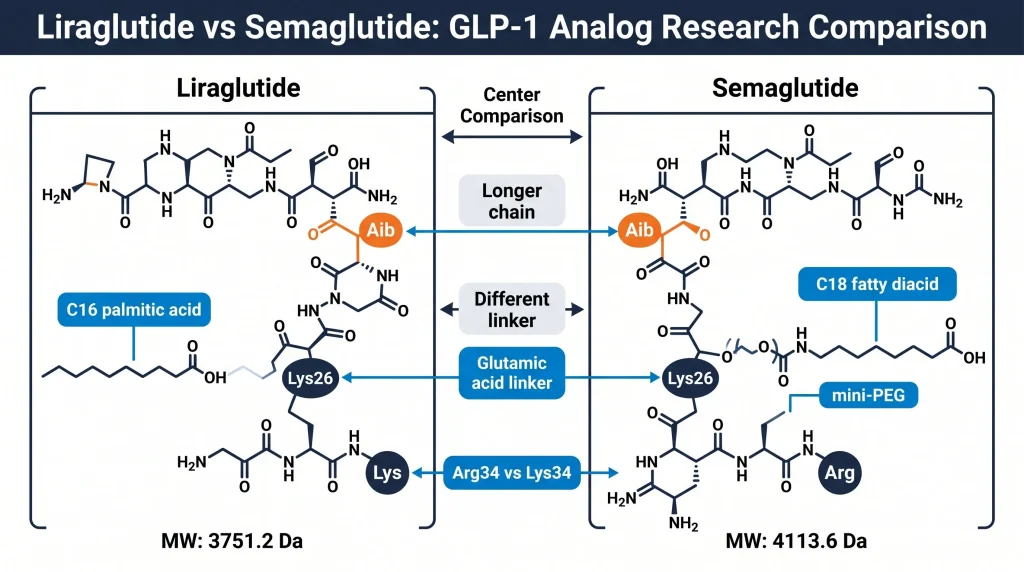
Liraglutide and semaglutide are GLP-1 (glucagon-like peptide-1, a 30-amino-acid incretin hormone) receptor agonist analogs. Both are synthetic modifications of native human GLP-1(7-37). Both have been studied in research for GLP-1R binding and DPP-4 resistance. Both also extend plasma half-life through albumin binding in animal models. According to Knudsen LB & Lau J (2019) (PMID 30891346), liraglutide and semaglutide were designed using successive structural optimization. Semaglutide features a longer fatty acid chain and a polar linker for stronger albumin binding.
Next Level Pharm is a US-based supplier of research-grade peptides. Both liraglutide and semaglutide are available with HPLC purity and mass spectrometry data on every COA. A lot number ships with every order.
Understanding these structural differences helps researchers interpret half-life models, receptor binding assays, and COA documentation.
Researchers studying GLP-1 receptor mechanisms may also find eloralintide relevant — it is a research-grade GIP/GLP-1 co-agonist analog available as a COA-verified, lyophilized research peptide.
Key Takeaways
- Both Are GLP-1(7-37) Analogs with DPP-4 Resistance: Liraglutide and semaglutide share a backbone based on GLP-1(7-37). Both include modifications at position 8 to resist DPP-4 enzymatic cleavage. DPP-4 resistance is a shared design feature of modern long-acting GLP-1 analogs.
- Liraglutide Has a C16 Fatty Acid Chain: Liraglutide has a C16 fatty acid chain (palmitic acid) at position 26 via a glutamic acid linker. This C16 chain has been studied for albumin binding and a plasma half-life of approximately 13 hours in animal models.
- Semaglutide Has a C18 Fatty Diacid Chain: Semaglutide has a C18 fatty diacid chain attached at lysine position 26 via a hydrophilic mini-PEG spacer. The longer chain and spacer have been studied for stronger albumin binding and a plasma half-life of approximately 168 hours in pharmacokinetic models.
- Semaglutide Has an Arg Substitution at Position 34: In liraglutide, position 34 retains lysine (Lys). In semaglutide, position 34 is substituted with arginine (Arg). This substitution blocks fatty acid acylation at position 34 and ensures the C18 chain attaches only at position 26.
- Both Bind GLP-1R in the Subnanomolar Range: In binding assays, both analogs bind GLP-1R with very high affinity. Semaglutide has been reported to have equal or slightly higher potency in some published data.
These structural differences are the focus of comparative pharmacology research. They explain differences in half-life profiles seen in animal model data.
How Do Liraglutide and Semaglutide Differ in Structure?
Liraglutide and semaglutide are both 31-residue peptides based on GLP-1(7-37). Both include an Aib substitution at position 8. This confers DPP-4 resistance. Both carry a fatty acid chain at Lys26 for albumin binding. The key differences are:
In liraglutide, the fatty acid chain is C16 (palmitic acid). It attaches to Lys26 via a single glutamic acid spacer. No substitution is made at position 34. Lys34 remains. The C16 chain has been studied for albumin binding. The studied half-life is about 13 hours in animal models.
In semaglutide, the fatty acid chain is C18 (stearic diacid). It attaches to Lys26 via a three-unit spacer. The spacer has two mini-PEG units and a gamma-glutamate. Position 34 is Arg (not Lys) to prevent off-target acylation. The C18 chain has been studied for stronger albumin binding. The studied half-life is about 168 hours in animal models.
What Is the Molecular Weight of Each Analog?
Liraglutide (free base) has a molecular weight of approximately 3751.2 Da. Semaglutide (free base) has a molecular weight of approximately 4113.6 Da. The difference is approximately 362 Da. This corresponds to the longer C18 diacid chain and linker system in semaglutide.
Both molecular weights are confirmed by mass spectrometry in COA testing. This is a required field on every COA. According to Baggio LL & Drucker DJ (2007) (PMID 17720798), the design of GLP-1 analogs has been guided by half-life modeling. The goal was to extend plasma half-life through albumin binding while maintaining GLP-1R potency. Mass spec COA data confirms each analog is the correct compound. It rules out truncated or substituted variants.
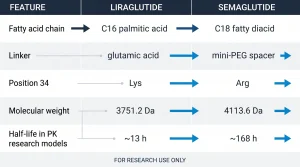
| Feature | Liraglutide | Semaglutide |
| Backbone | GLP-1(7-37) | GLP-1(7-37) |
| Position 8 | Aib | Aib |
| Fatty acid chain | C16 via Glu linker | C18 diacid via mini-PEG |
| Position 26 | Lys + C16 | Lys + C18 diacid |
| Position 34 | Lys | Arg |
| Molecular weight | ~3751.2 Da | ~4113.6 Da |
| Half-life (animal model) | ~13 hours | ~168 hours |
How Does the Fatty Acid Chain Affect Albumin Binding?
Albumin binding is the main mechanism that extends plasma half-life. Human serum albumin (HSA) binds fatty acid chains via hydrophobic pockets. A longer fatty acid chain binds with higher affinity to these pockets.
The C16 chain of liraglutide binds albumin with moderate affinity. The C18 chain of semaglutide binds with higher affinity. Higher albumin affinity reduces the free fraction in plasma. It also slows renal clearance. The relationship between chain length and albumin affinity has been studied in binding assays. This is the structural basis for semaglutide’s longer half-life in animal models compared to liraglutide.
What Is the DPP-4 Resistance Mechanism in Both Analogs?
DPP-4 (dipeptidyl peptidase-4) cleaves the His7-Ala8 bond at the N-terminus of native GLP-1. Both analogs use an Aib substitution at position 8 to resist this cleavage. Aib is alpha-aminoisobutyric acid. It is a non-proteinogenic amino acid with two methyl groups on the alpha carbon. The steric bulk blocks DPP-4 from forming its active site complex with the His7-Aib8 bond. This mechanism has been confirmed in DPP-4 enzymatic inhibition assays.
According to Drucker DJ (2018) (PMID 29866989), DPP-4 resistance is a shared feature of modern long-acting GLP-1 analogs. This includes both liraglutide and semaglutide. The Aib modification at position 8 has been studied as the primary mechanism. It confers resistance to N-terminal DPP-4 cleavage in GLP-1 analog research.
How Does GLP-1R Binding Compare Between the Two Analogs?
Both analogs bind GLP-1R through the same two-domain mechanism. The N-terminal segment (residues 7-10) engages the inner domain (TMD). The C-terminal helix (residues 18-30) binds the outer domain (ECD). This two-step binding activates GLP-1R. It stimulates cAMP production via Gs protein coupling.
Competitive binding assays using radiolabeled GLP-1 have been used to compare liraglutide and semaglutide. Semaglutide has been reported to have equal or slightly higher binding affinity. This is based on some published assay data from cell-based systems. These are in vitro binding data. For research purposes only.
What COA Data Distinguishes Liraglutide From Semaglutide?
The clearest way to distinguish the two analogs in a COA is mass spectrometry MW data. Liraglutide has a MW of approximately 3751.2 Da. Semaglutide has a MW of approximately 4113.6 Da. A difference of approximately 362 Da separates them in the mass spectrum.
A COA with HPLC purity and mass spectrometry data confirms which compound is in the vial. It also confirms the compound meets the purity threshold for research use. Shop research peptides at Next Level Pharm. Both analogs are available with COA documentation. COA includes HPLC purity and mass spec identity on every batch.
Frequently Asked Questions
What Is Liraglutide’s Molecular Weight?
Liraglutide (free base) has a molecular weight of approximately 3751.2 Da. This is confirmed by mass spectrometry in COA testing. It is smaller than semaglutide (approximately 4113.6 Da). It has a C16 chain instead of a C18 diacid chain. It also uses a simpler glutamic acid linker. Mass spec can distinguish all three: liraglutide, semaglutide, and native GLP-1(7-37) at approximately 3297 Da.
What Is the Half-Life of Liraglutide vs. Semaglutide in Research Models?
In animal models, liraglutide has been studied with a plasma half-life of approximately 13 hours. Semaglutide has been studied with a plasma half-life of approximately 168 hours. The longer half-life of semaglutide is due to stronger albumin binding via the C18 diacid chain and mini-PEG spacer. These are research data from animal models and in vitro albumin binding assays. For research purposes only.
What Is the Role of the Mini-PEG Spacer in Semaglutide?
The mini-PEG spacer in semaglutide is a short polar chain (two PEG units). It connects the C18 fatty diacid to the gamma-glutamate and then to Lys26. The spacer has been studied for keeping the C18 chain in solution. It also reduces peptide aggregation. The spacer positions the C18 chain to optimize albumin binding. It minimizes steric interference with GLP-1R binding. Liraglutide does not use a PEG spacer.
What Is the Role of the Arg Substitution at Position 34 in Semaglutide?
In semaglutide, position 34 is arginine instead of lysine. This blocks fatty acid acylation at position 34. Without this substitution, the C18 diacid linker could attach to Lys26 or Lys34. This would create a mixture of two acylation isomers. The Arg34 substitution ensures the C18 chain attaches only at Lys26. Liraglutide retains Lys34. Its C16 chain chemistry has lower non-selective acylation risk.
What Is the Glutamic Acid Linker in Liraglutide?
Liraglutide uses a single glutamic acid (Glu) spacer. It connects the C16 fatty acid chain to Lys26 on the peptide backbone. The Glu spacer adds charge at physiological pH. This helps keep liraglutide in solution and reduces aggregation. The chain is: Lys26 side chain – Glu spacer – C16 palmitic acid. This linker design was the first fatty acid-based approach for GLP-1 analog albumin binding. It was refined in later semaglutide development.
How Do You Confirm Liraglutide Identity by Mass Spectrometry?
Liraglutide identity is confirmed by high-resolution mass spectrometry. The expected molecular ion is approximately 3751.2 Da. In positive-ion mode at charge state +4, liraglutide appears at approximately m/z 938.8. This accounts for four protons. MS/MS fragmentation can confirm the sequence. It generates b and y ions for the GLP-1 backbone residues. A COA with MS1 data confirms identity. MS/MS data also confirms the amino acid sequence.
Are Liraglutide and Semaglutide Stable in the Same Storage Conditions?
Both analogs in lyophilized form are stable at room temperature for shipping. Long-term storage requires minus 20 degrees Celsius. Solutions for assay use are stored at 4 degrees Celsius. Both compounds include a tryptophan residue that is sensitive to oxidation. Oxidation adds 16 Da to the molecular weight. COA mass spec data can detect Trp oxidation as a shoulder peak or mass shift.
What Research Assays Use Liraglutide and Semaglutide as Reference Compounds?
Liraglutide and semaglutide are used as reference compounds in GLP-1R binding assays and cAMP stimulation assays. They are also used in half-life studies in animal models. These studies look at albumin binding and DPP-4 resistance. Comparative binding assays use radiolabeled GLP-1 or fluorescent probes. These measure displacement by liraglutide or semaglutide at different concentrations. All uses are for laboratory research purposes only.
What HPLC Purity Level Is Expected for Research-Grade Liraglutide and Semaglutide?
Research-grade liraglutide and semaglutide are expected to have purity of at least 99.0% by HPLC. The supplier average across 100 batches is 99.4%. The HPLC purity result appears on the COA for each lot. A purity below 99% increases the risk of false signals in sensitive assays. Always record the lot number and purity result in protocol files.
Can Liraglutide and Semaglutide Be Distinguished by HPLC Alone?
In some cases, yes. Liraglutide and semaglutide have different molecular weights. They also differ in hydrophobicity due to their fatty acid chains. In reverse-phase HPLC, semaglutide typically elutes later than liraglutide. This is due to its longer and more hydrophobic C18 chain. However, mass spectrometry is the definitive tool for distinguishing the two. HPLC retention time alone is not sufficient for identity confirmation.
Summary
Liraglutide and semaglutide are both GLP-1 receptor agonist analogs. Both have DPP-4 resistance at position 8. Both have fatty acid chains for albumin binding. Liraglutide has a C16 chain via a glutamic acid linker. Its studied plasma half-life is approximately 13 hours in animal models. Semaglutide has a C18 diacid chain via a mini-PEG spacer. Its studied plasma half-life is approximately 168 hours in animal models.
The molecular weights are 3751.2 Da (liraglutide) and 4113.6 Da (semaglutide). Mass spec COA data distinguishes the two compounds. Both bind GLP-1R with very high affinity in receptor binding assays.
What Should You Do Next?
When sourcing liraglutide or semaglutide, request a COA with HPLC purity and mass spec MW. The target is 3751.2 Da for liraglutide and 4113.6 Da for semaglutide. The lot number must match the vial. Record the lot number in protocol files. For comparison research, request COA data for both compounds from the same supplier. Verify purity before use.
Shop research peptides. Research-grade liraglutide and semaglutide are available at Next Level Pharm with full COA documentation on every batch.
People Also Read
- Liraglutide Research: GLP-1 Analog Mechanism and Studies
- GLP-1 Research Peptides: Receptor Mechanism Studies
About the Author
Next Level Pharm Research Team
Alex M covers peer-reviewed findings in peptide science for Next Level Pharm, a US-based supplier of research-grade peptides verified to ≥99% purity via HPLC and mass spectrometry on every batch.
Disclaimer: The information provided on this page is for educational and research purposes only. Next Level Pharm products are intended for laboratory research use only. They are not intended for human consumption, diagnostic, therapeutic, or medicinal purposes. This content does not constitute medical advice. Always consult a licensed healthcare professional before making any health-related decisions.