
GLP-1 Research Peptides: Receptor Mechanism Studies

Last updated: June 2026
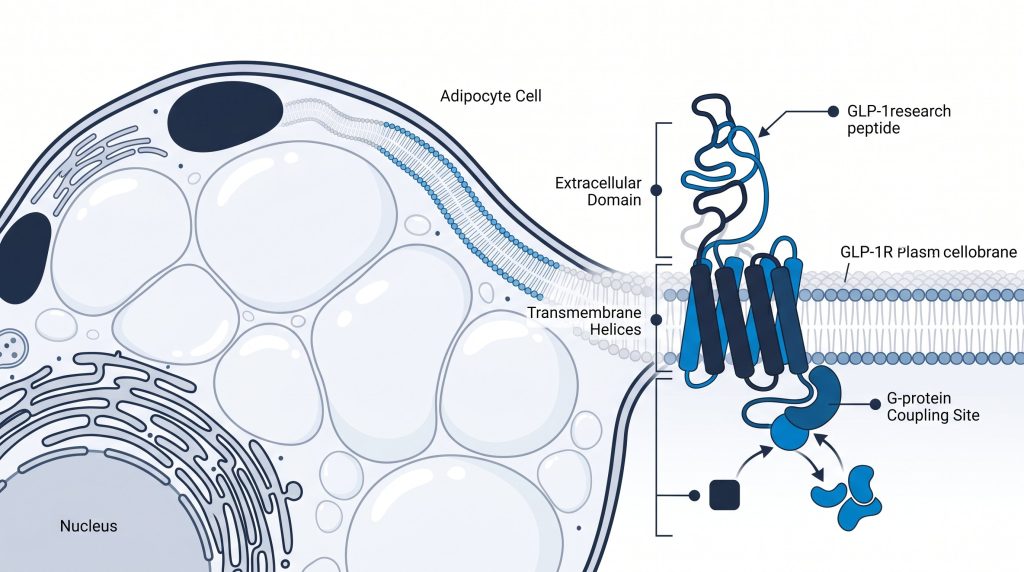
A GLP-1 research peptide is a synthetic compound that binds the glucagon-like peptide-1 receptor (GLP-1R). GLP-1R is a class B G-protein-coupled receptor found in pancreatic beta cells, the brain, and the gut. Lab teams study these peptides to understand receptor signaling and downstream cAMP pathways. Semaglutide, tirzepatide, and retatrutide are three compounds that have been studied for GLP-1R engagement in preclinical and clinical research settings.
Next Level Pharm is a US-based supplier of research-grade GLP-1 research peptides, verified to ≥99.4% purity by HPLC. Mass spectrometry on every batch. Each lot ships with a COA. A lot number for full traceability.
Researchers studying GLP-1 receptor mechanisms may also find eloralintide relevant — it is a research-grade GIP/GLP-1 co-agonist analog available as a COA-verified, lyophilized research peptide.
Key Takeaways
- GLP-1R is a class B GPCR. GLP-1 research peptides bind this receptor. Binding activates adenylyl cyclase and raises intracellular cAMP.
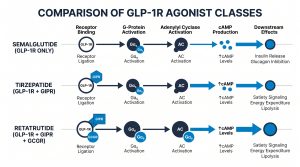
- Three studied agonist classes. Semaglutide targets GLP-1R alone. Tirzepatide is a dual GIP and GLP-1R agonist. Retatrutide has been studied as a triple agonist.
- Passive research framing required. Each compound has been studied in preclinical models. No outcome claims for human use are made in this catalog.
- COA-verified lots: Next Level Pharm ships lyophilized GLP-1 research peptides lots with HPLC. Mass spec data on every batch. Each lot has a traceable number.
- Research use only: All GLP-1 research peptides in this catalog is for laboratory research use only. No clinical outcomes are claimed.
What Is the GLP-1 Receptor and How Does It Work?
The GLP-1 receptor is a class B GPCR. It activates cAMP signaling when a peptide agonist binds.
According to Nauck and D’Alessio (2017), GLP-1R belongs to the secretin receptor family. This family couples to Gs proteins on binding. Gs activation stimulates adenylyl cyclase, which raises intracellular cAMP. Elevated cAMP then activates protein kinase A (PKA). PKA phosphorylates downstream targets in beta-cell research models. The extracellular domain (ECD) of GLP-1R anchors the N-terminus of agonist peptides. The transmembrane core then locks the bound conformation. Structural studies have used cryo-EM to map this two-step binding mechanism. These data help researchers design stable, long-acting agonist analogs for lab use.
What Is Semaglutide and How Has It Been Studied?
Semaglutide is a fatty-acid-conjugated GLP-1 analog. It has been studied for GLP-1R binding affinity in preclinical models.
According to Drucker (2018), semaglutide carries a C18 fatty-diacid chain. This chain links to lysine at position 26 via a hydrophilic linker. The modification extends plasma half-life in animal models to roughly seven days. Researchers use this property to study sustained GLP-1R occupancy. Semaglutide has been studied for its receptor-binding kinetics in vitro. Studies report high GLP-1R selectivity compared with earlier native GLP-1 analogs. Lab teams track binding by measuring cAMP accumulation in transfected cell lines. No outcome claims for human health are made in this research overview. All semaglutide lots from this catalog are for laboratory research only.
How Does Tirzepatide Differ From Single GLP-1R Agonists?
Tirzepatide is a dual GIP and GLP-1 receptor agonist. It has been studied for combined receptor activity in clinical research.
According to Frias et al. (2021), tirzepatide binds both GIPR and GLP-1R. The dual binding profile has been studied in phase 3 clinical trials. Research teams measure GIPR. GLP-1R activation separately using receptor assays. The GIP receptor (GIPR) is also a class B GPCR. It shares structural features with GLP-1R but has a distinct ECD shape. Tirzepatide has been studied for its cAMP response at each receptor subtype. Lab data show that the GIP arm drives a unique signaling profile. This profile differs from pure GLP-1R agonists in downstream PKA activation. The table below summarizes key receptor targets for three studied compounds.
| Agonist Class | ||
| Semaglutide | GLP-1R | Mono-agonist |
| Tirzepatide | GLP-1R, GIPR | Dual agonist |
| Retatrutide | GLP-1R, GIPR, GCGR | Triple agonist |
All compounds listed are for laboratory research use only.
What Is Retatrutide and What Receptors Has It Targeted?
Retatrutide has been studied as a triple agonist. It targets GLP-1R, GIPR. The glucagon receptor (GCGR).
GCGR is a class B GPCR that regulates hepatic glucose production in animal models. Retatrutide has been studied for simultaneous engagement of all three receptors. Research teams measure each receptor’s cAMP output when retatrutide is added. Phase 1 data published in peer-reviewed journals describe receptor occupancy profiles. The triple-agonist design is under active study for its distinct signaling pattern. Lab researchers use radioligand binding assays to rank affinities across receptors. GLP-1R affinity for retatrutide has been reported as sub-nanomolar in cell assays. GIPR and GCGR affinities differ, creating a tiered receptor engagement profile. These assay data are reported in the primary research literature for reference.
How Do Researchers Measure GLP-1R Binding in the Lab?
Researchers use cAMP assays and radioligand competition assays. Both methods measure GLP-1R binding in transfected cell lines.
The HTRF cAMP assay is a common tool for GLP-1R research. It detects cAMP produced when a test compound activates GLP-1R. Radioligand binding assays use labeled native GLP-1 as a reference. A test peptide competes with the labeled ligand for the receptor site. The IC50 value indicates binding strength at a given receptor concentration. Flow cytometry can also track GLP-1R internalization after agonist exposure. Western blot analysis measures PKA substrate phosphorylation downstream of cAMP. These methods require a high-purity, COA-verified peptide lot as the starting material. Lot purity below 99% can skew cAMP. Binding data in cell-based assays. Research teams should confirm purity by HPLC before running receptor studies
What Research Tools Support GLP-1 Peptide Research?
GLP-1R studies require a COA-verified peptide lot. HTRF cAMP kits and radioligand assay reagents are standard lab tools.
Research teams need a verified GLP-1 research peptides lot to run any study. The lot must match the published reference standard for molecular weight and purity. Next Level Pharm verifies each GLP-1 research peptides lot by HPLC. Mass spectrometry before shipping. HTRF cAMP assay kits compatible with GLP-1R studies are available from major reagent suppliers. Radioligand kits use iodinated or tritiated GLP-1 as the reference ligand. Both assay types require a stable, lyophilized peptide lot with confirmed mass spec data. View the GLP-1 research peptides product page for lot-specific COA and mass spec data.
Frequently Asked Questions
What does GLP-1R stand for in peptide research?
GLP-1R stands for glucagon-like peptide-1 receptor. It is a class B G-protein-coupled receptor (GPCR). The receptor is expressed in pancreatic beta cells, the brain stem, and the gut wall. Lab researchers study GLP-1R because it links peptide binding to downstream cAMP signaling. This signaling cascade is a target of interest in metabolic and neuroendocrine research.
Is semaglutide the same as native GLP-1?
No, semaglutide is not the same as native GLP-1. Native GLP-1 has a plasma half-life of roughly two minutes in animal models. Semaglutide carries a fatty-acid linker at lysine 26. This linker extends half-life to approximately seven days in animal studies. The structural change has been studied for its effect on GLP-1R binding affinity. Sustained receptor occupancy in preclinical models.
What receptors does tirzepatide bind in research models?
Tirzepatide has been studied for binding at two receptors: GLP-1R and GIPR. GIPR stands for glucose-dependent insulinotropic polypeptide receptor. Both receptors belong to the class B GPCR family. Research assays measure cAMP output at each receptor separately. The dual binding profile has been studied in phase 3 clinical trials published in peer-reviewed literature, including PMID 34408604 by Frias et al. (2021).
What makes retatrutide a triple agonist in research?
Retatrutide has been studied for activity at three receptors. GLP-1R, GIPR, and GCGR. GCGR stands for glucagon receptor. Each receptor is a class B GPCR with a distinct extracellular domain. Researchers measure retatrutide’s cAMP response at each receptor using separate cell lines. The triple-agonist profile creates a layered signaling pattern that differs from mono-. Dual-agonist compounds in lab assays.
How is cAMP used to measure GLP-1R activity?
cAMP, or cyclic adenosine monophosphate, is produced when GLP-1R couples to Gs protein. Gs protein activates adenylyl cyclase. This converts ATP to cAMP. Lab teams measure cAMP using the HTRF (homogeneous time-resolved fluorescence) assay. Higher cAMP levels indicate stronger GLP-1R agonist activity. The assay is run in transfected HEK293 cells that express human GLP-1R. Results are expressed as EC50 values in nanomolar concentration units.
What purity is needed for GLP-1 receptor binding assays?
Most published GLP-1R binding protocols require peptide purity of at least 95%. Higher purity reduces background interference in cAMP and radioligand assays. A lot at 99% or above is preferred for publication-grade data. Impurities can compete with the test peptide for receptor sites. This leads to artificially low IC50 readings and unreliable potency rankings. HPLC and mass spectrometry data on the lot COA confirm purity before assay setup.
Are GLP-1 research peptides approved for human use?
The GLP-1 research peptides listed in this catalog are not approved for human use. They are supplied for laboratory research only. Researchers must comply with all applicable institutional. Regulatory guidelines when handling these compounds. No health claims, outcome claims, or clinical use claims are made for any lot. All lots are sold with a COA. Lot number for research traceability only.
What is the difference between GLP-1R agonists and GLP-1 itself?
GLP-1 is an endogenous peptide produced in intestinal L-cells after a meal. It has a very short half-life due to rapid DPP-4 enzyme cleavage. GLP-1R agonists are synthetic analogs designed to resist DPP-4 cleavage. Structural modifications such as fatty-acid conjugation or amino acid substitution extend half-life in animal models. Researchers study these analogs to understand sustained receptor occupancy. Downstream signaling compared with native GLP-1.
Summary
GLP-1 research peptides bind the GLP-1 receptor, a class B GPCR that signals through cAMP. Semaglutide, tirzepatide, and retatrutide represent three studied agonist classes. Mono-, dual-, and triple-receptor targeting. Each compound has been studied in preclinical and clinical research settings. No outcome claims for human health are made in this overview.
Lab assays for GLP-1R study include HTRF cAMP accumulation and radioligand binding. Both methods require a high-purity, COA-verified peptide lot. Lot purity at 99% or above is preferred for publication-grade receptor data. HPLC and mass spectrometry on the COA confirm purity before any assay run.
What Should You Do Next?
- Review the lot COA for your GLP-1 research peptide before setting up any receptor assay.
- Confirm HPLC purity data. Mass spec molecular weight match the reference standard.
- Consult published GLP-1R binding protocols on PubMed before designing your cell assay.
- Request PhD research support if your lab requires guidance on assay setup procedures.
- Browse GLP-1 related peptides for related research tools.
- Shop research peptides at https://nextlevelpharm.com/shop/.
People Also Read
- Tirzepatide Research: GIP and GLP-1 Dual Agonist Studies
- Retatrutide Research: Triple Agonist Receptor Studies
About the Author
Next Level Pharm Research Team
Alex M covers peer-reviewed findings in peptide science for Next Level Pharm, a US-based supplier of research-grade peptides verified to ≥99% purity via HPLC and mass spectrometry on every batch.
Disclaimer: The information provided on this page is for educational and research purposes only. Next Level Pharm products are intended for laboratory research use only. They are not intended for human consumption, diagnostic, therapeutic, or medicinal purposes. This content does not constitute medical advice. Always consult a licensed healthcare professional before making any health-related decisions.