
Peptides in Neurogenesis Research: Current Studies

Last updated: July 2026
A peptide neurogenesis research model is a lab system that tests how small protein chains affect new neuron growth. Adult neurogenesis (the birth of new neurons) occurs mainly in the hippocampus of the brain. This process depends on brain-derived growth factor (BDNF) and a healthy mitochondrial energy supply. Peptides like Semax, PE-22-28, and NAD+ are studied for their roles in these pathways. According to PubMed (2011), Semax promotes BDNF output in brain tissue models, making it a key compound in neurogenesis research.
Next Level Pharm stocks research-grade neuropeptides for neurogenesis and BDNF pathway studies. Every vial is HPLC-tested and ships with a certificate of analysis (COA). Average purity across recent batches is 99.4%.
Neurogenesis research gives labs a way to study brain plasticity at the cellular level. BDNF is the main growth factor that drives new neuron growth. Peptides that raise BDNF or support mitochondrial health are key tools in this area. Understanding how each compound acts helps researchers pick the right model for their study.
Key Takeaways
- BDNF Is the Key Driver: Brain-derived growth factor (BDNF) promotes the growth and survival of new neurons. Peptides that raise BDNF output are a primary focus in neurogenesis research.
- Semax and BDNF: Semax is an ACTH(4-10) analog. It is studied for its ability to raise BDNF in brain cell culture models and brain tissue studies.
- PE-22-28 as a BDNF Mimetic: PE-22-28 is a short peptide based on the BDNF loop 4 structure. It binds the TrkB receptor, which is the main BDNF receptor on neurons. Labs use it to probe BDNF pathway effects.
- Selank and Neural Signaling: Selank is a synthetic enkephalin analog. It changes GABA and serotonin signal in the brain. Labs study its role in neural circuit stability and stress-response pathways.
- NAD+ and Mitochondrial Health: NAD+ (nicotinamide adenine dinucleotide) supports mitochondrial energy production. New neurons need high energy output. NAD+ is studied for its role in supporting the energy demands of neurogenesis.
- COA-Verified Supply: All neurogenesis peptides are lyophilized and batch-tested. Lot numbers link to purity records for lab traceability.
These six points define the research landscape covered in the sections below.
What Is Adult Neurogenesis in Lab Research?
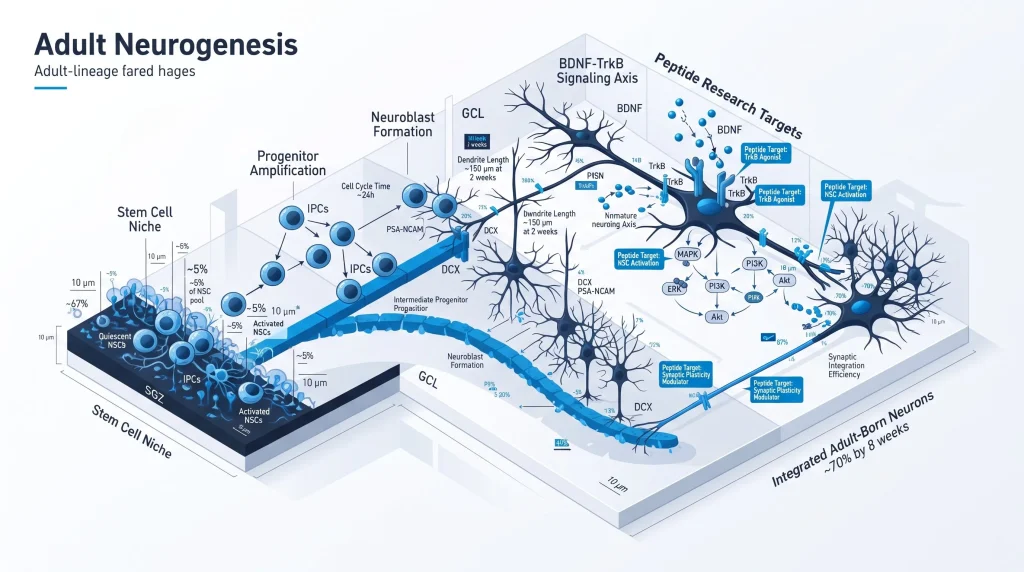
Adult neurogenesis is the process of making new neurons in an adult brain. It is most active in two regions: the hippocampal dentate gyrus and the olfactory bulb. The dentate gyrus is the main study site. New neurons here come from neural stem cells in the brain dentate gyrus. These cells mature, migrate, and link with existing circuits.
BDNF is the main growth factor that supports this process. It binds the TrkB receptor and activates pathways that promote neuron survival, branching, and circuit linking. Labs study the hippocampal dentate gyrus in both cell culture and rodent models. Each model gives different resolutions on how peptides change neuron formation speed, survival, and function.
How Does Semax Support BDNF in Neural Models?
Semax is a synthetic 7-amino-acid peptide based on the ACTH(4-10) sequence. It does not bind ACTH receptors directly. Instead, it acts through growth factor pathways. In brain tissue models, Semax raises the expression of BDNF and its receptor TrkB. Higher BDNF levels support more new neuron growth and better circuit linking in lab models.
Semax also changes serotonin and dopamine signals. These monoamines play a supporting role in neurogenesis by creating a brain environment that favors new cell growth. According to PubMed (2011), Semax raised BDNF mRNA in rat brain tissue. It also enhanced TrkB receptor output. Browse Semax research vials for COA-verified lab supply.
What Is PE-22-28 in BDNF Pathway Research?
PE-22-28 is a short peptide derived from the loop 4 region of BDNF. This region is the part of BDNF that binds the TrkB receptor. PE-22-28 mimics this binding region. By binding TrkB, it starts the TrkB signal without the full BDNF protein. This makes it a useful tool for studying downstream BDNF effects in isolation.
TrkB action triggers PI3K-Akt and MAPK-ERK inside neurons. PI3K-Akt promotes neuron survival. MAPK-ERK promotes cell growth and plasticity. Labs use PE-22-28 to study these downstream signals separately from upstream BDNF gene output. According to PubMed (2017), PE-22-28 activates the TrkB signal in brain cell culture models. Browse PE-22-28 research vials for batch-tested supply.
What Is the Role of Selank in Neural Research?
Selank is a synthetic hexapeptide (TKPRPG) related to the natural peptide tuftsin. It changes GABA-A receptor action and serotonin turnover in neural cell models. GABA is the main blocking signal in the brain. Proper GABA balance is needed for stable neural circuit function. Selank is studied for how it changes GABA-A receptor subunit expression in brain tissue.
Selank also raises brain enkephalin levels. Enkephalins are short opioid peptides that modulate pain and mood circuits. They also interact with neural circuits in the hippocampus. Labs study Selank in anxiety and stress-response models alongside neurogenesis assays. Browse Selank research vials for COA-verified, lyophilized supply.
Why Is NAD+ Studied in Neurogenesis Research?
NAD+ is nicotinamide adenine dinucleotide, a coenzyme in every cell. It is central to mitochondrial energy output. New neurons need lots of energy to grow and connect. Without strong energy output, new neuron survival drops. NAD+ is studied for its role in fueling neural stem cell division and new neuron growth.
NAD+ also switches on SIRT1, a protein deacetylase. SIRT1 promotes the survival of new neurons and supports axon growth. It also influences BDNF gene output. Labs use NAD+ in combined designs with BDNF-targeting peptides to study how mitochondrial support and growth factor signals interact in neurogenesis models. Browse NAD+ research vials for COA-verified supply.
How Do Neurogenesis Peptides Compare?
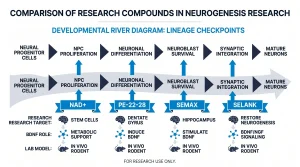
Labs choose neurogenesis peptides based on which pathway they want to probe. BDNF-targeting compounds differ from energy-support compounds in how they act.
| Peptide | Primary Target | Mechanism | Main Research Model |
| Semax | BDNF output | Raises BDNF and TrkB mRNA | Hippocampal cell culture, brain tissue |
| PE-22-28 | TrkB receptor | Direct TrkB binding and activation | Hippocampal neurons, stress-response models |
| Selank | GABA/serotonin | GABA-A change, enkephalin rise | Neural circuit, anxiety assays |
| NAD+ | Mitochondria | SIRT1 action, energy support | Neural stem cell, energy metabolism models |
Combining Semax with NAD+ lets labs study BDNF output and energy support together. This gives a fuller view of how neurogenesis is driven in lab models.
Frequently Asked Questions
What is peptide neurogenesis research?
Peptide neurogenesis research uses lab models to study how small protein chains affect new neuron growth in the adult brain. Researchers track peptide effects on BDNF output, TrkB receptor action, neural stem cell division, and mitochondrial energy supply. Common models include hippocampal cell cultures and rodent brain tissue studies. Semax, PE-22-28, Selank, and NAD+ are among the most studied compounds. All research is for lab use only.
What is BDNF and why is it important in neurogenesis?
BDNF is a brain-derived growth factor. It is the main growth factor that drives new neuron growth in the adult hippocampus. BDNF binds the TrkB receptor and activates PI3K-Akt and MAPK-ERK pathways inside neurons. These pathways promote neuron survival, branching, and circuit linking. According to PubMed (2011), raising BDNF levels in brain tissue models supports more new neuron growth and better circuit linking in lab settings.
How does Semax affect BDNF in neural models?
Semax is a synthetic peptide based on the ACTH(4-10) sequence. It raises BDNF and TrkB receptor output in hippocampal cell culture and brain tissue models. Higher BDNF supports more new neuron growth in these systems. Semax also changes serotonin and dopamine signals, which play a supporting role in creating a brain environment that favors new cell growth. Labs use it as a BDNF-upregulating tool in neurogenesis study designs.
What is PE-22-28 and how does it target TrkB?
PE-22-28 is a short peptide derived from loop 4 of the BDNF protein. This loop is the BDNF region that binds the TrkB receptor. PE-22-28 mimics this region and can bind TrkB directly without the full BDNF protein. When TrkB is bound, it starts PI3K-Akt and MAPK-ERK signals inside neurons. These promote neuron survival and growth. According to PubMed (2017), PE-22-28 activates the TrkB signal in brain cell culture models.
What is Selank and how is it studied in neural research?
Selank is a synthetic hexapeptide (TKPRPG) related to the natural peptide tuftsin. It changes GABA-A receptor subunit expression and raises brain enkephalin levels. GABA is the main blocking signal in the brain. Selank is studied for how it changes GABA circuit stability and stress-response patterns in neural models. Labs also test its role in anxiety models where GABA balance and serotonin breakdown are key variables.
Why is NAD+ included in neurogenesis research?
NAD+ is a coenzyme central to mitochondrial energy production. New neurons need large amounts of energy to grow and connect with existing circuits. Without strong mitochondrial function, new neuron survival drops in lab models. NAD+ switches on SIRT1, which promotes new neuron survival and supports axon growth. It also influences BDNF gene output. Labs use NAD+ in combined designs with BDNF-targeting peptides to study how energy support and growth signals interact.
What is the TrkB receptor and why do neurogenesis labs target it?
TrkB is the main receptor for BDNF on neurons. When BDNF or a mimetic like PE-22-28 binds TrkB, the receptor activates PI3K-Akt and MAPK-ERK. PI3K-Akt promotes cell survival. MAPK-ERK promotes cell growth and branching. These pathways are central to how new neurons mature and connect with circuits. Targeting TrkB directly, as PE-22-28 does, lets labs study downstream BDNF effects without relying on upstream gene output changes.
How are hippocampal cell culture models used in neurogenesis research?
Hippocampal cell culture models grow neural stem cells or neurons from the dentate gyrus of the hippocampus. Researchers apply peptides and measure BDNF output, TrkB action, and new neuron growth. These cultures allow precise control of peptide concentration and timing. They also allow direct imaging of new neuron branching and circuit connection. Labs use brain cell cultures as a first-step screen before moving to whole-brain rodent models.
Can Semax and PE-22-28 be studied together in one model?
Yes, combining Semax and PE-22-28 in one study covers both upstream BDNF output (Semax) and direct TrkB action (PE-22-28). This dual approach allows researchers to compare how raising BDNF gene output differs from directly activating the receptor. The two peptides target different points in the same pathway. Multi-compound designs give more complete data on how BDNF signal drives neurogenesis from start to finish in brain lab models.
What role does SIRT1 play in neurogenesis?
SIRT1 is a protein enzyme activated by NAD+. It modifies histones to change gene output patterns in neurons. In neurogenesis research, SIRT1 is studied for its role in promoting the survival of new neurons and supporting axon growth. SIRT1 also affects BDNF gene output at the gene control level. Labs measure SIRT1 activity as a proxy for NAD+-driven energy health in neural stem cell and new neuron models.
Summary
Neurogenesis peptide research studies how compounds affect new neuron growth in the adult brain. Semax raises BDNF and TrkB levels in hippocampal models. PE-22-28 binds TrkB directly to activate downstream survival signals. Selank changes GABA balance and enkephalin output in neural circuit models. NAD+ supports mitochondrial energy and SIRT1 activity in neural stem cell assays.
Each compound targets a different point in the neurogenesis pathway. Labs often combine BDNF-targeting peptides with mitochondrial support compounds to study the full range of signals that drive new neuron survival.
What Should You Do Next?
Researchers should define whether the model targets BDNF, TrkB, GABA, or mitochondrial signaling. Select the peptide and controls that isolate the chosen pathway. Review the COA and record purity, molecular identity, and the lot number before each run. Researchers sourcing these lab peptides can browse Next Level Pharm for full COA and lot traceability.
People Also Read
- Semax Research Peptide: BDNF and Neuropeptide Studies
- Selank Research Peptide: GABAergic Modulation for Labs
About the Author
Next Level Pharm Research Team
Alex M covers peer-reviewed findings in peptide science for Next Level Pharm, a US-based supplier of research-grade peptides verified to ≥99% purity via HPLC and mass spectrometry on every batch.
Disclaimer: For research purposes only. Not intended for human consumption. Next Level Pharm products are not intended for diagnostic, therapeutic, or medicinal use. This content does not constitute medical advice. Always consult a licensed healthcare professional before making any health-related decisions.