
Kidney Bioregulator Research: Nephron Peptide Studies

Last updated: July 2026
A kidney bioregulator is a short peptide studied for effects on kidney cell gene activity. The kidney is made up of functional units called nephrons. Each nephron filters blood and adjusts fluid and salt levels. Short peptides are studied for how they affect gene markers in nephron cells, including tubular cells and glomerular cells. According to Luger et al. (2007) (PMID 17934097), KPV reduced inflammatory gene markers in intestinal and kidney cell models. All cited data come from cell and animal studies.
Next Level Pharm is a US-based supplier of research-grade peptides. KPV, BPC-157, ARA-290, and SS-31 are available as COA-verified research compounds. Each lot is tested to ≥99% purity by HPLC and mass spec. The average purity across the last 100 batches is 99.4%.
Kidney research peptides are not approved drugs. They are studied only in cell and animal models. All findings cited here come from such models.
Key Takeaways
- The Nephron Is the Kidney’s Functional Unit: Each kidney has about one million nephrons. Each nephron filters blood and adjusts salt and fluid levels through a set of specialized cells.
- KPV Is an Anti-Inflammatory Tripeptide: KPV (Lys-Pro-Val) is a 3-amino acid peptide derived from alpha-MSH. It is studied for anti-inflammatory effects in tubular cell models.
- BPC-157 Is Studied for Kidney Cell Gene Markers: BPC-157 is a 15-amino acid peptide. It has been studied for effects on inflammatory markers in kidney cell models.
- ARA-290 Targets EPO Receptors in Kidney Cells: ARA-290 is derived from erythropoietin (EPO). It binds to the EPO receptor found on kidney tubular cells in cell models.
- SS-31 Targets Mitochondria in Tubular Cells: SS-31 targets the inner mitochondrial membrane. Tubular cells have high energy needs and are studied for mitochondrial peptide effects.
Researchers use these peptides to study how short amino acid chains affect gene activity in kidney cell models. The results guide further nephron biology research.
What Are Kidney Bioregulators?
A kidney bioregulator is a peptide studied for effects on nephron and tubular cell gene activity. These compounds are tested in cell assays and animal models. They are not approved drugs and are not for human use.
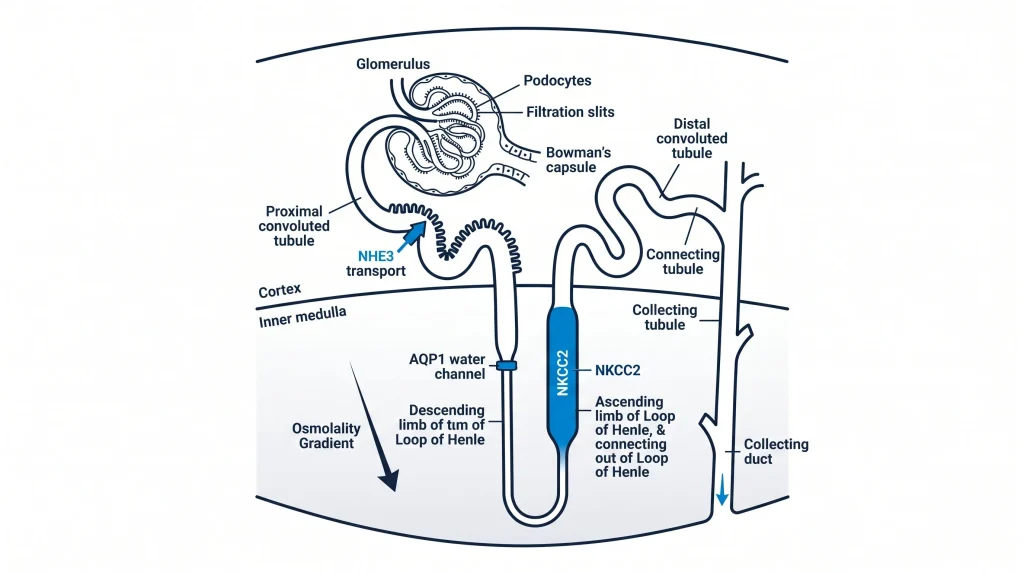
The nephron has several parts. The glomerulus (a tiny filter) removes waste from blood. The tubule adjusts what gets kept and what gets excreted. Tubular cells have very high energy needs. They use many mitochondria to run active transport of salts and water.
Kidney cell models include proximal tubular cell lines, such as HK-2 cells. These cells are grown in lab dishes. Researchers expose them to test peptides and then measure gene expression markers. Key markers include NF-kB (a gene switch for inflammation) and Bcl-2 (a cell survival gene).
What Is KPV and How Is It Studied?
KPV is a tripeptide. Its sequence is Lys-Pro-Val. These three amino acids come from the C-terminal region of alpha-MSH (alpha-melanocyte stimulating hormone). KPV is studied for its anti-inflammatory effects in cell models.
In cell assays, KPV has been shown to reduce NF-kB activity. NF-kB is a transcription factor. When active, it turns on genes that make inflammatory proteins. Less NF-kB activity means fewer inflammatory proteins. This is measured by gene expression assays.
KPV is studied in kidney tubular cells and intestinal cells. In tubular cell models, KPV exposure changed inflammatory gene markers. In intestinal models, it changed tight junction proteins that control cell barrier function.
KPV is available at Next Level Pharm as a COA-verified research compound. Every lot is tested by HPLC and mass spec to ≥99% purity. Each vial ships with a COA and lot number.
What Is BPC-157’s Role in Kidney Research?
BPC-157 is a 15-amino acid peptide. It is derived from a region of gastric juice protein. In cell and animal models, it has been studied for effects on inflammatory markers in multiple tissue types, including kidney cells.
In kidney research, BPC-157 is studied for changes in oxidative stress and inflammation markers in tubular cells. Oxidative stress is the buildup of reactive oxygen molecules in cells. High oxidative stress damages cell membranes and DNA.
According to Seiwerth et al. (2018) (PMID 29998800), BPC-157 reduced inflammatory markers in gastrointestinal and organ cell models. Kidney cell markers were also tracked in some models. All data came from in vitro assays and animal models.
What Is ARA-290 and How Does It Work?
ARA-290 is an 11-amino acid peptide. It is derived from erythropoietin (EPO), the kidney protein that signals for red blood cell production. ARA-290 keeps the part of EPO that binds to its receptor but removes the part that stimulates red blood cell production.
The EPO receptor (EPOR) is found on kidney tubular cells, nerve cells, and immune cells in animal models. ARA-290 binds to EPOR and activates a protective signaling pathway inside the cell. This pathway is called the innate repair receptor (IRR) pathway.
According to Brines et al. (2008) (PMID 18676614), EPO-derived peptides such as ARA-290 activated tissue-protective signaling through EPOR in cell models without stimulating red blood cell production. These are cell and animal model findings only.
What Is SS-31 and How Is It Studied?
SS-31 (Szeto-Schiller 31) is a 4-amino acid peptide. It targets the inner membrane of mitochondria. Kidney tubular cells use a large amount of energy. Each tubular cell has hundreds of mitochondria. These organelles power the active transport of salt and water across the tubule wall.
In tubular cell models, SS-31 is studied for effects on mitochondrial function and oxidative stress. It binds to cardiolipin, a lipid in the inner membrane that holds the energy-making proteins in place.
According to Szeto et al. (2011) (PMID 21546574), SS-31 reduced oxidative stress markers in kidney tubular cell models under ischemic conditions. ATP production also improved in treated cells. These are in vitro and animal model findings only.
SS-31 is available as a COA-verified research compound. Every lot is tested to ≥99% purity. Each vial ships with a COA and lot number.
How Do Kidney Peptides Differ From Approved Renal Drugs?
Approved renal drugs have completed human clinical trials. They have known safety profiles. Examples include ACE inhibitors and ARBs (angiotensin receptor blockers). These drugs lower blood pressure in the kidney’s filtration system.
Research peptides have not completed human clinical trials. They are studied in cell and animal models only. They target different steps in kidney biology. KPV targets NF-kB inflammation. ARA-290 targets EPOR survival signaling. SS-31 targets mitochondria in tubular cells.
Each mechanism is tracked with different lab assays. NF-kB assays use reporter gene kits. EPOR assays measure downstream signaling proteins. Mitochondrial assays track ATP and cardiolipin levels.
| Feature | Approved Renal Drug | Kidney Research Peptide |
| Clinical status | FDA-approved | Research-stage (cell/animal models only) |
| Study model | Human clinical trials | Cell assay, animal model |
| Key target | Blood pressure / filtration | Gene expression or mitochondria |
| Purity standard | Pharmaceutical-grade | ≥99% HPLC + mass spec |
| Availability | Prescription pharmacy | Research compound supplier |
| Application | Clinical care | Lab research only |
Frequently Asked Questions
What Are Kidney Bioregulators?
Kidney bioregulators are short peptides studied in cell and animal models for effects on nephron and tubular cell gene activity. Key examples include KPV (anti-inflammatory, NF-kB pathway), BPC-157 (oxidative stress markers), ARA-290 (EPO receptor signaling), and SS-31 (mitochondrial lipid pathway). Each targets a distinct step in kidney cell biology. All data come from cell and animal studies. These compounds are for lab research use only.
What Is KPV?
KPV (Lys-Pro-Val) is a 3-amino acid tripeptide. It comes from the C-terminal region of alpha-MSH. In cell models, it reduces NF-kB gene activity, which lowers inflammatory protein production. Scientists study it in kidney tubular cells and intestinal cells. In tubular cell models, KPV exposure changed inflammatory gene markers. Next Level Pharm supplies KPV at ≥99% purity for lab research. Each vial ships with a COA and lot number. For lab research use only.
What Is a Nephron?
A nephron is the functional unit of the kidney. Each kidney has about one million nephrons. Each nephron has a glomerulus and a tubule. The glomerulus filters blood to remove waste. The tubule then adjusts which substances get reabsorbed and which get excreted. Tubular cells line the tubule and do the active transport work. Short peptides are studied for how they change gene activity in these tubular cells.
How Is BPC-157 Studied in Kidney Research?
BPC-157 is studied in kidney tubular cell assays for effects on inflammatory and oxidative stress markers. Scientists measure NF-kB activity, reactive oxygen species levels, and cell survival markers after BPC-157 exposure. In some animal models, kidney tissue markers were also tracked after injury. Results from treated groups were compared to control groups. All data come from cell and animal studies. BPC-157 is for lab research use only.
What Is ARA-290?
ARA-290 is an 11-amino acid peptide derived from erythropoietin (EPO). It binds to the EPO receptor (EPOR) on kidney tubular cells, nerve cells, and immune cells in animal models. EPO is the protein that signals for red blood cell production. ARA-290 keeps the receptor-binding region of EPO but removes the blood cell stimulation region. In cell models, ARA-290 activated cell-protective signaling through EPOR. All data come from in vitro and animal studies.
How Do Kidney Tubular Cells Use Mitochondria?
Kidney tubular cells use active transport to move salt, water, and nutrients across the tubule wall. This transport needs energy in the form of ATP. Tubular cells have hundreds of mitochondria per cell to meet this energy demand. Mitochondrial dysfunction reduces ATP and weakens active transport. SS-31 and other mitochondrial peptides are studied for effects on tubular cell energy output. All data come from cell models.
What Is Cardiolipin?
Cardiolipin is a lipid found in the inner membrane of mitochondria. It holds the energy-making proteins in place so they can produce ATP efficiently. When cardiolipin breaks down, energy output drops and cell damage can occur. SS-31 is studied for effects on cardiolipin integrity in kidney tubular cells. Improved cardiolipin markers are tracked as a study outcome in cell assays. All data come from in vitro models.
Are These Compounds Synthetic?
Yes. Research-grade KPV (3 amino acids), ARA-290 (11 amino acids), and SS-31 (4 amino acids) are lab-synthesized. BPC-157 (15 amino acids) is also synthetic. Synthesis ensures exact sequences and consistent purity. It also removes the risk of contamination from biological sources. Research-grade compounds must meet ≥99% HPLC purity standards. Mass spec confirms the molecular weight for every batch.
How Are These Compounds Verified for Research Use?
Research-grade kidney peptides are tested by HPLC and mass spec per batch. HPLC confirms ≥99% purity for the target compound peak. Mass spec confirms molecular weight matches the expected amino acid sequence. A COA with lot number is provided per batch. All compounds are for lab research use only and are not for clinical or personal use of any kind.
What Cell Models Are Used in Kidney Research?
Common cell models include HK-2 cells (human kidney-2 proximal tubular cells) and MDCK cells (Madin-Darby canine kidney cells). HK-2 cells are widely used for kidney gene expression studies. MDCK cells are used for transport and barrier function research. Animal models include rat and mouse kidney injury models. Gene expression kits, ELISA assays, and ATP assays track the effects of test compounds. All cited data in this article come from these cell and animal model sources.
Summary
Kidney bioregulators are short peptides studied in cell and animal models for effects on nephron and tubular cell gene activity. Key compounds include KPV (anti-inflammatory, NF-kB pathway), BPC-157 (inflammatory markers), ARA-290 (EPO receptor), and SS-31 (mitochondrial cardiolipin).
Tubular cells have high energy demands and are a key research target for mitochondrial peptides. Anti-inflammatory peptides are studied for effects on NF-kB and oxidative stress. All cited findings come from cell and animal research. These compounds are for lab research use only.
What Should You Do Next?
Researchers studying kidney and tubular cell biology should source verified compounds for lab protocols. Before any study, confirm HPLC purity is ≥99% and mass spec matches the expected molecular weight. Record the lot number from the COA for batch traceability.
Shop research peptides. KPV, BPC-157, ARA-290, and SS-31 are available with HPLC and mass spec data on every COA.
People Also Read
- KPV Peptide Research: Anti-Inflammatory Pathways and Intestinal Studies
- Anti-Inflammatory Peptide Research: BPC-157, KPV, ARA-290
About the Author
Next Level Pharm Research Team
The Next Level Pharm research team is made up of biochemists and lab scientists. Their goal is to give researchers the highest-purity, COA-tested peptide compounds on the market. Every batch is HPLC and mass spec confirmed before dispatch.
Disclaimer: The information provided on this page is for educational and research purposes only. Next Level Pharm products are intended for laboratory research use only. They are not intended for human consumption, diagnostic, therapeutic, or medicinal purposes. This content does not constitute medical advice. Always consult a licensed healthcare professional before making any health-related decisions.