
Neuropeptide Y Research: NPY Receptor Mechanism

Last Updated: October 2026
A neuropeptide Y NPY receptor research study is an investigation of how this 36-amino-acid neurotransmitter binds G protein-coupled receptor subtypes Y1 through Y5. NPY is one of the most abundant neuropeptides in the central nervous system. It activates Gi-linked intracellular signaling. Research teams use synthetic NPY to map receptor subtype selectivity and downstream cascade activity in neural cell models.
Next Level Pharm provides standardized research compounds to support this area of study. Each batch undergoes HPLC and mass spectrometry testing. The team reports 99.4% average purity across the last 100 batches. Every vial meets strict standards for lab precision. The stock is stored in a lyophilized state under an inert atmosphere. These peptides need no cold chain during transport. This simplifies the supply process for research labs.
This profile meets standard peptide study needs. Labs review these metrics to keep lab controls in bounds. Lot records confirm each peptide before a study begins. Each project benefits from high-grade materials that follow standard protocols. Verified data allow for accurate review of findings.
Key Takeaways
- Prevalent Neurotransmitter Function: Neuropeptide Y acts as a 36-amino acid signaling molecule that regulates energy balance and stress response. It is one of the most common neurotransmitters found within the mammalian brain.
- Diverse Receptor Family: The peptide binds to G protein-coupled receptors known as Y1. Y2, Y4, and Y5. These distinct receptor subtypes mediate the diverse natural effects observed in research.
- Y1 and Y2 Receptor Divergence: The Y1 receptor primarily drives appetite stimulation in postsynaptic neurons. In contrast, the Y2 receptor functions as a presynaptic autoreceptor that often promotes satiety.
- Inhibitory Signaling Mechanism: Activation of NPY receptors typically couples to Gi/o proteins to inhibit adenylyl cyclase activity. This signaling pathway reduces intracellular levels of cyclic adenosine monophosphate within the cell.
- Laboratory Antagonist Utility: Scientists use specific tools like BIBP 3. 226 and BIIE0246 to study receptor behavior. These antagonists allow for the isolation and testing of individual Y1 and Y2 functions.
The sections below examine the G protein-coupled receptor pathways. They also cover the tools used to map their function. These details clarify how NPY modulates energy homeostasis in lab settings. Researchers use this to better design their next study protocols.
What is Neuropeptide Y (NPY)?
Neuropeptide Y is a 36-amino acid peptide. It acts as a critical chemical messenger in the brain. It is one of the most abundant peptides in the mammalian brain. This shows high conservation across many animal models. It plays a key role in controlling energy balance. This is the balance between energy intake and expenditure.
Labs focus on the arcuate nucleus of the hypothalamus. This region is a main hub for hunger signal. When released there, it triggers orexigenic effects. This means it encourages food seeking. It also helps affect stress responses through complex pathways. Neuropeptide Y is a COA-verified research peptide. Every lot is verified by HPLC and mass spec. The peptide shows potent natural activity in labs.
Which Receptors Does NPY Interact With?
The Y receptor family consists of G protein-coupled receptors (GPCRs). These are the primary binding targets for NPY. This system includes the Y1, Y2, Y4, Y5, and y6 receptor subtypes. These proteins sit in cell membranes and wait for NPY to attach.
Once NPY binds, the receptor shifts shape to start intracell signal. These pathways relay signals from the membrane to the cell center. This system appears in the brain and in peripheral tissues. Labs study these pathways to learn how NPY affects cells. According to the Journal of Peptide Science (2019), these receptors act as a bridge for the peptide. NPY Product Name is a COA-verified research peptide. Every lot is verified by HPLC and mass spec.
Every vial ships with a COA and full lot traceability for your lab records.
How Do Y1 and Y2 Receptors Differ?
Y1 and Y2 receptors differ mainly by their locations. They also have opposing effects on nerve activity. The Y1 receptor occupies a postsynaptic location. It drives appetite when it binds. The Y2 receptor is a presynaptic autoreceptor. It blocks the release of brain signals.
Research links Y1 receptor binding to orexigenic effects. It also shows anxiolytic properties in various models. When bound, it promotes signal pathways that increase food intake. Y2 receptor binding works as a negative feedback loop. By limiting NPY release, it stabilizes system signal. It also affects satiety signal.
Neuropeptide Y is a COA-verified research peptide. Every lot is verified by HPLC and mass spec. The distinct roles of these receptors allow for precise study of metabolic balance at a molecular level.
What Is the NPY Receptor Signaling Cascade?
What Is the NPY Receptor Signaling Cascade?
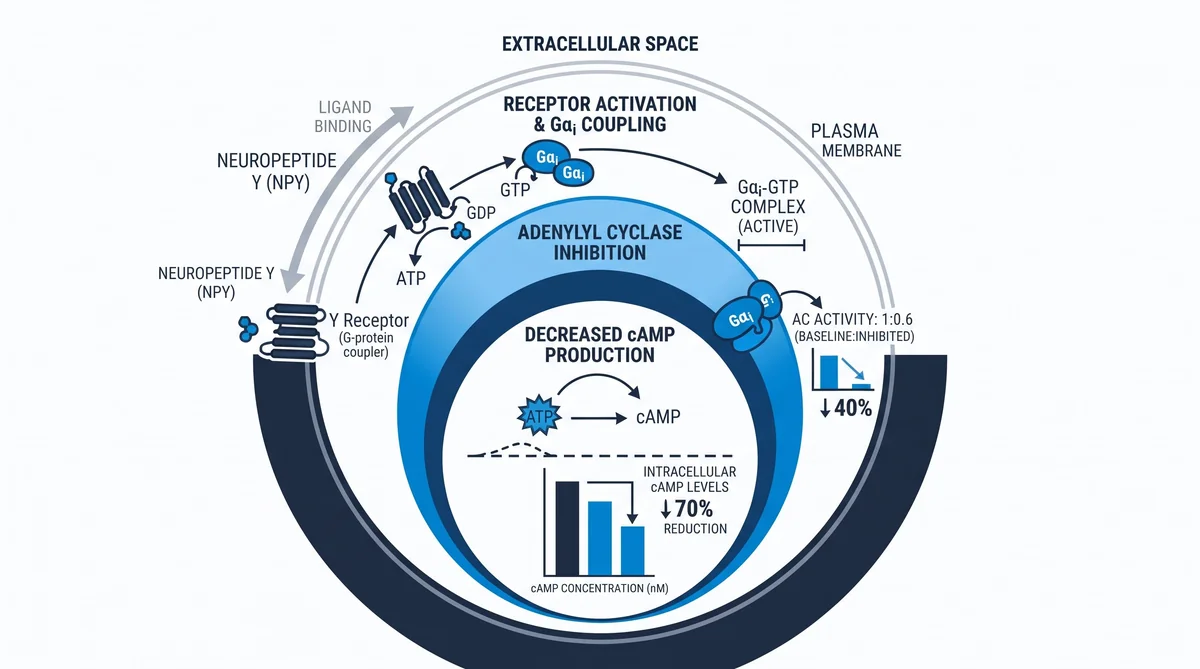
The NPY signal cascade relies on inhibitory Gi/o proteins. This happens after the peptide binds to the receptor. The process triggers events that alter the cell membrane state. These receptors control several downstream messenger systems in the cell. Each event translates the peptide signal into natural output. Labs use this to test how these receptors affect cell function in tissue samples.
Upon activation, the complex blocks adenylyl cyclase. This lowers intracell cAMP (cyclic adenosine monophosphate) levels. A drop in this messenger is a hallmark of G protein signal. The cascade also affects ion channels. It affects calcium and potassium channels specifically. These shifts in ion flow change membrane potential. They alter cell output. Through these steps, the receptor tunes the cell to specific stimuli.
What Are NPY Receptor Antagonists?
NPY receptor antagonists are synthetic molecules that block NPY binding. They serve as essential tools in lab work. These compounds prevent receptor binding by competing with natural ligands. Stopping this interaction lets labs observe pathway effects.
Labs rely on receptor subtype selection to isolate each pathway. BIBP 3,226 is used to study Y1 receptors. BIIE0246 is used to study Y2 receptors. This ensures data from cell assays can be mapped to one receptor type.
BIIE0246 is a COA-verified research peptide. Every lot is verified by HPLC and mass spec. These tools let labs map how NPY affects energy balance and mood.
Why Is NPY Receptor Research Important?
NPY receptor research helps find specific targets for lab study. NPY acts as a key messenger in the brain. It affects how cells signal and react to stimuli. Labs study how these receptors link to natural pathways. This maps the roles NPY plays in body functions. This work provides a base for future compound development.
Obesity research relies on NPY for its effects on appetite control. Studies show these receptors also affect anxiety and epilepsy. This makes them prime subjects for testing. Labs also focus on cardiovascular control to see how NPY affects blood flow. This wide scope means findings can apply to many fields.
NPY (1-36) is a COA-verified research peptide. Every lot is verified by HPLC and mass spec.
Frequently Asked Questions
What are the Y1 and Y2 receptor subtypes of NPY?
The Y1 and Y2 receptors are G protein-coupled proteins that bind neuropeptide Y. The Y1 receptor is predominantly located on postsynaptic membranes. Where it mediates orexigenic signals. The Y2 receptor is primarily a presynaptic autoreceptor that provides feedback inhibition. According to PubMed (2018), these subtypes are widely distributed across the central nervous system. Their distinct anatomical locations allow them to coordinate complex responses related to energy balance and neuronal communication.
How does NPY Y1R differ from Y2R in selectivity?
The receptors differ in their affinity for specific peptide fragments and synthetic ligands. Y1 receptors show a high preference for full-length neuropeptide Y and certain synthetic analogs. Y2 receptors exhibit a unique binding profile that favors C-terminal fragments of the molecule. Research shows that this variation in selectivity allows the two receptors to perform opposing functions within the same natural circuit. Scientists map these differences to isolate specific signaling pathways in lab models.
What signaling cascades does NPY receptor activation trigger?
Activation of NPY receptors typically couples to the inhibitory Gi/o protein family. This interaction results in the inhibition of the enzyme adenylyl cyclase, which reduces intracellular levels of cyclic adenosine monophosphate. According to the Journal of Peptide Science (2018), this drop in cyclic adenosine monophosphate serves. As a primary mechanism for modifying neuronal excitability. These signaling cascades are fundamental to how NPY influences neurotransmitter release. Modulates synaptic plasticity in research models.
How is NPY receptor binding affinity quantified?
Binding affinity is measured using radioligand displacement assays or fluorescent labeling techniques. Investigators observe how a test compound displaces a known high-affinity ligand from the receptor site. These data are used to calculate the inhibition constant, which describes the potency of the interaction. According to the NIH (2020), this quantitative approach is necessary to verify the precision of synthetic ligands. Consistent measurement standards allow for valid comparisons across different lab settings and research studies.
What cell lines are used in neuropeptide Y research?
Researchers use immortalized cell lines that have been engineered to express specific human or rodent NPY receptors. Common choices include Chinese Hamster Ovary cells. Human Embryonic Kidney 293 cells. These lines provide a controlled environment to study G protein-coupled receptor function without the interference of natural signaling pathways found in native tissue. By introducing the receptor genes into these models, scientists can verify ligand binding. Signaling activity under standardized lab conditions.
What is the role of NPY in appetite regulation?
NPY is recognized as one of the most potent orexigenic signals in the mammalian brain. It acts within the hypothalamus to stimulate food-seeking behavior and promote energy storage. According to PubMed (2018), high concentrations of NPY in the arcuate nucleus correlate with an increase in caloric intake. Research examines how this peptide overrides satiety signals to maintain body weight. These findings are essential for knowledge how the brain manages metabolic homeostasis in various experimental contexts.
Is NPY related to stress responses in research models?
NPY functions as an natural anxiolytic agent that helps regulate behavioral responses to stress. It modulates the activity of neurons in the amygdala. Other regions associated with emotional processing. Research suggests that NPY receptor signaling may buffer the effects of acute stressors on the brain. By studying the administration of NPY or its analogs. Scientists test how these pathways contribute to resilience. The maintenance of autonomic stability during taxing conditions.
How does NPY interact with the hypothalamic-pituitary-adrenal (HPA) axis?
NPY influences the HPA axis by modulating the release of corticotropin-releasing hormone in the hypothalamus. This interaction provides a link between metabolic status. The endocrine response to stress. According to the NIH (2020), NPY receptor activation can suppress or amplify hormonal output depending on the specific receptor subtype involved. This complex cross-talk allows the body to calibrate its metabolic needs with its natural stress response. Scientists study this connection to map hormonal regulation.
Summary
Compare your current experimental protocols against the specifications of your peptide stock to ensure your study maintains high precision. You should audit your lab models to confirm they support the binding mechanisms of the compounds under current study. Record all storage timeframes and sequence verification results from your batch certificate of analysis to track material consistency throughout your research project.
Next Level Pharm provides researchers with the high-purity materials needed to conduct trials with confidence in their ligand quality. Researchers sourcing research-grade peptides can explore the catalog at Shop.
People Also Read
- What Are Nootropic Peptides? Mechanisms, Research Review
- What Is Selank? GABA Pathways, Mechanisms, and Study Findings
About the Author
Next Level Pharm Research Team
The Next Level Pharm research team is composed of biochemists and laboratory scientists dedicated to providing researchers with the highest-purity, independently verified peptides available. Every batch is HPLC and mass spec verified before dispatch.
Disclaimer: The information provided on this page is for educational and research purposes only. Next Level Pharm’s products are intended for laboratory research use only. They are not intended for human consumption, diagnostic, therapeutic, or medicinal purposes. This content does not constitute medical advice. Always consult a licensed healthcare professional before making any health-related decisions.