
GH Pulsatility: Why Timing Matters in Research

Last updated: August 2026
GH pulsatility is the natural release of growth hormone from the pituitary gland. The hormone comes in brief, timed bursts rather than a steady flow. This pulsed pattern creates a better cellular environment than constant exposure. According to PubMed (2010), pulsed GH has a greater cellular effect than continuous delivery. It also stops receptor desensitization. Pulsatility lets the endocrine system stay in balance each day. By studying these cycles, labs see how compounds affect GH function and downstream growth paths.
Next Level Pharm provides high-purity research compounds for lab settings. Each lot is tested by HPLC and mass spectrometry on every vial. The brand holds an average purity of 99.4% across its last 100 batches. Every batch is third-party tested..
These research compounds follow strict lab standards to preserve compound integrity. Peptides are lyophilized, meaning freeze-dried and sealed in an inert atmosphere. This keeps them stable at room temperature. No cold chain is needed during transit. Dispatch takes about 48 hours from USA-stored inventory. The catalog holds 70+ peptide SKUs across 7 categories. It includes bundles such as the GLOW Stack and KLOW Stack for specific study models. Accurate compound tracking remains the primary focus of these research supplies.
Key Takeaways
- Pulsatile GH release: Growth hormone comes in rhythmic bursts, not a constant stream. Specific signaling peptides in the body control this release pattern.
- Enhanced cellular response: Frequent GH pulses stop receptor count drop in target tissue. Constant exposure reduces hormonal response over time.
- Aging and lifecycle effects: Pulse amplitude peaks during adolescence. It then declines as the body ages into adulthood and beyond.
- Factors increasing release: Deep sleep and intense exercise drive hormone release. These events raise the rate and force of pulses.
- Study of releasers: Modern research aims to support natural rhythms, not force constant output. Keeping the natural pulse cycle is the primary goal for compound testing.
The sections below explain how specific external agents interact with these natural pulse mechanisms. Labs study how releasers control pulse amplitude and rate to maintain steady control in diverse models.
What is the GH axis?
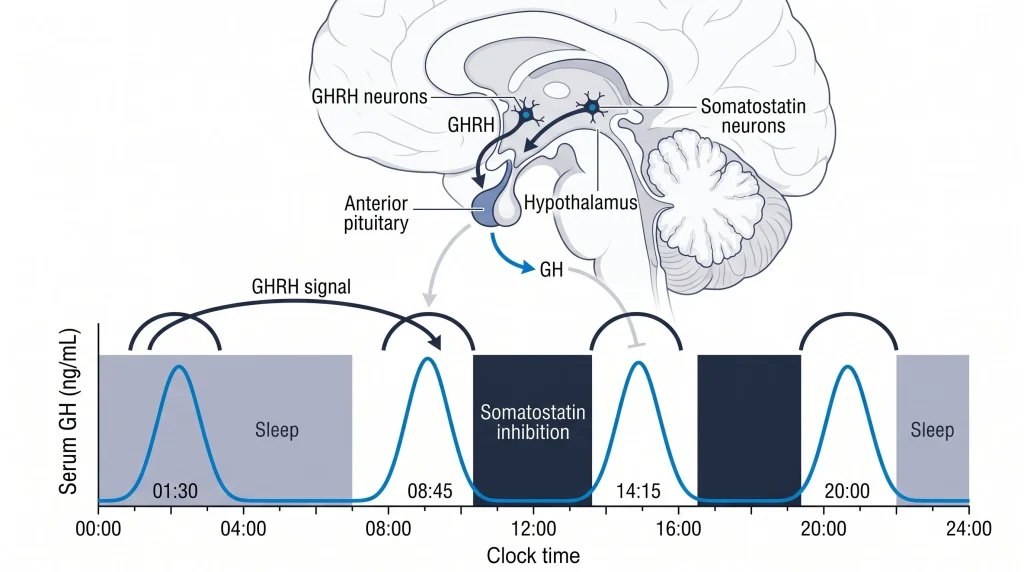
The HPS axis is a neuroendocrine feedback loop. It controls the output and release of growth hormone (GH) in the body. The loop starts in the hypothalamus, which acts as the master control center. It monitors circulating hormone levels and adjusts output based on those levels.
This region releases GHRH (growth hormone-releasing hormone) to start GH output. It also releases somatostatin (SST) to block this output. The pituitary gland receives both signals and releases GH into the blood. GH then signals the liver to make IGF-1 (insulin-like growth factor 1). High IGF-1 tells the hypothalamus to lower GHRH and raise somatostatin. This negative feedback loop creates the natural GH pulsatility pattern.
Sermorelin is available as a COA-verified research peptide. Each lot is tested by HPLC and mass spec.
Why does GH release in pulses?
GH release occurs in pulses to keep signaling efficient. Constant hormone exposure causes target cells to drop their surface receptors. Pulsing avoids this loss of receptor response. GHRH activates GH release. Somatostatin then blocks it. This alternating rhythm repeats throughout the day.
A key benefit is receptor health. Constant GH exposure causes liver and muscle cells to reduce their receptor count. Pulses let these receptors reset between each signal. This keeps the system responsive to hormonal input. Ipamorelin is available as a COA-verified research peptide. Each lot is tested by HPLC and mass spec. According to PubMed (2010), rhythmic release maintains normal cellular effects over time.
How do age and sex influence GH pulsatility?
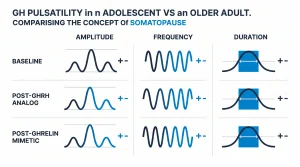
Age and sex affect GH pulsatility through shifts in gland response. During puberty, pulse amplitude peaks. It then declines with age in a process called somatopause. Male patterns tend to show higher amplitude. Female patterns tend to show higher frequency. According to PubMed (2021), these differences reflect how age and sex set the hormonal baseline.
Sex steroids are key modulators of pulse dynamics. Testosterone raises amplitude by boosting gland response. Estrogen raises frequency and elevates baseline GH levels. Researchers use specific peptide tools to isolate these factors. CJC-1295 is available as a COA-verified research peptide. Each lot is tested by HPLC and mass spec. These hormonal effects shape how GH output changes across a lifetime.
What role do sleep and exercise play?
The largest GH pulses occur during slow-wave sleep (SWS). SWS is the deep sleep phase that follows sleep onset. During SWS, the brain shifts to prioritize GHRH release. This starts a large burst from the pituitary. Researchers study this window to observe peak hormone output.
Intense exercise is a strong cellular stimulus for GH release. Acidosis and rising lactate levels signal the brain to boost output. These metabolic shifts prompt rapid hormonal pulses.
GHRP-2 is available as a COA-verified research peptide. Each lot is tested by HPLC and mass spec.
How do GH secretagogues affect pulsatility?
GH secretagogues (GHSs) alter the pulse profile through the HPS axis. GHRH variants mimic the natural stimulus to boost peak amplitude and pulse duration. Ghrelin mimetics act as selective agonists that sharpen the force of each burst. Both classes target different receptors to shift the 24-hour GH curve.
GHRH variants bind to GHRH receptors on pituitary somatotroph cells. This amplifies each pulse and extends its length. Ghrelin mimetics target the GHSR for an acute, intense release. Each compound acts on a specific receptor. By selecting between them, researchers can shift either duration or amplitude. Research in PubMed (2006) confirms these pathways allow precise control in research models.
Why is pulsatility important for research?
Pulsatility is key for research because it stops receptor downregulation. It also keeps target tissues sensitive to GH signals. Preserving the natural pulse pattern lets lab models study releasers. This avoids cell adaptations linked to constant, forced hormone exposure. If bursts deviate from the baseline rhythm, growth signal studies lose accuracy. Monitoring these rhythms gives researchers a clear view of how subjects respond to intervention.
Labs use pulse math to study these endocrine cycles. This method measures pulse mass, rate, and hormone half-life. Labs calculate the area under each burst. This shows if a compound boosts total release or just shifts timing. Peer-reviewed data confirms that tracking these traits leads to higher accuracy in research models.
According to PubMed (2010), pulsatile GH secretion is driven by alternating GHRH and somatostatin signals. According to PubMed (2006), disruption of GH pulse frequency alters downstream IGF-1 output in rodent models. According to PubMed (2021), GH pulse amplitude and frequency differ between sexes. They also change with age in human cohorts.
Frequently Asked Questions
What Is Growth Hormone Pulsatility?
Growth hormone pulsatility is the natural secretion cycle of the pituitary gland. The gland releases GH in discrete bursts rather than a steady stream. This pattern occurs day and night as the body responds to energy and brain signals. Research confirms these rhythms are needed to keep the somatotropic axis sensitive. According to PubMed (2010), this rhythmic release is a defining feature of the axis. Without it, target tissues lose their response to hormonal input over time.
How Do Secretagogues Alter Pulse Shape?
GHSs raise GH pulse amplitude or frequency by acting on GHRH or ghrelin receptors. They copy the body’s native signals to boost the volume of each burst. Research shows different compounds vary in how they shift this surge. Some agents extend the pulse duration. Others sharpen the peak output. These shifts are studied to assess signaling efficiency in lab models. The two receptor classes let labs target distinct parts of the pulse curve.
Why Does Fasting State Affect GH Response?
The fasting state shifts the somatotropic axis toward higher GH output to mobilize energy. The body raises pulse amplitude to prioritize lipolysis and protein sparing. Researchers track how caloric intake affects glandular rhythm in lab models. According to PubMed (2006), these internal shifts drive the control of specific hormonal pulses. This response is a key variable to account for in GH research protocol design.
How Is Pulsatility Measured in Studies?
Researchers measure pulsatility by collecting blood samples every ten to twenty minutes for a full day. They map hormone concentration over time to find specific peaks. Advanced algorithms define the amplitude and frequency of each burst. This quantitative method tests how specific research compounds alter the natural burst pattern. It provides precise data on pulse timing, duration, and total hormone output per cycle.
What Role Do Sleep and Exercise Play?
Deep sleep and intense exercise drive GH pulse volume in lab models. Most daily GH release occurs during slow-wave sleep. Intense exercise provides an acute stimulus that spikes hormone levels within minutes. Lab evidence confirms these events help the pituitary sustain its natural rhythm. They do this through periodic, high-output bursts. Researchers often include sleep and exercise data to account for these influences in GH studies.
What Is the Difference Between Pulse Amplitude and Frequency?
Pulse amplitude is the peak height of hormone released in each burst. Frequency is the number of pulses in a set period, such as 24 hours. Both metrics are tracked to understand how GHSs affect gland output. Higher amplitude raises the peak concentration per pulse. Higher frequency extends the total duration of elevated hormone levels. Together they define the overall 24-hour GH secretory profile in a research model.
How Does Somatopause Relate to GH Pulsatility?
Somatopause is the natural decline in GH secretion and pulse amplitude with age. It appears as weaker and less frequent hormone bursts over time. Research uses this decline to compare how test compounds might support a more youthful burst profile. According to PubMed (2021), understanding somatopause is critical for studying somatotropic feedback loops. The timing and extent of this decline vary by sex hormone levels.
Why Is Pulsatile GH Release Better Than Continuous Exposure?
Pulsatile release keeps receptor sensitivity high across target tissues. Constant GH exposure drops receptor density and reduces hormonal effects over time. Intermittent pulses give cells rest periods to reset their receptors. Research confirms this rhythm is more efficient for long-term cellular results. The alternating pattern mirrors how the body naturally manages hormone output. It also protects the pituitary from fatigue linked to constant stimulation.
Summary
GH pulsatility research depends on precise compound quality and records. Labs sourcing GHSs can explore the full selection in the fitness and GH category at Next Level Pharm. Each vial ships with a COA and full lot tracking. Confirming purity via HPLC and mass spec before a study ensures accurate results.
What Should You Do Next?
Labs sourcing research-grade peptides for lab studies can follow these steps:
- Review purity records. Confirm that COA data is available before ordering. Next Level Pharm provides lot-specific COA access for each vial.
- Check compound storage requirements. Lyophilized peptides stay stable at room temperature. Confirm your lab has the correct storage protocol before starting work.
- Request technical support if needed. PhD-level biochemist support is available for researchers with protocol questions.
People Also Read
- CJC-1295 Research: How This GHRH variant Works in Lab Models
- What Is Ipamorelin? Mechanism of Action and Research Overview
About the Author
Next Level Pharm Research Team
The Next Level Pharm research team is composed of biochemists and laboratory scientists dedicated to providing researchers with the highest-purity, COA-verified research peptides available. Every batch is HPLC and mass spec verified before dispatch.
Disclaimer: The information provided on this page is for educational and research purposes only. Next Level Pharm’s products are intended for laboratory research use only. They are not intended for human consumption, diagnostic, therapeutic, or medicinal purposes. This content does not constitute medical advice. Always consult a licensed healthcare professional before making any health-related decisions.