
LL-37 Research: Antimicrobial Peptide Studies

Last updated: August 2026
LL-37 is a 37-amino acid cationic antimicrobial peptide (AMP). It is the only human cathelicidin. It derives from a larger precursor protein called hCAP18, which is produced in neutrophils and epithelial cells. Its mass is about 4,493 Da. According to Journal of Peptide Science (2018), lab-made LL-37 matches the natural sequence. It meets identity standards by HPLC and mass spec. Research studies use LL-37 to examine membrane disruption, immune signaling, and epithelial cell models.
Next Level Pharm supplies LL-37 as a COA-verified research peptide. Every lot ships with HPLC and mass spec data. Average purity is 99.4% across the last 100 batches. A COA ships with every order.
LL-37 research spans antimicrobial membrane studies, innate immune signaling, and biofilm disruption models. Each study type relies on verified purity and confirmed sequence identity.
Key Takeaways
- Origin: LL-37 is the only human cathelicidin. It forms from hCAP18, a precursor protein produced in neutrophils and epithelial cells.
- Cationic Structure: LL-37 carries a net positive charge. It targets negatively charged bacterial membranes in lab models.
- Membrane Disruption: Research shows LL-37 disrupts bacterial membranes by embedding into the lipid bilayer. This is studied in membrane assays and bilayer models.
- Immune Signaling: LL-37 also interacts with immune receptors. Studies have looked at its effects on TLR4 and TLR9 signaling in macrophage and dendritic cell assays.
- Alpha-Helical Form: LL-37 takes an alpha-helical shape when it contacts a membrane. This shape is key to its membrane-active behavior in assay models.
Each H2 below covers a research area: membrane disruption, immune signaling, wound models, structure, and lot verification.
What Is LL-37 and Where Does It Come From?
LL-37 is a 37-amino acid antimicrobial peptide. It is the only cathelicidin found in humans. It forms from hCAP18 (human cationic antimicrobial protein 18), a precursor stored in neutrophil granules. Cleavage of hCAP18 by serine proteases releases the LL-37 fragment. Its mass is about 4,493 Da. The two “LL” letters at the start of its name refer to the two leucine residues at the N-terminus. According to NCBI (2020), lab-made LL-37 built by SPPS reproduces the full 37-amino acid sequence and meets identity standards by MS confirmation.
LL-37 is found in neutrophils, macrophages, skin epithelial cells, and lung airway cells. It is also found in plasma at low concentrations. Lab-grade LL-37 is a freeze-dried powder produced by SPPS. Each lot is tested by HPLC for purity and by MS for correct mass. TB-500 is another peptide studied in immune and tissue repair models, with a different sequence and focus.
How Does LL-37 Interact with Bacterial Membranes?
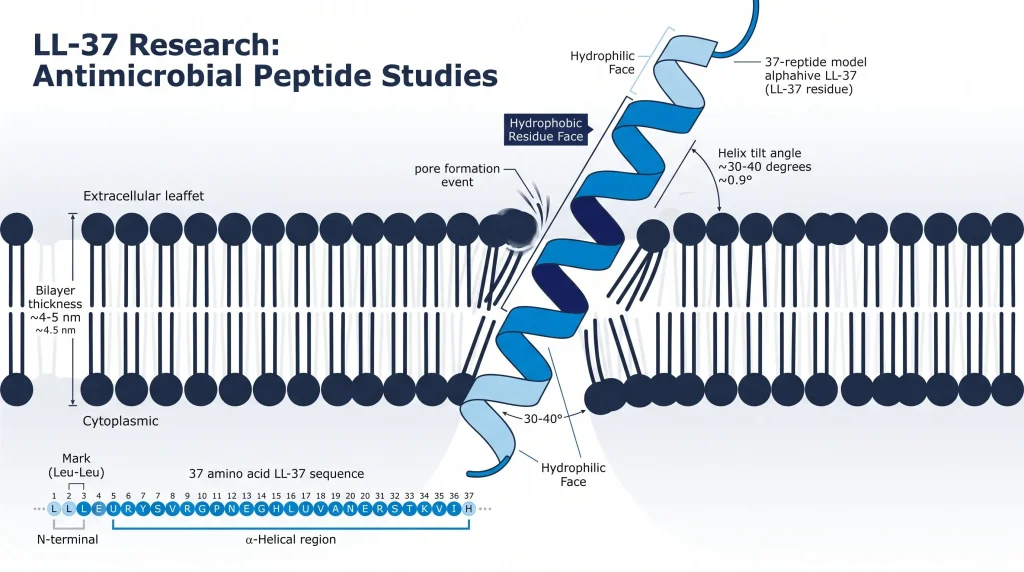
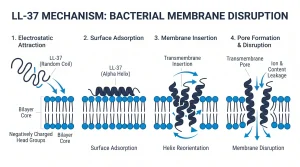
LL-37 is cationic, meaning it carries a net positive charge. Bacterial membranes carry a net negative charge. This charge difference draws LL-37 to the bacterial membrane surface. Once at the surface, LL-37 folds into an alpha-helical shape. This helix embeds into the membrane lipid layer. It disrupts the membrane, causing ion leakage and cell death in the bacterial model. According to Molecules MDPI (2019), several models describe how AMPs like LL-37 disrupt membranes. The carpet model and the toroidal pore model are the two most studied.
| Membrane Model | Description | Key Feature |
| Carpet model | LL-37 coats the membrane surface until it collapses | No stable pore formed |
| Toroidal pore | LL-37 curves the membrane inward to form a pore | Lipid and peptide line the pore |
| Barrel-stave | LL-37 inserts vertically into the bilayer | Peptide lines the pore |
| Detergent-like | LL-37 fragments the membrane like a detergent | Membrane dissolves |
Browse COA-verified research peptides with full HPLC and MS data per lot.
What Does Research Show About LL-37 and Immune Signaling?
LL-37 also acts on immune cell receptors. It is not only a membrane-active compound. In macrophage assays, LL-37 has been studied for its effects on TLR4 signaling. TLR4 (toll-like receptor 4) recognizes lipopolysaccharide (LPS) from gram-negative bacteria. LL-37 can block or change TLR4 activation by LPS, depending on the assay conditions. According to Journal of Peptide Science (2018), LL-37 also binds to receptor FPRL1 (formyl peptide receptor-like 1) on neutrophils, driving chemotaxis in these assay models.
In dendritic cell models, LL-37 has been shown to act with TLR9. It forms complexes with DNA and delivers the complex to intracellular TLR9. This leads to IFN-alpha release in plasmacytoid DC models. The cytokine profile in these assays shifts based on LL-37 concentration. High-purity lots give more consistent data because impurities do not block or activate the same receptors.
How Has LL-37 Been Studied in Wound Healing Models?
LL-37 has been studied in scratch assay and keratinocyte migration models. In these models, keratinocytes (skin cells) fill a wound gap over time. LL-37 has been shown to affect the rate of gap closure in these assays. It does this by acting on the EGF receptor (epidermal growth factor receptor) pathway. According to NCBI (2020), in vitro scratch assays have used LL-37 to study EGF receptor activation and downstream signaling in skin cell models.
Researchers also use collagen gel contraction assays and fibroblast models to study LL-37. In fibroblast assays, LL-37 has been studied for its effects on collagen production. The endpoints are usually measured at 24 or 48 hours. COA-verified LL-37 lots are needed for these assays because impurities can activate or block the EGF receptor pathway independently. BPC-157 is another peptide studied in tissue repair models with different receptor targets.
What Is the Molecular Structure of LL-37?
LL-37 has 37 amino acids. Its sequence is: LL-GDF-FAKR-LLGD-FFRKSKEK-IGKEF-KRIV-QRIK-DFLR-NLVP-RTES (abbreviated). The key structural feature is its ability to fold into an amphipathic alpha helix. An amphipathic helix has one face that is hydrophobic and one face that is positively charged. The hydrophobic face embeds into the membrane core. The charged face faces the aqueous environment. This arrangement is key to its membrane activity. According to Molecules MDPI (2019), the amphipathic helix is confirmed by circular dichroism (CD) in membrane-mimicking conditions.
The peptide has a high content of arginine and lysine residues. These give it the positive charge. Its mass of about 4,493 Da is confirmed by MS in each production lot. HPLC confirms purity. The two measurements together form the identity check on the COA. A lot with the correct mass and ≥99% purity meets the standard for research-grade LL-37.
How Is LL-37 Verified for Research Use?
HPLC verification runs a reverse-phase separation. The main peak area, as a share of total area, gives the purity percent. For research-grade LL-37, the target is ≥99%. Next Level Pharm reports 99.4% average purity across the last 100 batches. Other peaks are potential impurities. MS identifies each by mass. This confirms whether a peak is a deletion, truncated form, or oxidized variant.
The second step is MS confirmation of the full 37-amino acid mass. LL-37 has a mass of about 4,493 Da. A deletion or truncation drops the mass below this value. An oxidized methionine adds 16 Da. These shifts are caught only by MS. A COA that includes both the HPLC chromatogram and the MS mass confirms purity and identity. Both data sets are in the COA that ships with every LL-37 lot.
Frequently Asked Questions
What Is LL-37?
LL-37 is a 37-amino acid cationic antimicrobial peptide. It is the only human cathelicidin. It forms from hCAP18, a precursor protein stored in neutrophil granules. Its mass is about 4,493 Da. The “LL” in the name refers to the two leucine residues at the N-terminus. According to Journal of Peptide Science (2018), lab-made LL-37 built by SPPS must match the full 37-amino acid sequence. HPLC and MS confirm both purity and identity per lot.
Where Is LL-37 Found Naturally?
LL-37 is found in neutrophils, macrophages, skin epithelial cells, and lung airway cells. It is also present at low levels in blood plasma. It forms when the enzyme serine protease cleaves hCAP18 in neutrophil granules. Lab-grade LL-37 is made by SPPS rather than tissue extraction. This gives higher purity and allows lot-specific verification. According to NCBI (2020), SPPS allows consistent sequence replication across production batches.
How Does LL-37 Disrupt Bacterial Membranes?
LL-37 carries a positive charge. Bacterial membranes carry a negative charge. LL-37 binds to the membrane surface, then folds into an alpha helix. The helix embeds into the lipid layer and disrupts membrane integrity. This causes ion leakage in the bacterial model. Several membrane disruption models exist. According to Molecules MDPI (2019), the carpet model and the toroidal pore model are the two most studied for LL-37 membrane activity.
What Is an Amphipathic Alpha Helix?
An amphipathic alpha helix is a coiled protein structure. One face of the helix is hydrophobic (water-avoiding). The opposite face is positively charged (water-attracted). This layout lets the helix embed into a membrane with the hydrophobic face inside the lipid layer. LL-37 forms this structure when it contacts a membrane. The amphipathic helix is confirmed by circular dichroism (CD) spectroscopy in membrane-mimicking conditions. The helix shape is key to its membrane-active behavior in lab assay models.
How Has LL-37 Been Studied in Immune Cell Assays?
LL-37 has been studied in macrophage and dendritic cell assays. In macrophage models, it has been shown to affect TLR4 signaling triggered by LPS. In plasmacytoid DC models, it forms complexes with DNA and activates TLR9, leading to IFN-alpha release. The cytokine output profile varies with concentration and assay conditions. According to Journal of Peptide Science (2018), high-purity lots reduce variability in these receptor-based assays. Impurities that share structural features with LL-37 can affect the same receptors.
What Does a COA Show for LL-37?
A COA for LL-37 shows HPLC purity and MS-confirmed mass. For full-length LL-37, the correct mass is about 4,493 Da. A deletion sequence has a lower mass. An oxidized variant has a mass 16 Da higher. Without MS, neither can be detected by HPLC purity alone. The COA also includes the lot number, vial weight, and synthesis date. According to NCBI (2020), lot-level records allow consistent comparison of results across assay runs.
How Is LL-37 Synthesized for Research?
Lab-grade LL-37 is made by SPPS. Each of the 37 amino acids is added one at a time to a resin support. After cleavage from the resin, the crude peptide is purified by HPLC to reach ≥99%. The final lot is freeze-dried for stability. HPLC and MS are run before release. The mass of about 4,493 Da must be confirmed by MS. According to Molecules MDPI (2019), SPPS with reverse-phase HPLC purification is the standard method for research-grade AMP production.
How Stable Is LL-37 in Storage?
Freeze-dried LL-37 is stable in sealed vials away from moisture and light. Its high arginine and lysine content makes it less prone to oxidation than methionine-rich peptides. Even so, vials should stay sealed until use. HPLC at manufacture sets the purity baseline for later comparison. According to Journal of Peptide Science (2018), freeze-dried peptides stored in sealed, inert conditions maintain purity for extended periods. Storage conditions are listed on the COA.
What Assays Are Used in LL-37 Research?
Common assays include membrane disruption studies with bacterial lipid vesicles. Macrophage TLR4 assays, DC TLR9 assays, scratch assays for keratinocyte migration, and fibroblast collagen models are also used. Each requires a specific purity level. In membrane disruption assays, impurities that are also cationic can alter the observed disruption rate. According to NCBI (2020), consistent purity across lots is key to reducing assay variance in all LL-37 model types.
What Purity Level Is Standard for LL-37 Research?
Research-grade LL-37 targets ≥99% HPLC purity. At this level, non-target content is low enough for most membrane, immune, and cell-based assays. Lots below 98% may have deletion fragments or oxidized forms that affect sensitive models. The average is 99.4% from individual HPLC runs. According to Journal of Peptide Science (2018), lot-level purity data supports consistent assay planning and inter-run comparison.
Summary
LL-37 is a 37-amino acid cationic antimicrobial peptide and the only human cathelicidin. It forms from hCAP18 in neutrophil granules. Its alpha-helical structure drives membrane disruption activity in bacterial assay models. It also affects TLR4 and TLR9 signaling in immune cell models, and has been studied in keratinocyte migration and fibroblast assays. HPLC confirms purity. MS confirms the 4,493 Da mass and rules out deletions and oxidized variants. A full COA includes both data sets per lot. Next Level Pharm provides COA-verified LL-37 with full HPLC and MS data.
What Should You Do Next?
Review the HPLC chromatogram and MS data on the COA before any LL-37 assay. Confirm the mass matches about 4,493 Da for the full-length form. Check the purity is ≥99% and the lot number is on the COA.
Browse COA-verified research peptides with HPLC and MS data at Next Level Pharm.
People Also Read
- What Makes a Peptide Research Grade? Standards and Testing Explained
- BPC-157 vs TB-500: A Detailed Research Comparison Guide
About the Author
Next Level Pharm Research Team
The Next Level Pharm research team is composed of biochemists and laboratory scientists dedicated to providing researchers with the highest-purity, COA-verified research peptides available. Every batch is HPLC and mass spec verified before dispatch.
Disclaimer: The information provided on this page is for educational and research purposes only. Next Level Pharm’s products are intended for laboratory research use only. They are not intended for human consumption, diagnostic, therapeutic, or medicinal purposes. This content does not constitute medical advice. Always consult a licensed healthcare professional before making any health-related decisions.