Peptide Impurity Profiles: Deletion and Truncation

Last updated: August 2026
A peptide impurity profile is a detailed lab report that lists and measures non-target compounds in a synthesized batch. It maps out minor sequences that do not match the target structure. According to Journal of Peptide Science (2018), deletion sequences and truncated chains are the most common synthesis-related impurities in SPPS (solid-phase peptide synthesis) lots. A single purity percent does not reveal which specific impurities are present. A full profile does.
Next Level Pharm tests every vial with HPLC and mass spec (MS). Average purity runs at 99.4% across the last 100 batches. A COA ships with every order. Lot data is available online by lot number.
A complete impurity profile lets researchers confirm the exact chemical makeup of their sample before any study begins.
Key Takeaways
- Profile vs Percent: A single purity percent only reports how much is the target compound. A full profile identifies each specific impurity by type and source.
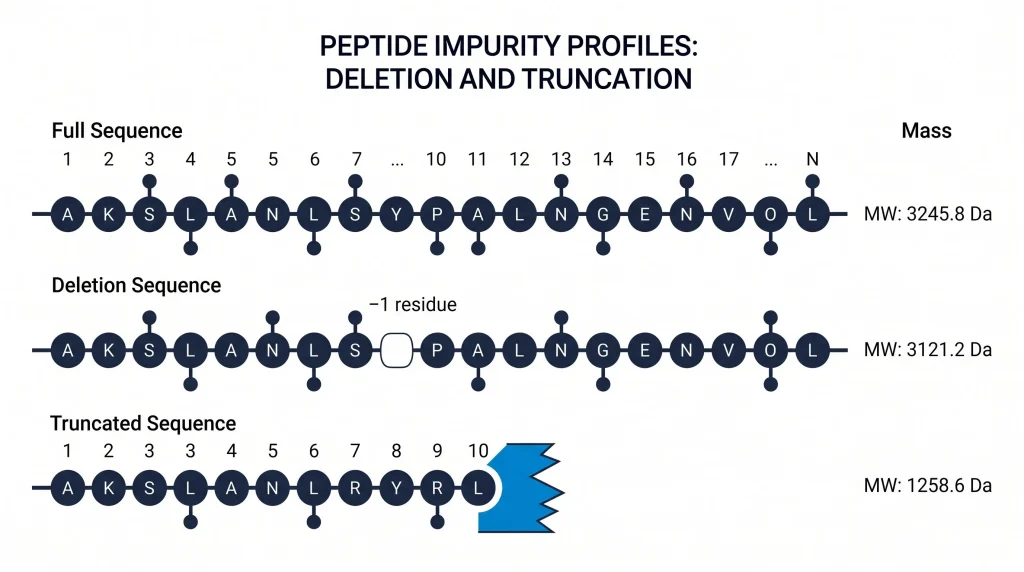
- Deletion Sequences: Deletion sequences form when one amino acid fails to couple. The chain grows but is missing a specific link. These are internal gaps.
- Truncated Chains: Truncated sequences form when the chain stops growing too early. The result is a shorter chain, not a chain with gaps.
- Modification Impurities: Oxidation and deamidation are chemical changes that can occur during storage. They alter the charge and shape of specific amino acids.
- HPLC and MS Together: HPLC separates impurities and measures peak areas. MS confirms the identity of each peak by molecular weight. Both are needed for a full profile.
Deletion sequences, truncated chains, and chemical modifications are three distinct classes of peptide impurity. Each forms through a different mechanism and requires a different type of data to detect.
What Are Synthesis-Related Impurities?
Synthesis-related impurities form during solid-phase peptide synthesis (SPPS). SPPS builds peptide chains by adding amino acids one at a time to a solid resin. When a coupling step fails, an amino acid does not bond to the chain. The chain continues to grow from that error. The result is a compound that differs from the target. BPC-157 lot COAs include full HPLC peak data so researchers can see the impurity profile.
Two common errors are missed couplings and early chain termination. Both produce sequences that are shorter or structurally different from the target. Steric hindrance (where large side chains block the coupling site) and low reagent concentration both drive these errors. Reagent purity also plays a role. Low-grade reagents introduce more side reactions than high-grade ones. Monitoring each coupling step during production limits the buildup of these impurities.
How Do Deletion Sequences Form?
Deletion sequences form when one amino acid fails to bond to the growing chain during SPPS. The synthesis continues, but one position in the chain is empty. The result is a chain that is one amino acid shorter than the target. Multiple missed couplings can create sequences missing two or more positions. These are called multiple deletions. According to Journal of Peptide Science (2018), deletion sequences are the most common SPPS-related impurity in synthetic peptide batches.
Deletion sequences are hard to separate from the target on HPLC alone. They may have a retention time close to the target because the overall chain is similar. MS is needed to distinguish them. A deletion sequence has a lower molecular weight than the target by the mass of the missing amino acid. MS catches this mass difference. That is why the full impurity profile requires both HPLC data and MS data.
What Causes Truncated Peptide Sequences?
Truncated sequences form when chain growth stops before the full length is reached. Unlike deletion sequences, which have internal gaps, truncated sequences simply stop at some point in the chain. The result is a partial sequence with fewer amino acids. The chain is correct up to the point where growth stopped, but it is shorter than the target.
Truncation often results from premature cleavage from the resin linker. If the protecting group breaks off early, the site loses the ability to add more amino acids. Reagent quality and reaction conditions both affect how often this occurs. According to NCBI (2020), truncated fragments can build up if the reaction rate drops significantly as the chain gets longer. TB-500 lot data includes MS results that confirm the full target length is present.
| Impurity Type | Cause | Detectable By |
| Deletion sequence | Missed coupling (internal gap) | MS (lower m/z by one AA mass) |
| Truncated sequence | Early chain termination | MS (lower m/z by multiple AA masses) |
| Oxidized variant | Oxygen added to side chain | MS (mass shift +16 Da) |
| Deamidated variant | Amide converted to acid | MS (mass shift +1 Da) |
Browse COA-verified research peptides with HPLC and MS data on every lot.
What Are Modification-Related Impurities?
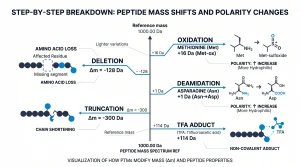
Modification-related impurities are chemical changes to amino acid side chains. They can occur during synthesis, storage, or handling. Two of the most common are oxidation and deamidation. Oxidation adds an oxygen atom to sensitive residues like methionine. This adds 16 Da (daltons) to the mass. MS detects this as a mass shift of +16 on the main peak or a new peak at that mass.
Deamidation converts an amide group to a carboxylic acid in residues like asparagine. This adds 1 Da to the mass and adds a negative charge to the peptide. Both changes affect how the peptide behaves in an assay. According to Molecules MDPI (2019), these shifts can reduce the stability of sensitive peptide sequences. Freeze-dried vials sealed under an inert atmosphere minimize exposure to oxygen and moisture.
Why Does an Impurity Profile Matter?
A purity percent only reports the total share of non-target content. It does not reveal what those impurities are. Some impurities are inert. Others are structurally similar to the target and can bind to the same receptor. An impurity that binds to the same receptor as the target adds noise to the data. It can make the observed effect larger or smaller than it should be.
For this reason, a full impurity profile is more useful than a single purity number. The profile maps each peak to a specific compound. It shows whether the 1% non-target content is an inert byproduct or a related peptide with biological activity. Next Level Pharm provides this level of detail in its COA documentation so researchers can evaluate each lot before use.
How Are Peptide Impurities Analyzed?
HPLC separates the sample components by how they move through a column. Each compound exits at a set time. The main peak area, compared to all peak areas, gives the purity percent. Smaller peaks represent impurities. HPLC cannot confirm what those impurities are. It only shows they exist and how large they are relative to the main compound.
MS fills that gap. After HPLC separates the peaks, MS measures the exact molecular weight of each. A mass shift from the expected value reveals the type of impurity. A shift of -AA mass means a deletion. A shift of -several AA masses means truncation. A shift of +16 Da means oxidation. A shift of +1 Da means deamination. When HPLC and MS data are combined, the result is a complete impurity profile with both quantity and type for each non-target compound.
Frequently Asked Questions
What Are Deletion Sequences?
Deletion sequences form when one amino acid fails to bond during SPPS. The chain continues to grow but skips that position. The result is a peptide that is one or more amino acids shorter than the target sequence, with internal gaps. According to Journal of Peptide Science (2018), deletion sequences are the most common SPPS-related impurity. They have a lower molecular weight than the target by the mass of the missing amino acid. MS detects this mass difference.
How Do Truncated Peptides Form?
Truncated peptides form when chain growth stops before the full length is reached. This can result from early cleavage of the protecting group or a drop in reaction rate as the chain gets longer. Unlike deletion sequences, which have internal gaps, truncated sequences are complete up to the point where they stopped. According to NCBI (2020), these fragments build up when the rate of coupling drops during long synthesis runs. MS detects them by their lower-than-expected molecular weight.
What Are Oxidized and Deamidated Variants?
Oxidized variants form when oxygen is added to sensitive residues like methionine. This adds 16 Da to the molecular weight. Deamidated variants form when an amide group in residues like asparagine converts to a carboxylic acid. This adds 1 Da and a negative charge. According to Molecules MDPI (2019), both changes alter the charge and polarity of the molecule. MS identifies them by their characteristic mass shifts. Proper storage in sealed, freeze-dried vials limits the conditions that drive these changes.
Why Do Related Impurities Matter More Than Total Purity?
Total purity only shows how much of the batch is the target compound. It does not show what the non-target content is. Some impurities are inert. Others can bind to the same receptor as the target and skew the data. A contaminant that blocks the target receptor makes the observed effect appear smaller. One that activates the same receptor makes it appear larger. The impurity profile names each contaminant type. The purity percent alone cannot.
How Are Impurity Classes Reported?
Impurity classes are reported by listing each peak from the HPLC chromatogram with its area percent and corresponding MS mass. Each peak is matched to a compound type, such as a deletion sequence, truncated chain, oxidized variant, or solvent residue. The report groups these findings by class. This format lets researchers see at a glance how much of each impurity type is present. A well-structured COA includes this level of detail so lot-to-lot differences can be compared.
Does 99% Purity Mean No Harmful Impurities Are Present?
No. A 99% purity reading confirms that 99% of the sample is the target compound. The remaining 1% may include inert byproducts or compounds with biological activity. Whether that 1% affects a study depends on the impurity type and assay sensitivity. For sensitive receptor binding studies, small amounts of a similar impurity can shift results. The COA impurity profile is the only way to assess the non-target content.
How Does Storage Affect a Peptide’s Impurity Profile?
Moisture, heat, and light drive chemical changes in stored peptides. Oxidation and hydrolysis can increase impurity levels over time even in sealed vials. Freeze-dried peptides stored in inert conditions have a lower rate of degradation than those exposed to air or moisture. According to Journal of Peptide Science (2018), lyophilized storage limits the rate at which new impurities form. Researchers should note the storage conditions on the COA and keep vials sealed until use.
What Is the Main Peak on an HPLC Chromatogram?
The main peak on an HPLC chromatogram is the signal produced when the target peptide exits the column. Its area, compared to the total area of all peaks, gives the purity percent. Peaks that appear before or after the main peak represent impurities with different retention times. The position and area of each peak are recorded in the chromatogram data. MS is then used to confirm the identity of each peak by measuring its molecular weight.
Can Impurities Be Removed After Synthesis?
Some labs run additional purification steps after synthesis to reduce impurity levels. This process, called re-purification, can remove some impurities but also reduces yield. It is not always possible to separate impurities that have similar chemical properties to the target. For research-grade material, the goal is to control impurities during synthesis rather than remove them after. Each re-purification run must be re-tested with HPLC and MS to confirm the new purity level.
What Is the Difference Between Peptide Purity and Peptide Content?
Peptide purity is the HPLC ratio of the target peptide to all other compounds in a sample, expressed as a percent. Peptide content is the total mass in a vial, including counter-ions and bound water. These two measures are not the same. A vial can have 99% purity but a lower net peptide content if counter-ions make up a large portion of the vial weight. Both can appear on a COA if the lab measures net peptide content separately.
Summary
A peptide impurity profile goes beyond a single purity percent. It identifies each non-target compound by type and molecular weight. Deletion sequences form when an amino acid fails to couple, leaving an internal gap. Truncated sequences form when chain growth stops early. Oxidized and deamidated variants form when side chains react with oxygen or water. HPLC separates the components and measures their peak areas. MS confirms the identity of each compound by mass. A full COA combines both types of data so researchers can evaluate every lot before use.
What Should You Do Next?
Review the HPLC chromatogram on the COA before starting any study. Look for the number and size of impurity peaks alongside the main peak. Check the MS data for mass shifts that indicate oxidation or deamidation. For studies that require strict control over receptor interactions, compare impurity profiles across lots.
Browse COA-verified research peptides with full HPLC and MS impurity data at Next Level Pharm.
People Also Read
- What Makes a Peptide Research Grade? Standards and Testing Explained
- BPC-157 vs TB-500: A Detailed Research Comparison Guide
About the Author
Next Level Pharm Research Team
The Next Level Pharm research team is composed of biochemists and laboratory scientists dedicated to providing researchers with the highest-purity, COA-verified research peptides available. Every batch is HPLC and mass spec verified before dispatch.
Disclaimer: The information provided on this page is for educational and research purposes only. Next Level Pharm’s products are intended for laboratory research use only. They are not intended for human consumption, diagnostic, therapeutic, or medicinal purposes. This content does not constitute medical advice. Always consult a licensed healthcare professional before making any health-related decisions.