
How Peptide Identity Is Confirmed in the Lab

Last updated: August 2026
A peptide identity confirmation is the lab test that proves a synthesized peptide is the correct molecule. It verifies the amino acid sequence and molecular weight. According to Journal of Peptide Science (2018), combined HPLC and MS data is the standard for synthetic peptide lot release. Both identity and purity must be confirmed. High purity alone does not prove identity. A sample may be 99% pure but still be the wrong compound.
Next Level Pharm tests every vial with HPLC and MS. Average purity runs at 99.4% across the last 100 batches. A Certificate of Analysis (COA) ships with every order. Researchers can look up their lot data online by lot number.
Lab identity testing uses more than one method to build a full chemical profile. Each method checks a different property.
Key Takeaways
- Dual Method Required: HPLC alone cannot confirm peptide identity. MS is needed to verify the exact molecular weight. Both tests together give a full picture.
- Purity vs Identity: A sample may pass HPLC purity checks but still be the wrong peptide. Identity testing confirms the structure, not just the amount.
- COA Standard: A valid COA includes both HPLC purity data and MS mass data. A COA with only one method is incomplete.
- Mass-to-Charge Ratio: MS confirms identity by measuring the mass-to-charge ratio (m/z) of the sample and matching it to the expected value.
- Reference Standard: All identity tests compare the sample to a certified reference of known structure and purity.
Two analytical methods work together in most identity testing workflows. Understanding each method helps researchers evaluate the data in their COA.
What Is Peptide Identity Testing?
Peptide identity testing is the process of verifying that a synthesized peptide matches the intended amino acid sequence and molecular structure. It goes beyond purity testing, which only measures how much of the sample is the target compound. Identity testing confirms the target compound is the right one. BPC-157 identity data is available on every lot COA, showing both HPLC and MS results.
Most labs use two tests in sequence. First, HPLC checks purity by measuring peak area ratios. Second, MS confirms the molecular weight by measuring the m/z of the main peak. The HPLC step tells the lab how clean the sample is. The MS step tells the lab what the compound actually is. Both are needed before a lab can make a full identity claim.
How Does Mass Spectrometry Confirm Identity?
MS confirms peptide identity by measuring the exact molecular weight of the sample and comparing it to the expected value. The instrument ionizes the peptide and separates ions by their mass-to-charge ratio. The result is an m/z spectrum. The main peak should match the expected m/z for the target sequence.
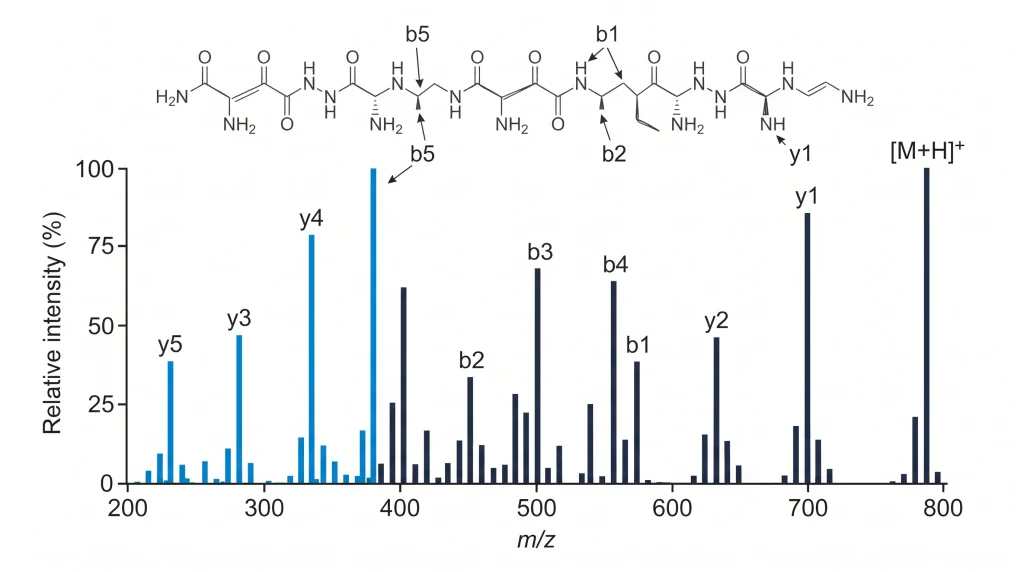
According to Journal of Peptide Science (2018), this high-resolution mass data allows labs to identify complex molecules with high accuracy. A peptide’s molecular weight is unique. Even a single amino acid swap changes the mass. MS can catch this error in a way that HPLC cannot. For complex sequences, tandem MS (MS/MS) fragments the peptide and maps the mass of each fragment. This gives a more detailed view of the sequence order.
What Role Does HPLC Play in Identity Testing?
HPLC separates peptide components by how they interact with a liquid solvent in a column. Each compound exits the column at a set time (retention time). When the sample’s retention time matches a certified reference standard, that provides evidence of identity. This alone is not enough proof. Two different peptides can share a similar retention time if they have similar chemical traits.
TB-500 HPLC data is available on every lot COA with purity percent and retention time recorded. According to Molecules MDPI (2019), HPLC is the standard method for purity analysis in synthetic peptide research. The chromatogram shows peaks for the target peptide and any impurities. The area under the main peak, compared to all peaks, gives the purity percent. HPLC is fast and sensitive. It works well alongside MS for a complete identity profile.
| Feature | HPLC | Mass Spectrometry (MS) |
| What it measures | Purity (area percent) | Molecular weight (m/z) |
| Identity role | Retention time (indirect) | Exact mass (direct) |
| Can spot the wrong peptide? | Sometimes (if mass differs enough) | Yes (unique mass per sequence) |
| Speed | Fast | Moderate |
| Standard use | Purity release testing | Identity confirmation |
Browse COA-verified research peptides with HPLC and MS data on every lot.
What Is Amino Acid Analysis?
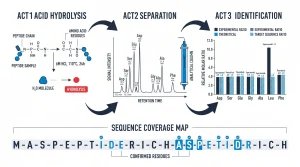
Amino acid analysis (AAA) breaks a peptide into its individual amino acids using acid hydrolysis. The analyst then measures the ratios of each amino acid in the sample. These ratios can be compared against the expected ratios for the target sequence. AAA does not map the order of amino acids. It only confirms which building blocks are present and in what amounts.
AAA is useful as a secondary identity check. It can confirm the correct composition even when sequencing is not needed. According to NCBI (2020), elemental composition data from AAA supports identity claims when paired with MS data. AAA does not replace MS. It is an additional data point for complex or high-value research lots.
Can Sequencing Verify a Peptide?
Yes. Tandem MS (MS/MS) and Edman sequencing both confirm the order of amino acids in a chain. MS/MS fragments the peptide at each peptide bond. The mass of each fragment is measured. By reading the mass differences between fragments, a lab can reconstruct the sequence from the raw data.
Edman sequencing removes one amino acid at a time from the chain’s N-terminus. Each removed unit is identified. The sequence is built step by step. This method is slower than MS/MS but provides high certainty for short chains. Both methods are used for definitive sequence verification when the identity of a research lot is in question. According to NCBI (2020), full sequence verification is standard practice for research-grade synthetic peptide lots.
Why Can a Pure Sample Be the Wrong Peptide?
A sample can be 99% pure and still be the wrong compound. HPLC measures purity by comparing peak areas. If a different peptide has a similar retention time, it can appear as the target peak. This is called co-elution. Two peptides with near-identical chemical properties may move through the column at the same speed.
MS solves this problem. Even if two peptides share a retention time, they rarely share the same molecular weight. MS measures the actual mass and compares it to the expected value. A match is strong evidence of correct identity. A mismatch, even with a clean HPLC trace, flags the sample for further review. This is why both methods are required in a complete identity testing protocol.
Frequently Asked Questions
What Is Peptide Identity Testing?
Peptide identity testing confirms that a synthesized peptide matches the intended amino acid sequence and molecular structure. It is distinct from purity testing. Purity testing measures how much of the sample is the target compound. Identity testing confirms that compound is the right one. According to Journal of Peptide Science (2018), combined HPLC and MS data is the standard for identity and purity confirmation. Both tests must pass before a COA can be issued for research-grade material.
How Does Molecular Weight Confirm Identity?
Every peptide has a unique molecular weight based on its amino acid sequence. MS measures the mass-to-charge ratio (m/z) of the sample and compares it to the expected m/z for the target. A match confirms the compound has the right mass. Even a single amino acid change shifts the mass by at least one dalton. According to Molecules MDPI (2019), precise mass data is a standard requirement for verifying biomolecular materials in lab settings.
What Is Amino Acid Analysis?
Amino acid analysis (AAA) breaks a peptide into its individual amino acids using acid hydrolysis. The freed amino acids are then separated and measured to get a ratio profile. This profile is compared to the expected ratios for the target sequence. AAA does not map the order of amino acids. It confirms which building blocks are present and in what amounts. It is used as a secondary identity check alongside MS, when full sequencing is not required.
Can Sequencing Verify a Peptide?
Yes. Tandem MS (MS/MS) fragments the peptide inside the instrument and measures the mass of each fragment. By reading the mass gaps between fragments, a lab reconstructs the full amino acid order. Edman sequencing removes one amino acid at a time from the chain’s N-terminus. Each removed unit is identified, building the sequence step by step. Both give a high level of certainty about the true structure. They are used when complete sequence confirmation is required for a research lot.
Why Can a Pure Sample Be the Wrong Peptide?
HPLC separates peptides by how they move through a column. Two different peptides can share a similar retention time. When this happens, the wrong peptide appears as the target peak. The purity looks high, but the identity is incorrect. MS resolves this. Each peptide has a unique molecular weight. Even peptides with identical retention times almost always differ in mass. Pairing HPLC with MS is the standard way to confirm both purity and identity in the same testing workflow.
What Is the Primary Method for Peptide Identity Confirmation?
MS is the primary method for identity confirmation. It provides direct evidence of molecular weight for each peptide sequence. HPLC supports identity claims through retention time comparison but cannot confirm identity on its own. Most labs require both methods. The COA should show HPLC purity data and MS m/z data. If either is missing, the identity claim is not complete. According to Journal of Peptide Science (2018), combined HPLC and MS data is the standard for synthetic peptide batch release.
How Does HPLC Differ from MS for Peptide Analysis?
HPLC measures purity. It separates peptide components in a liquid column and compares the area of the main peak to all peaks. This gives a purity percent. HPLC also provides a retention time that can be compared to a reference standard. MS measures mass. It ionizes the peptide and measures the m/z of the resulting ions. MS confirms what the compound is. HPLC confirms how pure the compound is. Together, they address identity and purity in a single testing workflow.
Is a COA Sufficient Proof of Peptide Identity?
A COA is sufficient if it includes data from both HPLC and MS. A COA that only shows purity data without MS mass data does not confirm identity. Researchers should check the COA for the MS m/z value and HPLC purity percent. The lot number on the COA should match the lot number on the vial. According to Journal of Peptide Science (2018), both HPLC and MS data are required for identity confirmation. A COA lacking either is incomplete.
What Is a Reference Standard?
A reference standard is a well-characterized sample of known purity and structure used for comparison during testing. Labs use a reference standard to calibrate instruments and confirm that test results reflect the true properties of the sample. Without a reference standard, there is no baseline for comparison. Any test result could be off without a way to verify instrument accuracy. Reference standards are used in both HPLC and MS workflows. They are a key part of any quality-controlled testing lab.
What Are the Risks of Using a Peptide with Unconfirmed Identity?
If the identity of a peptide is not confirmed, the research may be studying the wrong compound. Any data collected would reflect the behavior of an unknown substance, not the target. This makes the results impossible to reproduce. According to NCBI (2020), consistent material characterization is essential for minimizing experimental error. Conclusions based on an unconfirmed compound are not valid. Identity confirmation is a prerequisite for any research claiming to test a specific peptide.
Summary
Peptide identity confirmation is a two-step process. MS measures the molecular weight and compares it to the expected value. HPLC measures purity by comparing peak areas. Together, they confirm the compound is both the right molecule and clean. AAA and sequencing methods provide additional verification for complex lots. A complete COA shows data from both HPLC and MS. Any COA that lacks MS data does not fully confirm identity. Lot numbers must match between the vial and the COA to ensure the data applies to the correct sample.
What Should You Do Next?
Check the COA that ships with every vial for both HPLC purity data and MS m/z data. Confirm the lot number on the COA matches the lot number on the vial label. For long-term studies, source all material from one lot to keep identity data consistent. If the COA only shows purity, contact the supplier for MS data before starting any study.
Browse COA-verified research peptides with both HPLC and MS data on every lot at Next Level Pharm.
People Also Read
- What Makes a Peptide Research Grade? Standards and Testing Explained
- BPC-157 vs TB-500: A Detailed Research Comparison Guide
About the Author
Next Level Pharm Research Team
The Next Level Pharm research team is composed of biochemists and laboratory scientists dedicated to providing researchers with the highest-purity, COA-verified research peptides available. Every batch is HPLC and mass spec verified before dispatch.
Disclaimer: The information provided on this page is for educational and research purposes only. Next Level Pharm’s products are intended for laboratory research use only. They are not intended for human consumption, diagnostic, therapeutic, or medicinal purposes. This content does not constitute medical advice. Always consult a licensed healthcare professional before making any health-related decisions.