HPLC vs Mass Spectrometry in Peptide Testing

Last updated: July 2026
HPLC (High-Performance Liquid Chromatography, a column-based separation method) and mass spectrometry are two complementary methods used to verify research peptides. HPLC separates sample components to measure purity as a percentage. Mass spectrometry measures the mass-to-charge (m/z) ratio of ions to confirm the exact molecular weight. According to NCBI (2019), both methods are required together to verify that a synthetic peptide matches its stated specifications.
Next Level Pharm tests every research peptide by HPLC and mass spectrometry. Average purity holds at 99.4% across the last 100 batches. Both results appear on the COA for each lot shipped.
Understanding what each method measures helps researchers interpret COA data and assess material quality. A high HPLC purity score alone is not sufficient for full verification. The sections below explain why both tests are needed and what each one proves.
Key Takeaways
- HPLC Measures Purity: HPLC separates sample components to calculate the area percent of the target peptide. This gives the purity value reported on the COA.
- Mass Spec Confirms Identity: Mass spectrometry measures the exact molecular weight of the compound. This verifies the peptide matches the intended chemical sequence.
- Both Are Required: HPLC alone cannot confirm whether the pure substance is actually the correct peptide. Dual testing removes this ambiguity.
- Purity vs Identity Gap: A sample can show 99% HPLC purity but fail mass spec if it contains the wrong peptide sequence. The two tests catch different types of errors.
- COA Completeness: A valid COA must include data from both HPLC and mass spec. A document with only one test is incomplete for research use.
The sections below cover how each method works, why both are needed, and how to read the data on a COA.
What Does HPLC Measure in a Peptide Sample?
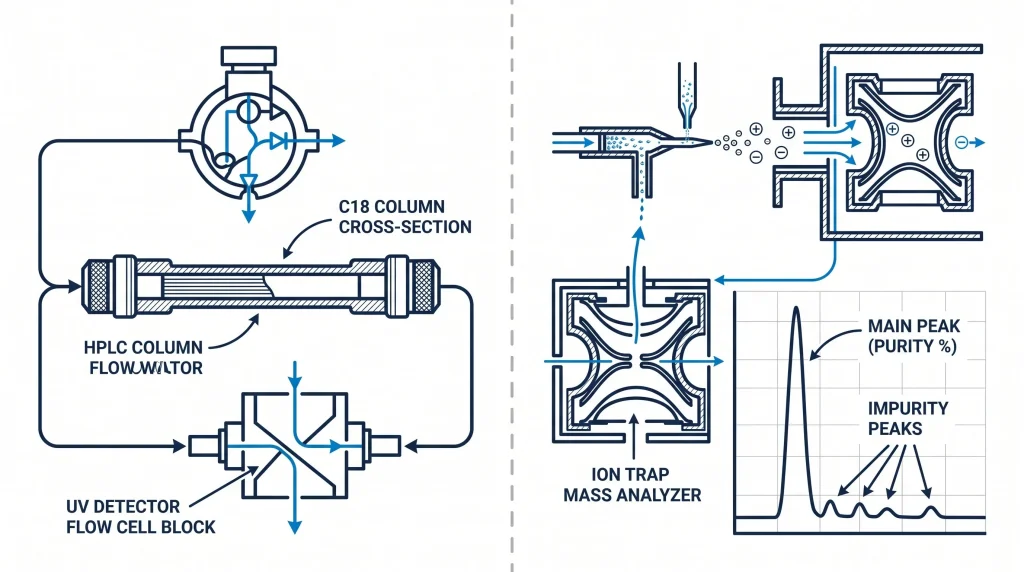
HPLC measures purity by passing the sample through a column filled with a stationary phase. Each component interacts with the column material at a different rate. This produces different retention times for each component. The detector records this as a chromatogram with one peak per detected substance.
Purity percentage is the area under the main peak divided by the total area of all peaks. A narrow, isolated main peak with few shoulder peaks indicates high purity. According to NCBI (2020), HPLC area-percent purity is the standard measure for synthetic peptide purity. The method is precise. But it cannot confirm whether the target peak is the correct peptide or a compound with a similar retention time.
Tirzepatide HPLC results appear on the COA with the chromatogram and area-percent purity for that lot.
What Does Mass Spectrometry Confirm?
Mass spectrometry confirms a peptide’s identity by ionizing the sample. It measures the mass-to-charge ratio of the resulting ions. This m/z value is compared to the theoretical molecular weight of the target sequence. A match within accepted tolerance confirms the compound as the intended peptide.
The instrument can also fragment the peptide and measure the resulting fragment ions. This fragmentation pattern maps the amino acid sequence. This is more detailed than molecular weight alone. According to Molecules (MDPI) (2020), fragmentation mass spec is standard for sequence verification of synthetic peptides above 10 amino acids.
BPC-157 mass spec results confirm the molecular weight and sequence of each lot before dispatch.
Why Are Both Methods Required?
Both methods are required because they measure different properties. HPLC reports purity. Mass spec reports identity. A high purity result means nothing if the compound is not the correct peptide.
This gap is real. A peptide with a synthesis error can show 99% HPLC purity if the error product separates cleanly. Mass spec would detect the wrong molecular weight in this case. Using only HPLC creates a risk of confirming a highly pure but incorrect peptide. Dual testing closes this gap. According to NCBI (2021), combined HPLC and mass spec verification is the standard practice for peptide release in research settings.
Can a Peptide Pass HPLC but Fail Mass Spec?
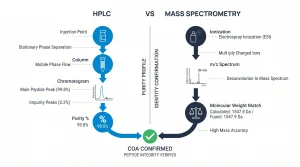
Yes. A peptide can show 99%+ HPLC purity but fail mass spectrometry. This happens when a synthesis error produces the wrong sequence. If the error product has similar hydrophobic properties, it separates cleanly in HPLC. The chromatogram shows a clean, single peak. But the peak represents the wrong peptide.
Mass spectrometry reveals the discrepancy. The measured m/z does not match the theoretical value for the intended sequence. This is a clear failure regardless of HPLC purity. The material must be rejected or resynthesized before it can be used in a study. Each lot must pass both HPLC and mass spec before it is released for sale.
How Do HPLC and Mass Spectrometry Compare?
The table below shows how the two methods differ across key parameters.
| Parameter | HPLC | Mass Spectrometry |
| What it measures | Purity percentage | Molecular identity (m/z) |
| What it proves | Target compound is dominant | Correct peptide sequence |
| What it misses | Cannot confirm identity | Cannot quantify purity |
| Output | Chromatogram (peaks) | Mass spectrum (m/z) |
| Standard result | ≥99% area percent | Exact m/z match |
| Required for COA? | Yes | Yes |
Both tests are listed on the COA for every lot. A document that shows only one test type does not meet the dual-method standard. Research teams should check for both data types before accepting any lot.
How Is Dual Testing Reflected on a COA?
A complete COA includes the HPLC chromatogram with area-percent purity and the mass spec m/z data. The HPLC section shows the purity percentage and the main peak retention time. The mass spec section shows the measured m/z and the theoretical value for the target.
Some COAs also include tandem mass spec (LC-MS/MS) data. LC-MS/MS fragments the peptide and maps the amino acid sequence. This is a higher standard of confirmation than single-stage mass spec. It verifies not just the molecular weight but the order of residues in the chain. Browse COA-verified research peptides at Next Level Pharm, each with HPLC and mass spec data on every lot.
Frequently Asked Questions
What does HPLC measure in a peptide sample?
HPLC measures purity by separating the sample components based on their interaction with a column stationary phase. Each component elutes at a different retention time. The area under the main peak, divided by the total area of all peaks, gives the purity percentage. This tells researchers how much of the sample is the target compound versus impurities. It does not confirm whether the target compound is the correct peptide.
What does mass spectrometry confirm?
Mass spectrometry confirms the identity of a peptide by measuring its mass-to-charge ratio. This measured value is compared to the theoretical molecular weight for the intended sequence. A match within accepted tolerance confirms the compound is the correct peptide. Fragmentation analysis (LC-MS/MS) goes further by mapping the amino acid sequence. This is the most definitive form of peptide identity confirmation available.
Why are both HPLC and mass spectrometry required?
HPLC and mass spectrometry measure different properties. HPLC shows how pure the sample is. Mass spec shows what the sample actually is. A highly pure but incorrect peptide would pass HPLC and fail mass spec. Both tests together confirm that the material is both the correct compound and of sufficient purity for research use. Both tests are needed to rule out a compound that is pure but incorrect.
Can a peptide pass HPLC but fail mass spectrometry?
Yes. A peptide with a synthesis error can show high HPLC purity if the error product separates cleanly from other components. The HPLC chromatogram shows one clean peak. But the mass spec reveals a molecular weight that does not match the target. This scenario demonstrates why HPLC alone is not sufficient for full verification. Both tests must pass before a lot can be confirmed as research-grade material.
What does dual-method verification prove?
Dual-method verification proves that the sample is both the correct compound and sufficiently pure. HPLC proves purity. Mass spec proves identity. Together they rule out two major failure modes: an impure sample and an incorrect sample. A COA that carries both results is the minimum documentation standard for research peptides. A document with only one test type is incomplete. Either test alone leaves a gap that dual verification closes.
What is a typical purity level for research-grade peptides?
Research-grade peptides typically target 98% purity or higher by HPLC area percent. Some applications require 99% or above for sensitive assays. Next Level Pharm maintains a minimum of 99% for all lots, with an average of 99.4% across the last 100 batches. This level ensures that impurities remain below detectable limits for most research protocols. The HPLC purity value on the COA is the reference figure for each specific lot.
How is a COA generated after dual testing?
After HPLC and mass spec are run on the batch, the lab compiles the results into a COA document. The HPLC section shows the chromatogram and purity percentage. The mass spec section shows the measured m/z and the theoretical value for the target. The lot number ties both results to the specific batch. Every batch is third-party tested..
Does storage affect HPLC purity over time?
Yes. Peptides exposed to moisture, heat, or light can degrade over time. Degradation products appear as new peaks on the HPLC chromatogram. This lowers the area-percent purity of the main peak. Lyophilized (freeze-dried) peptides are more stable in storage. They should be kept in a dry, cool environment to maintain the purity level listed on the original COA. Reviewing the original COA date at receipt confirms the purity is current.
Summary
HPLC and mass spectrometry each verify a different property of a research peptide. HPLC measures purity by separating sample components. Mass spec confirms identity by molecular weight. A complete COA must include both for full verification. Using either test alone leaves a gap that can allow an incorrect or impure compound to go undetected.
What Should You Do Next?
When reviewing a COA, confirm both the HPLC purity percentage and the mass spec m/z value are present. Check that the HPLC purity is at or above 99%. Verify that the m/z matches the theoretical value for the target peptide. If only one test appears, request the missing result before use. Browse dual-verified research peptides with both HPLC and mass spec data on every lot.
People Also Read
- What Makes a Peptide Research Grade? Standards and Testing Explained
- BPC-157 Mechanism of Action: What Research Shows
About the Author
Next Level Pharm Research Team
The Next Level Pharm research team is composed of biochemists and laboratory scientists dedicated to providing researchers with the highest-purity, COA-verified research peptides available. Every batch is HPLC and mass spec verified before dispatch.
Disclaimer: The information provided on this page is for educational and research purposes only. Next Level Pharm’s products are intended for laboratory research use only. They are not intended for human consumption, diagnostic, therapeutic, or medicinal purposes. This content does not constitute medical advice. Always consult a licensed healthcare professional before making any health-related decisions.