
Acetate vs TFA Salt Form in Peptide Research

Last updated: July 2026
A peptide salt form is the counterion paired with a peptide to hold it in solid state after synthesis. This creates a stable, lyophilized (freeze-dried) powder for research use. Researchers must account for the counterion. It affects the net peptide mass in each vial. TFA (trifluoroacetate) and acetate are the two most common forms. According to Molecules (MDPI) (2020), TFA is significantly more membrane-active than acetate at the same concentration.
Next Level Pharm provides COA-verified research peptides for laboratory use. Each vial is tested by HPLC and mass spec. Both confirm identity and purity. Average purity holds at 99.4% across the last 100 batches. The salt form and counterion type appear on every COA.
Salt form selection depends on the research application. Acetate is favored for cell-based assays due to its mild chemical profile. TFA is the default from standard HPLC purification. The sections below compare both forms. They explain how each affects assay design.
Key Takeaways
- Salt Form Origin: Acetate and TFA enter the peptide during HPLC purification. Both remain bound to the peptide chain in the final lyophilized powder.
- Chemical Difference: Acetate is mild and biocompatible in cell assays. TFA is a strong acid that can lower pH and stress cell cultures at higher concentrations.
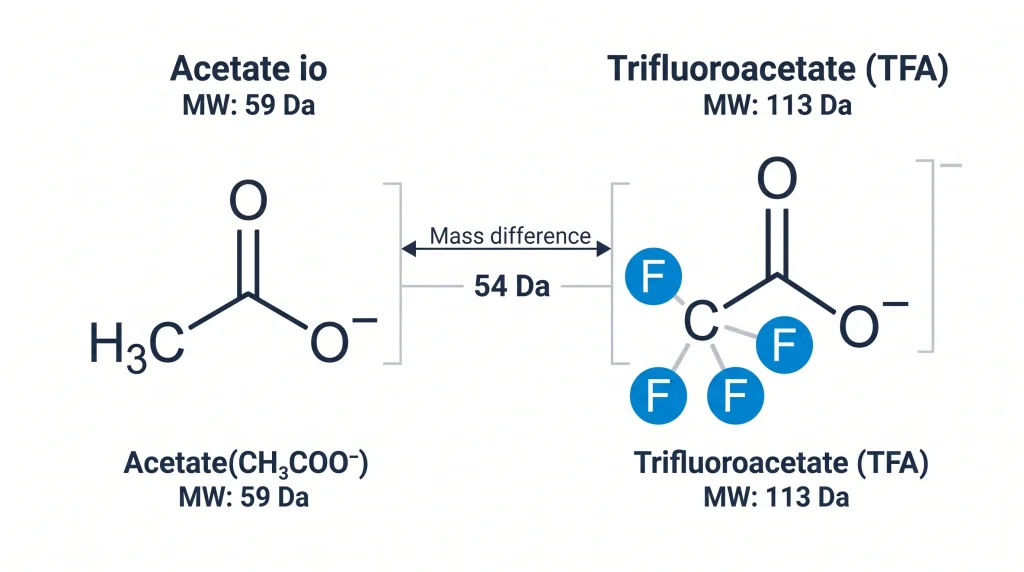
- Net Peptide Content: Counterion mass adds to labeled vial weight. Because TFA is heavier (113 Da vs 59 Da for acetate), TFA-form vials have lower net peptide content per labeled milligram.
- COA Documentation: The COA lists the specific counterion and the net peptide content percentage. Researchers use this to calculate the true active mass.
- Salt Exchange Option: TFA can be replaced with acetate via salt exchange when the assay requires a milder counterion. This step reduces TFA load but adds processing time.
The following sections cover each of these points in more detail. They focus on how salt form choice affects assay accuracy and how to read the COA data.
What Is a Peptide Salt Form?
A peptide salt form is the ionic state of a peptide after it pairs with a counterion during purification. Most lab peptides are basic molecules with charged amino acid residues. They require an acid counterion. This creates a stable, powdered solid. Without this, the peptide remains unstable and difficult to store.
HPLC purification introduces the counterion during the mobile phase. The acid pairs with the charged sites on the backbone. The result is a salt form. It persists through the freeze-drying process. Both acetate and TFA are common choices at this stage. According to Journal of Peptide Science (2018), salt conversion is a standard method for securing peptide integrity during final processing.
BPC-157 and other research peptides at Next Level Pharm are tested by IC and NMR to confirm the counterion type on the COA.
How Do Acetate and TFA Counterions Differ?
Acetate (CH3COO-) is a mild, naturally occurring anion. It is biocompatible and well tolerated in most biological assay systems. TFA (CF3COO-) is a strong synthetic acid. Its molecular weight is higher than acetate. It is more reactive. It can disrupt biological membranes at low concentrations.
TFA is the standard counterpart from RP-HPLC purification. It works well for synthesis and isolation but may not suit cell-based work. Acetate is preferred for in vitro studies where pH and cell health must stay stable. According to NCBI (2019), TFA residues in peptide stock solutions can interfere with cell membrane function at concentrations far below those of acetate.
Why Is Acetate Preferred for Cell-Based Research?
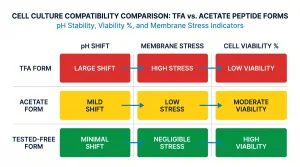
Acetate is preferred for cell-based research because it does not alter the pH or membrane state of the culture medium. TFA is acidic. It can lower pH in the well if not fully buffered. This pH shift changes the baseline environment and can affect cell viability or signaling.
At sub-millimolar levels, TFA may suppress cell growth. It can also alter uptake rates. Acetate shows no such effect at typical research dilutions. Researchers who switch from TFA-form to acetate-form peptides often see more stable baseline results. According to NCBI (2021), controlling for residual TFA is a standard quality step in quantitative cell-based peptide assays.
Does Salt Form Change Net Peptide Content?
Salt form directly changes net peptide content. Each counterion has a different molecular weight. TFA has a molecular weight of 113 Da. Acetate has a molecular weight of 59 Da. This 2x mass difference means TFA-form vials hold less active peptide per labeled milligram.
For example, a 10mg TFA-form vial may hold 8.1mg of active peptide. The same 10mg vial in acetate form may hold 8.8mg. Researchers who ignore this will miscalculate stock concentrations. The COA net content percentage corrects for this gap. According to NCBI (2018), always applying the net content correction from the COA is required for accurate molar concentration calculations in quantitative studies.
How Is Salt Form Listed on a COA?
The COA (Certificate of Analysis) lists the counterion type alongside HPLC purity and net peptide content. The counterion field specifies whether the batch is TFA form, acetate form, or another salt. The net content field gives the active peptide percentage per total weight. Researchers use both values to find the exact active mass for their assay.
Some COAs include IC (ion chromatography) or NMR data. These quantify the counterion. These measurements confirm the TFA or acetate percentage by weight. This data is separate from HPLC purity. HPLC only measures the peptide sequence quality. Tirzepatide COA records at Next Level Pharm include the salt form and net content for every lot.
How Do the Two Salt Forms Compare for Research Use?
The table below compares TFA-form and acetate-form peptides across key research parameters.
| Parameter | TFA Form | Acetate Form |
| Counterion molecular weight | 113 Da | 59 Da |
| Net peptide content (typical) | 80 to 90% | 88 to 95% |
| HPLC purification default | Yes | Requires exchange |
| pH impact in cell media | Lower (more acidic) | Minimal |
| Cell culture compatibility | Lower at high levels | Higher |
| Additional processing needed | No | Salt exchange required |
TFA is the default in most catalog peptides. It requires no extra processing. It also achieves high HPLC purity. Acetate form requires a salt exchange step but delivers better compatibility for cell work. The right choice depends on the assay and its acid sensitivity.
Frequently Asked Questions
What Is a Peptide Salt Form?
A peptide salt form is the ionic compound formed when a peptide base pairs with a counterion during purification. Most lab peptides are basic and need an acid to form a stable solid. The salt keeps the peptide stable in lyophilized powder form. Acetate and TFA are the two most common counterions in research-grade peptide lots. The specific form is listed on the COA for every batch.
How Do Acetate and TFA Salts Differ?
Acetate is a mild, naturally occurring anion that is well tolerated in biological systems. TFA is a strong synthetic acid used in HPLC purification. TFA has a higher molecular weight (113 Da vs 59 Da for acetate). This means TFA adds more non-active mass per ion. According to Molecules (MDPI) (2020), TFA is also more membrane-active than acetate, which matters in cell assay design.
Why Is Acetate Preferred for Cell-Based Work?
Acetate does not lower the pH of cell culture media at standard research dilutions. TFA can acidify the well and stress or damage cell cultures at higher loads. Using acetate form avoids this variable. It ensures that the observed results reflect the peptide’s activity, not the counterion’s effect. Most cell assay protocols specify acetate form when buffer compatibility is a concern.
Does Salt Form Change Net Peptide Content?
Yes. The counterion molecular weight determines how much of the labeled mass is active peptide. TFA (113 Da) adds more mass per ion than acetate (59 Da). A 10mg TFA-form vial may hold only 8.1mg of active peptide. The same vial in acetate form may hold 8.8mg. Always apply the COA net content percentage to correct for this difference. Skipping it leads to dosing errors in assay work.
How Is Salt Form Listed on a COA?
The COA specifies the counterion type, usually as TFA salt, acetate salt, or HCl salt. It also lists the net peptide content as a percentage of total powder weight. These two values let researchers calculate the exact active peptide mass per labeled milligram. IC or NMR data may also appear to confirm the counterion mass fraction. This is the primary document for verifying lot composition before any assay.
Can TFA Be Removed from a Sample?
Yes. TFA can be removed via salt exchange. This replaces TFA counterions with acetate or another mild anion. The process uses repeated lyophilization with an acetate buffer or an ion-exchange resin. Each cycle displaces TFA and replaces it with acetate. The number of cycles depends on the TFA load in the original lot. Salt exchange adds processing time but is worth it for acid-sensitive cell assays.
Does Salt Form Affect Stability or Solubility?
Salt form influences both solubility and storage stability. Certain counterions help keep hydrophobic sequences dissolved in aqueous solvents. Some forms are less prone to oxidation or aggregation over time. TFA form tends to be more stable during long-term, room-temperature storage. Acetate form may absorb moisture faster in some environments. Check the COA for lot-specific storage notes when switching between salt forms.
What Is a Counterion in Peptide Chemistry?
A counterion is the anion paired with the positively charged groups on a peptide. Basic amino acids like lysine, arginine, and histidine carry positive charges. These must be balanced by a negative ion to form a stable, neutral salt. TFA and acetate are both negatively charged anions that fill this role. The counterion type is set during the final purification stage.
Is a 99% Purity Score Affected by Salt Form?
No. HPLC purity measures the peptide sequence quality, not the salt content. A vial with 99% HPLC purity can still carry 12 to 18 percent TFA by total mass. HPLC does not detect inorganic anions like TFA or acetate. Net peptide content from the COA accounts for both the peptide and the counterion. Reviewing both values gives a complete picture of each lot’s composition.
Summary
Acetate and TFA are the two most common salt forms in research peptides. TFA is the default from HPLC purification. It adds more non-active mass per ion. Acetate is milder, more biocompatible, and preferred for cell-based assays. The COA lists the counterion type and net content for every lot. Researchers should review both values before preparing any stock solution.
What Should You Do Next?
Check the COA for each lot before building a stock solution. Confirm the counterion type. Use the net content percentage to find active peptide mass. If the assay needs low acid input, request or select an acetate-form peptide. Browse COA-verified research peptides at Next Level Pharm with lot-specific salt form and net content data.
People Also Read
- What Makes a Peptide Research Grade? Standards and Testing Explained
- GHK-Cu Research Explained: What Peer-Reviewed Studies Show
About the Author
Next Level Pharm Research Team
The Next Level Pharm research team is composed of biochemists and laboratory scientists dedicated to providing researchers with the highest-purity, COA-verified research peptides available. Every batch is HPLC and mass spec verified before dispatch.
Disclaimer: The information provided on this page is for educational and research purposes only. Next Level Pharm’s products are intended for laboratory research use only. They are not intended for human consumption, diagnostic, therapeutic, or medicinal purposes. This content does not constitute medical advice. Always consult a licensed healthcare professional before making any health-related decisions.