
How Is BPC-157 Reconstituted? A Research Guide

Last updated: July 2026
BPC-157 reconstitution converts freeze-dried powder into a liquid sample for lab assays. A lab adds a sterile solvent to the vial to reach the right sample level. Research shows BPC-157 holds its structure in gastric fluid for over 24 hours. This result supports its use in long assay designs. This stability profile makes it a common target for structural peptide research.
Next Level Pharm supplies COA-verified research peptides for labs. Its range covers 70-plus active peptide SKUs across 7 study areas. Every vial is tested by HPLC and mass spec to confirm identity and purity. Average purity holds at 99.4% across the last 100 batches. All compounds ship as freeze-dried powders sealed under an inert gas. This keeps the material stable at room temp with no cold chain needed.
This supply approach helps labs plan assays with a steady, known material. Access to a COA with each order lets researchers log findings with confidence. The research focus stays on how the peptide interacts with cell signals. Verified material is a core need for keeping test variables separate. Careful supply control limits the chance of error in study data. Researchers choosing compounds for stability studies benefit from access to batch-specific COA data and lot numbers. This traceability supports both internal audits and regulatory documentation requirements.
Key Takeaways
- Freeze-Dried Form: BPC-157 ships as a dry, freeze-dried powder to hold its structure. The powder needs a liquid solvent before any lab work can begin.
- Standard Solvent: Bacteriostatic water (BAC water) is the common diluent for this process. It has 0.9% benzyl alcohol to block microbe growth in multi-use vials.
- Gentle Mixing: A researcher must add the solvent down the inner vial wall. A direct stream can damage the fragile bonds of the peptide.
- Level Calculation: Divide the total peptide mass by the final liquid volume to get the sample level. Record this number for all future draws from the vial.
- Cold Storage: Mixed vials must stay cold at 2-8 degrees C. Keep them from direct light to slow the decay of the compound.
The next sections cover the full protocol for BPC-157 lab prep. They detail storage needs, mixing steps, and factors that affect data quality.
What Materials Are Needed for BPC-157 Reconstitution?
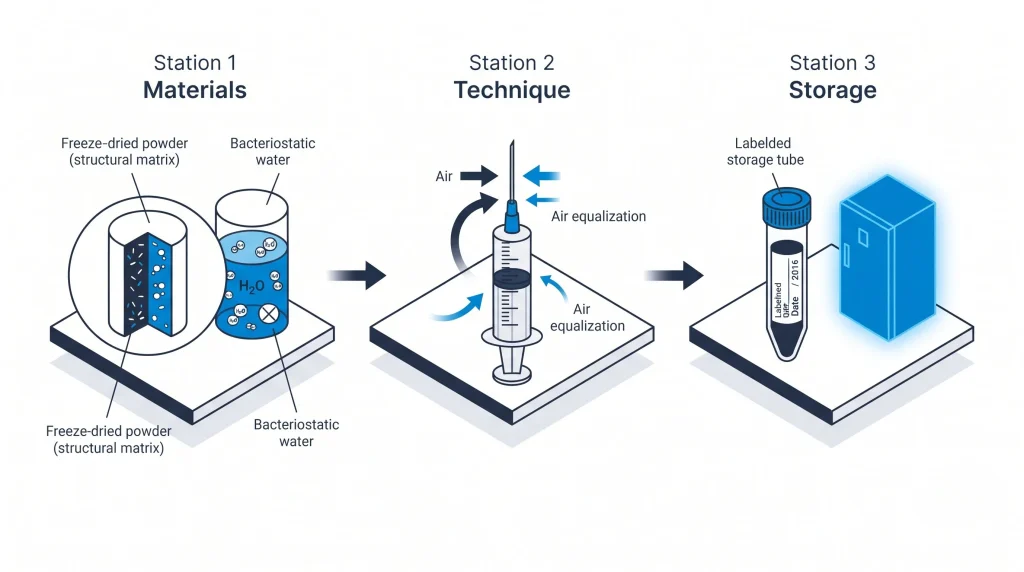
Mixing BPC-157 requires a freeze-dried vial of the peptide, a sterile solvent, and a calibrated lab syringe. These tools work together to reach a stable, usable sample level. A calibrated syringe is key because it controls the final peptide level. Exact volumes lead to steady draws across all assay phases. Accuracy at this stage limits errors that could hurt study results. Next Level Pharm supplies BPC-157 as a COA-verified research peptide. Each lot is tested by HPLC and mass spec. According to NCBI (2013), BPC-157 holds its form when mixed in BAC water under sterile lab conditions.
The standard solvent is BAC water, which contains 0.9% benzyl alcohol. This alcohol blocks microbe growth in multi-use vials. It helps keep the mixed sample stable during the study period. A calibrated syringe allows for the exact ratio to reach the target level. Researchers note that wrong ratios can skew findings. All steps should be done in a clean area to block outside impurities. Proper care at the start protects the quality of all collected data. Laboratory conditions, including ambient temperature and air circulation, can affect contamination risk. Researchers standardize all preparation conditions to support reproducibility across multiple experiments.
How Is Diluent Volume Determined for a Vial?
Choosing diluent volume means picking the liquid amount that creates the target sample level. Researchers pick this volume based on the peptide mass in the vial. The goal is a level that makes it easy to draw exact sample sizes. Controlling the ratio of solvent to peptide keeps accuracy high across all phases.
For example, adding 2mL of BAC water to a 10mg vial creates a level of 5mg/mL. This simplifies math: 0.1mL of the solution holds exactly 500mcg of the peptide. According to NCBI (2015), precise volume is a key step for assay repeat results in research labs. Steady volumes help limit errors when handling small amounts in recurring tasks.
What Is the Step-by-Step Reconstitution Process?
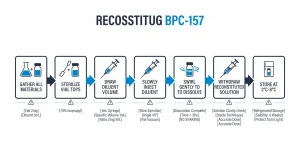
The mixing process follows a clean lab protocol to protect the sample. It starts by wiping the rubber vial stopper with an alcohol swab. A researcher then draws the set volume of solvent into the lab syringe. The needle is placed into the vial, and the solvent is slowly let in.
The needle must angle so the liquid runs down the inner vial wall. This stops the solvent from hitting the freeze-dried powder directly. Direct force can damage the delicate chain of the peptide. Once the liquid is in, the vial should be gently swirled until the powder melts. A researcher must never shake the vial, as rapid motion disrupts the delicate peptide chain. Slow, steady swirling keeps the peptide intact for all study tasks. Researchers may browse the full recovery catalog to view specs and COA data.
How Should Reconstituted BPC-157 Be Handled?
A mixed BPC-157 sample needs gentle care. The peptide is fragile in liquid form and can break down from physical force. Keeping its chain form is vital for accurate lab results. Next Level Pharm supplies this compound with a COA that confirms purity per lot.
Hard shaking can break delicate peptide bonds. This makes the compound inactive and unfit for research. When drawing from the vial for an assay, all motion must be slow. Deliberate moves protect the peptide form during the study. According to NCBI (2018), mechanical stress during sample handling is a top cause of assay error in research labs. Keep the vial steady at all times.
How Is Reconstituted BPC-157 Stored for Stability?
For peak stability, a mixed BPC-157 sample must stay cold at 2-8 degrees C. This range keeps the peptide intact after it moves from a dry to a liquid state. The vial should also sit in a dark space. Direct light can trigger photo-decay in the compound. Researchers often keep vials in the original box or a light-proof case.
Under these conditions, research shows the sample stays stable for several weeks. Freezing the mixed sample is not advised because freeze-thaw cycles can damage the peptide chain. Repeated temp changes make the sample unstable and affect the validity of later test results. This affects the validity of later test results. A steady cold storage spot is the most reliable way to protect the sample.
What Are Signs of Improper Reconstitution or Spoilage?
Key warning signs include a cloudy or off-color liquid, visible particles, or powder that will not dissolve. A correct sample should be clear and colorless. Any cloudiness or floating bits points to impurity or decay. If the solution is not clear, discard it. Its quality cannot be confirmed for research use. Catching these issues early stops bad samples from entering study data.
Even a clear liquid can hide tiny clumps if handling or storage is poor. These fragments often cannot be seen without special lab tools. Researchers should inspect vials under a bright light to check for clarity. If any odd signs appear, the sample is unfit for lab use. Strict physical checks at each prep stage protect the validity of all test data.
What Are Standard BPC-157 Lab Prep Parameters?
The table below lists standard parameters for BPC-157 reconstitution in a research setting. Researchers use these values as a baseline for designing in vitro assay protocols. Adjustments may depend on the requirements of the study design and the target concentration.
| Parameter | Standard Value | Notes |
| Diluent | BAC water | 0.9% benzyl alcohol |
| Volume for 10mg vial | 2mL | Creates 5mg/mL level |
| Sample level per 0.1mL | 500mcg | For standard assay use |
| Cold storage temp | 2-8 degrees C | Keep away from light |
| Dry shelf life | Up to 2 years | At room temp, sealed |
| Mixed shelf life | Several weeks | Cold storage only |
Frequently Asked Questions
How is BPC-157 supplied for research?
The compound is supplied as a freeze-dried powder in a vacuum-sealed vial. This dry state removes moisture to limit chemical decay and ensure room-temp stability. Each vial is sealed under inert gas to keep the peptide stable until a solvent is added. This form is standard for research peptides that must be stored before lab use.
What diluent volume is standard for a 10mg vial?
While volume is the researcher’s choice, 2mL of BAC water is a common pick for a 10mg vial. This ratio creates an easy level: each 0.1mL holds 500mcg of the compound. Some researchers pick a different volume to match the needs of their assay. The chosen volume must always be recorded to keep results steady across all samples.
How is concentration calculated per unit?
The sample level is found by dividing the total peptide mass by the total solvent volume added. For a 10mg vial mixed with 2mL of BAC water, the result is 5mg per mL. That equals 500mcg per 0.1mL. This math is a basic need in any lab protocol. Steady units throughout the math limit errors and improve the quality of data.
Why is BPC-157 dissolved slowly down the vial wall?
Adding the solvent down the inner wall protects the peptide chain. If the liquid hits the powder directly, it causes force on fragile molecular bonds. Running the stream along the wall lets the solvent wet the powder gently. This ensures a complete and even melt. This technique stops clumps and limits decay when the stream strikes with force. Researchers who apply this technique consistently achieve better sample uniformity. This uniformity is especially important when running multiple assays from a single vial.
How should mixed BPC-157 be stored?
Once in liquid form, the vial must stay cold at 2-8 degrees C. Keep it in a dark spot or opaque case to block light decay. Proper cold storage keeps the sample stable for several weeks. Researchers track these conditions to ensure each sample stays steady throughout the study. Keeping a written log of storage conditions for each vial supports reproducibility across long-term laboratory investigations.
Can sterile water be used instead of BAC water?
Sterile water lacks the microbe-blocking agents found in BAC water, which has 0.9% benzyl alcohol. Any sample mixed with plain sterile water can grow microbes fast if not used in one session. Researchers often prefer BAC water for multi-use vials to maintain sterility over time. The choice depends on the protocol and the planned study timeline.
What does lyophilization mean for peptides?
Lyophilization freeze-dries a substance by pulling water out under a vacuum. This lets the peptide go from liquid to a stable dry powder without high heat. Heat often breaks delicate peptide chains. So this process is the most reliable way to store the compound until use. The powder is then sealed under inert gas to block oxygen and moisture.
What are the signs of improperly mixed or spoiled BPC-157?
Signs of spoilage include cloudiness, a yellow tint, or sediment in the vial. A good mixed sample should be clear and free of particles. If the liquid is cloudy, the sample is compromised and must not be used. Researchers do a visual check under a bright light before each assay. Turbidity is a technical term for cloudiness that signals protein aggregation or precipitation. Researchers record any turbidity as part of their quality verification process.
What happens if you shake the BPC-157 vial instead of swirling it?
Shaking adds physical stress that can unfold the peptide chains. Fast motion creates air-liquid interfaces where proteins may form tiny clumps. These clumps can affect test accuracy and may cause errors in lab tools. Proper technique is gentle swirling or slow rolling to dissolve the powder without bubbles. Sub-visible particles from aggregation cannot be detected by standard visual inspection alone. Advanced analytical instruments are required to identify them in a laboratory setting.
Summary
BPC-157 reconstitution is a standard lab step that converts freeze-dried powder into a liquid for assays. BAC water is the common solvent, used in precise volumes to reach a set sample level. The key steps are sterile prep, slow solvent addition down the vial wall, and gentle swirling. After mixing, the sample must be stored cold at 2-8 degrees C in a dark space. Cloudiness or sediment in the mixed sample signals decay and means the vial must be discarded.
What Should You Do Next?
Researchers planning BPC-157 assays should confirm their solvent supply and cold storage setup. Review the batch COA to verify HPLC and mass spec results before mixing. Browse COA-verified, freeze-dried BPC-157 and related recovery peptides at Next Level Pharm.
People Also Read
- BPC-157 vs TB-500: A Detailed Research Comparison Guide
- BPC-157 Mechanism of Action: A Research-Based Explainer
About the Author
Next Level Pharm Research Team
The Next Level Pharm research team is composed of biochemists and laboratory scientists dedicated to providing researchers with the highest-purity, COA-verified research peptides available. Every batch is HPLC and mass spec verified before dispatch.
Disclaimer: The information provided on this page is for educational and research purposes only. Next Level Pharm’s products are intended for laboratory research use only. They are not intended for human consumption, diagnostic, therapeutic, or medicinal purposes. This content does not constitute medical advice. Always consult a licensed healthcare professional before making any health-related decisions.