
Matrixyl Research: Palmitoyl Pentapeptide Studies

Last updated: July 2026
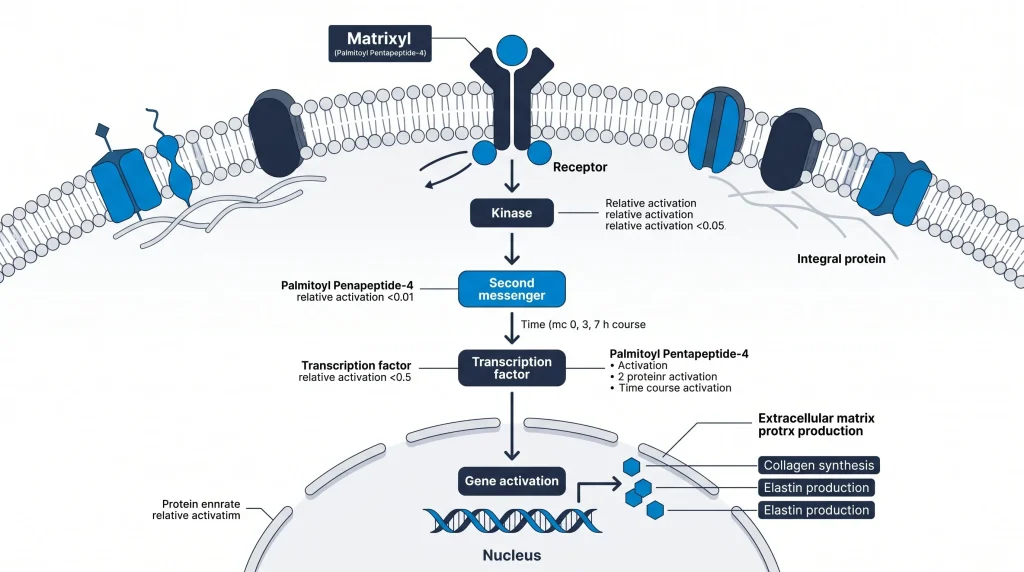
A matrixyl peptide research compound is a lab-made fragment from human pro-collagen I. Researchers study its effect on the protein networks around cells. This substance mimics a messenger peptide. It signals cells to make more proteins in skin. Lab studies show that adding palmitoyl pentapeptide-4 boosts collagen I output by 212%. Collagen IV also increases by up to 327% (PubMed, 2002). These findings show how lab-made peptide fragments work with cell signals in lab settings.
Next Level Pharm keeps a research-grade supply with 99.4% purity across 100 batches. The lab team runs HPLC and mass spec tests on every vial. These checks ensure accuracy. The compounds are freeze-dried and sealed under inert gas. They stay stable at room temperature and don’t need cold-chain transport. Every order includes a COA copy for full lot tracking.
Next Level Pharm stocks 70+ peptides across seven categories. Researchers can build custom study steps for collagen and skin cell testing. Standard prep steps help researchers get steady results. These materials ship from USA storage in about 48 hours. Next Level Pharm focuses on giving steady access to high-purity lab materials. These materials are made only for confirmed research sites and academic study.
Key Takeaways
- Lab-Made Peptide: Matrixyl is the trade name for palmitoyl pentapeptide-4, a lab-made fragment of pro-collagen I. It copies natural collagen signal sequences in skin.
- Cell Signal Method: The peptide works as a matrikine to signal skin cells for more collagen and fibronectin output. This direct interaction may shift how skin builds proteins. According to Paccola et al. (2025), cosmeceutical peptide research continues to clarify how signal chains influence dermal remodeling in laboratory assessments.
- Fat Chain for Reach: Adding a fat acid chain boosts the peptide’s ability to cross the lipid skin barrier. This change helps the molecule reach target cell sites.
- Lab Evidence: Multiple studies report reduced wrinkle depth and shifts in skin texture metrics. These findings compare the peptide’s effects versus control groups in lab settings.
- Newer Peptide Forms: Newer versions like Matrixyl 3000 and Matrixyl Synthe’6 use different peptide chains for specific targets. These forms let researchers track complex protein work.
The sections below examine the cell mechanics behind signal peptides. Their results in lab models and detailed assessments provide essential context. This research examines how specific chains drive protein output and skin cellular action.
What Is Matrixyl (Palmitoyl Pentapeptide-4)?
Matrixyl is the trade name for palmitoyl pentapeptide-4, a lab-made peptide fragment from pro-collagen I. It serves as a signal molecule in tests on cell-level protein markers. Its makeup consists of a pentapeptide chain attached to a palmitoyl compound. This boosts its ability to enter lab cell cultures.
The exact sequence, known as the KTTKS sequence (Lys-Thr-Thr-Lys-Ser), acts as a cell messenger. Research names this peptide a matrikine. It is a fragment of a protein that sends messages to cells. By copying natural peptide fragments from collagen, it tells the cell to shift its action in lab models. The molecule is built to study the signal pathways involved in collagen output and tissue support. Palmitoyl pentapeptide-4 is offered as a COA-verified lab peptide. Every lot gets verified by HPLC and mass spec.
How Does Matrixyl Signal Collagen Output?
Matrixyl works as a matrikine that signals skin cells to make and control cell-level protein parts (ECM). Matrikines are active peptide fragments from the break-down of ECM proteins. They act as chemical messengers, sending info to skin cells about the state of the protein setting. When found, these messages push the cells to start repair processes.
This signal pathway ramps up the output of key proteins in the tissue setting. According to Tałałaj et al. (2019), cellular signal chains promote measurable rises in collagen types I and III output. Research also documents effects on collagen type IV production. Research also shows an increase in fibronectin output. Fibronectin is a protein that aids in cell joining and tissue work.
Matrixyl 3000 is offered as a COA-verified lab peptide. Every lot gets verified by HPLC and mass spec.
Higher output of these proteins lets the ECM keep its protein framework. By pushing the natural output of collagen and fibronectin, researchers can shift the density of the skin layer in lab models. The signal process keeps ECM makeup steady by moving protein levels based on cell need. Steady results rest on the exactness of the peptide messages sent to skin cells.
Does Palmitoylation Improve Absorption?
Adding a palm fat group to a peptide boosts its fat-based nature. This lets the molecule become more fat-soluble. This process, called palmitoylation, shifts how a peptide talks with cell layers during lab tests. Raising the fat-solubility is a common tool to help researchers see how peptides work in specific cell settings.
Better fat-solubility is thought to boost a peptide’s ability to cross the top lipid layer of skin. This is the skin’s top fat barrier. Once the peptide gets past this dense layer, it can reach target sites like skin cells in deeper layers. This lipid barrier often stops big polar molecules from getting through. This shift in chemistry is a tool for rising movement across skin tissue.
Beauty Peptides are offered as COA-verified lab peptides. Every lot gets verified by HPLC and mass spec. By shifting these chemical traits, researchers gain more detail on tissue penetration.
What Do Human Lab Studies Report?
Human lab studies report clear gains in skin look metrics through double-blind, control-based trials. These tests focus on measuring shifts in protein markers in deeper skin layers. Data from such studies let researchers see how exact peptides shift skin traits in lab settings. By setting active groups next to those getting a fake treatment, experts keep high marks for getting plain facts on skin shifts
Published research shows these effects clearly. Based on a 2013 study in the Dermatologic Therapy journal, people showed clear drops in wrinkle depth and size over weeks. The study also tracked skin roughness, noting good shifts in top texture next to fake-treatment groups. Researchers use these sight and body metrics to track how exact peptide chains work with skin tissue. Copper Peptide GHK-Cu is offered as a COA-verified lab peptide. Every lot gets verified by HPLC and mass spec. Such findings give a clear baseline for those tracking tissue upkeep.
How Does Its Method Differ From GHK-Cu?
Matrixyl works mainly as a signal peptide that targets the output of cell-level protein parts. GHK-Cu acts as a broad carrier peptide that binds to copper atoms. As a matrikine, Matrixyl sends chemical messages to skin cells to boost the output of collagen and fibronectin directly. This focus is on protein output for tissue upkeep. In contrast, GHK-Cu shows a wider, multi-step method that involves moving copper atoms and broad gene shifts. This peptide talks with genes tied to immune action and many proteins in tissue.
Matrixyl and GHK-Cu are each offered as COA-verified lab peptides. Every lot gets verified by HPLC and mass spec. By shifting gene shifts in many pathways, GHK-Cu shapes many cell functions at once. Lab work from NCBI (2015) shows that GHK-Cu gives broad shifts of these cell messages. Matrixyl stays more focused for the skin matrix through its message role.
What Are Next-Gen Matrixyl Peptides?
Next-gen Matrixyl peptides are custom forms that mix distinct peptide chains to target exact pathways in skin makeup and repair messages. These mixes aim to give lab models exact tools for seeing how message molecules shift the cell-level protein network. By using set peptide links, researchers can track how exact protein fragments talk with cell sites to shift protein output.
Matrixyl 3000 has two main chains: palmitoyl tripeptide-1 and palmitoyl tetrapeptide-7. These molecules are tested for their roles in message methods that guide tissue upkeep and repair. In contrast, Matrixyl Synthe’6 is based on palmitoyl tripeptide-38. This peptide focuses on wider message networks meant to hold up the power of protein parts. Based on the Journal of Peptide Science (2014), the shift of these exact pathways is vital for seeing cell shifts in many states.
Matrixyl 3000 and Matrixyl Synthe’6 are offered as COA-verified lab peptides. Every lot gets verified by HPLC and mass spec. Each type offers unique chains for message tests.
Frequently Asked Questions
What Is Matrixyl?
Matrixyl is a trade name for palmitoyl pentapeptide-4, a lab-made peptide chain. It has five amino acid pieces joined to a palmitoyl part. This aids its ability to cross fat barriers. In lab tests, it is often studied for its role in cell messages. Facts suggest this chain copies segments of type I collagen. It may function as a message molecule in the cellular protein network, signaling new protein output.
How Does Palmitoylation Improve Skin Reach?
Palmitoylation involves adding a fat acid, chiefly palm fat, to the peptide chain. This shift boosts the fat nature of the molecule. It lets the molecule cross the fatty layers of cell layers more easily. Based on the Journal of Peptide Science (2014), shifting peptides with fat chains clearly boosts their strength and uptake in test cell models. This shields the peptide from early break-down during travel.
What Do Collagen Output Tests Show?
Lab tests on the KTTKS chain show its power to push skin cells to build protein parts. These tests show that the peptide well copies the break-down bits of collagen. When skin cells find these bits, they reply by making more pro-collagen, fibronectin, and clear acids. According to Gomes et al. (2022), this message loop is a primary focus for laboratory researchers. Studies examine how the cellular protein network maintains its structural composition.
How Does It Match With GHK-Cu?
While both compounds are well-tested as message molecules, they differ in their main routes and makeup. GHK-Cu acts as a copper-binding peptide that shifts gene output and cell messages. Matrixyl works mainly via the KTTKS pentapeptide chain. The Journal of Peptide Science (2014) shows that these peptides target distinct cell messages to shift tissue upkeep. Researchers often track them to learn how different routes shift the depth of protein parts.
What Do Control Tests Report?
Control tests on palmitoyl pentapeptide-4 check shifts in tissue depth and look after long study. Facts show that the peptide can shift the marks of skin makeup via steady push of skin cells. Based on NCBI (2007), lab facts show that people reply to the use of these peptides with shifts in the look of fine lines. The exact message power shifts based on single test models and study time.
Is Matrixyl tied to Argireline (acetyl hexapeptide-8)?
Matrixyl and Argireline use different methods in the skin’s cell makeup. Matrixyl acts as a matrikine, sending messages for the output of protein parts. Argireline is built to block brain message release at the nerve link. They do not share the same chain or cell goal. Tests often track them side-by-side to learn their single shifts on cell messages and protein makeup in the cell-level protein setting.
What is the role of the KTTKS sequence in lab tests?
The KTTKS pentapeptide acts as an exact signal for cell upkeep and protein output. It happens by nature a bit when collagen type I goes through enzyme break-down. By bringing in outside KTTKS to the test setting, scholars copy these nature-based break-down messages. This signal prompts skin cells to initiate a maintenance cycle. Higher production of critical protein components supports cellular protein network integrity.
Do tests tell apart Matrixyl 3000 and Synthe’6?
Labs tell apart these compounds by their unique peptide chains and aimed message routes. Matrixyl 3000 has palmitoyl tripeptide-1 and palmitoyl tetrapeptide-7. They target skin upkeep and immune marks. Synthe’6 holds palmitoyl tripeptide-38. It is tested for its power to spark six key parts of the cell-level protein network. Though they share a trade name, their chemistry and target sites for protein help in tissue are not the same.
What does “matrikine” mean in lab tests?
In lab tests, a matrikine is a matricryptin. It is a break bit of the cell-level protein network that sends cell info to nearby cells. These peptides act like chemical messages that tell the cell about its area. When found, they spark exact cell shifts. Matrixyl fits as a matrikine since it copies the natural messages sent during collagen break-down, pushing the cell to start a make-up output.
Are there live-body tests on Matrixyl’s shifts?
Live-body tests show that palmitoyl pentapeptide-4 shows clear shifts in build steps in skin. Lab tests show that the peptide reaches the target skin cell group and sparks the output of pro-collagen I. Lab tests noted in NCBI (2007) help the fact that top use leads to shifts in deeper skin layers. These tests stay key for checking how matrikines move from theory message agents to clear body shifts in cell sets.
Summary
Check your inner lab logs to find the exact peptide chains that fit your current test goals. Set these facts next to the given purity marks to check they meet the marks needed for your model. Make sure your lab is set for the storage of freeze-dried materials as you track your test steps.
Next Level Pharm holds up your lab by giving checked material with clear lot tracking. Researchers getting these peptides can view the list at shop.
What Should You Do Next?
Researchers investigating palmitoyl pentapeptide-4 mechanisms can access research-grade beauty peptides at the lab. Each batch carries a certificate of analysis and lot number for full traceability. The research catalog lists COA-verified cosmeceutical peptides for laboratory use. For background on the supplier, visit the About page.
- Review the current Certificate of Analysis for each compound.
- Set up lab conditions appropriate for collagen biosynthesis studies.
- Document baseline protein output metrics before beginning peptide exposure protocols.
People Also Read
- GHK-Cu Research Explained: What Peer-Reviewed Studies Show
- What Are Longevity Peptides? A Complete Research Review
About the Author
Next Level Pharm Research Team
The Next Level Pharm research team is composed of biochemists and lab scientists dedicated to providing researchers with the highest-purity, COA-verified research peptides available. Every batch is HPLC and mass spec verified before dispatch.
Disclaimer: The information provided on this page is for educational and research purposes only. Next Level Pharm’s products are intended for lab research use only. They are not intended for human consumption, diagnostic, therapeutic, or medicinal purposes. This content does not constitute medical advice. Always consult a licensed healthcare professional before making any health-related decisions.