Why Third-Party Testing Matters for Peptides

Last updated: July 2026
A third-party peptide testing program is an independent lab review of peptide identity, purity, and batch records. The lab has no tie to the supplier. It reviews a peptide for purity, identity, and structural accuracy. The two main tools are HPLC (high-performance liquid chromatography, a separation method) and mass spectrometry (a tool that measures exact molecular mass). According to the Journal of Peptide Science (2012), unverified compounds can vary 10% or more in purity across batches.
Next Level Pharm is a US-based supplier of research-grade peptides, verified to ≥99.4% purity by HPLC and mass spectrometry on every batch. Each lot ships with a COA and a lot number for full traceability.
Research-grade peptides must meet strict purity standards. A compound below stated purity can give results that are hard to repeat. Third-party testing provides an independent check of the supplier’s in-house data.
Key Takeaways
- Independent review matters: Third-party testing confirms purity with no conflict of interest from the supplier.
- HPLC sets the purity baseline: HPLC separates a peptide from impurities and gives a purity percentage.
- Mass spec confirms identity: Mass spectrometry checks the exact molecular mass against the target compound.
- COA-verified lots: Next Level Pharm ships lyophilized peptide lots with HPLC and mass spec data on every batch. Each lot has a traceable number.
- Research use only: All peptides in this catalog are for laboratory research use only. No clinical outcomes are claimed.
What Is Third-Party Peptide Testing?
Third-party peptide testing is an independent purity and identity check run by a lab with no supplier affiliation.
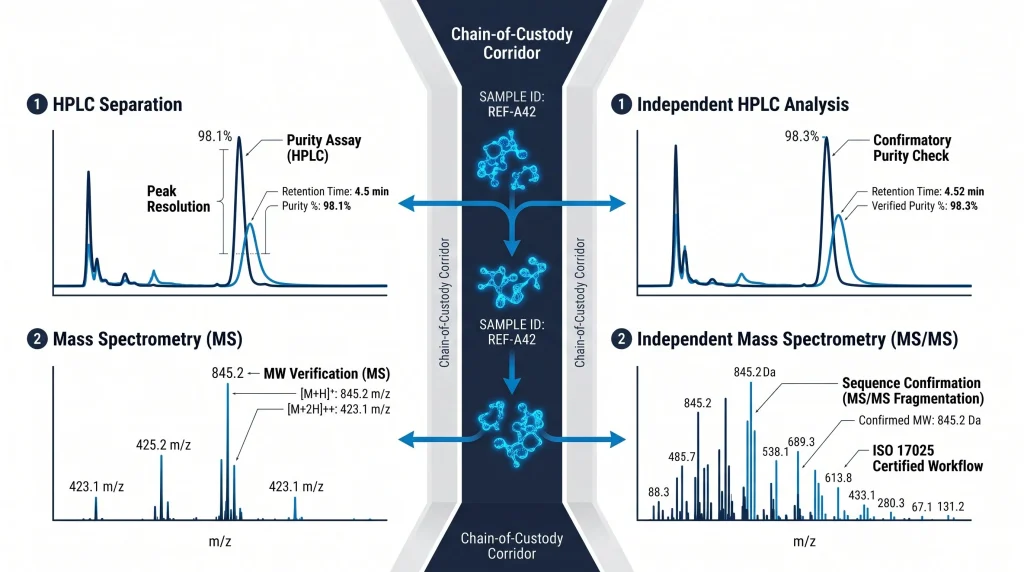
Third-party testing means a lab outside the supply chain reviews the compound. The lab gets a sample from the same production lot. It runs HPLC and mass spec on that sample. It checks the results against the stated specs. If the compound meets the specs, the lab issues a certificate of analysis (COA). The COA lists purity, molecular mass, and the lot number.
Without third-party testing, a supplier’s in-house data is the only quality check. In-house labs have a financial interest in passing their own lots. An independent lab has no such interest. Researchers who need consistent, reproducible data rely on third-party COAs.
According to Huff et al. (2004), peptide purity affects in vitro assay outcomes. Compounds below 95% purity can give inconsistent results in receptor binding studies. The accepted floor for research use is ≥98% purity by HPLC.
| Testing Type | Who Runs It | Conflict of Interest | COA Issued By |
| In-house | Supplier’s own lab | Yes | Supplier |
| Third-party | Independent lab | No | External lab |
| Dual-verified | Both labs | Minimal | Both |
What Does HPLC Reveal About Peptide Purity?
HPLC measures what fraction of a sample is the target compound and gives a purity percentage.
HPLC pushes a dissolved sample through a column under high pressure. The column separates the target peptide from impurities. A UV detector tracks each compound as it exits. The result is a chromatogram, a graph of peaks. The target peptide peak area divided by total peak area gives the purity percentage.
A purity of ≥99% means the target compound makes up at least 99% of the sample. Impurities can include truncated sequences, oxidized forms, and residual synthesis reagents. Each impurity shows as a separate peak. Third-party labs measure all peaks. They do not filter out small peaks. This makes their data more reliable than a quick in-house check.
Key HPLC parameters follow these standards.
- Column type: reversed-phase C18 is standard for most research peptides.
- Detection: UV at 214 nm detects peptide bonds across all amino acid types.
- Mobile phase: acetonitrile and water gradient, with TFA modifier.
How Does Mass Spectrometry Confirm Peptide Identity?
Mass spec measures the exact molecular mass and confirms the correct peptide was synthesized.
Mass spectrometry (MS) measures the mass-to-charge ratio (m/z) of ions in a sample. For peptides, the result is the molecular mass in daltons. Researchers compare this measured mass to the theoretical mass of the target sequence. If the values match within 0.1 Da, the compound is confirmed as the correct peptide.
Mass spec catches errors that HPLC misses. Two peptides can have the same size and charge but different sequences. HPLC would not separate them well. Mass spec measures mass directly and reveals the difference. A compound that passes HPLC but fails mass spec has an identity error. That kind of error can ruin a study if caught late.
According to Smart et al. (2007), combined HPLC and mass spec verification reduces identity errors in synthetic peptide lots. Single-method testing is not enough for research-grade quality assurance.
What Information Does a COA Provide for Research?
A COA lists the lot number, purity, molecular mass, and test methods for each peptide batch.
A certificate of analysis (COA) records all test results for a specific lot. It must state the lot number, peptide name, purity percentage (HPLC), measured molecular mass (mass spec), and test dates. Each lot number links the document to a specific production batch. Researchers cite the lot number to confirm they are using the same material in their study.
A good COA also lists the testing lab, the instrument type, and the test method. These details let another lab reproduce the purity check if needed. Without this information, the COA is just a number on a page.
Check each COA for these five items.
- Purity percentage ≥99% by HPLC.
- Measured mass within 0.1 Da of theoretical mass.
- Test method listed (RP-HPLC C18, for example).
- Lot number matches the vial label.
- Third-party lab name and accreditation listed.
How Is In-House Testing Different from Third-Party?
In-house testing is run by the supplier. Third-party testing is run by an independent lab with no supplier tie.
In-house testing means the supplier runs its own HPLC and mass spec. The data never leaves the supplier’s facility. There is no external check. The supplier decides what passes and what fails. This creates a conflict of interest. If a lot fails, the supplier loses money. An in-house lab may re-run tests or adjust thresholds.
Third-party labs have no financial stake in the outcome. They run the same methods on the same sample. Their results go directly to the research buyer. The researcher can compare the third-party COA to the supplier’s in-house data. If both match, confidence in the lot is high.
Browse BPC-157 and GHK-Cu product pages for lot-specific COA and mass spec data verified by independent labs.
What Research Tools Support Third-Party Testing Research?
Answer capsule: HPLC systems, mass spectrometers, and COA-verified peptide lots are the core tools for testing-focused research.
Research teams need a verified peptide lot to run any study. The lot must match the published reference standard for molecular weight and purity. Next Level Pharm verifies each peptide lot by HPLC and mass spectrometry before shipping. Standard tools include a reversed-phase HPLC system with a C18 column and UV detection at 214 nm. An ESI mass spectrometer and a reference COA for the target compound are also needed. View the research peptide catalog for lot-specific COA and mass spec data.
Frequently Asked Questions
What is third-party peptide testing?
Third-party peptide testing is a purity and identity check run by an independent lab. The lab has no tie to the supplier. It runs HPLC to measure purity and mass spectrometry to confirm molecular mass. Results are recorded in a certificate of analysis (COA). The COA lists the lot number, purity percentage, and measured mass. This process provides an unbiased review of peptide quality. It is required for reproducible research results.
Why is HPLC used in peptide quality control?
HPLC gives a direct purity percentage for a peptide sample. The method separates the target compound from impurities using a pressure-driven column. A UV detector measures each compound as it exits. The area of the target peak divided by total peak area gives purity. This method is fast and reproducible. It can detect impurities at very low levels, often below 0.5% of the sample. HPLC is listed in pharmacopeial guidelines as the standard method for peptide purity testing.
What does a COA include for research peptides?
A COA for a research peptide includes the lot number, peptide name, and purity by HPLC. It also lists the molecular mass by mass spectrometry, the test dates, and the testing lab name. It may also list the column type used for HPLC and the ionization method used for mass spec. The lot number is the key identifier. It links the COA to a specific batch. Researchers cite the lot number so others can trace the exact material used in their study.
What is the difference between purity and identity testing?
Purity testing measures how much of a sample is the target compound. Identity testing confirms that the compound is actually the right molecule. HPLC gives purity. Mass spectrometry gives identity. A sample can pass a purity test but still be the wrong compound if two peptides look the same by HPLC. Mass spec catches this because it measures molecular mass directly. Both tests are needed for full quality assurance of any research peptide.
What is the acceptable purity level for research peptides?
The accepted floor for research-grade peptides is ≥98% purity by HPLC. Many labs require ≥99% for receptor binding or cell-based assays. Below 95% is not suitable for reproducible research because impurities can alter results. Average batch purity is ≥99.4% across the last 100 lots tested. Researchers should request a COA for the specific lot received and confirm purity matches the stated spec before starting any experiment.
Can in-house testing replace third-party testing?
In-house testing can complement third-party testing but should not replace it for research use. A supplier’s own lab has a financial interest in passing lots. This can bias results. Third-party labs have no stake in the outcome. Their results are independent. For research that will be published or that requires reproducible data, a third-party COA is the preferred standard. Some frameworks require third-party verification for any research compound used in a formal study.
What is mass spectrometry used for in peptide testing?
Mass spectrometry (MS) identifies a peptide by measuring its exact molecular mass in daltons. The instrument ionizes the compound and measures mass-to-charge ratio. The result is compared to the theoretical mass of the target sequence. If values match within 0.1 Da, identity is confirmed. MS can also detect oxidation and deamidation, changes that alter mass and affect peptide behavior in lab assays. Third-party MS testing catches errors that HPLC alone cannot detect.
How often should peptide lots be tested?
Each production lot should be tested before release. A lot is a single production batch. Different lots of the same peptide can have different purity levels. Retesting is needed if a lot is stored for a long time or exposed to poor conditions. Lyophilized peptides (freeze-dried compounds) are stable at room temperature during shipping. Cold storage after receipt extends shelf life. Researchers should check lot numbers when switching vials to confirm consistency.
What is the role of lot numbers in peptide traceability?
A lot number links a peptide vial to its production batch and its COA. When a researcher cites a lot number in their methods section, another lab can request the same lot or COA to verify the source. This is key to reproducible science. Without lot numbers, comparing results across labs is hard. If a supplier does not provide lot numbers, researchers cannot trace the compound back to a specific quality check. Lot numbers are a minimum standard for any research-grade peptide supplier.
Summary
Third-party peptide testing gives researchers an independent check on purity and identity. HPLC measures purity as a percentage. Mass spectrometry confirms molecular identity. Together, these two tests form the basis of any COA from a verified supplier.
Third-party labs have no financial stake in passing a lot. That independence is the key advantage over in-house testing. Researchers who need consistent, publishable data should always request a third-party COA with a confirmed lot number.
Next Level Pharm verifies every peptide lot by HPLC and mass spec before shipping. Average batch purity is 99.4% across the last 100 lots. Each COA is accessible by lot number for full traceability.
What Should You Do Next?
Researchers should review the independent COA before starting any experiment. Confirm that reported purity and measured mass match the stated peptide and lot. Record the testing lab, test date, and vial lot number in the protocol file. Researchers sourcing these lab peptides can shop research peptides with full COA and lot traceability.
People Also Read
- BPC-157 Research: Peptide Purity and Lab Verification
- GHK-Cu Research: Copper Peptide Quality Standards
About the Author
Next Level Pharm Research Team
Alex M covers peer-reviewed findings in peptide science for Next Level Pharm, a US-based supplier of research-grade peptides verified to ≥99% purity via HPLC and mass spectrometry on every batch.
Disclaimer: For research purposes only. Not intended for human consumption. Next Level Pharm products are not intended for diagnostic, therapeutic, or medicinal use. This content does not constitute medical advice. Always consult a licensed healthcare professional before making any health-related decisions.