
Peptides and the Hypothalamic-Pituitary Axis

Last updated: July 2026
A hypothalamic pituitary axis peptides study is a lab model of compounds that signal along the brain-gland pathway controlling growth hormone (GH) release. The hypothalamus sits at the base of the brain. It sends short chemical pulses to the pituitary gland. The pituitary responds by releasing GH into the blood. Research peptides that act on this chain are called GH secretagogues or GHRH analogs. According to PubMed (2006), GHRH analogs like CJC-1295 can extend GH pulse output in lab models for up to 14 days.
Next Level Pharm stocks research-grade GH axis peptides. Every vial is batch-tested to at least 99% purity by HPLC and mass spectrometry. A certificate of analysis (COA) ships with each order.
The HPA axis is one of the most studied hormone systems in peptide research. GHRH analogs and GH secretagogues let labs probe this axis at two distinct receptor points. Knowing how each compound works helps researchers pick the right tool for each study design.
Key Takeaways
- Two-Stage Signal Chain: The hypothalamus sends GHRH (growth hormone-releasing hormone) to the pituitary. The pituitary releases GH. Research peptides can act at either stage.
- GHRH Analogs: Compounds like CJC-1295 and Sermorelin mimic natural GHRH. They bind the GHRH receptor on pituitary cells and trigger a cAMP cascade that releases GH.
- GH Secretagogues: Ipamorelin and GHRP-2 bind the ghrelin receptor (GHS-R1a). They amplify GH pulse output through a different receptor than GHRH analogs use.
- Half-Life Differences: Natural GHRH breaks down in minutes. Modified analogs like CJC-1295 with DAC bind serum albumin and stay active for days. This suits longer study windows.
- Pulsatile GH Pattern: GH is released in pulses. Research designs must account for pulse timing. Secretagogues can be timed to probe specific pulse windows in lab models.
- COA-Verified Supply: All GH axis peptides are lyophilized and ship with a COA. Lot numbers link to online purity records for each batch.
These six points frame the sections below. Each section covers one part of the HPA axis peptide research landscape in detail.
What Is the Hypothalamic-Pituitary Axis?
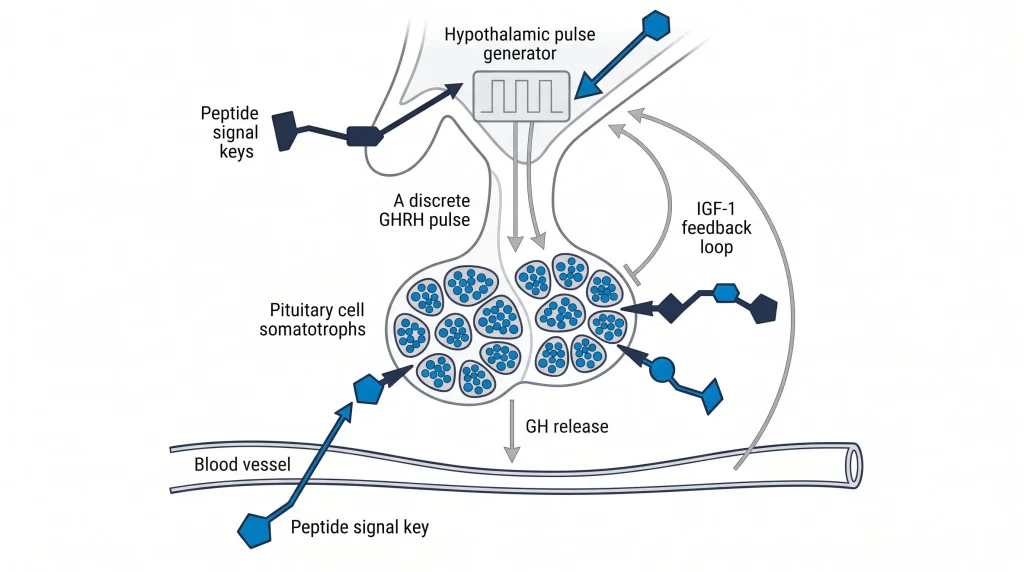
The hypothalamic-pituitary axis is the hormone link between the brain and the pituitary gland. The hypothalamus sends GHRH pulses a few millimeters to the pituitary. Pituitary cells called somatotrophs pick up this signal. They release GH into the blood. GH then acts on the liver to trigger IGF-1 (insulin-like growth factor 1) release. IGF-1 feeds back to slow future GH pulses.
This feedback loop keeps GH levels in a narrow range. Research models use this loop to study how peptides change pulse timing and output. Labs measure both GH and IGF-1 to track axis activity. Short bursts of GHRH from the hypothalamus create the natural pulsatile GH pattern seen in healthy lab animals.
How Do GHRH Analogs Signal the Pituitary?
GHRH analogs bind the GHRH receptor on pituitary somatotroph cells. Binding activates adenylyl cyclase. This raises cyclic AMP (cAMP) inside the cell. High cAMP activates protein kinase A (PKA). PKA triggers calcium influx and GH vesicle fusion with the cell membrane. GH is then released in a pulse.
Natural GHRH has a half-life of two to four minutes. Enzymes in the blood break it down fast. Synthetic analogs slow this breakdown. Sermorelin is the first 29 amino acids of GHRH. It holds full binding activity but clears quickly. CJC-1295 adds a Drug Affinity Complex (DAC) that binds serum albumin. According to PubMed (2006), CJC-1295 kept GH and IGF-1 elevated for up to 14 days in research models.
What Is CJC-1295 in Pituitary Research?
CJC-1295 is a synthetic GHRH analog with the DAC modification. The DAC group binds albumin, a carrier protein in the blood. This keeps CJC-1295 active much longer than natural GHRH. It extends the GH pulse window. This suits studies that need sustained GHRH receptor activity over many days.
In lab models, CJC-1295 is often paired with a GH secretagogue like ipamorelin. The pair acts at two different receptor sites. GHRH analogs act at the GHRH receptor. GH secretagogues act at GHS-R1a. Using both can amplify total GH pulse output. Browse CJC-1295 research vials at Next Level Pharm for COA-verified options.
How Does Ipamorelin Target GH Release?
Ipamorelin is a selective GH secretagogue. It binds GHS-R1a, the ghrelin receptor. Binding activates Gq protein signaling. This raises intracellular calcium and triggers GH vesicle fusion. Ipamorelin does not raise cortisol or prolactin in animal models. This sets it apart from older GH secretagogues. According to PubMed (1998), ipamorelin showed high GH selectivity in animal studies without cortisol co-release.
Ipamorelin’s clean signal profile makes it a useful research tool. Labs can probe GHS-R1a without triggering stress axis changes. This helps researchers isolate GH effects. Labs studying combined GHRH and GHS-R1a signals can pair it with Sermorelin. Browse ipamorelin peptide vials, each COA-verified and batch-tested by HPLC.
What Does Sermorelin Reveal in Studies?
Sermorelin is GHRH(1-29), the active 29-amino-acid fragment of natural GHRH. It binds the GHRH receptor with full activity. In lab models, Sermorelin triggers GH pulses in a level-linked pattern. The pulse profile it creates mirrors the natural GH release rhythm in study animals. Its shorter half-life (10-20 minutes) suits short-pulse study designs.
Labs use Sermorelin to test how the GHRH receptor responds to brief, natural-length signals. This complements CJC-1295, which suits longer study windows. According to PubMed (2009), Sermorelin is a reliable probe for pituitary GH output capacity in both young and aged lab models. Browse Sermorelin research vials. Each vial is HPLC-verified with a COA.
How Do These GH Axis Peptides Compare?
GH axis peptides differ by receptor target, half-life, and signal profile. Choosing the right compound depends on study design goals. Short-pulse studies need a fast agent. Extended studies need a compound with a long active window.
| Peptide | Receptor Target | Half-Life | Research Use |
| Sermorelin | GHRH receptor | 10-20 min | Short-pulse GH studies |
| CJC-1295 (no DAC) | GHRH receptor | ~30 min | Mid-length GH pulse studies |
| CJC-1295 (DAC) | GHRH receptor | 6-10 days | Extended GH axis studies |
| Ipamorelin | GHS-R1a | ~2 hours | Selective GH without cortisol |
| GHRP-2 | GHS-R1a | 1-2 hours | GH and cortisol axis mapping |
Labs often combine one GHRH analog with one GH secretagogue. This covers both major GH release pathways. Browse GHRP-2 research vials for the secretagogue side of this two-compound design.
Frequently Asked Questions
What is the hypothalamic-pituitary axis in peptide research?
The hypothalamic-pituitary axis is the brain-gland chain that controls growth hormone release. The hypothalamus sends GHRH pulses to the pituitary. Pituitary somatotroph cells release GH into the blood. GH then triggers IGF-1 from the liver, which feeds back to slow future pulses. Research peptides target this axis at two points: the GHRH receptor and the ghrelin receptor. Labs use these compounds to probe how the brain controls GH output in animal models.
What is GHRH and why is it a research target?
GHRH is growth hormone-releasing hormone, a 44-amino-acid peptide from the hypothalamus. It binds pituitary somatotroph cells and triggers GH release via a cAMP signal. Natural GHRH has a half-life of two to four minutes. Synthetic GHRH analogs like Sermorelin and CJC-1295 extend this signal. They let labs study GHRH receptor responses over longer time windows than natural GHRH allows. This helps researchers map GH axis responses to sustained receptor input.
How does CJC-1295 differ from Sermorelin in lab studies?
CJC-1295 has a DAC group that binds serum albumin and extends activity to days. Sermorelin is the first 29 amino acids of GHRH with a half-life of 10-20 minutes. Labs use Sermorelin for short-pulse studies and CJC-1295 for extended multi-day studies. Both bind the GHRH receptor on pituitary cells and trigger cAMP-mediated GH release. The choice depends on how long the study window needs to be and how many GH pulse events must be captured.
How does ipamorelin differ from GHRP-2 in receptor studies?
Both ipamorelin and GHRP-2 bind the GHS-R1a ghrelin receptor. GHRP-2 also triggers cortisol and prolactin release alongside GH. Ipamorelin is more selective and does not raise cortisol in animal models. This makes ipamorelin better for studies focused on the GH axis alone. GHRP-2 is better when research aims to map the full cortisol co-release pattern. Both are available as COA-verified, HPLC-tested research peptides with lot-specific purity records.
What is a GH secretagogue and how does it work?
A GH secretagogue triggers GH release by binding the ghrelin receptor (GHS-R1a) on pituitary cells. Binding activates Gq protein signaling. This raises intracellular calcium. Calcium triggers GH vesicle fusion with the cell membrane. GH is released into the blood. This mechanism differs from GHRH analogs, which use cAMP signaling. Using both receptor types in one study lets labs observe two distinct GH release pathways in the same model.
Why do labs combine GHRH analogs with GH secretagogues?
The two compound types act at different receptors. GHRH analogs act at the GHRH receptor via cAMP. GH secretagogues act at GHS-R1a via calcium. Using both covers two distinct GH release pathways. This can amplify total GH pulse output in research models. It also helps map how the two pathways interact. Labs use this approach to observe additive or synergistic effects at both receptor levels in controlled preclinical settings.
What is IGF-1 and how does it relate to GH axis research?
IGF-1 is insulin-like growth factor 1. The liver makes it in response to GH signals from the pituitary. IGF-1 then feeds back to the hypothalamus and pituitary to slow future GH release. In research, IGF-1 blood levels serve as a proxy for GH axis activity. Labs measure IGF-1 to track whether a GHRH analog or secretagogue is changing axis output over time. This gives a stable, measurable marker of sustained GH signaling in lab models.
What does pulsatile GH release mean for study design?
GH is released in pulses, not a steady flow. Peaks vary in timing and size. Research models must account for this. A secretagogue given at the wrong point in the pulse cycle may show blunted results. CJC-1295 with DAC extends the GH-primed window so more pulse events occur during the study. Sermorelin and ipamorelin must be timed more precisely to observe clear level-response patterns in animal models.
Which peptides are used to study the HPA axis in labs?
The main compounds are Sermorelin, CJC-1295, ipamorelin, and GHRP-2. Sermorelin and CJC-1295 are GHRH analogs that target the GHRH receptor. Ipamorelin and GHRP-2 are secretagogues that target GHS-R1a. Labs also study Hexarelin, a secretagogue with high GHS-R1a affinity. The choice of compound depends on receptor target, half-life, and study signal needs. All are available as COA-verified, HPLC-tested research peptides with lot-specific records.
Summary
The hypothalamic-pituitary axis is a two-stage hormone chain. The hypothalamus sends GHRH to pituitary somatotrophs. These cells release GH, which drives IGF-1 in the liver. IGF-1 feeds back to slow the next pulse. Research peptides target this axis at two points: the GHRH receptor and GHS-R1a.
GHRH analogs like Sermorelin and CJC-1295 act at the GHRH receptor. GH secretagogues like ipamorelin and GHRP-2 act at GHS-R1a. Labs often combine both types to cover both GH release pathways. Each compound offers a different half-life and signal profile for study design.
What Should You Do Next?
Researchers should define the study window and choose a short-pulse or extended GH-axis design. Match the peptide to the GHRH or GHS-R1a pathway under study. Review the COA and record HPLC purity, mass spec identity, and the lot number before each run. Researchers sourcing these lab peptides can shop research peptides with full COA and lot traceability.
Related research: ACTH 1-39 adrenal research, Tesamorelin (GHRH analog) research, and oxytocin neuropeptide research.
People Also Read
- CJC-1295 Research Compound: GHRH Analog for Lab Use
- Ipamorelin Research Compound: GH Secretagogue Studies
About the Author
Next Level Pharm Research Team
Alex M covers peer-reviewed findings in peptide science for Next Level Pharm, a US-based supplier of research-grade peptides verified to ≥99% purity via HPLC and mass spectrometry on every batch.
Disclaimer: For research purposes only. Not intended for human consumption. Next Level Pharm products are not intended for diagnostic, therapeutic, or medicinal use. This content does not constitute medical advice. Always consult a licensed healthcare professional before making any health-related decisions.