
PT-141 vs Kisspeptin-10: Sexual Research Compared

Last updated: July 2026
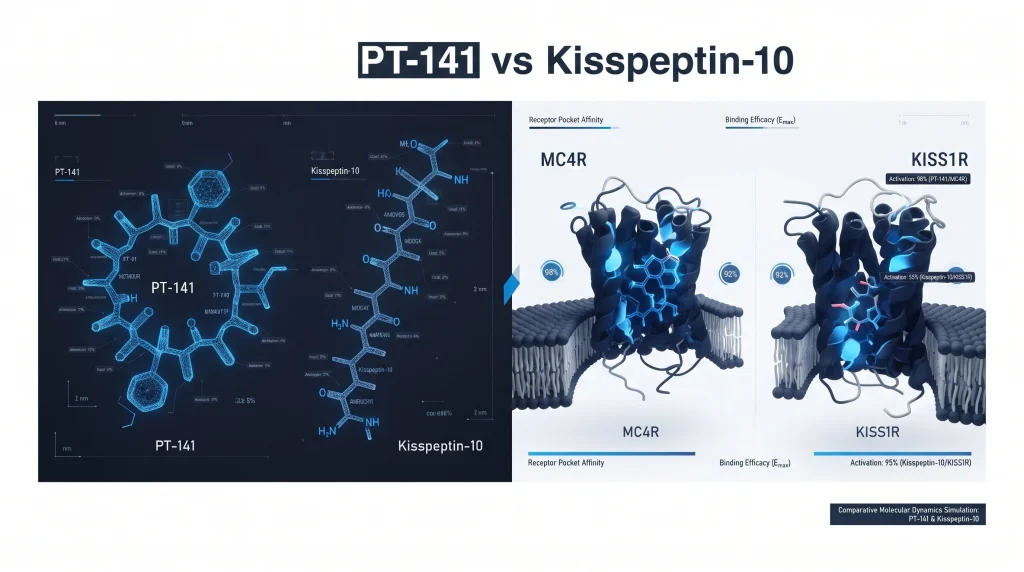
A PT-141 vs kisspeptin research review is a comparison of two compounds that act through different receptor systems. PT-141, also called bremelanotide, is a cyclic peptide that binds to melanocortin receptors in the brain. Kisspeptin-10 is a decapeptide that binds to the GPR54 receptor, also known as KISS1R, to drive hormone release. Both serve as lab tools for mapping the neuroendocrine system. Published research covers receptor binding, pathway steps, and hormone pulse patterns.
Next Level Pharm supplies COA-verified research peptides to labs worldwide. Each lot reaches ≥99% purity, with a 99.4% average across the last 100 batches. HPLC and mass spectrometry verify every vial. Compounds arrive lyophilized (freeze-dried) and stay stable at room temp. No cold-chain shipping is needed. Researchers get consistent materials for receptor binding studies and hormone research.
PT-141 and Kisspeptin-10 act on separate parts of the neuroendocrine system. PT-141 targets melanocortin signals in the brain. Kisspeptin-10 targets the hypothalamic-pituitary-gonadal (HPG) axis. The HPG axis links brain signals to hormone release. Knowing each compound’s receptor profile helps researchers isolate steps in these complex pathways. PT-141 data focuses on CNS arousal mapping. Kisspeptin-10 data focuses on upstream hormone control.
Key Takeaways
- Distinct Receptor Targets: PT-141 binds MC3R and MC4R receptors in the brain. Kisspeptin-10 binds only to the KISS1R receptor on GnRH neurons.
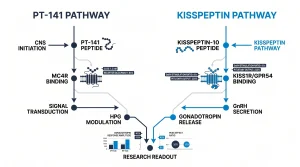
- Different Signaling Pathways: PT-141 engages the melanocortin pathway to model brain-based arousal signals. Kisspeptin-10 activates the HPG axis to study hormone pulse patterns.
- Structural Differences: PT-141 is a cyclic heptapeptide derived from alpha-MSH. Kisspeptin-10 is a linear decapeptide fragment of the full kisspeptin protein.
- Research Applications: PT-141 is studied in models of brain-based signal change. Kisspeptin-10 is studied in models of hormone feedback and endocrine coordination.
- Data Availability: Bremelanotide has a large peer-reviewed data set from formal research studies. Kisspeptin-10 research stays active in core reproductive endocrinology.
- COA Verification: Both peptides come as lot-verified compounds with HPLC and mass spectrometry docs.
These receptor differences shape how each compound works as a lab tool. The sections below compare the two peptides by pathway, preclinical data, systemic effects, and research scope.
What Is PT-141 (Bremelanotide)?
PT-141, also known as bremelanotide, is a synthetic analog of alpha-MSH. It is a cyclic heptapeptide that binds to MC3R and MC4R receptors in the brain. These receptors help coordinate brain signals tied to arousal-related neural activity.
PT-141’s action differs from peptides that alter blood flow. It acts on specific brain pathways rather than vascular systems. According to PubMed (2020), MC4R binding drives brain signals linked to arousal-related neural outputs. Researchers study this to map how melanocortin receptor binding starts downstream neural activity. Each lot is COA-verified with HPLC and mass spectrometry data on every vial.
The alpha-MSH analog structure of PT-141 was built to improve receptor targeting. Labs use it to probe how MC3R and MC4R differ in their roles within the arousal pathway. The cyclic structure adds stability in solution, which helps keep results consistent across repeated assays.
What Is Kisspeptin-10’s Mechanism?
Kisspeptin-10 is a decapeptide that binds to KISS1R, also called GPR54. This receptor sits on GnRH neurons in the hypothalamus. GnRH stands for gonadotropin-releasing hormone. Once Kisspeptin-10 binds to KISS1R, it triggers GnRH release. This starts a hormone cascade through the HPG axis.
GPR54 binding is the key first step in hormone coordination. According to PubMed (2020), kisspeptin neurons are main regulators of the pulsatile release of GnRH. This pulse pattern drives LH and FSH release from the pituitary. LH is a luteinizing hormone. FSH is a follicle-stimulating hormone. Researchers use Kisspeptin-10 to model this upstream step. Its short structure offers stability in cell assays.
How Do Their Receptor Targets Differ?
PT-141 and Kisspeptin-10 use entirely separate receptor systems. PT-141 binds MC3R and MC4R in the brain and starts a neural cascade through the melanocortin pathway. Kisspeptin-10 binds KISS1R on GnRH neurons and starts an endocrine cascade through the HPG axis. The two peptides share no receptor targets or downstream signals.
According to PubMed (2013), KISS1R binding is a key upstream step in the reproductive hormone axis. MC4R binding produces local neural effects tied to brain arousal signals. These differences let researchers study either the neural layer or the endocrine layer of hormone control. Each compound gives a clear handle for isolating steps in complex feedback systems.
Shop research peptides at Next Level Pharm
What Does Preclinical Research Show?
Preclinical studies on PT-141 use animal models to see how MC4R binding affects arousal-related signals. The peptide acts on the central nervous system, not on vascular systems. According to PubMed (2020), this binding shows the brain’s role in arousal control. Studies map how melanocortin receptor binding changes neural output in key brain regions.
Preclinical studies on Kisspeptin-10 focus on hormone output. Animal research shows GPR54 binding triggers LH and FSH release via the HPG axis. According to PubMed (2012), kisspeptin neurons are key for integrating sex steroid feedback. They also help maintain hormone pulses. Researchers build models to show how the upstream KISS1R signal drives the endocrine cascade.
Cell culture studies use small peptide doses to track how quickly GPR54 binding leads to GnRH output. This data helps researchers set the timing for in vitro hormone assays. Both peptide classes show reliable, repeatable results in well-controlled lab models.
Are There Differences in Systemic Effects?
Yes, each compound shows very different systemic effects due to separate receptor profiles. PT-141 acts on melanocortin receptors, which also coordinate metabolic signals and blood pressure. According to PubMed (2006), the broad melanocortin receptor profile can produce metabolic findings in lab studies. Researchers account for these wider effects when planning PT-141 protocols.
Kisspeptin-10 activity stays within the HPG axis. It targets KISS1R on hypothalamic neurons. Its effects focus on GnRH release and downstream hormones. It does not engage the metabolic or vascular pathways linked to melanocortin. This focused action lets researchers study hormone control without the extra variables seen in wider receptor systems.
These systemic differences matter for study design. Researchers using PT-141 should plan for metabolic variables. Researchers using Kisspeptin-10 can focus tightly on the hormone cascade. Each compound’s receptor profile defines the scope of what a study can measure.
Which Peptide Has More Research Data?
Bremelanotide has a large published data set. Formal studies cover its receptor binding, half-life, and CNS signaling profile. Multiple peer-reviewed papers map how MC4R binding drives measurable neural changes in research models. According to PubMed (2019), these studies give detailed data on MC4R agonists and central neural pathways. Browse the sexual health peptide research collection to see how this data guides current lab designs.
Kisspeptin research focuses on its role as the main upstream regulator of the HPG axis. Academic studies describe it as a key gatekeeper for hormone release. The Kisspeptin-10 data set keeps growing through early-stage animal and cell culture studies. Researchers can also explore the sexual health peptide category for more lab materials.
Researchers can view peer-reviewed literature on both compounds through PubMed. Searches by receptor name (MC4R, KISS1R) yield the most targeted results. Pairing compound names with a receptor gives the narrowest, most useful data set for protocol design.
PT-141 vs Kisspeptin-10: At a Glance
| Feature | PT-141 (Bremelanotide) | Kisspeptin-10 |
| Receptor target | MC3R, MC4R | KISS1R (GPR54) |
| Mechanism class | Melanocortin receptor agonist | Peptide receptor agonist |
| Pathway | Central melanocortin system | HPG axis |
| Half-life | Approx. 2.7 hours (research estimates) | Approx. 28 minutes (research estimates) |
| Primary research area | CNS arousal signal modeling | Reproductive neuroendocrine regulation |
Frequently Asked Questions
What is the difference between PT-141 and kisspeptin peptide?
PT-141 is a synthetic agonist of melanocortin receptors. It is used to study arousal signals in the brain. Kisspeptin acts on the HPG axis to study hormone release. PT-141 targets MC3R and MC4R to track neural signal changes. Kisspeptin acts as a peptide signal to influence hormone feedback loops. Research tells these two apart by receptor target and the type of signal each one drives. Both are lab-use peptides only.
How does PT-141 compare to kisspeptin in melanocortin receptor research?
PT-141 is made for high-affinity binding to MC3R and MC4R in the brain. Kisspeptin does not act on the melanocortin system. It binds only to KISS1R. Scientists use PT-141 to map melanocortin signals tied to arousal. They use kisspeptin to study the upstream control of GnRH. These two peptides hold separate roles in neuroendocrine signaling and share no receptor pathways. This makes each compound a clean tool for its specific research question.
Is PT-141 or kisspeptin more studied for reproductive neuroendocrine research?
Kisspeptin is the more studied compound for reproductive neuroendocrine research. According to PubMed (2012), kisspeptin neurons are key for linking sex steroid feedback to hormone pulses. PT-141 is studied for brain-based arousal signals in the central nervous system. Kisspeptin is the first choice when researchers want to track the full hormone cascade in the reproductive axis. Each compound fills a different lab role. Neither replaces the other in research design.
What is the primary mechanism of PT-141 in research models?
PT-141 binds to the melanocortin 4 receptor (MC4R) in the brain. By binding MC4R, the peptide mimics signals that drive arousal-related neural outputs. Research focuses on this action to see how brain signals start responses without altering blood flow. Scientists study this binding pattern to map how melanocortin pathways guide complex signals in lab models. The receptor-ligand step is the core of this research focus.
What is the role of the KISS1R receptor in kisspeptin’s function?
KISS1R, also known as GPR54, is the binding site for kisspeptin in the hypothalamus. When Kisspeptin-10 binds to KISS1R, it prompts the hypothalamus to release GnRH. This step is key for hormone coordination and pulse patterns. Without KISS1R binding, the downstream pathway stays quiet. Studies use this receptor interaction to see how peptide signals drive hormone pulses throughout the reproductive system.
Are PT-141 and Melanotan II structurally related?
PT-141 is a synthetic peptide derived from the Melanotan II sequence. Lab researchers changed the Melanotan II structure to isolate arousal-related signals while cutting skin-pigment effects. According to PubMed (2020), this change lets scientists target MC3R and MC4R without the wider melanocortin effects of unmodified agonists. The cyclic heptapeptide form of PT-141 gives it better receptor targeting than its parent compound.
How does Kisspeptin-10 relate to the full kisspeptin protein?
Kisspeptin-10 is a short fragment of the full kisspeptin protein. Research uses this decapeptide because it keeps the binding affinity needed to engage KISS1R in lab settings. Its short sequence offers stability and reliable results in cell assays. All key biological activity in endocrine research is carried by this active core fragment. It is the functional unit for studying GPR54 binding.
Do PT-141 and kisspeptin have different systemic effects in research?
PT-141 shows CNS-specific effects tied to arousal signal research. Kisspeptin shows systemic hormone changes through the HPG axis. PT-141 models show local activation in brain regions that handle arousal signals. Kisspeptin models show shifts in LH and FSH output. Researchers group these as central versus endocrine effects. PT-141 informs brain-signal studies. Kisspeptin informs research on reproductive hormone feedback systems. The key difference is receptor location in the body.
What purity standards apply to research peptides like PT-141 and Kisspeptin-10?
Research-grade peptides need strict purity checks to give valid lab data. Both PT-141 and Kisspeptin-10 should meet a 99% purity minimum. A COA (certificate of analysis) lists the lot number, purity result, and test method used. HPLC and mass spectrometry confirm purity on every lot. These two methods verify both structure and purity. Researchers should check each lot’s COA before starting a study. A 99.4% average across batches is a strong benchmark for supplier reliability.
Where can researchers source verified PT-141 and Kisspeptin-10?
Verified research-grade PT-141 and Kisspeptin-10 come from suppliers that provide HPLC and mass spectrometry COAs with every order. Compounds should arrive lyophilized to stay stable in transit. An online COA lookup lets researchers check purity before starting any study. Third-party testing in addition to in-house analysis is a key sign of a reliable supplier. Lot-level docs should cover both structural identity and purity percentage.
Summary
PT-141 and Kisspeptin-10 target separate receptor systems and serve different lab goals. PT-141 binds MC3R and MC4R in the brain to model arousal-related neural signals. Kisspeptin-10 binds KISS1R on GnRH neurons to study the upstream control of the HPG axis.
Choosing between them depends on the research model. Studies on brain-based arousal signals benefit from PT-141’s melanocortin pathway targeting. Studies on hormone pulse patterns and HPG axis control benefit from Kisspeptin-10’s focused KISS1R binding. Both come as COA-verified, lyophilized peptides with full lab documentation from Next Level Pharm.
Researchers should review lots of COAs and publish receptor data before choosing between them. The two peptides address different parts of neuroendocrine biology and work well in their respective research models.
What Should You Do Next?
Researchers should confirm whether the model targets melanocortin signaling or the GPR54-mediated HPG axis. Review receptor-binding studies and select assay controls that isolate the chosen pathway. Confirm HPLC purity, mass spec identity, and lot numbers before adding either compound to a protocol. Researchers sourcing these lab peptides can shop research peptides with full COA and lot traceability.
People Also Read
- What Is PT-141? Melanocortin Receptor Research Explained
- Kisspeptin-10 Research: GPR54 Receptor and Study Findings
About the Author
Next Level Pharm Research Team
Alex M covers peer-reviewed findings in peptide science for Next Level Pharm, a US-based supplier of research-grade peptides verified to ≥99% purity via HPLC and mass spectrometry on every batch.
Disclaimer: For research purposes only. Not intended for human consumption. Next Level Pharm products are not intended for diagnostic, therapeutic, or medicinal use. This content does not constitute medical advice. Always consult a licensed healthcare professional before making any health-related decisions.