
Sermorelin vs Ipamorelin: GH Research Compared

Last updated: July 2026
A sermorelin vs ipamorelin research review is a comparison of two peptide types that trigger GH (growth hormone) release through separate receptor pathways. Sermorelin is a 29-amino-acid piece of natural GHRH (growth hormone-releasing hormone). Ipamorelin is a five-amino-acid peptide. It acts as a selective ghrelin receptor agonist. Both are studied in lab settings to map the GH axis and compare release patterns. Research shows each peptide’s unique structure creates a distinct receptor binding profile.
Next Level Pharm gives both peptides as COA-verified (Certificate of Analysis) research materials. Each batch hits 99.4% purity across the last 100 batches. All vials are lyophilized (freeze-dried) and tested by HPLC (high-performance liquid chromatography) and mass spectrometry before dispatch. No cold-chain shipping is required. Labs can access per-lot COAs for each peptide to confirm purity and identity before any assay begins.
These two peptides draw research interest because they act on different receptor sites on the pituitary gland. Sermorelin binds GHRH receptors. Ipamorelin binds GHS-R1a (ghrelin receptor, type 1a). The receptor difference means each peptide gives a distinct hormone signal in lab assays. Studies use this contrast to isolate key signal pathways and map the GH axis.
Key Takeaways
- GHRH Analog vs. GHRP: Sermorelin mimics natural GHRH to bind pituitary GHRH receptors and trigger GH release. Ipamorelin is a GHRP (growth hormone-releasing peptide) that triggers GHS-R1a through the ghrelin pathway.
- Targeting Advantage: Ipamorelin triggers GH output without raising cortisol or prolactin in lab models. Sermorelin also keeps a clean hormone profile in most study conditions.
- Half-Life Difference: Sermorelin has a plasma half-life of about 10 to 12 minutes. Ipamorelin stays active for about two hours, which allows a wider study window in lab assays.
- Synergistic Effect: Research shows pairing a GHRH analog with a GHRP can boost GH output beyond what either peptide achieves alone. The two pathways act on separate receptor families.
- Natural-Release Profile: Sermorelin’s short action window mirrors the natural pulsed rhythm of GH release. This profile suits studies that need a true-to-life hormone model.
These differences help researchers pick the peptide that fits their study goals. The sections below cover receptor pathways, targeting data, half-life timing, and paired-pathway findings.
What Are Sermorelin and Ipamorelin?
Sermorelin is a lab-made analog of the first 29 amino acids of human GHRH. It is also called GRF 1-29 (growth hormone-releasing factor, residues 1 to 29). This piece carries the active binding site of the full hormone. It signals the pituitary to release stored GH through the standard GHRH cascade. Labs use it to study pituitary response and to model natural GH rhythms in controlled settings.
Ipamorelin is a research-grade five-amino-acid peptide and a selective ghrelin mimic. It binds GHS-R1a on the pituitary and hypothalamus. This binding triggers GH release without activating appetite pathways or raising cortisol levels. The peptide is COA-verified and batch-tested. Each lot is confirmed by HPLC and mass spectrometry. Its compact amino acid structure allows precise receptor targeting in fine assays. Both peptides are in the fitness and GH peptide catalog for labs studying GH release.
How Do Their Mechanisms Differ?
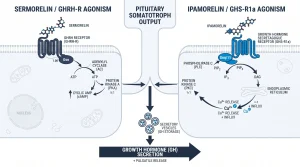
Sermorelin binds GHRH receptors on the pituitary. This triggers adenylate cyclase, raises cyclic AMP (cAMP) levels, and boosts GH release. The pulse mirrors the body’s natural hormone rhythm. This process suits studies that model native GH control and pituitary response across test points.
Ipamorelin binds GHS-R1a through a ghrelin-mimic pathway. This raises cell calcium and triggers GH release apart from GHRH signaling. According to PubMed (1998), ipamorelin’s targeted action gives a distinct hormone profile compared to GHRH analogs. The two peptides activate different receptor families. So their outputs do not overlap. Labs studying both pathways at once can see added or combined effects on GH output.
What Does Research Show About Selectivity?
Research on ipamorelin confirms high targeting for GH. Studies show it does not raise cortisol or prolactin in lab models. This is a key advantage over older GHRP peptides such as GHRP-2 and GHRP-6. Those older peptides can raise other hormones at high levels. According to PubMed (1998), ipamorelin shows superior targeting for GHS-R1a and avoids other hormone axes.
Sermorelin also keeps a clean profile in most lab models. It binds GHRH receptors without triggering ghrelin or other pathways. For research needing clean hormone data with few other shifts, both peptides give a focused GH signal. Ipamorelin’s targeting record in lab models is the more well-documented of the two. Labs that need strict hormone control in long-term assays often pick ipamorelin for this reason.
Shop research peptides at Next Level Pharm
How Do Half-Lives Compare?
Sermorelin has a plasma half-life of about 10 to 12 minutes. This short window reflects high enzyme breakdown. Teams must time their checks well to capture the full GH pulse before the peptide clears. For more on how half-life affects peptide study design, the peptide half-life and stability research guide covers these kinetic basics in detail.
Ipamorelin has a plasma half-life of about two hours. This longer window cuts the need for rapid back-to-back measurements. Labs planning longer study periods often pick this peptide. The table below sums up the key differences between both peptides.
| Feature | Sermorelin | Ipamorelin |
| Peptide class | GHRH analog (GRF 1-29) | GHRP (ghrelin mimetic) |
| Receptor target | GHRH receptor | GHS-R1a (ghrelin receptor) |
| Half-life | ~10 to 12 minutes | ~2 hours |
| Signaling scope | cAMP pathway via GHRH cascade | Calcium signaling via ghrelin pathway |
| Key research use | GH pulse kinetics, pituitary response | Selective GH elevation, cortisol-free assays |
What Does Research Say About Combined Administration?
Pairing a GHRH analog like sermorelin with a GHRP like ipamorelin gives a larger GH pulse than either peptide alone. Lab data confirm this because the two activate separate receptor pathways in the pituitary at the same time. For a broader look at secretagogue mix studies, the GH secretagogues research overview on CJC-1295, ipamorelin, and sermorelin gives more context.
Two-pathway use boosts GH output without needing high levels of a single peptide. The GHRH analog binds GHRH receptors while the GHRP targets GHS-R1a. By triggering both pathways at once, the pituitary gives a stronger response than a single agonist can produce. Labs studying peak GH output find this paired approach useful for seeing bigger responses in lab models.
What Are the Key Differences in Study Findings?
Sermorelin research focuses on pituitary response and natural GH control. According to PubMed (1992), its main lab use is testing the pituitary’s stored hormone levels in GH assays. Its short half-life and natural-release profile make it a standard reference peptide in GH studies. Labs use it to assess how intact the GH axis is under study conditions.
Ipamorelin research centers on selective GH release and receptor targeting. According to PubMed (1998), ipamorelin shows high power for GH release while keeping clean targeting for GHS-R1a. It does not trigger the cortisol or prolactin axes. This profile makes it a top pick for studies needing a focused GH boost. Both peptides are available as batch-tested, COA-verified research peptides for lab use.
Frequently Asked Questions
What is the difference between sermorelin and ipamorelin?
Sermorelin is a GHRH analog that binds pituitary GHRH receptors to trigger GH release through the cAMP cascade. Ipamorelin is a ghrelin mimic that activates GHS-R1a through a calcium-based pathway. The main difference is the receptor family each peptide targets. Sermorelin gives a short pulse that mirrors natural GH rhythms. Ipamorelin gives a longer, selective GH signal without affecting cortisol or prolactin. Labs choose based on whether the study needs natural-release timing or receptor-specific use.
Which is more selective for GH stimulation?
Ipamorelin has the stronger targeting record in lab models. Studies confirm it does not raise cortisol or prolactin even at high levels. Sermorelin also keeps a clean profile, but older GHRP peptides have shown other hormone shifts in some models. According to PubMed (1998), ipamorelin’s receptor affinity for GHS-R1a avoids off-target hormone effects. Labs needing strict hormone control in assays often pick ipamorelin for this trait.
Can sermorelin and ipamorelin be combined in a study?
Research plans often pair these agents to study combined GH output. Because they bind different receptor families, the two peptides activate the pituitary through two pathways. Data show this dual boost gives a larger GH pulse than either alone. Next Level Pharm supplies both peptides as COA-verified research materials. This lets labs design mix studies with consistent purity baselines across all lots.
How does sermorelin act in laboratory research?
Sermorelin binds GHRH receptors on the pituitary and raises cAMP levels to boost GH release. As a 29-amino-acid piece of natural GHRH, it carries the active binding site of the full hormone. This gives it a solid and direct signal for pituitary studies. According to PubMed (1992), its main use is testing pituitary response and stored GH levels in lab models.
What is ipamorelin’s primary mechanism in preclinical studies?
Ipamorelin binds GHS-R1a and raises cell calcium to trigger GH release. It does not bind GHRH receptors, prolactin receptors, or thyroid receptors. This narrow receptor profile lets labs isolate ghrelin-pathway GH output without other hormone shifts. In lab models, ipamorelin gives measurable GH pulses without the cortisol or prolactin rises seen with older GHRP peptides.
Does ipamorelin research indicate effects on cortisol?
Studies confirm ipamorelin does not raise cortisol or prolactin in lab models. According to PubMed (1998), this is a defining trait of the peptide’s receptor targeting. The structure of ipamorelin does not trigger the adrenal or lactotroph axes even at high levels. Labs that need a stable hormone baseline during long-term programs pick ipamorelin for this trait.
What is the typical half-life of sermorelin in studies?
Sermorelin has a half-life of about 10 to 12 minutes in the blood. This fast clearance reflects high enzyme breakdown. The short window requires careful timing of checks during lab work. Teams must plan sample times around this quick decay to capture the full GH pulse. This brief half-life also makes sermorelin’s timing closely match the natural pulsed rhythm of GH release.
What is the research-backed half-life of ipamorelin?
Ipamorelin has a plasma half-life of about two hours. This longer window supports extended study periods without the rapid decay seen with GHRH analogs. Labs planning assays that need sustained GH signaling often pick ipamorelin for this long window. The two-hour window cuts the need for rapid back-to-back sampling. Compared to sermorelin, ipamorelin gives a more gradual and prolonged GH signal in lab settings.
How does sermorelin compare to CJC-1295 in research?
Sermorelin is a short-acting GHRH piece with a half-life of nearly 10 minutes. CJC-1295 is a modified GHRH analog with a half-life of several days. This is due to albumin-binding changes in its structure. According to PubMed (2006), these structural differences give very different GH release profiles. Sermorelin copies natural short pulses. CJC-1295 sustains high GH signaling across longer study windows. Labs choose based on whether the study needs short pulses or extended release.
What does a GH pulse mean in peptide research?
A GH pulse is a brief, high-intensity burst of growth hormone released into the blood. In peptide research, the pulse is the main metric for testing pituitary response. Researchers measure pulse rate and size to assess how well a peptide activates the GH axis. A steady pulse pattern shows that the peptide is engaging the target receptor at the expected level. Pulse data form the basis for comparing peptides across different study designs and models.
Summary
Sermorelin and ipamorelin each offer a distinct way to study GH release in lab settings. Sermorelin acts as a GHRH analog with a 10 to 12 minute half-life that mirrors natural pulsed GH release. Ipamorelin acts as a ghrelin mimic with a two-hour half-life and high targeting for GHS-R1a.
Research shows ipamorelin avoids cortisol and prolactin rises, while sermorelin mirrors natural GH rhythms. Combined studies show pairing these two peptide types gives a larger GH output than what either achieves alone. Each peptide offers a distinct use for labs mapping the GH axis in controlled models.
What Should You Do Next?
Researchers should choose the GHRH or ghrelin receptor pathway that matches the planned GH assay. Compare the reported half-lives of sermorelin and ipamorelin with the study window. Review each lot COA and record the peptide identity, purity, and lot number before the first run. Researchers sourcing these lab peptides can shop research peptides with full COA and lot traceability.
People Also Read
- What Is Ipamorelin? Mechanism of Action and Research Overview
- Sermorelin vs CJC-1295: What Research Shows About Each GHRH Analog
About the Author
Next Level Pharm Research Team
Alex M covers peer-reviewed findings in peptide science for Next Level Pharm, a US-based supplier of research-grade peptides verified to ≥99% purity via HPLC and mass spectrometry on every batch.
Disclaimer: For research purposes only. Not intended for human consumption. Next Level Pharm products are not intended for diagnostic, therapeutic, or medicinal use. This content does not constitute medical advice. Always consult a licensed healthcare professional before making any health-related decisions.