
What Is the Structure of Semaglutide?

Last updated: July 2026
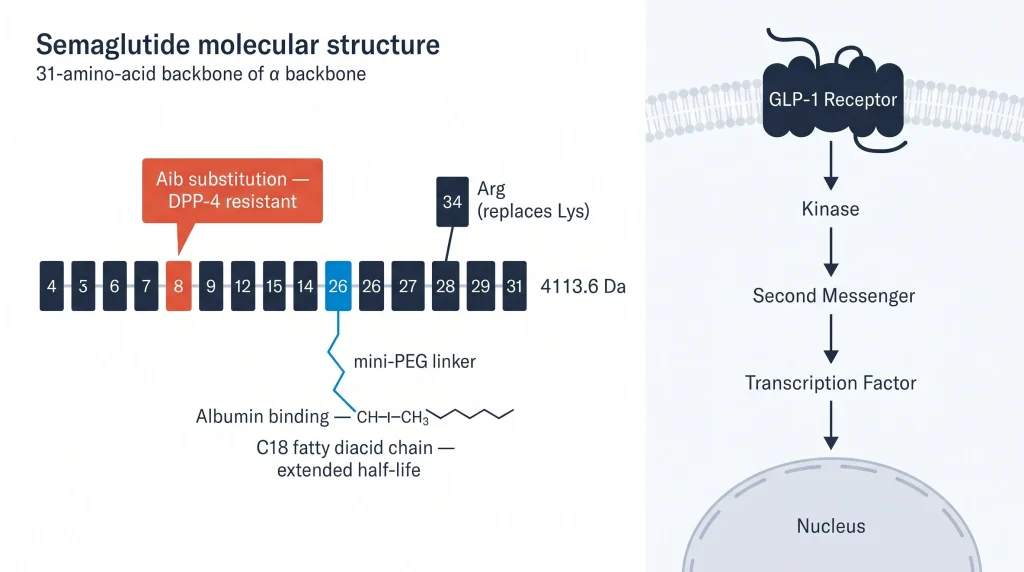
Semaglutide is a synthetic analog of GLP-1 (glucagon-like peptide-1, a 30-amino-acid incretin hormone). It has been studied in research for its structural modifications. These modifications confer resistance to DPP-4 (dipeptidyl peptidase-4) enzymatic cleavage. They also extend albumin binding. According to Lau J et al. (2015) (PMID 25674782), semaglutide was designed as a once-weekly GLP-1 analog. It was developed to extend plasma stability and maintain GLP-1R binding potency.
Next Level Pharm is a US-based supplier of research-grade peptides. Research-grade semaglutide lots are verified to 99.4% average purity by HPLC and mass spectrometry. A COA with a lot of ships with every order.
Understanding the structure and sequence of semaglutide helps researchers interpret receptor binding data, pharmacokinetic models, and COA documentation.
Researchers studying GLP-1 receptor mechanisms may also find eloralintide relevant — it is a research-grade GIP/GLP-1 co-agonist analog available as a COA-verified, lyophilized research peptide.
Key Takeaways
- Semaglutide Is Based on GLP-1(7-37): Semaglutide’s backbone is the 26-amino-acid sequence of human GLP-1(7-37), which is the active form of GLP-1 in incretin research. The backbone spans from histidine at position 7 to glycine at position 37 of the full GLP-1 proglucagon peptide.
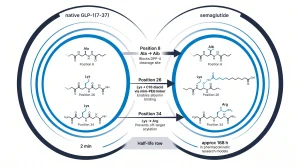
- Position 8 Is Modified to Resist DPP-4 Cleavage: In native GLP-1, position 8 is alanine. DPP-4 cleaves the His-Ala bond at positions 7 and 8. In semaglutide, position 8 has been substituted with Aib (alpha-aminoisobutyric acid). Aib has been studied for resistance to DPP-4 cleavage in research models.
- Position 34 Is Modified to Prevent Renal Excretion: In native GLP-1, position 34 is lysine. In semaglutide, position 34 has been substituted with arginine. This blocks acylation at position 34 and ensures the fatty acid chain attaches only at position 26.
- A C18 Fatty Diacid Chain Confers Albumin Binding: A C18 fatty diacid is attached at position 26 via a mini-PEG linker. This chain has been studied for albumin binding, which extends plasma half-life in pharmacokinetic studies.
- Semaglutide Binds the GLP-1 Receptor with High Affinity: Semaglutide has been studied for GLP-1R binding with subnanomolar affinity in in vitro assays.
These structural features are the focus of published research on semaglutide’s pharmacology. They explain the differences between semaglutide and earlier GLP-1 analogs in binding assay and pharmacokinetic models.
What Is the Amino Acid Sequence of Semaglutide?
The semaglutide amino acid sequence is: His-Aib-Glu-Gly-Thr-Phe-Thr-Ser-Asp-Val-Ser-Ser-Tyr-Leu-Glu-Gly-Gln-Ala-Ala-Lys(C18-linker)-Glu-Phe-Ile-Ala-Trp-Leu-Val-Arg-Gly-Arg. Position 8 is Aib (not Ala as in GLP-1). Position 26 carries the C18 fatty diacid chain. Position 34 is Arg (not Lys as in GLP-1). Total length is 31 residues in the active form. Molecular weight is approximately 4113.6 Da (free base), which is confirmed by mass spectrometry in COA testing.
According to Knudsen LB & Lau J (2019) (PMID 30891346), semaglutide’s design was informed by earlier work on liraglutide. It was optimized to extend plasma half-life while maintaining GLP-1R binding potency. The fatty acid chain design was studied using albumin binding assays. Pharmacokinetic animal models were also used.
How Does the C18 Fatty Acid Chain Affect Structure?
The C18 fatty diacid chain at position 26 is the key factor behind semaglutide’s extended plasma half-life. The chain connects to Lys26 via a spacer (two mini-PEG units and a gamma-glutamate). This spacer reduces chain aggregation. It keeps the molecule in solution.
The C18 chain binds reversibly to albumin in plasma. Albumin is a large plasma protein (67 kDa). Albumin binding protects semaglutide from renal clearance. The bound fraction acts as a depot. It releases free semaglutide gradually. This mechanism has been studied in pharmacokinetic models. The studied half-life is approximately 168 hours in those models.
What Is the Role of the Aib Substitution at Position 8?
In native GLP-1(7-36 amide), position 8 is alanine. The DPP-4 (dipeptidyl peptidase-4) enzyme cleaves the His7-Ala8 bond. This inactivates native GLP-1 within minutes of secretion. In semaglutide, position 8 has been modified to Aib (alpha-aminoisobutyric acid). Aib is a non-proteinogenic amino acid with two methyl groups on the alpha carbon. This extra bulk blocks DPP-4 from cleaving the bond. The Aib substitution has been studied for steric resistance to DPP-4 cleavage in enzymatic assay models.
According to Baggio LL & Drucker DJ (2007) (PMID 17720798), DPP-4 resistance is a key design feature for long-acting GLP-1 analogs. Native GLP-1 has a plasma half-life of about 2 minutes. This is due to DPP-4 cleavage and renal clearance. Structural modifications at position 8 have been studied as a primary strategy. They extend GLP-1 analog stability in research models.
How Does Semaglutide Bind to the GLP-1 Receptor?
The GLP-1 receptor (GLP-1R) is a class B G protein-coupled receptor (GPCR). It has two main domains. The outer domain (ECD) binds the C-terminal helix of GLP-1 analogs. The inner domain (TMD) is engaged by the N-terminal segment. Semaglutide binds GLP-1R in the same manner as native GLP-1.
The N-terminal His-Aib segment of semaglutide engages the inner domain (TMD). The C-terminal helix (residues 18-30) binds the outer domain (ECD). Together these interactions activate GLP-1R. They stimulate adenylate cyclase (cAMP production) in cells. GLP-1R binding affinity for semaglutide has been studied in competitive assays using radiolabeled GLP-1. Binding in the subnanomolar range has been reported in published assay data.
| Feature | Native GLP-1(7-37) | Semaglutide |
| Position 8 | Ala | Aib (DPP-4 resistant) |
| Position 26 | Lys | Lys + C18 diacid chain |
| Position 34 | Lys | Arg |
| Molecular weight | ~3297 Da | ~4113.6 Da |
| Plasma half-life (research model) | ~2 min | ~168 hours |
| Albumin binding | None | Strong (C18 chain) |
How Does Semaglutide Structure Compare to Native GLP-1?
Native GLP-1(7-37) has a molecular weight of approximately 3297 Da. Semaglutide is larger at approximately 4113.6 Da. This is due to the C18 diacid linker system added at position 26. The backbone sequence is identical at most positions. The three key differences are the Aib substitution at position 8, the fatty acid chain at position 26, and the Arg substitution at position 34. These changes are visible in the mass spectrum of a COA.
In receptor binding assays, semaglutide and native GLP-1 have been compared for GLP-1R affinity. Published binding data show semaglutide has subnanomolar affinity for GLP-1R. This is similar to or slightly higher than native GLP-1 in some assay systems. Structural differences affect albumin binding and plasma half-life. They do not affect the core GLP-1R engagement mechanism.
What COA Data Is Available for Research-Grade Semaglutide?
A research-grade semaglutide COA includes several key fields. It lists HPLC purity as a percentage and mass spec MW (target 4113.6 Da). It also shows the lot number, synthesis date, and test methods used. Some COAs also include an HPLC chromatogram and mass spectrum.
The lot number on the COA must match the lot number on the vial. The HPLC purity result should be at least 99% for research-grade material. This should appear on each batch COA. Mass spectrometry identity data confirms the compound is semaglutide and not a related GLP-1 analog. Shop research peptides at Next Level Pharm. Research-grade semaglutide is available with COA documentation on every batch.
Frequently Asked Questions
What Is Semaglutide’s Molecular Weight?
Semaglutide (free base) has a molecular weight of approximately 4113.6 Da. This is confirmed by mass spectrometry in COA testing. The molecular weight is higher than native GLP-1(7-37) at approximately 3297 Da due to the C18 fatty diacid chain and linker added at position 26. High-resolution mass spectrometry confirms semaglutide identity to within 0.01 Da of the expected value.
What Is the GLP-1 Receptor?
The GLP-1 receptor (GLP-1R) is a class B G protein-coupled receptor. It is expressed in pancreatic cells, the brain, heart, and kidneys in mammalian models. It is activated by binding of GLP-1 or GLP-1 analogs. Activation of GLP-1R stimulates adenylate cyclase. This increases intracellular cAMP. GLP-1R is the target studied in semaglutide receptor binding assays. All references to GLP-1R binding are from in vitro receptor studies and animal pharmacokinetic models. For research purposes only.
What Does DPP-4 Do to Native GLP-1?
DPP-4 (dipeptidyl peptidase-4) is a serine protease enzyme. It cleaves the His7-Ala8 bond at the N-terminus of native GLP-1(7-36 amide). This cleavage inactivates GLP-1. Native GLP-1 has a plasma half-life of approximately 2 minutes in research models due to combined DPP-4 cleavage and renal clearance. Structural modifications at position 8 have been studied as a strategy to resist DPP-4 cleavage. They extend plasma stability in pharmacokinetic studies.
What Is Aib?
Aib is alpha-aminoisobutyric acid, a non-proteinogenic amino acid. It is not one of the 20 standard amino acids encoded by the human genome. Aib has two methyl groups on the alpha carbon (instead of one in alanine), which makes it more sterically hindered. This steric hindrance has been studied as the mechanism of DPP-4 resistance when Aib is placed at position 8 of GLP-1 analogs. Aib is used in semaglutide synthesis and appears as a modified residue in the mass spectrometry fragmentation pattern.
What Is Albumin Binding in GLP-1 Analog Research?
Albumin (human serum albumin, HSA) is the most abundant plasma protein. It binds fatty acid chains non-covalently. GLP-1 analogs with fatty acid chains bind albumin in plasma. This binding protects the compound from renal clearance and DPP-4 cleavage. The bound fraction acts as a slow-release depot. The half-life of albumin-bound GLP-1 analogs has been studied in animal models. Albumin binding is measured by competitive assays using fluorescent or radiolabeled probes.
How Does Semaglutide Differ from Liraglutide in Structure?
Liraglutide has a C16 fatty acid chain attached at position 26 via a glutamic acid linker. Semaglutide has a C18 fatty diacid chain at position 26 via a mini-PEG spacer. Semaglutide also differs from liraglutide at position 8 (Aib vs. Aib in liraglutide also) and position 34 (Arg vs. Lys). The longer C18 chain and mini-PEG linker in semaglutide have been studied for stronger albumin binding. The studied plasma half-life of semaglutide is about 168 hours, compared to about 13 hours for liraglutide in pharmacokinetic models. These are structural research differences, not clinical claims.
What HPLC Method Is Used for Semaglutide Purity Testing?
Semaglutide purity is measured by reverse-phase HPLC (RP-HPLC) using a C18 column. The mobile phase is a gradient of water and acetonitrile with TFA or formic acid. Detection is at 214 to 220 nm UV absorbance. Semaglutide elutes at a specific retention time. Its retention time is driven in part by the C18 fatty acid chain. Purity is calculated as the target peak area divided by total peak area. Research-grade material should show at least 99% purity.
Is Semaglutide Stable at Room Temperature?
In lyophilized (freeze-dried) form, semaglutide is stable at room temperature for shipping. For long-term storage, the compound is kept at minus 20 degrees Celsius. Solutions for assay use are stored at 4 degrees Celsius. Semaglutide is sensitive to oxidation of the tryptophan (Trp) residue at position 25. Oxidation adds 16 Da to the molecular weight. It appears as a shoulder peak in the HPLC chromatogram. COA mass spec data can detect Trp oxidation if present.
What Is the Difference Between GLP-1(7-36 amide) and GLP-1(7-37)?
GLP-1(7-36 amide) is the predominant active form of GLP-1 in circulation. It is 29 residues long (His at position 7 through Arg at position 36) with a C-terminal amide. GLP-1(7-37) is a 30-residue form with a free C-terminal glycine. Both are active at GLP-1R. Semaglutide is based on GLP-1(7-37). The glycine at position 37 is included in the semaglutide backbone. In mass spectrometry, GLP-1(7-36 amide) and GLP-1(7-37) differ by 1 Da and can be distinguished by high-resolution MS.
What Is the cAMP Signaling Pathway in GLP-1 Receptor Research?
When a GLP-1 analog binds GLP-1R, the receptor activates adenylate cyclase via Gs protein coupling. Adenylate cyclase converts ATP to cAMP (cyclic adenosine monophosphate). cAMP is a second messenger. It activates protein kinase A (PKA) and other effectors. In cell research models, cAMP production is measured as a proxy for GLP-1R activation. HTRF or ELISA-based cAMP assays are used. These are in vitro assay data. For research purposes only.
Summary
Semaglutide is a GLP-1 receptor agonist analog with three key structural modifications to native GLP-1(7-37). Position 8 uses Aib instead of alanine. Aib has been studied for resistance to DPP-4 cleavage in enzymatic models. Position 26 carries a C18 fatty diacid chain via a mini-PEG linker. This has been studied for albumin binding and extended plasma half-life in animal models. Position 34 uses arginine instead of lysine to prevent off-target acylation.
The molecular weight of semaglutide is approximately 4113.6 Da. It is confirmed by mass spectrometry in COA testing. Research-grade semaglutide COAs include HPLC purity, mass spec identity, and lot number on every batch. These fields are required for all research-grade lots.
What Should You Do Next?
When sourcing research-grade semaglutide, request a COA with HPLC purity, mass spec MW (target 4113.6 Da), and a lot number. The lot number must match the vial. Record the lot number in your protocol files. For structural research, also request the HPLC chromatogram and mass spectrum to verify compound integrity.
Shop research peptides. Research-grade semaglutide is available at Next Level Pharm with full COA documentation on every batch.
People Also Read
- Semaglutide Research: GLP-1 Receptor Agonist Mechanism
- GLP-1 Research Peptides: Receptor Mechanism Studies
About the Author
Next Level Pharm Research Team
Alex M covers peer-reviewed findings in peptide science for Next Level Pharm, a US-based supplier of research-grade peptides verified to ≥99% purity via HPLC and mass spectrometry on every batch.
Disclaimer: The information provided on this page is for educational and research purposes only. Next Level Pharm products are intended for laboratory research use only. They are not intended for human consumption, diagnostic, therapeutic, or medicinal purposes. This content does not constitute medical advice. Always consult a licensed healthcare professional before making any health-related decisions.