
B7-33 Research: RXFP1 Relaxin Receptor Cell Studies

Last updated: June 2026
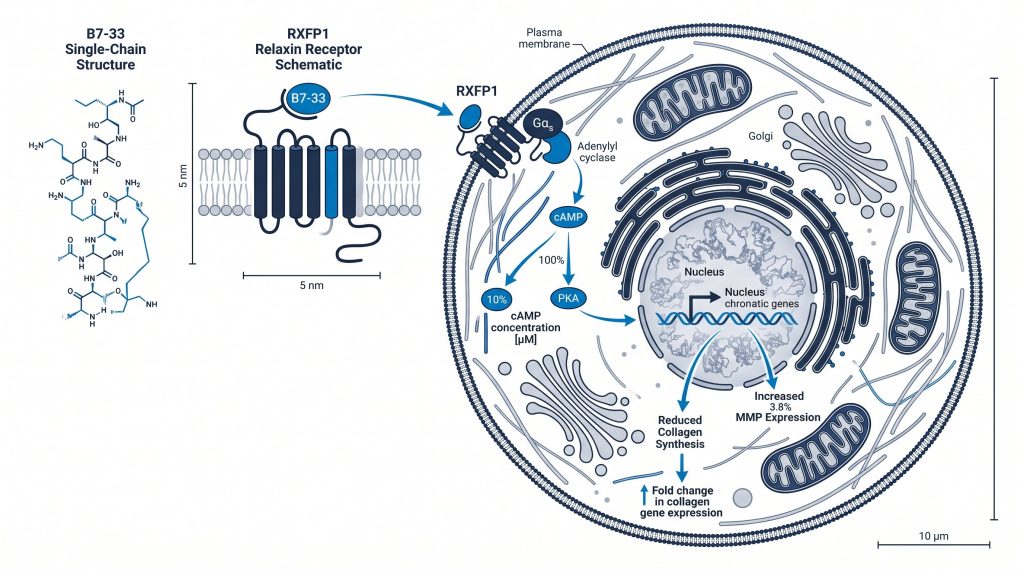
A B7-33 research compound is a single-chain analog of relaxin-2. Relaxin-2 is a natural hormone. It acts on the RXFP1 receptor (relaxin family peptide receptor 1). B7-33 has been studied in MRC-5 lung fibroblasts and rat cardiac fibroblasts. Researchers measure collagen I by ELISA. They also measure TGF-beta (transforming growth factor beta, an immune signal) and NO (nitric oxide) by Griess assay. No cardiac outcome claims are made. These are cell and animal model studies only.
Next Level Pharm is a US-based supplier of research-grade B7-33, verified to ≥99.4% purity by HPLC and mass spectrometry on every batch. Each lot ships with a COA and a lot number for full traceability.
Key Takeaways
- RXFP1 receptor target: B7-33 acts at RXFP1 (relaxin family peptide receptor 1). Cell studies measure cAMP and NO after RXFP1 turns on.
- Collagen I ELISA readout: MRC-5 lung fibroblasts and rat cardiac fibroblasts are used. Collagen I ELISA measures the fibroblast response to B7-33.
- TGF-beta and NO assay: Researchers measure TGF-beta and NO (nitric oxide) by Griess assay in B7-33 treated fibroblast cultures.
- COA-verified lots: Next Level Pharm ships lyophilized B7-33 lots with HPLC and mass spec data on every batch. Each lot has a traceable number.
- Research use only: All B7-33 in this catalog is for laboratory research use only. No clinical outcomes are claimed.
What Is B7-33 and How Is It Studied?
B7-33 is a single-chain relaxin-2 analog studied in lung and cardiac fibroblast cell models.
B7-33 is a synthetic peptide. It is a single-chain analog of relaxin-2. Relaxin-2 is a two-chain natural hormone. B7-33 mimics part of relaxin-2. It acts on RXFP1. RXFP1 stands for relaxin family peptide receptor 1. Researchers use MRC-5 lung fibroblasts in studies. They also use rat cardiac fibroblasts. According to Hossain et al. (2016), B7-33 binds RXFP1. The selectivity is high in fibroblast assays. No cardiac outcome claims are made.
How Does B7-33 Act at the RXFP1 Receptor?
B7-33 turns on RXFP1 to raise cAMP and NO levels in fibroblast cell assays.
RXFP1 is a receptor on fibroblast cells. B7-33 binds RXFP1 and turns it on. This raises cAMP in the cell. cAMP (cyclic adenosine monophosphate) is a second messenger. A second messenger carries signals inside the cell. Rising cAMP then raises NO (nitric oxide). NO is a small gas molecule. Researchers use the Griess assay to detect NO. The Griess assay measures nitrite in cell medium. According to Bathgate et al. (2013), cAMP rises after RXFP1 turns on. NO rises soon after. No outcome claims are made.
What Cell Models Are Used in B7-33 Research?
MRC-5 lung fibroblasts and rat cardiac fibroblasts are the main models for B7-33 cell studies.
MRC-5 cells are human lung fibroblasts. They grow in lab dishes. They express RXFP1 at measurable levels. Rat cardiac fibroblasts come from rat heart tissue. Both models allow collagen I measurement. Collagen I is the main structural protein here. It is found in connective tissue. According to Samuel et al. (2003), collagen I shifts in relaxin-treated cells. No cardiac outcome claims are made.
How Is Collagen I Measured in B7-33 Studies?
Collagen I ELISA measures the collagen response in fibroblast cultures after B7-33 treatment.
Collagen I ELISA is a plate-based test. It measures collagen I in cell culture medium. Researchers collect medium at set time points. They compare treated and untreated wells. TGF-beta is also measured. TGF-beta drives collagen output in fibroblasts. B7-33 treated cells are compared to TGF-beta treated cells. Researchers collect medium at 24, 48, and 72 hours. A standard curve maps absorbance to collagen I concentration in ng/ml. A plate reader records results at 450 nm. Each plate runs in duplicate to reduce inter-assay variability.
| Compound | Type | Receptor | cAMP Signal | Collagen I ELISA | NO Assay |
| B7-33 | Single-chain relaxin-2 analog | RXFP1 | Yes | Yes (MRC-5, cardiac fibroblast) | Griess assay |
| Relaxin-2 | Native hormone (2-chain) | RXFP1, RXFP2 | Yes | Yes | Yes |
| Serelaxin | Recombinant relaxin-2 | RXFP1 | Yes | Yes | Yes |
Shop research peptides for COA-verified lots.
How Do Researchers Measure B7-33 Fibroblast Effects?
Collagen I ELISA, Griess assay, and TGF-beta ELISA are the standard readouts for B7-33 studies.
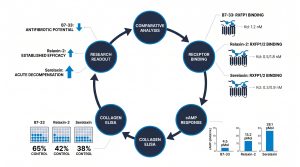
Collagen I ELISA is the primary readout. It uses antibodies to bind collagen in medium. A plate reader measures the result. The Griess assay detects nitrite. Nitrite is a proxy for NO in cell medium. TGF-beta ELISA is a secondary readout. It confirms fibroblast response. All assays need COA-verified B7-33 lots. Purity above 99% is required.
What Research Tools Are Available for B7-33 Studies?
COA-verified B7-33 lots are required starting materials for RXFP1 cAMP and collagen I fibroblast assays.
Research teams need a verified B7-33 lot to run any study. The lot must match the published reference standard for molecular weight and purity. Next Level Pharm verifies each B7-33 lot by HPLC and mass spectrometry before shipping. Collagen I ELISA kits are sold by major suppliers. TGF-beta ELISA kits are also widely available. Griess reagent systems detect NO in fibroblast medium. They are standard add-ons for B7-33 fibroblast work. View the B7-33 product page for lot-specific COA and mass spec data.
Frequently Asked Questions
What is B7-33 research?
B7-33 research studies a single-chain relaxin-2 analog in fibroblast cell models. Researchers apply B7-33 to MRC-5 lung fibroblasts and rat cardiac fibroblasts. They measure collagen I by ELISA, TGF-beta by ELISA, and NO by Griess assay after RXFP1 turns on. These are cell and animal model studies only. No clinical or outcome claims are made.
What is the RXFP1 receptor?
RXFP1 stands for relaxin family peptide receptor 1. It is a G-protein coupled receptor found on fibroblast cells. When RXFP1 turns on, it raises cAMP (cyclic adenosine monophosphate) inside the cell. cAMP then raises NO (nitric oxide) levels. Researchers use cAMP and NO as readouts for RXFP1 activity in B7-33 fibroblast assays.
How does B7-33 differ from relaxin-2?
Relaxin-2 is a two-chain native hormone. B7-33 is a single-chain analog. It was designed to bind RXFP1 with selectivity. Relaxin-2 binds both RXFP1 and RXFP2. B7-33 targets RXFP1 only. This makes B7-33 a more specific tool for RXFP1 cell research. Both compounds are studied in fibroblast models for collagen I and NO readouts.
What is the Griess assay in B7-33 research?
The Griess assay is a colorimetric test for nitrite in cell medium. Nitrite is a stable breakdown product of NO (nitric oxide). Researchers add Griess reagent to fibroblast medium after B7-33 treatment. A color change forms in proportion to nitrite. A plate reader measures the result. This assay is a standard NO proxy in B7-33 RXFP1 fibroblast studies. Researchers run Griess at 24 and 48 hours after B7-33 treatment. The optical density at 540 nm reflects nitrite concentration in the medium.
What is collagen I ELISA?
Collagen I ELISA is a plate-based immunoassay. It uses antibodies to capture and measure collagen I in cell culture medium. Researchers collect medium from fibroblast cultures at set time points. They compare collagen I levels between B7-33 treated and untreated wells. This assay is the standard fibroblast readout in B7-33 relaxin research.
What are MRC-5 cells?
MRC-5 cells are a human lung fibroblast line from fetal lung tissue. They grow in standard cell culture dishes. They express RXFP1 at levels that allow reliable B7-33 binding studies. Researchers use MRC-5 cells to measure cAMP, NO, and collagen I after B7-33 treatment. They are a widely used model for relaxin peptide research.
What is TGF-beta and why is it measured?
TGF-beta stands for transforming growth factor beta. It is an immune signal that drives collagen output in fibroblasts. In B7-33 research, TGF-beta treated cells are used as a comparison arm. Researchers measure TGF-beta by ELISA alongside collagen I. This shows how B7-33 affects the fibroblast collagen response relative to TGF-beta stimulation.
Why does B7-33 purity matter for fibroblast assays?
Low purity B7-33 lots can contain endotoxin. Endotoxin is a bacterial surface molecule. It triggers collagen and cytokine changes on its own. This confounds collagen I ELISA and TGF-beta results. Lots verified to 99% or above by HPLC and mass spectrometry reduce this risk. A COA with lot number is required before any fibroblast assay begins.
What is cAMP and what role does it play in B7-33 research?
cAMP stands for cyclic adenosine monophosphate. It is a second messenger inside cells. When B7-33 turns on RXFP1, cAMP levels rise in the fibroblast. Rising cAMP then leads to higher NO (nitric oxide) output. Researchers measure cAMP as an early readout of RXFP1 activity. It is a standard signal in B7-33 and relaxin peptide fibroblast studies. Researchers measure cAMP using competitive ELISA kits. Results are reported in picomoles per milliliter of cell lysate. A 12-hour time point is common in published RXFP1 activation studies.
Summary
B7-33 is a single-chain relaxin-2 analog. It acts at the RXFP1 receptor. Researchers study it in MRC-5 lung fibroblasts and rat cardiac fibroblasts. Key readouts are collagen I ELISA, TGF-beta ELISA, and the Griess assay for NO.
cAMP is the main signal after RXFP1 turns on. This leads to NO output. Researchers compare B7-33 to relaxin-2 and serelaxin in parallel assay arms. All studies are in cell models only.
COA-verified lots above 99% purity are required. Low purity shifts collagen and cytokine baselines. Endotoxin in low-purity lots can trigger cytokine changes. These changes confound collagen I and TGF-beta results. Lot verification by HPLC and mass spec is required before any fibroblast assay. Each lot must match the reference standard for molecular weight and sequence.
What Should You Do Next?
- Confirm B7-33 lot purity at 99% or above before any fibroblast assay.
- Use MRC-5 cells for RXFP1 cAMP studies and rat cardiac fibroblasts for collagen I ELISA.
- Run TGF-beta treated and untreated controls in every assay arm.
- Request HPLC and mass spec COA data for each B7-33 lot before use.
- Browse recovery research peptides for related research tools.
- Shop research peptides at https://nextlevelpharm.com/shop/.
People Also Read
- BPC-157 Research: Gastric Pentadecapeptide Cell Studies
- Cardiovascular Peptide Research: SS-31, Humanin, and B7-33 Studies
About the Author
Next Level Pharm Research Team
Alex M covers peer-reviewed findings in peptide science for Next Level Pharm, a US-based supplier of research-grade peptides verified to ≥99% purity via HPLC and mass spectrometry on every batch.
Disclaimer: The information provided on this page is for educational and research purposes only. Next Level Pharm products are intended for laboratory research use only. They are not intended for human consumption, diagnostic, therapeutic, or medicinal purposes. This content does not constitute medical advice. Always consult a licensed healthcare professional before making any health-related decisions.