
Anti-Inflammatory Peptide Research: BPC-157, KPV, ARA-290

Last updated: June 2026
An anti-inflammatory peptide research compound is a short amino acid chain. It is studied in cell models for cytokine signaling and immune pathway activity. Researchers use these compounds in RAW264.7 immune cell assays, Caco-2 gut lining cultures. Peripheral blood mononuclear cell (PBMC) panels to measure changes in IL-6, IL-1beta, and TNF-alpha output. Three compounds attract particular interest: BPC-157, KPV, and ARA-290.
Next Level Pharm is a US-based supplier of research-grade BPC-157, verified to ≥99.4% purity by HPLC. Mass spectrometry on every batch. Each lot ships with a COA and a lot number for full traceability.
Key Takeaways
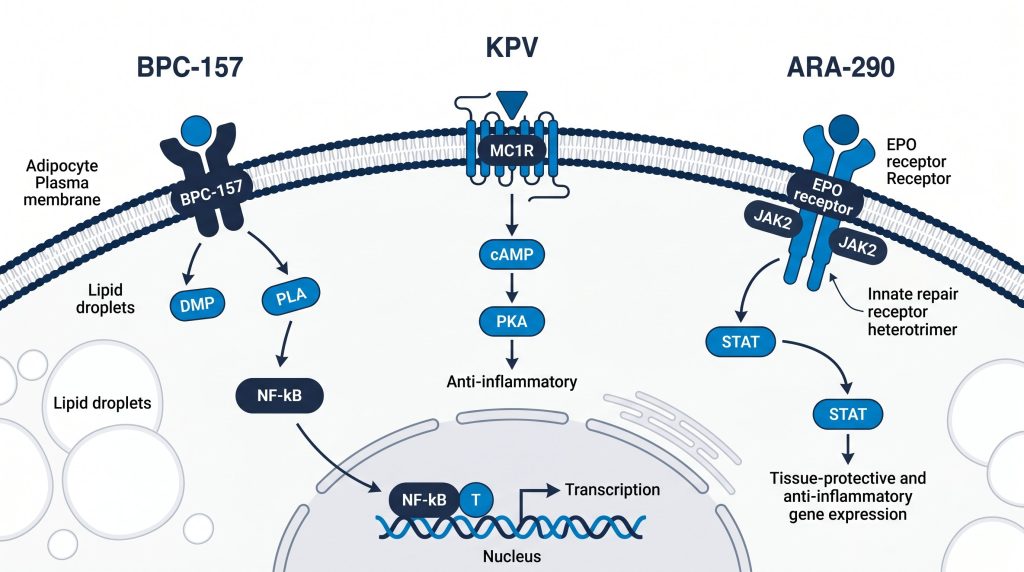
- BPC-157 shifts NF-kB: The 15-amino-acid peptide has shown NF-kB pathway modulation in immune cell cell assays, with changes in FAK/paxillin signaling noted.
- KPV targets MC1R in vitro. The Lys-Pro-Val tripeptide acts at the melanocortin 1 receptor (MC1R). Cell studies report reduced IL-6 and TNF-alpha in treated cultures.
- ARA-290 engages the EPO receptor. This erythropoietin (EPO) receptor agonist analog activates JAK2/STAT3 signaling. PBMC studies show shifts in pro-inflammatory biomarker levels.
- COA-verified lots: Next Level Pharm ships lyophilized BPC-157 lots with HPLC. Mass spec data on every batch. Each lot has a traceable number.
- Research use only: All BPC-157 in this catalog is for lab research use only. No clinical outcomes are claimed.
What Is BPC-157 and How Is It Studied?
BPC-157 is a 15-amino-acid peptide studied in immune cell and lining cell assays for NF-kB pathway activity.
BPC-157 stands for body protection compound 157. It contains 15 amino acids in a stable lyophilized form. Researchers most often use RAW264.7 immune cell cultures. Caco-2 gut lining cell lines to test it. The peptide sequence allows researchers to track FAK (focal adhesion kinase). Paxillin signaling changes after treatment.
According to Sikiric et al. (2018), BPC-157 cell data show shifts in NF-kB reporter activity in treated immune cell cultures. NF-kB (nuclear factor kappa-light-chain-enhancer of activated B cells) is a key transcription factor in immune gene expression. Researchers also apply the Griess assay. This colorimetric method measures nitric oxide synthase (NOS) changes in treated cells. ELISA panels for IL-6 and IL-1beta are standard readouts in these assays. Each assay requires a COA-verified lot with confirmed target weight. Purity above 99% to align with published reference standards.
How Does KPV Work in Cell Inflammation Models?
KPV is a three-amino-acid fragment of alpha-MSH that binds MC1R and lowers IL-6 and TNF-alpha in treated cell cultures. KPV stands for Lys-Pro-Val. It is the C-terminal tripeptide fragment of alpha-melanocyte stimulating hormone (alpha-MSH). Its small size makes it suitable for gut lining cell work because short peptides cross cell monolayers at measurable rates.
According to Dube et al. (2012), KPV reduces IL-6 and TNF-alpha levels in lipopolysaccharide (LPS)-stimulated cell cultures. LPS is a bacterial cell wall component used to trigger inflammation in vitro. KPV acts at the MC1R (melanocortin 1 receptor).
It is expressed on immune cells and lining cells. MC1R onset suppresses NF-kB nuclear translocation. NF-kB translocation is the step where the protein moves into the cell nucleus. Drives cytokine gene expression. Researchers confirm MC1R binding via competitive binding assays and western blot for tagged NF-kB subunits. Caco-2 monolayer models are particularly common for KPV work because the cells express MC1R at physiologically relevant levels.
What Makes ARA-290 Different From BPC-157 and KPV?
ARA-290 targets the EPO receptor rather than NF-kB directly, activating JAK2/STAT3 tissue-protective signaling in PBMC models. ARA-290 is a synthetic analog of erythropoietin (EPO). EPO is the hormone that regulates red blood cell production. ARA-290 is engineered to bind the tissue-protective EPO receptor (EPOR) complex without triggering red blood cell formation. This makes it distinct from both BPC-157 and KPV. Act upstream at adhesion kinase and melanocortin receptor sites.
According to Thrane et al. (2021), ARA-290 activates the JAK2/STAT3 signaling axis in peripheral blood mononuclear cell (PBMC) models. JAK2 (Janus kinase 2) is an enzyme that phosphorylates STAT3. STAT3 (signal transducer and activator of transcription 3) shifts gene expression toward tissue-protective patterns. PBMC panels allow researchers to quantify changes in TNF-alpha and IL-1beta output after EPOR onset. Flow cytometry and ELISA are the primary readout tools for ARA-290 PBMC studies. Lot purity above 99% is required to avoid EPO receptor cross-reactivity from impurities.
Which Cell Models Are Used for These Peptide Studies?
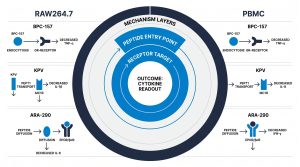
RAW264.7 immune cells, Caco-2 lining cells. PBMCs are the three main cell model types used in anti-inflammatory peptide research. Cell model selection depends on the peptide target and the cytokine panel being measured. Each model has specific strengths for peptide research.
RAW264.7 cells are mouse immune cell-like cells. They are easy to stimulate with LPS and respond quickly to NF-kB pathway modulators. BPC-157 and KPV studies frequently use RAW264.7 cells for initial cytokine screening.
Caco-2 cells are human colorectal adenocarcinoma cells that form tight junctions in culture. They model gut lining barriers. Are standard for KPV work because KPV was originally studied in gut inflammation models. Researchers measure translining electrical resistance (TEER) as a barrier integrity readout alongside cytokine ELISAs.
PBMCs come from human donor blood and include monocytes, lymphocytes, and natural killer cells. They are the preferred model for ARA-290 because EPOR is expressed on monocytes and immune cell precursors. PBMC studies require strict lot verification to rule out endotoxin impurity. Would independently trigger cytokine release.
| Peptide | Length | Receptor Target | Primary Cell Model | Key Biomarker |
| BPC-157 | 15 amino acids | FAK/paxillin, NF-kB | RAW264.7 immune cells | IL-6, NF-kB reporter |
| KPV | 3 amino acids | MC1R, NF-kB | Caco-2 lining | IL-6, TNF-alpha ELISA |
| ARA-290 | 11 amino acids | EPO receptor (EPOR) | PBMCs | TNF-alpha, JAK2/STAT3 |
Researchers select the model based on the receptor being studied. All three peptides require COA-verified lots with confirmed endotoxin levels to produce reliable cytokine data. Shop research peptides for COA-verified lots with HPLC and mass spec data.
How Do Researchers Measure Anti-Inflammatory Activity?
ELISA panels, NF-kB reporter assays. The Griess colorimetric assay are the standard readout methods for peptide cell studies. Measurement methods must match the pathway being studied. Each assay has a specific role in anti-inflammatory peptide research.
ELISA (enzyme-linked immunosorbent assay) is the standard tool for quantifying IL-6, IL-1beta. TNF-alpha in cell supernatants. Researchers collect supernatant at timed intervals after peptide treatment and compare cytokine levels to untreated controls. ELISA kits are commercially available for both mouse and human cytokines, matching the cell model species.
NF-kB reporter assays use cells transfected with a luciferase gene placed under NF-kB promoter control. When NF-kB is active, cells emit light detectable by a plate reader. BPC-157 and KPV studies both use this system to quantify pathway suppression after treatment.
The Griess assay detects nitrite as a proxy for nitric oxide (NO) production. NO is generated by nitric oxide synthase (NOS) in activated immune cells. BPC-157 studies apply the Griess assay alongside ELISA to capture both cytokine. NOS readouts from the same culture supernatant. All assay systems require peptide lots with confirmed purity. Impurities above 1% can shift baseline cytokine readings and confound study results.
What Research Tools Are Available for BPC-157 Studies?
COA-verified lots of BPC-157, KPV. ARA-290 are required as starting materials for anti-inflammatory cell assays. Research teams need a verified BPC-157 lot to run any study. The lot must match the published reference standard for target weight and purity. Next Level Pharm verifies each BPC-157 lot by HPLC and mass spectrometry before shipping. Assay kits for IL-6, IL-1beta. TNF-alpha ELISA are available from major life-science suppliers. Are designed to pair with research-grade peptide lots.
NF-kB reporter cell lines are commercially available for RAW264.7 and Caco-2 formats. The Griess reagent system for nitric oxide detection is a standard add-on for BPC-157 immune cell work. View the BPC-157 product page for lot-specific COA and mass spec data.
Frequently Asked Questions
What is anti-inflammatory peptide research?
Anti-inflammatory peptide research studies short amino acid chains in cell models to measure their effect on cytokine signaling pathways. Researchers apply peptides to immune cell, lining, or immune cell cultures. Measure changes in IL-6, TNF-alpha, and NF-kB activity. These studies are conducted in lab settings for scientific investigation only. Results are not clinical outcomes. Each vial is lot-tested. Purity meets 99% HPLC.
What is the primary cell model for BPC-157 research?
RAW264.7 mouse immune cells are the most common cell model for BPC-157 research. Researchers stimulate these cells with LPS to induce immune signaling, then apply BPC-157 and measure NF-kB reporter activity. IL-6 output by ELISA. Caco-2 gut lining cells are also used in BPC-157 assays that focus on tight junction signaling. Run each condition in triplicate. Include a no-peptide control.
What receptor does KPV target in cell studies?
KPV targets the MC1R (melanocortin 1 receptor) in cell studies. MC1R is expressed on immune cells and gut lining cells. Binding at MC1R suppresses NF-kB nuclear translocation. In turn lowers cytokine gene expression. Researchers confirm MC1R binding through competitive receptor binding assays and western blot for tagged NF-kB subunits. COA data ships with each order. Check the lot before use.
How is ARA-290 different from an EPO protein?
ARA-290 is a short synthetic analog engineered to engage the tissue-protective EPO receptor (EPOR) complex without triggering erythropoiesis (red blood cell formation). Full EPO protein activates both erythropoietic and tissue-protective receptor forms. ARA-290 selectively targets the non-erythropoietic complex. Makes it more specific for cell-level signaling studies in PBMC and immune cell models. ARA-290 ships COA-verified. Each lot is HPLC-tested.
What biomarkers are used in peptide inflammation assays?
The primary biomarkers are IL-6, IL-1beta. TNF-alpha, measured by ELISA from cell culture supernatants. NF-kB reporter assays quantify transcription factor activity in cells transfected with a luciferase construct. The Griess assay measures nitrite as a proxy for nitric oxide production. These biomarkers together give a multi-pathway view of immune signaling changes after peptide treatment. Store supernatants at -80°C. Use fresh aliquots each run.
What is the NF-kB reporter assay?
The NF-kB reporter assay uses cells that carry a luciferase gene placed under the control of an NF-kB-responsive promoter. When NF-kB is active in the cell, the luciferase enzyme is expressed and emits light. A plate reader measures this light output as a proxy for NF-kB pathway activity. Researchers compare light output between treated and untreated cell populations to quantify pathway modulation. Luminescence is read in RLU. Background wells are required.
Why does peptide purity matter for cytokine assays?
Impurities in peptide preparations can independently activate cytokine signaling in cell cultures. Endotoxin impurity is the most common confound. Even trace amounts of lipopolysaccharide (LPS) from synthesis residues trigger IL-6 and TNF-alpha release. Lots verified to at least 99% purity by HPLC and mass spectrometry reduce this risk. COA data also confirms target weight. Is essential for accurate molar level calculations in assay setup. Use endotoxin-tested lots. Run a Limulus assay to confirm.
What is the Griess assay and what does it measure?
The Griess assay is a colorimetric method that detects nitrite in cell culture supernatant as a stable breakdown product of nitric oxide (NO). Immune cells produce NO via nitric oxide synthase (NOS) when activated. Adding Griess reagent to the supernatant produces a pink color proportional to nitrite level, measured by absorbance at 540 nm. BPC-157 research uses this assay alongside ELISA to track NOS activity changes in RAW264.7 cultures. Prepare fresh reagent each run. Read at 540 nm.
Can BPC-157, KPV, and ARA-290 be compared directly?
Researchers compare these peptides by running parallel arms in the same cell model, typically RAW264.7 immune cells with LPS stimulation. Each peptide is tested at the same molar level against a common cytokine panel. Differences in receptor targets mean each compound shifts signaling at a different step. Direct comparison requires measuring multiple pathway nodes simultaneously, not a single cytokine readout.
Summary
BPC-157, KPV, and ARA-290 are three distinct anti-inflammatory peptide research compounds studied in cell models for their effects on cytokine signaling. BPC-157 shifts the FAK/paxillin and NF-kB pathways in RAW264.7 immune cell assays. KPV acts at MC1R to suppress NF-kB translocation in Caco-2 lining cultures. ARA-290 activates the JAK2/STAT3 axis through the EPO receptor in PBMC panels. Each lot ships with a COA. Purity is ≥99% by HPLC and mass spec.
Standard readout methods include ELISA for IL-6, IL-1beta, and TNF-alpha. NF-kB reporter assays; and the Griess colorimetric assay for nitric oxide. Cell model selection follows receptor expression. RAW264.7 cells suit BPC-157 and KPV NF-kB work. Caco-2 monolayers suit KPV lining barrier studies. PBMCs suit ARA-290 EPOR work.
Peptide purity above 99% is required for all three compound types. Endotoxin impurity from low-purity lots can confound cytokine ELISAs and NF-kB reporter readings. COA-verified lots with confirmed target weight. HPLC data are the standard starting point for reproducible anti-inflammatory peptide research.
What Should You Do Next?
- Confirm peptide lot purity at 99% or above before setting up cytokine assays.
- Select the cell model based on the receptor target. RAW264.7 for NF-kB, Caco-2 for MC1R lining work, PBMCs for EPOR studies.
- Run a parallel LPS-only control and an untreated control in every assay to establish baseline cytokine output.
- Request COA and mass spec data for every lot to verify target weight and rule out endotoxin impurity.
- Browse recovery research peptides for related research tools.
- Shop research peptides at https://nextlevelpharm.com/shop/.
People Also Read
- BPC-157 Research: Gastric Pentadecapeptide Cell Studies
- KPV Research: Tripeptide Anti-Inflammatory Cell Studies
About the Author
Next Level Pharm Research Team
Alex M covers peer-reviewed findings in peptide science for Next Level Pharm, a US-based supplier of research-grade peptides verified to ≥99% purity via HPLC and mass spectrometry on every batch.
Disclaimer: The information provided on this page is for educational and research purposes only. Next Level Pharm products are intended for laboratory research use only. They are not intended for human consumption, diagnostic, therapeutic, or medicinal purposes. This content does not constitute medical advice. Always consult a licensed healthcare professional before making any health-related decisions.