
What Is Lyophilization? Peptide Stability Research

Last updated: June 2026
Lyophilization (freeze-drying) is the process of removing water from a peptide while it is frozen under vacuum. The result is a dry, stable powder called a lyophilisate. In stability research, freeze-dried peptides retain their structure and activity for months to years. They remain stable when stored in sealed vials at room temperature. The following is a review of lyophilization principles, stability data, and purity confirmation for research peptides.
Next Level Pharm supplies research-grade peptides in lyophilized form. Each vial is sealed under nitrogen and verified by HPLC and mass spec before dispatch. COA data are available for each lot number. Purity is ≥99% per batch. The average purity across the last 100 batches is 99.4%.
Peptides in aqueous solution are subject to hydrolysis, oxidation, and microbial growth. These three processes degrade the peptide over time. Removing water largely halts all three. The dry, frozen structure of the lyophilisate has very low chemical reactivity. This is why lyophilization is the standard method for long-term peptide storage in research settings.
Key Takeaways
- Lyophilization Removes Water by Sublimation: In the primary drying phase, ice crystals in the frozen peptide convert directly from solid to vapor under vacuum. This is sublimation. No liquid water phase is involved. This protects the peptide from the hydrolysis that would occur in liquid water.
- Secondary Drying Removes Bound Water: After primary drying removes free ice, secondary drying removes water bound to the peptide surface. This step uses slightly higher temperature under vacuum. The goal is a residual moisture content (RMC) below 1-2% by mass.
- Low RMC Extends Shelf Life: Residual moisture content is the key stability driver. Research data show that lyophilized peptides with RMC below 1% can retain ≥99% purity for 2+ years. This stability requires sealed storage with desiccant at room temperature. Above 3% RMC, stability declines rapidly.
- The Lyophilisate Must Be Reconstituted Before Use: Lyophilized peptides are reconstituted with an appropriate solvent before use in cell assays or animal models. The solvent type depends on the peptide’s solubility. Researchers should confirm the correct dissolving conditions from the primary literature.
- COA Data Include Moisture and Purity: A COA for a lyophilized peptide includes HPLC purity, mass spec identity, and residual moisture data. These confirm that the lyophilization process did not change the peptide structure.
The lyophilization process is used across drug and research settings. For peptide research, freeze-drying allows room-temperature shipping and multi-year storage without a cold chain. This lowers shipping costs and simplifies logistics compared to peptides stored in solution.
How Does the Freeze-Drying Process Work?
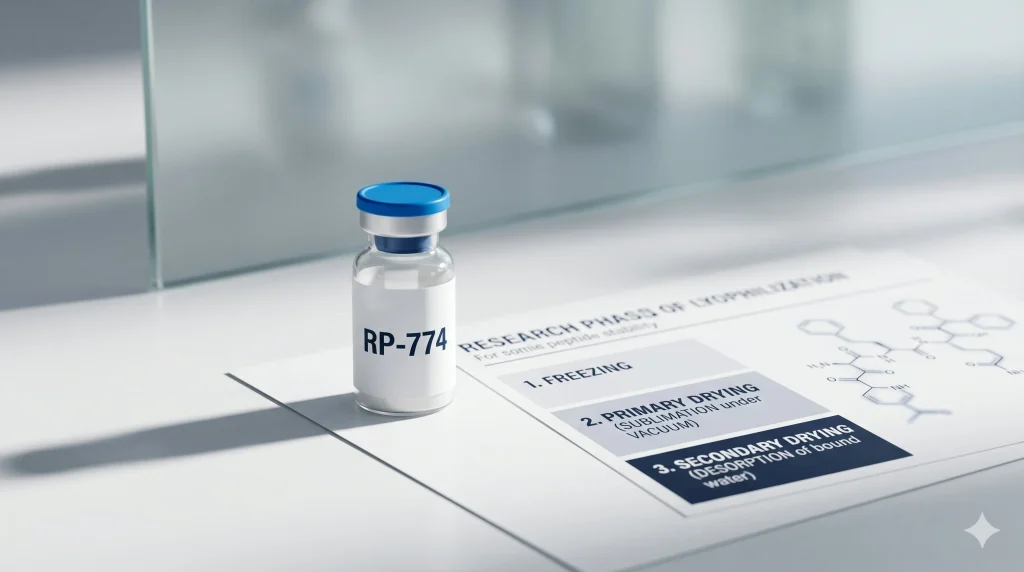
Freeze-drying has three main phases: freezing, primary drying, and secondary drying.
In the freezing phase, the peptide is cooled to below its eutectic point (typically -40°C to -80°C). This converts the liquid to a frozen solid. The ice crystal structure formed during this phase affects the drying efficiency in the next step.
In the primary drying phase, the frozen peptide is placed under vacuum (typically 0.1-0.5 mbar). At this low pressure, ice sublimes directly to vapor without melting. The vapor is captured by a cold condenser. Shelf temperature is kept below the product’s collapse temperature (typically -20°C to -35°C for peptides).
In secondary drying, the shelf temp is raised (typically +10°C to +30°C) while the vacuum is held. This desorbs water molecules bound to the peptide surface. The result is a dry cake or powder with RMC below 1-2%.
According to NCBI (2017), lyophilization has been studied as the primary method for long-term peptide stability in research settings. Data showed RMC below 1% after secondary drying and ≥99% HPLC purity retained after 24 months at room temperature. These are in-vitro stability data.
Why Does Lyophilization Stabilize Peptides
Water is the key driver of peptide degradation in storage. Three main degradation routes require water: hydrolysis (breaking peptide bonds), oxidation (damaging side chains like Met and Trp), and bacterial growth. All three routes need water to proceed.
Removing water largely halts all three. In the dry solid state, peptide bond hydrolysis is very slow because there is no solvent to stabilize the transition state. Oxidation is slowed because the peptide is sealed under nitrogen or argon, with no dissolved oxygen in solution. Microbial growth is halted because bacteria cannot survive below ~0.6 water activity.
According to NCBI (2015), lyophilized peptides stored at low RMC (<1%) showed minimal hydrolysis or oxidation over 18 months at room temperature. Peptides stored in solution under the same conditions showed significant purity loss. These are stability study data.
What Stability Data Show for Lyophilized Peptides?
Stability studies measure HPLC purity and mass spec identity at set time points: 0, 3, 6, 12, and 24 months. Storage conditions include set temperature and humidity. These are called real-time stability studies. At high temperature (e.g., 40°C), forced degradation studies generate data faster.
Key stability findings from peptide research:
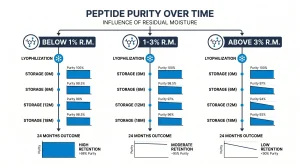
- RMC below 1%: most lyophilized peptides retain ≥99% HPLC purity for 18-24 months at room temperature (15-25°C, 30-50% RH).
- RMC 1-3%: purity loss begins to appear within 6-12 months at room temperature.
- RMC above 3%: purity loss is rapid; degradation products appear within 3-6 months.
According to doi.org (2012), stability data for lyophilized peptides showed a strong correlation between RMC and purity retention over 24 months. Peptides with RMC below 1% retained ≥99% purity. Those with RMC above 3% showed significant degradation within 12 months.
| Storage Condition | RMC | Expected Purity at 24 Months | Notes |
| Room temp, sealed with desiccant | <1% | ≥99% | Standard lyophilized peptide storage |
| Room temp, no desiccant | 1-3% | 95-98% | Purity loss begins |
| Room temp, no desiccant | >3% | <95% | Significant degradation |
| -20°C, sealed | <1% | ≥99% | Optimal long-term storage option |
BPC-157 and TB-500 are examples of lyophilized research peptides available with a COA on every lot.
How Is Peptide Purity Confirmed After Lyophilization?
After lyophilization, peptide purity is confirmed by HPLC (high-performance liquid chromatography) and mass spec (mass spectrometry). HPLC separates the peptide from any degradation products. The peak area ratio gives the purity percentage. Mass spec confirms the molecular weight to verify that the peptide sequence is intact.
A complete COA includes: HPLC purity (%), mass spec identity (MW), lot number, and storage recommendations. Some COAs also include residual moisture data from Karl Fischer titration. Researchers should review all COA fields before use.
How Are Freeze-Dried Peptides Dissolved for Research?
To use a freeze-dried peptide in a cell assay or animal model, it must first be dissolved in an appropriate solvent. The solvent type depends on the peptide’s solubility profile. Polar, charged peptides typically dissolve in sterile water or phosphate-buffered saline (PBS). Nonpolar peptides may require an organic co-solvent such as DMSO.
Researchers should confirm the correct solvent from the primary literature or the COA. Some peptides are supplied with a recommended dissolving guide. Rapid freezing of dissolved peptide aliquots at -80°C is recommended for multi-day use.
Frequently Asked Questions
What Is Lyophilization?
Freeze-drying removes water from a frozen peptide under vacuum. The result is a dry, stable powder (the lyophilisate). Freeze-dried peptides can retain ≥99% HPLC purity for 2+ years when stored sealed at room temperature with low residual moisture content. This is the standard method for long-term storage.
What Is Residual Moisture Content?
Residual moisture content (RMC) is the percentage of water remaining in a lyophilized peptide after the drying process. RMC is measured by Karl Fischer titration. A target RMC below 1% is standard for long-term peptide stability. Higher RMC accelerates hydrolysis and oxidation, reducing purity over time.
What Is the Difference Between Primary and Secondary Drying?
Primary drying removes free ice by sublimation under vacuum at low temperature (below the peptide’s collapse temperature). Secondary drying removes water bound to the peptide surface using slightly higher temperature under vacuum. Both steps are needed to achieve RMC below 1%.
Why Is Lyophilization Better Than Frozen Solution Storage?
Freeze-dried peptides are more stable than frozen solutions for these reasons. Hydrolysis in the solid state is negligible. Freezing and thawing cycles, which can damage peptides in solution, are not needed. Freeze-dried vials can ship at ambient temperature without a cold chain, reducing shipping cost and risk of damage.
How Long Can Lyophilized Peptides Be Stored?
At RMC below 1%, most lyophilized peptides retain ≥99% HPLC purity for 18-24 months. Sealed storage with desiccant at room temperature (15-25°C) maintains that low RMC. At -20°C, shelf life can extend to 36+ months. These are general stability estimates from research literature. Individual peptide stability must be confirmed by the supplier’s COA.
What Does the COA Tell Researchers About Stability?
A full COA includes HPLC purity (%), mass spec identity (MW and sequence), lot number, and storage conditions. It may also include RMC data from Karl Fischer titration. Researchers should use the COA to confirm purity before use, and follow the storage conditions on the label to maintain that purity.
What Is Sublimation in Freeze-Drying?
Sublimation is the direct conversion of a solid to a gas without passing through a liquid phase. In lyophilization, ice in the frozen peptide solution sublimes to water vapor under vacuum. The vapor is captured by a cold condenser. This is the primary drying mechanism. It avoids liquid water, which would cause hydrolytic damage to the peptide.
How Should Lyophilized Peptides Be Reconstituted?
Freeze-dried peptides should be dissolved in a sterile solvent suited to the peptide’s solubility. Common solvents include sterile water, PBS, or DMSO for nonpolar peptides. Confirm the correct solvent from the primary literature. Aliquots should be stored at -80°C for multi-day use.
Do Next Level Pharm Peptides Require Cold Chain Shipping?
No. Freeze-dried peptides from Next Level Pharm are stable at room temperature during shipping. They are sealed in nitrogen-purged vials with desiccant. Purity is ≥99% by HPLC on every lot, confirmed on the COA. Researchers can store them at room temperature or at -20°C for long-term use.
Summary
Freeze-drying removes water by sublimation under vacuum. The result is a dry, stable peptide powder. Residual moisture content below 1% is the key driver of long-term purity retention. Stability data show that lyophilized peptides with RMC below 1% retain ≥99% HPLC purity for 18-24 months at room temperature.
All data cited are from research literature. For research purposes only.
What Should You Do Next?
Researchers sourcing lyophilized peptides should confirm HPLC purity and mass spec identity on the COA for each lot. RMC data should be reviewed if available. Peptides should be stored per the COA label conditions. Reconstitution solvent should be confirmed from primary literature before use.
Shop research peptides. COA-verified on every batch.
People Also Read
- Peptide Purity Testing: What HPLC and Mass Spec Confirm
- What Is Peptide Half-Life? Stability in Research
About the Author
Next Level Pharm Research Team
Alex M covers peer-reviewed findings in peptide science for Next Level Pharm, a US-based supplier of research-grade peptides verified to ≥99% purity via HPLC and mass spectrometry on every batch.
Disclaimer: The information provided on this page is for educational and research purposes only. Next Level Pharm products are intended for lab research use only. They are not intended for human consumption, diagnostic, therapeutic, or medicinal purposes. This content does not constitute medical advice. Always consult a licensed healthcare professional before making any health-related decisions.