
SS-31, MOTS-c, and Humanin: Mitochondrial Peptides


Last updated: June 2026
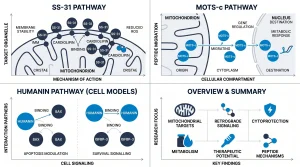
SS-31, MOTS-c, and Humanin are three mitochondria-linked peptides studied in cell and animal models. Each has a distinct structure and receptor target. SS-31 is a synthetic tetrapeptide that binds cardiolipin (CL) in the inner mitochondrial membrane. MOTS-c is a 16-amino-acid peptide coded by the 12S rRNA gene of the mitochondrial genome. Humanin is a 21-amino-acid peptide also coded by the 16S rRNA region of mitochondrial DNA. All three are studied as mitochondrial research tools.
Next Level Pharm is a US supplier of research-grade peptides. SS-31, MOTS-c, and Humanin are each available with a COA verified by HPLC and mass spec on every lot. Purity is ≥99% per batch. The average purity across the last 100 batches is 99.4%.
Mitochondria are the primary site of ATP production in cells. They also regulate cell death signals and reactive oxygen species (ROS). ROS are unstable molecules that form as a byproduct of ATP synthesis. All three peptides are studied for their interactions with mitochondria in cell and animal models.
Key Takeaways
- SS-31 Binds Cardiolipin in the Inner Membrane: SS-31 (also called elamipretide) is a synthetic tetrapeptide with an alternating aromatic and cationic amino acid pattern. It targets CL (cardiolipin), a phospholipid found only in the inner mitochondrial membrane in cell studies.
- MOTS-c Is Coded by the Mitochondrial Genome: MOTS-c (16 amino acids) is one of the few known peptides coded by mtDNA. It is expressed mainly in skeletal muscle and liver in rodent models. In cell studies, it can move from the cytoplasm to the nucleus.
- Humanin Is a Cytoprotective Mitochondrial Peptide: Humanin (21 amino acids) is coded by the 16S rRNA region of mtDNA. In cell assays, it has been studied for its role in binding apoptosis-linked proteins such as BAX and IGFBP-3.
- All Three Are Studied in Separate Research Contexts: SS-31 is studied for its CL-binding effects. MOTS-c is studied for its nucleus-to-mitochondria communication role. Humanin is studied for its binding of cell death signaling proteins.
- None Are FDA-Approved: All three are research compounds. All data are from cell and animal model studies unless otherwise noted.
The mitochondrial peptide field has grown since the discovery that mtDNA encodes short functional peptides. SS-31 was designed to target CL. MOTS-c and Humanin were found as naturally-encoded sequences from mtDNA. Each has a distinct path of action in cell models.
What Is SS-31 and How Does It Work?
SS-31 is a synthetic tetrapeptide: H-D-Arg-Dmt-Lys-Phe-NH2. It has four amino acids in an alternating pattern of polar and nonpolar side chains. This pattern lets it bind to CL (cardiolipin) in the inner mitochondrial membrane in cell assays.
CL is a phospholipid found only in the inner mitochondrial membrane. It helps anchor cytochrome c and complex I/III/IV of the electron transport chain (ETC). When CL is disrupted, ETC function drops and ROS output rises. In cell models, SS-31 has been studied for its role in stabilizing CL and reducing ROS output.
According to NCBI (2020), SS-31 has been studied as a CL-binding tetrapeptide in cell and animal models. The data showed reduced ROS levels and maintained ETC activity in treated cells. These are cell and rodent model findings.
What Is MOTS-c and How Does It Signal?
MOTS-c (Mitochondrial Open Reading Frame of the 12S rRNA-c) is a 16-amino-acid peptide. Its sequence is coded by the 12S rRNA gene in the mitochondrial genome (mtDNA). It is one of the few known mtDNA-encoded peptides outside of the 13 ETC subunits.
In cell studies, MOTS-c has been observed to move from the cytoplasm to the cell nucleus in response to metabolic stress. Once in the nucleus, it has been studied for its role in binding gene promoter regions linked to metabolic function. These findings are from cell and rodent cell studies.
According to NCBI (2015), MOTS-c has been studied for its nucleus-localization behavior in cell stress models. The data showed nuclear entry of MOTS-c and changes in gene expression markers. These are cell findings from metabolic stress assays.
What Is Humanin and What Does It Bind?
Humanin (HN) is a 21-amino-acid peptide coded by the 16S rRNA region of mtDNA. It was first found in the occipital cortex of patients with Alzheimer’s disease. In cell assays, HN has been studied for its binding to the pro-apoptotic protein BAX and to IGFBP-3 (insulin-like growth factor binding protein 3).
BAX is a BCL-2 family protein that promotes cell death when activated. In cell models, HN has been studied for its ability to reduce BAX-mediated cell death signals. IGFBP-3 is an IGF-1 carrier protein also linked to apoptosis in some cell contexts. These are cell-model findings.
According to doi.org (2003), Humanin has been studied for its binding to IGFBP-3 in cell models. The study found that HN and IGFBP-3 interact at the cell surface. These are cell findings from a cell binding assay.
How Do These Three Peptides Compare?
| Feature | SS-31 | MOTS-c | Humanin |
| Length | 4 AA (tetrapeptide) | 16 AA | 21 AA |
| Origin | Synthetic | mtDNA (12S rRNA) | mtDNA (16S rRNA) |
| Primary target | Cardiolipin (inner membrane) | Nucleus (stress response) | BAX, IGFBP-3 |
| Cell location | Inner mitochondrial membrane | Cytoplasm → nucleus | Cell surface, cytoplasm |
| Research context | ETC, ROS, CL-binding | Metabolic stress signaling | Apoptosis, IGF-1 pathway |
| FDA-approved | No | No | No |
SS-31, MOTS-c, and Humanin are each available as COA-verified research peptides.
What Do Animal Studies Show for Each Peptide?
SS-31 has been studied in rodent heart failure and ischemia models. In these models, SS-31 was administered before or after a cell stress event. The data showed maintained mitochondrial membrane potential and reduced ROS in treated tissue. These are animal model findings.
MOTS-c has been studied in aged rodent models and in high-fat diet models. In rodent studies, MOTS-c was tracked for changes in skeletal muscle and liver tissue. These are standard rodent metabolic endpoints and are not clinical data.
Humanin has been studied in rodent brain models and in cell lines derived from neural tissue. In these models, HN was studied for its effect on BAX-triggered cell death. The data are from rodent and cell-model research only.
Frequently Asked Questions
What Is SS-31?
SS-31 (also called elamipretide) is a synthetic tetrapeptide with the sequence H-D-Arg-Dmt-Lys-Phe-NH2. It has four amino acids in an alternating polar and nonpolar pattern. In cell models, SS-31 has been studied for its binding to cardiolipin (CL) in the inner mitochondrial membrane. CL anchors the electron transport chain (ETC) complexes. SS-31 is not FDA-approved and is used in research only.
What Is MOTS-c?
MOTS-c is a 16-amino-acid peptide coded by the 12S rRNA gene in mitochondrial DNA (mtDNA). It is expressed in skeletal muscle and liver in rodent models. In cell studies, MOTS-c has been observed to move to the cell nucleus in response to metabolic stress. These are cell-model findings. MOTS-c is not FDA-approved.
What Is Humanin?
Humanin (HN) is a 21-amino-acid peptide coded by the 16S rRNA region of mtDNA. It was first found in cortical tissue studies. In cell models, HN has been studied for its binding to the pro-apoptotic protein BAX and to IGFBP-3. These are cell findings. Humanin is not FDA-approved and is used in research only.
What Is Cardiolipin?
Cardiolipin (CL) is a phospholipid with four acyl chains found only in the inner mitochondrial membrane. It helps anchor the electron transport chain (ETC) complexes I, III, and IV. CL also anchors cytochrome c. When CL is disrupted, ETC function drops and ROS output rises. SS-31 is studied for its CL-binding effects in cell models.
How Is MOTS-c Different from Humanin?
Both MOTS-c and Humanin are coded by mtDNA, but at different genes. MOTS-c (16 AA) is coded by the 12S rRNA gene and is studied for its role in nucleus-localized metabolic stress responses. Humanin (21 AA) is coded by the 16S rRNA gene and is studied for its binding to BAX and IGFBP-3. Their cell targets and signal paths are distinct.
Is SS-31 the Same as Elamipretide?
Yes. SS-31 is the research name. Elamipretide is its INN (International Nonproprietary Name). Both names refer to the same synthetic tetrapeptide: H-D-Arg-Dmt-Lys-Phe-NH2. In clinical trial literature, elamipretide is used. In cell and animal model research, SS-31 is used. Neither is FDA-approved as of this writing.
What Does ROS Mean in Mitochondrial Research?
ROS stands for reactive oxygen species. They are unstable molecules (such as superoxide and hydrogen peroxide) that form as a byproduct of ATP synthesis in the ETC. At high levels, ROS can damage lipids, proteins, and DNA in the cell. SS-31 has been studied for its ability to reduce ROS output in cell and animal models by stabilizing CL.
How Is Purity Confirmed for These Peptides?
Each peptide at Next Level Pharm is tested by HPLC and mass spec on every lot. HPLC confirms purity (≥99%). Mass spec confirms the molecular weight and sequence identity. Researchers should match the lot number on the COA to the vial before any study use.
What Research Models Use All Three Together?
No established research model uses SS-31, MOTS-c, and Humanin in a single study. Each is studied in its own cell or animal model context. SS-31 is used in CL and ETC studies. MOTS-c is used in metabolic stress studies. Humanin is used in apoptosis and IGF-1 pathway studies. Combination use would be an independent research design.
Summary
SS-31, MOTS-c, and Humanin are three mitochondria-linked research peptides with distinct structures and cell targets. SS-31 binds cardiolipin in the inner membrane. MOTS-c migrates to the nucleus under stress. Humanin binds BAX and IGFBP-3 in cell models.
Each is studied in its own lab context. None are FDA-approved. All findings are from cell and animal research models only.
What Should You Do Next?
Researchers sourcing SS-31, MOTS-c, or Humanin should confirm HPLC purity and mass spec identity on the COA for each compound. Lot numbers should match the COA on file. Each peptide has a distinct sequence and should be confirmed by molecular weight before study use.
Shop research peptides. COA-verified on every batch.
People Also Read
- SS-31 Research: Mitochondria-Targeting Peptide and Oxidative Stress Studies
- MOTS-c Research: Mitochondrial Peptide and Metabolic Studies
About the Author
Next Level Pharm Research Team
Alex M covers peer-reviewed findings in peptide science for Next Level Pharm, a US-based supplier of research-grade peptides verified to ≥99% purity via HPLC and mass spectrometry on every batch.
Disclaimer: The information provided on this page is for educational and research purposes only. Next Level Pharm products are intended for lab research use only. They are not intended for human consumption, diagnostic, therapeutic, or medicinal purposes. This content does not constitute medical advice. Always consult a licensed healthcare professional before making any health-related decisions.