
Cagrilintide Research: Amylin Analog Mechanism Studies

Last updated: June 2026
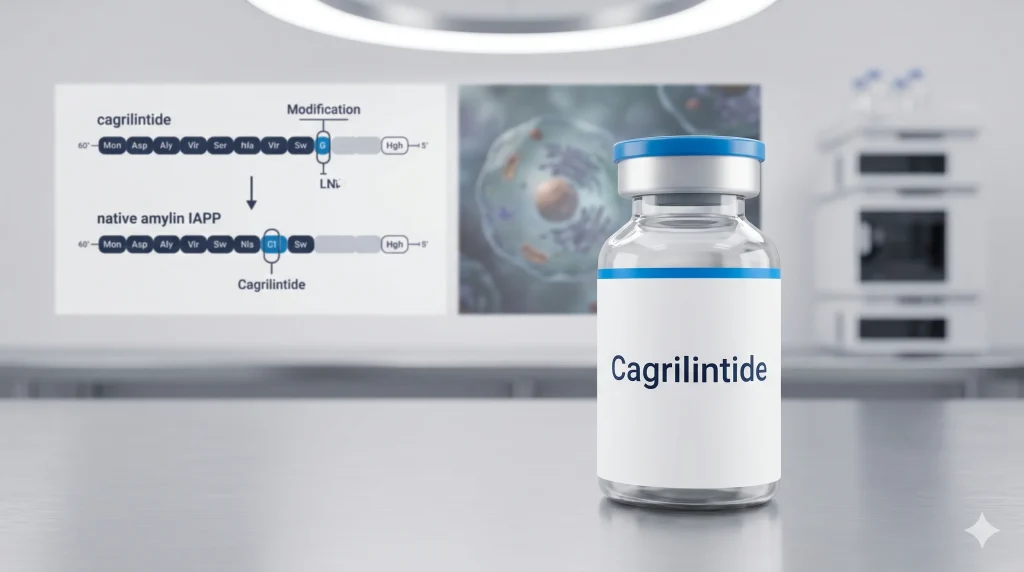
Cagrilintide is a long-acting analog of human amylin, a 37-amino-acid peptide secreted by pancreatic beta cells. Amylin is also called IAPP (islet amyloid polypeptide). Cagrilintide has been studied as an amylin receptor agonist in cell and animal models. Its modified structure gives it a much longer half-life than native amylin. The following is a review of findings from lab research models. It is for lab use only.
Next Level Pharm is a US supplier of research-grade peptides. Cagrilintide is COA-verified and batch-tested to ≥99% purity by HPLC and mass spec. The average purity across the last 100 batches is 99.4%. Researchers can view lot-specific results before any study use.
Amylin research has expanded in recent years. Native amylin has a very short half-life of about 15 minutes in plasma. Cagrilintide extends that to about 7 days in animal models. This longer half-life makes it more useful for sustained receptor research.
Researchers studying GLP-1 receptor mechanisms may also find eloralintide relevant — it is a research-grade GIP/GLP-1 co-agonist analog available as a COA-verified, lyophilized research peptide.
Key Takeaways
- Cagrilintide Is a Modified Amylin Analog: It shares the 37-amino-acid core of human amylin (IAPP). Structural changes extend its half-life in animal models.
- Amylin Receptors Are CTR-RAMP Complexes: Amylin binds to receptors formed by CTR plus a RAMP (receptor activity-modifying protein). Three subtypes (AMY1, AMY2, AMY3) differ by which RAMP is present.
- A Fatty Acid Chain Extends Half-Life: Cagrilintide carries a C20 fatty acid at position K25. This change promotes albumin binding. It slows clearance and extends research exposure time.
- Amylin Signals Through the Brainstem and Hypothalamus: Animal studies found amylin receptors in the area postrema and hypothalamus. These are key brain regions studied for food intake and energy signaling.
- Cagrilintide Is Not FDA-Approved: It has been studied in clinical trials but is not approved for any clinical use. All findings below are from cell or animal research models.
Cagrilintide is studied as a tool for amylin receptor biology research. Its structure makes it one of the most stable amylin analogs for long-duration cell and animal studies. It is not a drug or clinical product. It is a research-grade compound only.
What Is Cagrilintide?
Cagrilintide is a synthetic amylin analog. It is based on the 37-amino-acid sequence of human amylin (IAPP). Several structural changes were made to extend its half-life and improve receptor binding in research models.
Native amylin is secreted with insulin by beta cells. In cell models, it binds to CTR-RAMP complexes (amylin receptors). Its plasma half-life is about 15 minutes. Cagrilintide extends this to roughly 7 days in animal models through fatty acid change and sequence changes.
According to a study in NEJM (2023), cagrilintide has been studied as a long-acting amylin receptor agonist. Animal model data showed sustained receptor activation over multi-day periods. These are lab findings.
How Is Cagrilintide Structurally Modified?
Cagrilintide retains the 37-amino-acid core of human amylin. Key changes include a fatty acid change at position K25. The change is a C20 fatty diacid (behentriloyl) attached via a linker. This chain binds albumin in plasma, which slows clearance and extends the half-life in animal models.
A second change is an S-S bridge at positions 2 and 7, which is also present in native amylin. This bridge keeps the N-terminal ring intact. The ring structure is key for receptor binding in cell assays. Cagrilintide retains this ring.
According to a review in Physiol Rev (2007), fatty acid changes to amylin have been studied for receptor binding and half-life in plasma models. The data showed fatty acid chains slow clearance without disrupting binding. These are in-vitro and animal model findings.
How Do Amylin Receptors Work?
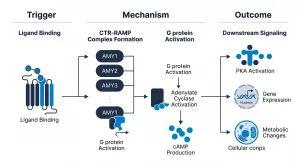
Amylin does not have its own unique receptor. It binds to CTR-RAMP complexes. CTR (calcitonin receptor) is a peptide receptor in many tissues. RAMPs are small proteins that combine with CTR to change its binding specificity. CTR combines with RAMP1 to form AMY1, with RAMP2 to form AMY2, and with RAMP3 to form AMY3.
All three AMY subtypes bind amylin and cagrilintide. They all signal through cAMP and calcium pathways. The cAMP rise is the first step in cell signaling. In cell models, amylin receptor binding raises cAMP and triggers kinase signaling. The receptor is expressed in the brain, kidney, and other tissues in animal models.
| Feature | Native Amylin (IAPP) | Cagrilintide |
| Amino acids | 37 | 37 (modified) |
| Plasma half-life | ~15 minutes | ~7 days (animal models) |
| Fatty acid chain | None | C20 at K25 |
| Receptor | CTR-RAMP (AMY1-3) | CTR-RAMP (AMY1-3) |
| Albumin binding | Minimal | Yes (via fatty acid) |
| Research status | Reference standard | Long-acting research tool |
What Has Animal Research Found About Amylin Signaling?
Animal studies found amylin receptors in the area postrema and key brain regions. These sites have been studied for food intake and energy sensing. In rodent models, amylin receptor binding in this region has been studied for its effect on food intake.
Cagrilintide has been studied in metabolic animal models. In rodent studies, it has been noted for sustained receptor coverage due to its long half-life. These are animal model findings.
How Does Cagrilintide Compare to Native Amylin in Research?
Native amylin (IAPP) has a very short half-life and forms amyloid fibers in cell models at high concentrations. Amyloid formation is a known property of native IAPP and limits its use in long-duration studies. Cagrilintide has been modified to reduce fiber tendency.
The C20 fatty acid and sequence changes in cagrilintide reduce fiber formation in cell models. This makes it more suitable for sustained animal model dosing in research.
Fiber formation is a key challenge with native IAPP. At high local levels, native amylin can form solid fibers in cell models. These fibers are not active at the receptor and limit lab use. Cagrilintide was designed to avoid this. Its modified sequence reduces the chance of fiber clumping in cell studies. Shop cagrilintide for COA-verified cagrilintide and related compounds.
According to a study in Diabetes (2022), cagrilintide has been studied with GLP-1 analogs in animal models. Research examined amylin and GLP-1 receptor co-activation. The study found that each compound acted on a distinct receptor while acting on overlapping tissues in the brain and gut. These are animal model findings.
Shop research peptides at Next Level Pharm. All compounds are COA-verified with HPLC and mass spec data on every batch.
Frequently Asked Questions
What Is Cagrilintide?
Cagrilintide is a synthetic analog of human amylin (IAPP), a 37-amino-acid peptide secreted by beta cells. It has a C20 fatty acid chain at K25. This extends its half-life in animal models to about 7 days. It is used in research as a long-acting amylin receptor agonist tool compound.
What Is Amylin (IAPP)?
Amylin, also called IAPP (islet amyloid polypeptide), is a 37-amino-acid peptide secreted with insulin by pancreatic beta cells. It binds to CTR-RAMP complexes (AMY1, AMY2, AMY3) in cell and animal models. Its natural half-life in plasma is about 15 minutes. It has a S-S bridge at positions 2 and 7 that is key for receptor binding.
What Are Amylin Receptors?
Amylin receptors are complexes formed by CTR plus a RAMP protein. CTR combines with RAMP1 to form AMY1, with RAMP2 to form AMY2, and with RAMP3 to form AMY3. All three subtypes bind both native amylin and cagrilintide. They signal through cAMP and calcium pathways in cell models.
How Does the Fatty Acid Chain Extend Half-Life?
The C20 fatty acid chain at K25 of cagrilintide binds albumin in plasma. Albumin is a large carrier protein with a long plasma half-life. When cagrilintide binds albumin, it is not freely filtered and cleared as quickly. Native amylin has a half-life of about 15 minutes. Cagrilintide extends this to about 7 days in animal models.
What Is the Area Postrema in Amylin Research?
The area postrema is a brainstem region outside the blood-brain barrier. It expresses amylin receptors in animal models. Amylin receptor activation in this region has been studied in rodent research. The focus is on satiety and food intake signaling. It is a key site for amylin peptide interaction in animal brain research.
Is Cagrilintide the Same as Pramlintide?
No. Pramlintide is an earlier amylin analog (FDA-approved as Symlin) with three proline substitutions to reduce amyloid formation. Cagrilintide is a newer analog with a fatty acid chain for extended half-life. The two differ in structure and half-life. Cagrilintide is not FDA-approved and is used only in research settings.
What Is CagriSema?
CagriSema is a research combination of cagrilintide and semaglutide. Semaglutide is a GLP-1 receptor agonist. CagriSema combines two distinct receptor agonists (AMY and GLP-1) into one research blend. It is under clinical study but is not FDA-approved. It is available as a research compound in the same category as cagrilintide and semaglutide.
How Is Cagrilintide Purity Confirmed?
Each batch of cagrilintide at Next Level Pharm is tested by HPLC and mass spec. HPLC confirms purity as a percentage of peak area. Mass spec confirms molecular identity and the presence of the fatty acid change. A COA is issued for every lot with both results available for researcher review.
What Is the Difference Between AMY1, AMY2, and AMY3?
AMY1, AMY2, and AMY3 are subtypes of the amylin receptor. They are each formed by the CTR combined with a different RAMP: RAMP1, RAMP2, or RAMP3. The RAMP changes the binding specificity and expression pattern of the complex. All three subtypes bind amylin and cagrilintide in cell assays.
Summary
Cagrilintide is a long-acting amylin analog modified with a C20 fatty acid chain at K25. It binds CTR-RAMP amylin receptors and signals through cAMP and calcium pathways in cell models. Animal studies found sustained receptor coverage due to its about 7-day half-life.
All findings cited above are from cell and animal research models. They have not been confirmed in clinical settings. This compound is for lab and research use only. It is not a drug or clinical product.
What Should You Do Next?
Researchers sourcing cagrilintide should verify HPLC purity and mass spec identity from the COA before any study use. Confirm the lot number matches the COA on file.
Cagrilintide is sold as a lyophilized research compound. Each vial is stable at room temp during shipping. The COA confirms purity by HPLC. It also confirms molecular identity by mass spec for the lot number.
Shop research peptides. COA-verified on every batch.
People Also Read
- Retatrutide Research: Triple Receptor Agonist Mechanisms
- AOD-9604 Research: What Studies Show About This HGH Fragment
About the Author
Next Level Pharm Research Team
Alex M covers peer-reviewed findings in peptide science for Next Level Pharm, a US-based supplier of research-grade peptides verified to ≥99% purity via HPLC and mass spectrometry on every batch.
Disclaimer: The information provided on this page is for educational and research purposes only. Next Level Pharm products are intended for lab research use only. They are not intended for human consumption, diagnostic, therapeutic, or medicinal purposes. This content does not constitute medical advice. Always consult a licensed healthcare professional before making any health-related decisions.