
Isothermal Titration Calorimetry Peptide ITC Research

Last updated: October 2026
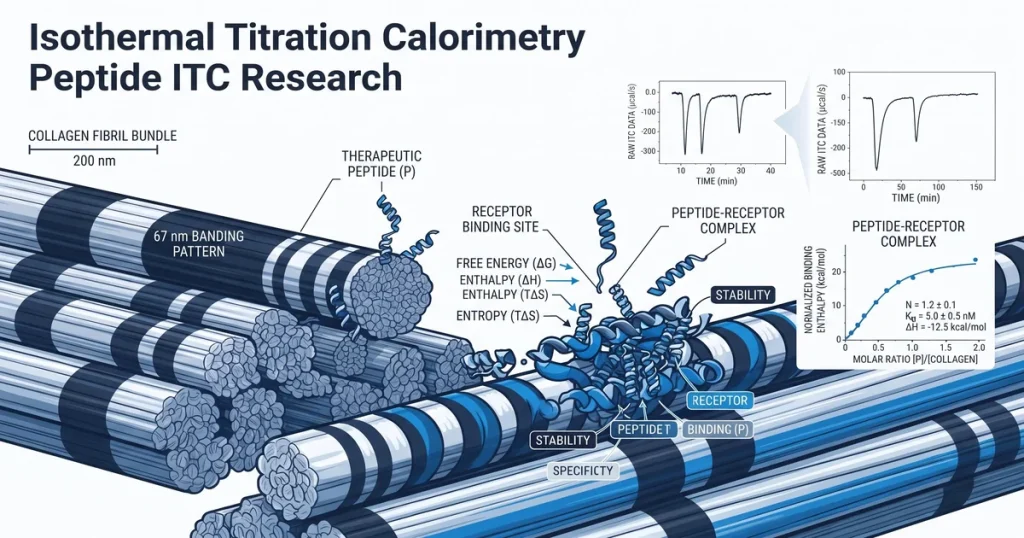
A method known as isothermal titration calorimetry (ITC) is a heat-based tool for binding studies in solution. The instrument tracks that heat with each step to calculate binding affinity, heat change, entropy, and binding ratio from one run. ITC needs no labels, no surface attachment, and no chemical change to either binding partner.
Next Level Pharm provides research-grade peptides for binding studies. The catalog lists 70+ active peptide SKUs across 7 groups. Each batch is verified at 99% or higher purity by HPLC (high-performance liquid chromatography) and mass spectrometry.
Average purity across the last 100 batches is 99.4%. All compounds are lyophilized (freeze-dried) for stable room-temperature shipping. Lot records and a COA (certificate of analysis) ship with every order.
ITC is applied across a wide range of peptide binding studies. Recovery peptides are often tested using ITC to map binding energy at their target sites. Sample purity directly affects signal quality and data consistency in every ITC assay.
Precise control over buffer, level, and temperature is needed in every run. The sections below outline the key concepts and lab steps used in peptide ITC research.
Key Takeaways
- Direct Heat Measurement: ITC measures the heat released or absorbed during molecular binding in real time. This gives direct energy data without any chemical labels.
- Full Energy Profile: One ITC run yields binding affinity (Ka), heat change (delta H), entropy (delta S), and binding ratio (n). No other single method provides all four in one step.
- Label-Free Technique: ITC needs no fluorescent dyes, tracer labels, or surface-bound capture agents. Peptides and targets interact in their native solution state.
- High Purity Requirement: ITC signals are sensitive to contaminants that shift the heat baseline. Peptides at 99% or higher purity give the cleanest, most reliable heat curves.
- Solution-Phase Measurement: ITC operates in free solution. Unlike SPR (surface plasmon resonance), neither binding partner is fixed to a chip.
This keeps the natural shape of each molecule during binding.
The sections below describe how ITC works, what data it yields, and how researchers design peptide binding experiments for reliable results.
What Is Isothermal Titration Calorimetry?
Isothermal titration calorimetry measures heat change when a ligand binds a target molecule. The instrument holds two cells at the same temperature. One cell holds the target.
The other holds buffer only.
A syringe injects the peptide into the sample cell in small, equal steps. Each step produces one heat peak in the raw thermogram (a chart of power versus time).
The area of each peak, plotted against molar ratio, forms the binding isotherm used for energy analysis.
How Does ITC Measure Peptide Binding?
ITC tracks tiny power differences between the sample and reference cells. Each step causes heat to flow as the peptide binds the target. A thermopile (a device that converts heat gaps into voltage) records this change at each step.
The raw output is a series of heat peaks, one per injection. According to Leavitt and Freire (2001), fitting the isotherm to a one-site binding model gives Ka, heat change, and binding ratio in one run.
Shop research-grade peptides for ITC studies. All lots are HPLC and mass spec tested. Each vial ships with a COA and traceable lot number.
What Energy Data Does ITC Yield?
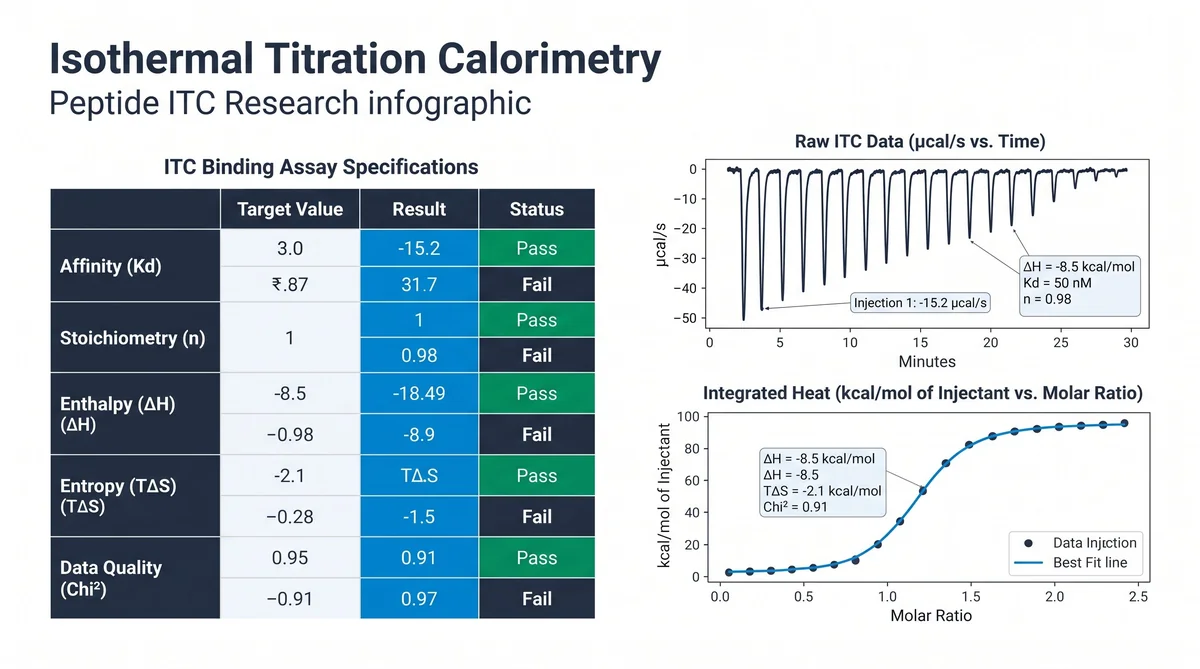
ITC yields four primary values from one experiment. Binding affinity (Ka), heat change (delta H), and binding ratio (n) are measured directly. Gibbs free energy (delta G) and entropy (delta S) are then derived from Ka and delta H.
According to a review in Molecules (2020), combining heat change and entropy data shows the forces driving binding. Large, negative delta H points to strong hydrogen bonding or charged contacts. Positive delta S with delta H near zero shows hydrophobic burial at the surface.
How Is an ITC Experiment Designed?
ITC design starts with buffer matching. Both the peptide and target must share the same buffer. This stops heat-of-dilution artifacts from altering the signal.
Peptide level in the syringe is set at 10 to 20 times the target level. A control step adds peptide to buffer first to measure dilution heat. According to a 2024 review in the Journal of Peptide Science (2024), careful control subtraction is needed to isolate true binding heat from background signals.
Next Level Pharm provides COA-tested peptides at 99% or higher purity for ITC assay work. Fitness and GH peptides with traceable lot numbers are available for receptor binding studies.
What Are the Limits of ITC for Peptides?
ITC uses more sample than most other binding methods. A standard cell volume is 200 to 300 microliters. Both the cell and syringe need high-level stock solutions.
ITC also struggles at Ka extremes. Very tight binders (Ka above 10^9 M^-1) give a steep rectangular isotherm with poorly constrained fits. Very weak binders (Ka below 10^3 M^-1) give nearly flat curves with too little heat signal.
Beauty peptides with known binding behavior are often run first to check instrument settings before novel samples are measured.
How Does ITC Compare to SPR for Peptides?
ITC and SPR (surface plasmon resonance) both measure peptide binding but capture different data. ITC gives a full energy profile in free solution. SPR measures binding kinetics on a chip surface.
ITC is chosen when the energy profile of a binding event is needed. SPR is used for kinetic rate constants or when sample is limited. The two methods are often used together in lab research.
| Feature | ITC | SPR |
|---|---|---|
| Data type | heat-based (Ka, delta H, delta S, n) | Kinetic (ka, kd) and Ka |
| Label required | None | One partner anchored to chip |
| Sample volume | 200 to 300 microliters per run | Microliters per cycle |
| Affinity range | Nanomolar to micromolar | Picomolar to micromolar |
| Run time | 1 to 2 hours | 20 to 60 minutes |
| Key strength | Complete energy profile | Fast kinetic ranking |
Frequently Asked Questions
What is the ITC measurement principle for peptide binding?
ITC holds two cells at the same temperature: a sample cell with the target and a reference cell with buffer only. A syringe delivers the peptide in small, equal steps while the device logs the power difference between cells after each step. Each heat peak, plotted against molar ratio, forms the binding isotherm used to fit the energy parameters and derive Ka, delta H, and binding ratio.
How is an ITC experiment designed for a peptide interaction?
Both the peptide and target must share the same buffer before a run, since any mismatch creates heat-of-dilution artifacts. Target level in the cell is set at about 10 times the expected Kd, and the syringe is at 10 to 20 times that. A control step adds peptide to buffer first, and dilution heat is then removed.
Lab work uses pure, tested peptides for clear data.
What heat-based parameters does ITC measure?
ITC directly measures binding constant (Ka), heat change (delta H), and binding ratio (n) from one titration run. Gibbs free energy (delta G) and entropy (delta S) are then derived from Ka and delta H using standard energy equations. These five values define the full energy profile and show whether the interaction is heat-driven, entropy-driven, or both, which guides further study design.
Lab work uses pure, tested peptides for clear data.
How is binding ratio determined from ITC data?
Binding ratio (n) is extracted from the inflection point of the sigmoidal binding isotherm after fitting. At the inflection point, the molar ratio of peptide to target equals the binding site count per molecule. Accurate ratio data requires exact amount data for both the syringe stock and the cell stock, since errors in either shift the inflection point.
Lab work uses pure, tested peptides for clear data.
What levels are required for peptide ITC experiments?
Target level in the sample cell is typically set between 10 and 100 micromolar, with the exact value based on the expected Kd. The peptide syringe is usually 10 to 20 times the target level to ensure full binding site coverage during the titration. A Wiseman c value between 5 and 1000 gives a well-shaped isotherm for reliable and precise fitting.
Lab work uses pure, tested peptides for clear data.
Can ITC detect peptide aggregation in solution?
ITC can detect heat changes linked to peptide aggregation. Aggregation appears as irregular peaks in the thermogram, not a clean sigmoidal curve. These signals fail standard one-site binding models and give poor fits.
Researchers run DLS (dynamic light scattering) checks alongside ITC to confirm the signal is from specific binding, not particle formation.
Lab work uses pure, tested peptides for clear data.
What is the difference between ITC and SPR for peptides?
ITC measures binding energy in free solution, giving Ka, delta H, delta S, and n from one run without surface attachment. SPR attaches one partner on a sensor chip and measures on-rate and off-rate as the free partner binds. The two methods are paired: ITC gives the energy profile and SPR gives the kinetic profile of the same binding event.
Lab work uses pure, tested peptides for clear data.
How does buffer composition affect ITC results for peptides?
Buffer proton transfer adds heat artifacts to ITC data during binding, making the measured heat change differ from the true binding value. High-proton buffers such as Tris make this worse, which is why low-proton buffers like phosphate or HEPES are preferred. Both the peptide and target must be in the same buffer mix to stop heat-of-mixing signals from altering the true binding signal.
Summary
Isothermal titration calorimetry is a label-free physical method that measures peptide binding energy in solution. One run yields Ka, heat change, entropy, and binding ratio without chemical change to either partner.
Sample purity is a central requirement for ITC. Contaminants shift the heat baseline and distort the isotherm shape. Peptides verified at 99.4% average purity by HPLC and mass spectrometry give the most reliable ITC results.
Buffer matching, level control, and dilution heat subtraction are all required before valid energy data can be extracted. Researchers pair ITC with SPR to build a full picture of binding energy and kinetics for peptide-target binding.
What Should You Do Next?
Confirm that your peptide and target are dialyzed into the same buffer before setting up an ITC run. Calculate the Wiseman c value using the estimated Kd and planned target level to check that the isotherm will be well-shaped. Run a peptide-into-buffer control first to measure dilution heat for subtraction.
Next Level Pharm supplies COA-tested, HPLC-tested research peptides at 99% or higher purity for ITC and binding assay work. Browse the full catalog to find batch-documented peptides for your next binding study.
People Also Read
- Surface Plasmon Resonance Peptide Binding Research
- Circular Dichroism Peptide Research: CD Spectroscopy
About the Author
Next Level Pharm Research Team
The Next Level Pharm research team is composed of biochemists. Laboratory scientists dedicated to providing researchers with the highest-purity, lab-tested peptides available. Every batch is HPLC and mass spec verified before dispatch.
Disclaimer: The information provided on this page is for educational and research purposes only. Next Level Pharm’s products are intended for laboratory research use only. They are not intended for human consumption, diagnostic, therapeutic, or medicinal purposes.
This content does not constitute medical advice. Always consult a licensed healthcare professional before making any health-related decisions.