Peptide Polymorphism Research: Crystal Hydrate Forms

Last updated: October 2026
A peptide conformational polymorphism is the ability of a peptide to exist in more than one crystal structure from the same compound. Each form has its own properties, like dissolving rate and stability. These crystal shifts can change how a compound acts in laboratory tests, so knowing the form matters for consistent results.
Next Level Pharm gives labs high-purity compounds for their studies. Each batch holds an average purity of 99.4% based on the last 100 test runs.
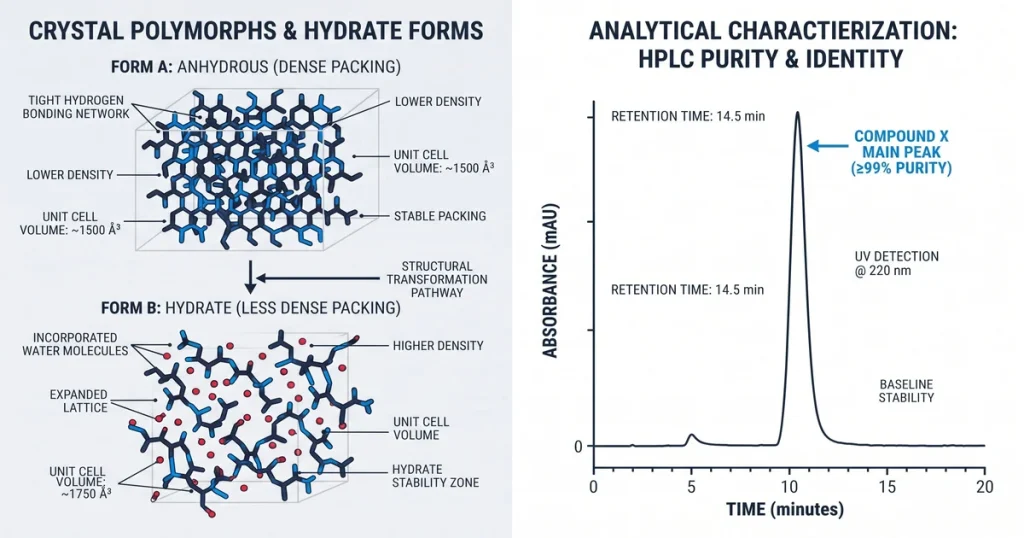
The team checks every vial with HPLC (high performance liquid chromatography, a method that tests purity). They also confirm molecular weight with mass spectrometry.
These compounds ship in a freeze-dried (lyophilized) state. They stay stable at room temperature with no cold chain shipping needed.
The crystal structure of a peptide matters for lab work. Changes in folding can shift how a compound fits a binding site or resists breakdown. Labs that track these properties get results that repeat each time.
The sections below cover how these shifts happen and how they affect lab studies.
Key Takeaways
- Polymorphism Defined: A single peptide can form more than one crystal structure, and these forms are called polymorphs. Each one has its own physical properties.
- Research Impact: Each crystal form differs in stability and dissolving rate, which affects the outcome of lab tests. Knowing the form helps keep results consistent.
- Hydrate Forms: Some crystal forms hold water molecules in their lattice, unlike water-free versions. Labs must track which form they use.
- Detection Methods: Tools like XRPD, DSC, and FTIR can identify different crystal forms by reading different properties. Used together, they give a complete picture.
- Control Factors: Crystal form depends on cooling and drying conditions, including solvent choice, temperature, and pH. Slow cooling tends to produce the most stable form.
- Freeze-Dried State: Freeze-drying often produces a non-crystal solid that can change if stored in heat or moisture. Proper storage keeps the intended form intact.
Each crystal structure gives a compound a distinct set of properties. Labs track these forms to keep test results consistent.
Forces between molecules guide how peptides line up in a crystal lattice. Hydrogen bonds and van der Waals forces set the rules for how they stack. Even small shifts in spacing can create a new crystal form.
Each form has its own stability and dissolving rate. Good control of these forces leads to more reliable results.
How do polymorphs affect peptide research?
Crystal forms affect peptide research by changing the physical properties of a sample. These changes shift how the compound acts in a controlled test.
A sample with unknown crystal forms adds extra variables. This can hide the true cause of the results. Careful testing of the form ensures each trial uses the same material.
Setting a strict baseline for these properties is key to good bench work. Labs focus on purity and crystal form to keep their data valid across tests.
Why are crystal hydrates important in polymorphism?
Crystal hydrates are forms that hold water in their crystal lattice. This water acts as part of the structure. It can make the form more or less stable.
Hydrates differ from water-free forms, which have no water in their lattice. The water inside the lattice changes how the crystal packs. This affects the stability of the material.
This bound water shifts the bonds between molecules. It changes properties like moisture uptake, physical stability, and dissolving speed.
When water sits in the lattice, it can shield or expose parts of the molecule. According to the Journal of Peptide Science (2018), these changes matter for knowing how a peptide keeps its intended properties. Labs check for these states as a standard part of their analysis.
What techniques detect peptide polymorphs?
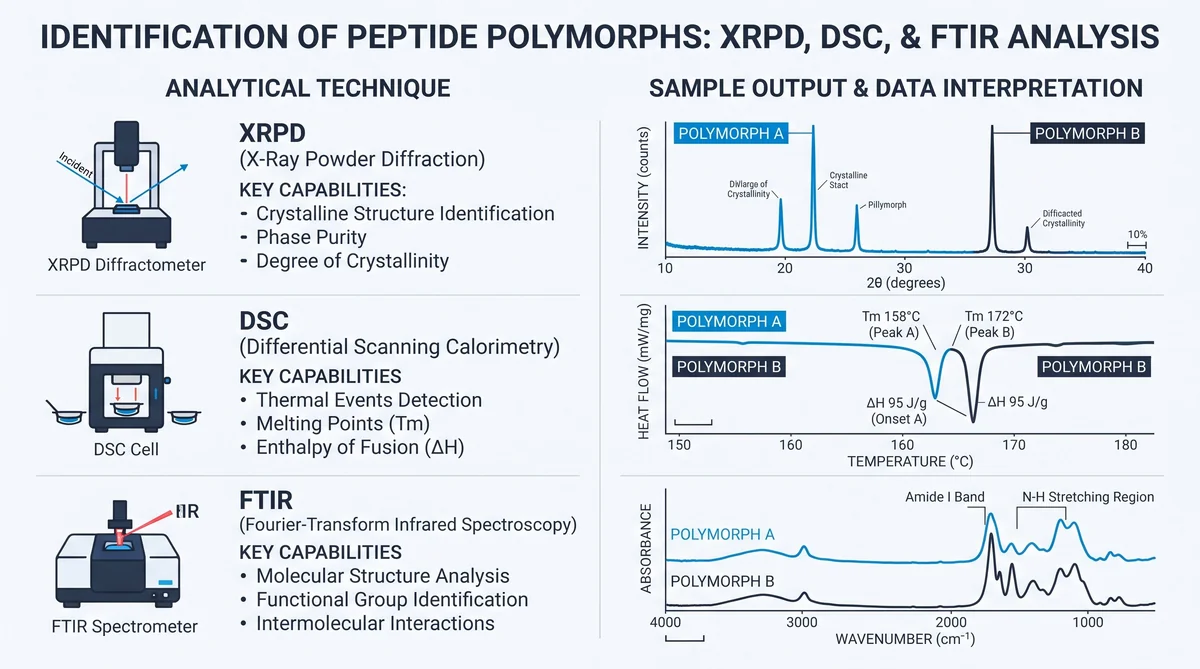
Labs find peptide crystal forms using a mix of analytical tools. XRPD (X-ray powder diffraction, a method that maps crystal structure using X-rays) is the primary method. It creates a unique pattern for each solid form, like a fingerprint.
Other tools like DSC (differential scanning calorimetry, a heat-based test) and spectroscopy (a scan based on bond vibrations) add more detail.
XRPD maps the crystal lattice. DSC tracks the heat needed for phase changes. This shows the energy stability of each form.
Methods like FTIR and Raman look at specific bonds in the peptide chain. They spot subtle shifts in how the molecule folds. According to Molecules (2021), testing these properties ensures samples stay the same during later lab work.
| Method | What It Measures | Use Case |
|---|---|---|
| XRPD | Crystal lattice pattern | Spotting crystal form |
| DSC | Heat flow in phase changes | Energy stability of forms |
| FTIR | Bond vibrations in the chain | Finding folds and shifts |
| Raman | Light scatter from bonds | Checking molecular shape |
Next Level Pharm tests every lot to confirm the quality of the material. This ensures labs get precise, stable compounds for their studies.
How is conformational polymorphism controlled?
Labs control crystal form by managing the conditions during crystal growth. Solvent choice, temperature, pressure, and pH all affect how molecules pack. Keeping these factors steady is key to getting one form each time.
Seed formation and crystal growth speed drive the final result. Fast cooling often triggers random seed formation. This leads to many mixed or less stable crystal types.
Slow, watched growth tends to produce the most stable form. Adding a small amount of the desired crystal (called seeding) helps guide the process. The seeds act as a template for the rest of the material.
By choosing the right seeds, labs can stop unwanted crystal types from forming.
Does polymorphism affect lyophilized peptides?
Freeze-drying (lyophilization, the removal of water by freezing and vacuum) often makes a non-crystal solid. During this process, the fast removal of solvent stops molecules from lining up into an ordered lattice. The peptide gets locked in a shapeless, glass-like state.
This non-crystal state can be less stable than a crystal form. If the material sits in too much heat or moisture, molecules can gain enough energy to move. They may then form crystals on their own, in random patterns.
The conditions used during mixing back into liquid also play a role. Precise control over storage and prep keeps the intended form of the material.
Frequently Asked Questions
What is crystal polymorphism in peptide research?
According to PubMed (2024), this topic draws strong research interest. Crystal forms (polymorphs) are different ways a peptide can organize into a solid. The chemical makeup stays the same, but the lattice structure changes.
These shifts come from different growth conditions or packing patterns during crystal formation. Each form has its own set of physical properties. These properties affect how the compound acts in lab tests.
How do different crystal forms of a peptide differ in stability?
Crystal forms have different levels of energy-based stability. One form may stay stable under normal conditions. Another may slowly shift into a more stable state over time.
This gap in stability affects shelf life and how a sample reacts in tests. According to Molecules (MDPI) (2020), how molecules pack in the lattice sets how well a crystal resists stress from temperature or pressure during testing.
What analytical methods identify peptide polymorphs?
Labs identify crystal forms by looking at how atoms are arranged in a solid. Methods like infrared spectroscopy and thermal analysis give data on molecular interactions. X-ray diffraction (a method that maps crystal lattices) is the primary tool.
According to Peptides (2018), combining these methods lets labs confirm the identity and purity of a crystal form in a given batch.
How does hydrate formation affect peptide crystal stability?
A hydrate forms when water molecules become part of the crystal lattice. This changes the internal structure and can shift how stable the solid is. The water may improve or reduce the stability of the crystal form.
According to Molecules (2019), labs track hydration levels because these molecules change the dissolving rate and physical integrity of the peptide in varying moisture.
What XRPD analysis is used to characterize peptide polymorphs?
XRPD (X-ray powder diffraction) measures how X-rays scatter off the crystal parts of a peptide sample. The resulting pattern acts as a fingerprint for the lattice structure. This method does not damage the sample, so labs can check which form is in a vial.
According to Frontiers (2020), XRPD gives the baseline data needed to tell different crystal forms apart during quality control and material testing.
Is an amorphous solid considered a polymorph?
A non-crystal (amorphous) solid is not a polymorph because it lacks the ordered atomic pattern found in a crystal. Non-crystal materials have a shapeless, glass-like structure with no repeating molecular pattern.
The molecules in such a solid have not organized into a set lattice. According to Frontiers (2018), labs often compare crystal and non-crystal forms to find which state suits specific test conditions.
Can a peptide convert from one polymorph to another?
A crystal form change happens when a peptide shifts from one arrangement to another. This shift is often driven by changes in temperature, pressure, or solvent contact. Some forms are less stable and will slowly convert to a more stable arrangement.
According to NCBI PMC (2020), knowing the speed of these transitions is key for keeping samples consistent throughout a study or laboratory observation.
How does polymorphism impact peptide formulation for research?
The crystal form of a peptide sets its dissolving rate and how well it mixes in different buffers. Each form has a unique lattice energy, so they respond differently when placed in a solvent. This can lead to variable results in assays if the physical form is not controlled.
According to NCBI PMC (2019), labs track the crystal form to make sure the peptide acts the same across repeated trials and different test conditions.
What is a solvate in the context of peptide crystals?
A solvate is a crystal solid that contains solvent molecules trapped inside its structure. Unlike a hydrate, which holds water, a solvate holds organic solvents or other liquids. These molecules sit in specific sites in the lattice and can influence the density and shape of the crystal.
According to NIH (2018), identifying solvates matters because these trapped molecules can affect the reactivity and stability of the peptide.
How does peptide polymorphism affect solubility and dissolution rate?
The arrangement of molecules in a crystal sets how easily a solvent can pull them apart. A less stable crystal form often dissolves faster than a tightly packed, stable form. This property influences how a peptide disperses during laboratory tests.
According to NIH (2019), the surface area and lattice energy of a crystal form set the rate at which the solid turns into a liquid.
Summary
Peptide crystal forms (polymorphs) play a key role in laboratory research. Each form has its own stability, dissolving rate, and physical properties. These shifts can change how a compound acts in tests.
Labs that track crystal forms get more consistent, repeatable results. Tools like XRPD, DSC, and FTIR help confirm which form is present. Proper storage and handling keep the intended form intact.
Next Level Pharm provides high-purity research materials with verified lot data for labs that need consistent results. Every vial ships with a COA (certificate of analysis) and full lot tracking.
What Should You Do Next?
Check that your study design lists the peptide concentration, purity threshold, and test model for each assay. Review the lot-specific COA for each compound to confirm purity meets the 99% or higher standard.
Next Level Pharm stocks COA-verified research compounds for lab teams that need consistent purity across batches. Browse research peptides to source materials for your next study.
Browse recovery peptides for COA-verified research compounds.
Browse fitness peptides for COA-verified research compounds.
People Also Read
- Peptide Excipient Compatibility Research: Stabilizers
- Peptide Thermal Denaturation Research: DSC Studies
About the Author
Next Level Pharm Research Team
The Next Level Pharm research team is made up of biochemists and lab scientists. Their goal is to give researchers the highest-purity, COA-tested compounds on the market. Every batch is HPLC and mass spec confirmed before dispatch.
Disclaimer: The information provided on this page is for educational and research purposes only. Next Level Pharm’s products are intended for laboratory research use only. They are not intended for human consumption, diagnostic, therapeutic, or medicinal purposes. This content does not constitute medical advice. Always consult a licensed healthcare professional before making any health-related decisions.