
Defensin Peptide Research: Antimicrobial Host Defense

Last updated: October 2026
A defensin antimicrobial peptide is a small, charged molecule that helps the body combat microbes across many species. These peptides contain 18 to 45 amino acids and three disulfide bonds that hold their structure together. They are rich in cysteine (a sulfur-containing amino acid) and carry a strong positive charge, according to PubMed (2011).
These peptides disrupt microbe cell walls through charge-based binding. Lab teams study how they interact with cell pathways in controlled settings.
Next Level Pharm keeps strict quality controls for all research materials. Each batch goes through HPLC (high-performance liquid chromatography) and mass spec testing. Across the last 100 batches, the average purity is 99.4 percent.
The catalog has over 70 active peptide products for lab use. Every vial is freeze-dried and sealed under inert gas for stable storage. These steps help ensure clear, steady results across study types.
Researchers can also find study bundles like the GLOW Stack or KLOW Stack. These sets include COA (certificate of analysis) verified compounds sold only for research. Next Level Pharm focuses on proven purity and stable storage for modern lab work.
Key Takeaways
- Defensin Structural Families: These peptides fall into alpha, beta, and theta groups based on how their disulfide bonds connect.
- Primary Antimicrobial Mechanism: Defensins disrupt microbe cell walls to cause fatal leakage and cell death in laboratory models.
- Laboratory Research Methods: MIC assays measure the lowest peptide level needed to stop visible microbe growth in controlled settings.
- Beyond Germ Fighting: Defensins also recruit immune cells to infection sites, linking innate and adaptive defense responses.
Researchers sort these compounds by size and bond layout. The three disulfide bonds in each peptide determine its structure and function.
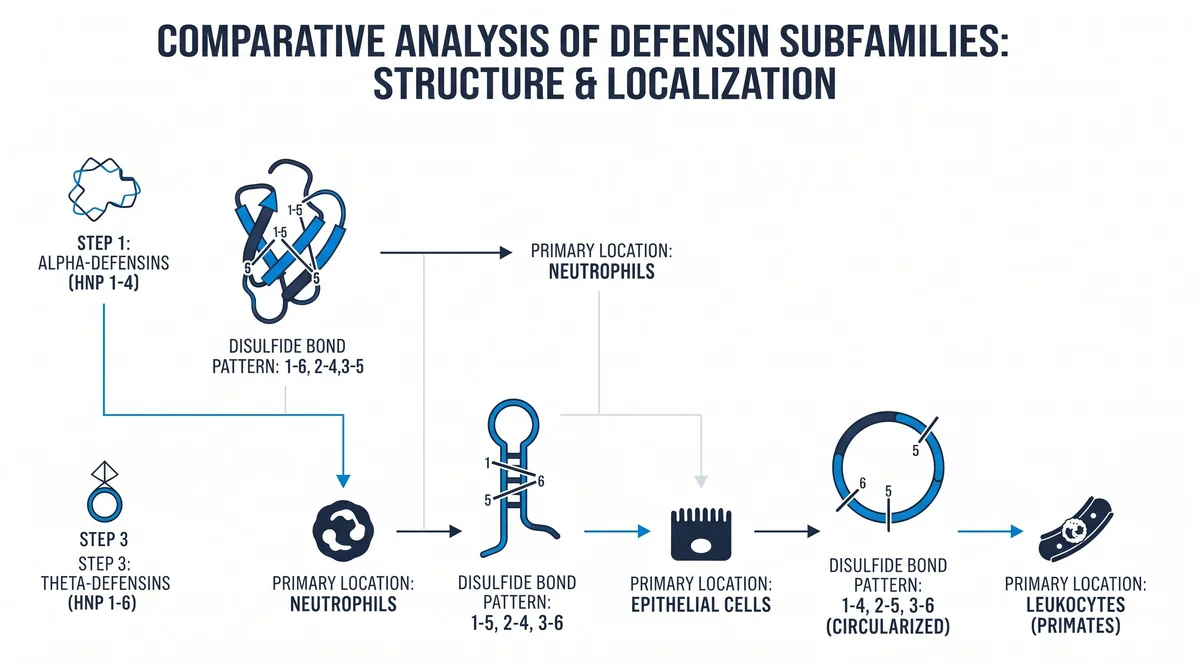
These peptides split into two main types: alpha-defensins and beta-defensins. The split depends on how their internal disulfide bonds connect. This bond layout gives them the strength to stay active in various test settings.
The exact spacing of cysteine parts lets each type fold into a distinct shape. These shapes affect how they attach to microbe surfaces. Next Level Pharm provides high-purity versions for laboratory study.
How Do Defensins Exert Antimicrobial Action?
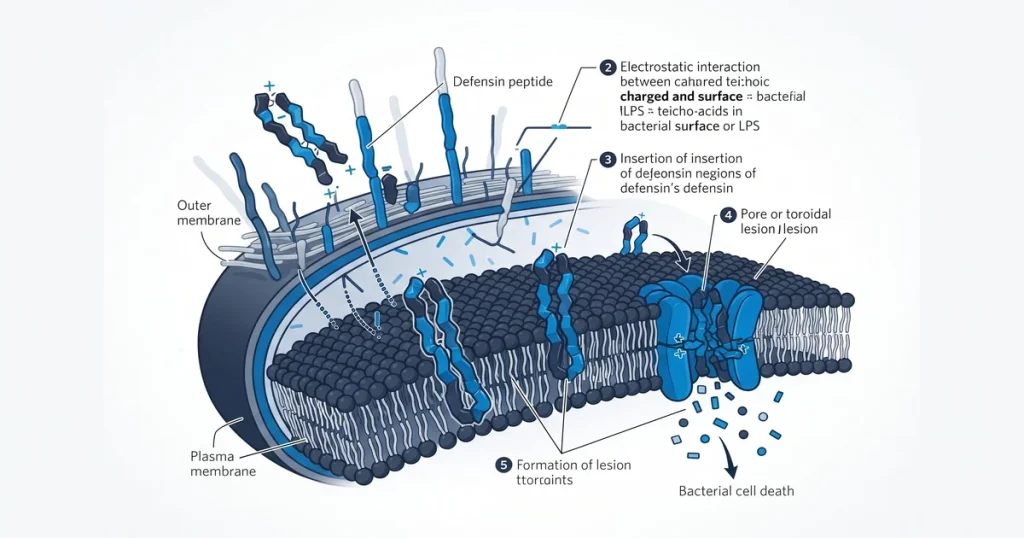
Defensins combat microbes mainly by disrupting their cell membranes. This causes the cell contents to leak out. The process starts with charge-based binding between the peptide and the microbe.
The positive charge on the peptide sticks to the negative charge on the microbe surface. Once attached, the peptide opens holes in the cell membrane. Scientists call this membrane permeabilization (making the barrier porous).
Two main models describe how the holes form. In the barrel-stave model, peptides push straight into the lipid layer of the membrane. They cluster to form a channel through the entire barrier.
In the toroidal pore model, peptides bend the membrane around them. This creates an opening that spans the full lipid layer. Both methods cause the microbe to lose balance and die.
According to the Journal of Peptide Science (2007), these steps are key to grasping how small molecules disrupt lipid barriers.
What Are the Main Human Defensin Subfamilies?
The two main types are alpha-defensins and beta-defensins. They differ in their disulfide bond layout. These small proteins act as a first line of defense in the body.
Alpha-defensins live in the granules of neutrophils (a type of white blood cell). They also appear in Paneth cells in the small intestine. Beta-defensins come from epithelial tissues to guard mucosal body surfaces.
Human Neutrophil Peptides (HNPs) are the primary alpha-defensins. They serve as key markers in immune research. Human Beta-Defensins (HBDs) come from surface cells in response to outside signals.
According to the Journal of Peptide Science (2012), the bond layout defines how these molecules fold. It also controls how they interact with target cells. These shape differences help researchers map the roles of innate defense systems.
What Is Defensins’ Role Beyond Antimicrobial Effects?
Defensins also act as signaling molecules in the immune system. They bridge the innate and adaptive parts of immune defense. They recruit immune cells toward sites of infection or tissue damage.
These peptides draw T-cells, monocytes, and dendritic cells to problem areas. This movement happens through the CCR6 receptor on cell surfaces. Beyond fighting microbes, defensins are studied for roles in wound healing and cell growth.
By guiding how immune cells move and activate, these peptides do more than kill microbes. They help organize a broader cell response after the initial contact with a pathogen.
Studies show defensins start chemotaxis (cell movement toward chemical signals). This pulls dendritic cells and other immune cells to local sites. According to PubMed (2002), human beta-defensins trigger the movement of immature dendritic cells and memory T-cells.
These findings suggest defensins signal the immune system to mount a more focused defense. Also, studies observe these peptides may promote skin cell growth and tissue repair. This diverse range of roles is why researchers study defensins for complex cell signaling.
Researchers studying tissue repair and inflammatory pathways can explore the BPC-157 catalog for their studies. Each lot is tested by HPLC and mass spec to meet high laboratory standards. Full analytical reports are posted online for all stock items.
How Are Defensins Evaluated in Research?
Scientists measure defensin potency with laboratory assays. The most common is the MIC (Minimum Inhibitory Concentration) assay. This test finds the lowest amount of peptide needed to stop visible microbe growth.
Researchers prepare serial dilutions of the peptide in growth broth with the target microbe. After a set incubation period, the team checks each sample. The point where growth stops gives a clear number for comparing peptide activity.
Other methods include radial diffusion assays. In these, peptides go into agar gel with microbes to show clear inhibition zones. Scientists also use fluorescent dye tests to track how well a peptide disrupts a microbe membrane.
According to Peptides (2011), these methods allow precise observation of peptide action under controlled conditions. This approach helps describe the speed and scope of membrane disruption.
What Are Key Challenges in Defensin Research?
Defensin research faces several hurdles in the laboratory. These include salt sensitivity, possible cell harm at high levels, breakdown by enzymes, and hard-to-scale production. Salt levels in body fluids can block defensin activity.
According to Peptides (2012), high salt disrupts the charge-based binding needed to attach to microbe membranes. This means researchers often use low-salt buffers in laboratory assays. Low salt helps ensure correct results for peptide function.
Enzymes called proteases in complex biological systems can break these molecules apart. Making these disulfide-rich compounds takes advanced chemistry and costly methods. High levels may also harm non-target cells, which makes data harder to interpret.
Frequently Asked Questions
What is the structural basis of defensin antimicrobial activity?
Defensins have a compact shape held together by three disulfide bonds. According to Molecules (2024), this area draws strong research interest. These bonds create a molecule with two distinct sides: one that repels water and one with a positive charge.
According to Molecules (2012), this layout lets the peptide push into the lipid layer of microbe cell walls. The rigid fold helps the peptide survive harsh conditions in various laboratory settings.
How do alpha-defensins differ from beta-defensins in structure?
The key difference lies in how their six cysteine parts connect. Alpha-defensins use a 1-6, 2-4, and 3-5 bond pattern. Beta-defensins follow a 1-5, 2-4, and 3-6 pattern instead.
According to the NCBI (2007), these patterns control how the molecule folds in three dimensions. Both types share a similar core sheet structure. But their bond layout changes how each class attaches to microbe cell walls.
What membrane interaction mechanism do defensins use?
Defensins use a pore-forming method to disrupt microbe cell membranes. The positive charge on the peptide pulls it toward the negative charge on microbe surfaces. Once attached, the peptides group together and push into the membrane.
They form small channels that let cell contents leak out, killing the microbe. According to the NIH (2003), this leads to rapid cell death through direct contact with the lipid layer.
How is defensin antimicrobial activity measured in vitro?
Scientists use standard laboratory assays to find how much peptide stops microbe growth. These assays run in liquid growth broth at set times and temperatures. According to Frontiers (2010), results are reported as the MIC (minimum inhibitory concentration).
This number gives a clear baseline for comparing different defensin types against each other. Researchers can then rank how well each version works against bacteria, fungi, or viruses.
What are the minimum inhibitory concentration assay conditions for defensins?
Finding the MIC requires close control of salt levels and pH (acid-base balance). These factors strongly affect how well the peptide binds to microbe surfaces. Researchers use low-salt buffers to stop charge-blocking effects.
Without this step, the positive peptide may not reach the negative microbe membrane. According to Frontiers (2020), standard methods use serial dilution in liquid broth. The assay then finds the exact point where microbe growth fully stops.
Are defensins specific to certain types of microbes?
Defensins show broad-spectrum activity, which means they work against many types of bacteria, fungi, and some viruses. They do not target specific receptors on microbe surfaces. Instead, they exploit basic charge differences between microbe and animal cell membranes.
The negative surface charge on most pathogens provides a shared target for binding. This broad mode of action lets defensins work against many microbe types without needing a specific protein receptor.
What role does defensin research play in studying antibiotic resistance?
Defensins disrupt the structure of cell membranes rather than blocking specific enzymes inside the cell. This sets them apart from standard antibiotics in a key way. Microbes struggle to resist membrane-disrupting agents.
Changing the lipid makeup of the entire cell membrane costs too much energy for most microbes. According to NCBI PMC (2016), this research helps map how microbes dodge immune defenses. The data guides new ways to manage resistant microbe populations.
Can defensins be synthesized for therapeutic or research purposes?
Scientists make defensins through solid-phase synthesis or recombinant (gene-based) methods. Both produce high-purity material for laboratory study. This lets researchers add changes like non-standard amino acids or ring structures.
Such changes can boost stability in tough laboratory settings and broaden the range of possible assays. According to NIH (2019), these synthetic versions are needed for detailed structure-function studies. They help isolate specific forms that are hard to extract from biological tissues.
How do defensins compare to other antimicrobial peptides like cathelicidins?
Both types serve as host defense molecules, but they differ in shape and structure. Defensins have a rigid frame locked by disulfide bonds. Cathelicidins have a flexible, helix-shaped structure that forms only on contact with a membrane.
According to ClinicalTrials.gov (2008), this shape difference changes their speed of action and membrane preferences. Each class has distinct immune signaling roles that remain a focus of comparative laboratory research.
What immunomodulatory functions do defensins have beyond killing microbes?
Beyond killing microbes directly, defensins act as signals that recruit immune cells to key areas. They adjust the levels of cytokines and chemokines (immune signaling proteins) at the site. This helps link the innate immune response to the adaptive one in a more focused way.
According to ClinicalTrials.gov (2011), these peptides can also push epithelial cells to produce their own defense molecules. These secondary roles show the complexity of defensin-mediated immune regulation.
Summary
Defensins are small, charged peptides that form a core part of the innate immune system. They combat microbes by disrupting cell membranes through charge-based binding. Laboratory assays like MIC tests measure their potency with clear numerical results.
These peptides also function as immune signals. They recruit defense cells to infection sites and help link innate and adaptive immune responses. Salt sensitivity, enzyme breakdown, and production costs remain the main research hurdles.
Next Level Pharm provides high-purity, COA-verified defensin research materials. Every batch is HPLC and mass spec tested before dispatch.
What Should You Do Next?
Review your research protocols to confirm the lab setup meets the peptide stability needs noted above. Check your buffer salt levels, as high salt can alter how defensins bind during MIC assays. Match your project timeline to the 48-hour average dispatch schedule.Every batch is third-party tested.. This confirms the purity levels of your research samples.
Researchers sourcing defensin and innate immunity peptides can browse the full catalog. Every vial ships with a COA and full lot traceability.
Browse recovery peptides for COA-verified research compounds.
Browse research peptides for COA-verified research compounds.
Browse fitness peptides for COA-verified research compounds.
People Also Read
About the Author
Next Level Pharm Research Team
The Next Level Pharm research team is made up of biochemists and lab scientists. Their goal is to give researchers the highest-purity, COA-tested compounds on the market. Every batch is HPLC and mass spec confirmed before dispatch.
Disclaimer: The information provided on this page is for educational and research purposes only. Next Level Pharm’s products are intended for laboratory research use only. They are not intended for human consumption, diagnostic, therapeutic, or medicinal purposes. This content does not constitute medical advice. Always consult a licensed healthcare professional before making any health-related decisions.