
Arrhenius Model Peptide Stability: Accelerated Studies

Last updated: October 2026
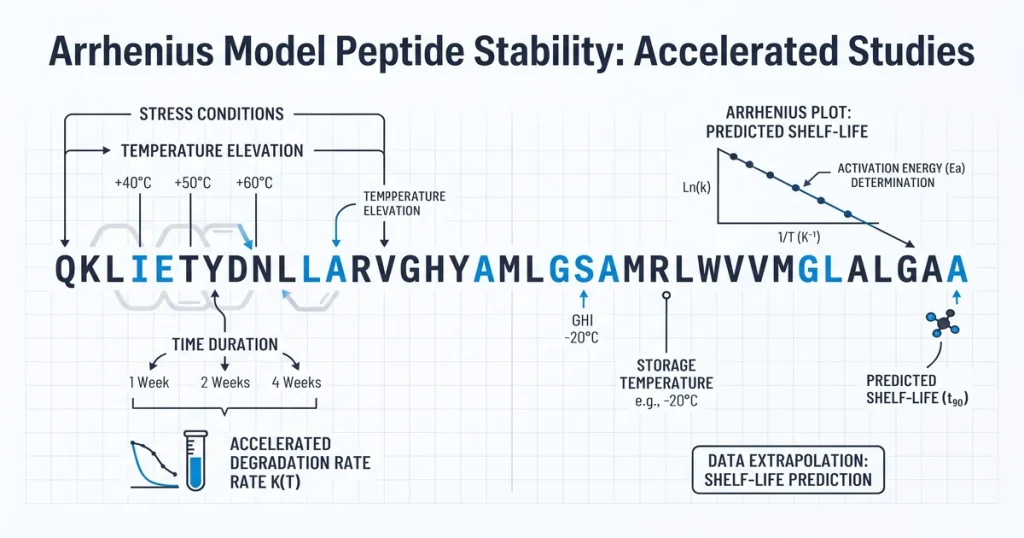
A study on Arrhenius accelerated stability peptide research is a lab method that uses high heat to predict how long peptides will last. In many cases, breakdown rates rise two to four times for every 10 degree Celsius increase. Researchers track these rates at set time points and then apply a math formula to estimate shelf life at normal storage temps.
Next Level Pharm holds strict quality controls for all peptides in its catalog. The lab records a 99.4% average purity across its last 100 batches.
Every vial gets HPLC (high-performance liquid chromatography, a method that measures purity) checks. It also gets mass spec (mass spectrometry, a tool that confirms molecular identity) testing.
All orders include a COA (Certificate of Analysis). This report lists the purity results for each batch.
Next Level Pharm stocks 70+ peptide SKUs that ship from its domestic facility. Each compound comes in lyophilized (freeze-dried) form. It is sealed under an inert gas.
This article breaks down how the Arrhenius model works for peptide research. It covers study design, data tools, shelf-life prediction, and model limits.
Key Takeaways
- Heat-Based Prediction: The Arrhenius model uses raised temps to forecast how fast peptides break down. This cuts years off shelf-life testing.
- Data Collection Methods: HPLC and mass spec track purity loss and spot breakdown products at each time point.
- Shelf-Life Estimates: By plotting breakdown rates on a graph, researchers can predict how long a peptide lasts at normal storage temps.
- Model Limits: The model only covers chemical breakdown. It does not predict physical changes like clumping or falling out of solution.
- Lyophilized Stability: Freeze-dried peptides tend to show higher stability in these tests because the lack of water slows breakdown.
These concepts form the basis of how peptide labs assess compound shelf life. The sections below cover each step in detail.
What is the core principle of the Arrhenius model?
The Arrhenius model shows how temp changes affect the speed of a chemical reaction. It links the rate to the activation energy (the least energy needed for a change to happen). It also factors in the temp in Kelvin.
This math lets researchers predict peptide breakdown across a range of heat levels.
The equation is k = Ae^(-Ea/RT). Ea stands for activation energy. A is a factor based on how often molecules collide.
Plotting the log of the rate against the inverse of temp gives a straight line. This line lets scientists extend data from high-heat tests to real storage temps.
According to the Journal of Peptide Science (2012), kinetic modeling is standard practice for finding the shelf life of lyophilized compounds. Scientists use these methods to confirm that compounds keep their structure during storage.
Why is accelerated stability testing necessary?
Accelerated stability testing gives fast results on chemical breakdown that would otherwise need years of real-time study. By raising the temp and controlling humidity, labs simulate long-term storage in a much shorter time frame. This lets them set early shelf-life estimates for their research materials.
These tests also help compare different peptide formulas. By checking which blends resist breakdown well, labs can make informed choices before starting long trials. This step is a core part of quality control for research compounds.
Beauty peptides are among the research compounds that benefit from these studies.
How is an Arrhenius study designed for peptides?
Researchers set up an Arrhenius study by placing samples in chambers with raised temps and controlled humidity. This lets them watch how peptides respond to heat stress over a set period. Next Level Pharm provides many options for researchers who study these traits.
The study design follows these steps.
- Set three or more temp levels above normal storage.
- Place sealed peptide samples in controlled chambers.
- Pull samples at fixed time points for HPLC testing.
- Log purity data at each interval.
The chosen temps must be high enough to speed up the reaction. But they must stay low enough to keep the same breakdown path. According to the Journal of Peptide Science (2018), kinetic modeling lets scientists estimate stability at room temp based on stress data.
Browse recovery peptides for COA-verified research compounds.
What data is collected in these stability studies?
HPLC is the main test method in stability studies to measure peptide purity and spot breakdown products. Researchers track the percent of intact peptide left at each time point. By comparing peaks against a standard, the system flags new impurities caused by heat stress.
According to Peptides (2018), this approach gives a clear metric for tracking purity loss over time. Mass spec serves as a key tool to find new chemical species from the breakdown process. It gives the structural data needed to confirm what the breakdown products are.
| Method | What It Measures | Role in Stability Testing |
|---|---|---|
| HPLC | Purity level and impurity peaks | Tracks how much intact peptide remains |
| Mass Spec | Molecular weight and structure | Identifies breakdown products |
| pH Monitoring | Acidity shifts | Flags internal molecular changes |
| Visual Check | Color, clarity, particles | Spots physical changes the math misses |
Data collection also includes tracking shifts in pH or how well the sample dissolves. These can point to internal molecular changes.
How do results predict peptide shelf life?
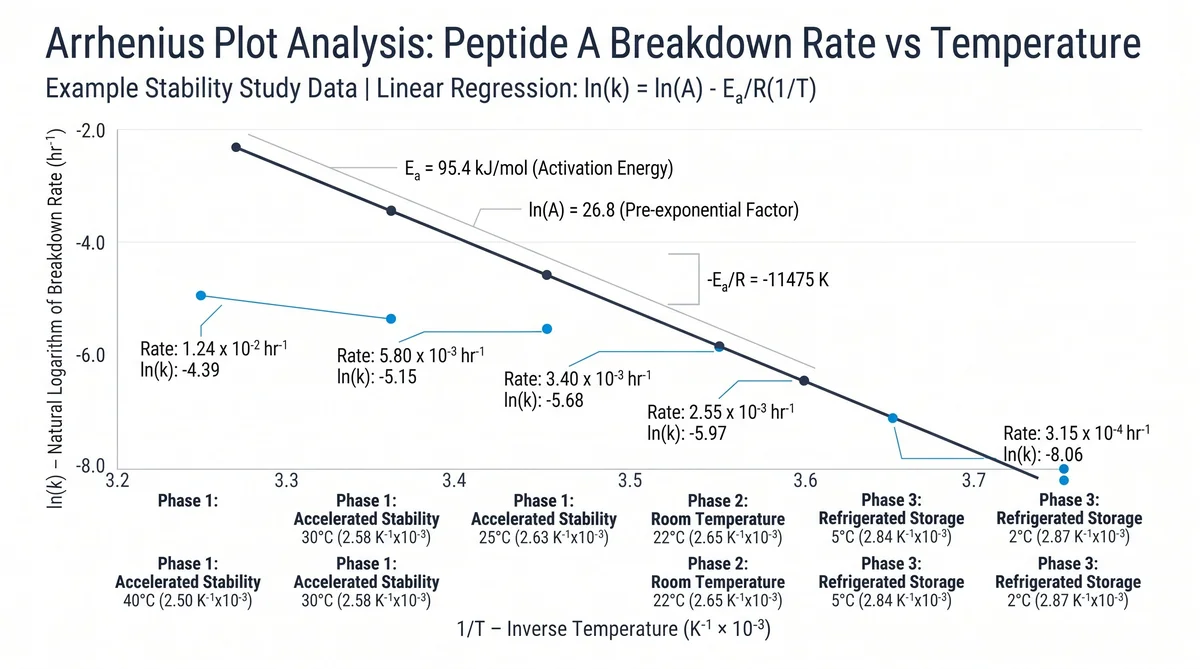
Results predict shelf life by using an Arrhenius plot. This plot models how temp affects the breakdown rate. Scientists graph the log of the rate against the inverse of temp in Kelvin.
This creates a clear line that maps the peptide’s behavior across heat levels.
A fitted line is drawn through the data points. According to Peptides (2012), this line models the link between heat and molecular stability. Scientists extend the line to a standard storage temp, such as 2 to 8 degrees Celsius.
This math gives an estimate of how fast the compound breaks down under normal conditions. Labs then use this estimate to set storage rules and shelf-life labels. Next Level Pharm supplies all its peptides with a COA and full lot data.
What are the limitations of Arrhenius modeling?
The Arrhenius model only works for chemical breakdown. It assumes the breakdown path stays the same at all tested temps.
High heat can trigger a new path not seen at normal temps. If this happens, the model loses its value.
The model also fails to predict physical changes that can happen alongside chemical breakdown.
Factors the model does not cover are listed below.
- Clumping or forming particles in solution.
- Light exposure damage.
- Humidity-driven changes.
- Phase shifts unrelated to heat.
According to Molecules (2012), physical and chemical stability are distinct processes. Researchers must also check physical states through visual review and other test methods.
Frequently Asked Questions
What is the Arrhenius equation as applied to peptide stability?
The Arrhenius equation models how chemical reaction rates change with temp and helps researchers predict how fast peptides break down over time. For peptide stability, it shows how heat energy drives breakdown paths like hydrolysis (water-based bond splitting) or oxidation (oxygen-based change). According to PubMed (2024), this research area remains active as the equation links reaction rate, temp, and activation energy into one framework.
How is an accelerated stability study designed for a peptide?
A study starts by placing peptide samples in chambers at temps above normal storage, with set time points to pull samples for purity testing. Researchers track purity with HPLC and must confirm that the added heat stress does not trigger new breakdown paths not seen at room temp. According to Molecules (MDPI) (2021), this method gives the data needed to build a model of how well the compound holds up over time.
What temperatures are used in peptide Arrhenius stability testing?
Testing temps range from 25 to 60 degrees Celsius, with the exact range based on how sensitive the peptide chain is to thermal stress. Temps must be high enough to speed up breakdown but not so high that they cause changes to the peptide’s fold or structure. As noted by the Journal of Peptide Science (2018), keeping temps below certain limits ensures the breakdown path stays the same for accurate modeling.
How is the activation energy calculated from Arrhenius data?
Activation energy comes from the slope of the Arrhenius plot, which maps the log of the reaction rate against the inverse of the temp. The slope shows the ratio of activation energy to the gas constant, and a fitted line through the data reveals this value. According to the NIH (2020), this number shows how sensitive a given peptide is to changes in heat during storage.
How does Arrhenius modeling predict peptide shelf life?
The model predicts shelf life by using activation energy to extend breakdown rates to standard storage temps like 4 or 25 degrees Celsius. Once the rate at a target temp is known, researchers calculate how long it takes for purity to drop below a set threshold level. According to Frontiers (2012), this method helps labs set expiration dates and storage rules while assuming the breakdown path stays the same.
Does lyophilization affect Arrhenius modeling results?
Lyophilization (freeze-drying) changes the peptide’s physical state by removing the water needed for hydrolysis, a process of water-based chemical breakdown. The Arrhenius model still applies to the dry powder, but the activation energy for breakdown is often much higher than in liquid form. According to Frontiers (2018), the rigid structure of the freeze-dried matrix slows the breakdown rates that the Arrhenius equation predicts.
What is the Q10 temperature coefficient in stability studies?
The Q10 value shows how much a reaction rate rises with a 10 degree Celsius increase in temp, acting as a quick shortcut for prediction. Researchers use it to estimate the impact of short temp changes on sample purity without needing to build a full Arrhenius plot. According to the NIH (2020), the Q10 value works well when the activation energy stays constant across the tested temp range.
What is the difference between kinetic and thermodynamic stability?
Kinetic stability refers to how fast a peptide breaks down over time, while thermodynamic stability describes the energy gap between folded and unfolded states. A peptide may be unstable in energy terms but still last a long time due to high kinetic barriers that slow the breakdown process. According to NCBI PMC (2018), telling these two types of stability apart is key for planning long-term storage of research compounds.
Summary
The Arrhenius model gives researchers a fast way to estimate peptide shelf life. By raising the temp and tracking breakdown rates, labs build data that extends to normal storage conditions.
HPLC and mass spec are the core tools for this work. The model has limits and does not cover physical changes. But it remains a key part of quality control for research compounds.
What Should You Do Next?
Review your study plans to confirm the purity levels your research needs. Check that your lab storage meets the right standards.
This keeps molecular integrity for the length of your trial. If you are setting up new assays, review your compound needs against the available high-purity inventory.
Researchers sourcing peptides can browse the Shop for documented purity data. Every vial ships with a COA and full lot traceability.
Browse recovery peptides for COA-verified research compounds.
Browse research peptides for COA-verified research compounds.
Browse fitness peptides for COA-verified research compounds.
People Also Read
- Peptide Thermal Denaturation Research: DSC Studies
- Buffer pH Peptide Stability Research: Ionic Strength
About the Author
Next Level Pharm Research Team
The Next Level Pharm research team is made up of biochemists and lab scientists. Their goal is to give researchers the highest-purity, COA-tested compounds on the market. Every batch is HPLC and mass spec confirmed before dispatch.
Disclaimer: The information provided on this page is for educational and research purposes only. Next Level Pharm’s products are intended for laboratory research use only. They are not intended for human consumption, diagnostic, therapeutic, or medicinal purposes. This content does not constitute medical advice. Always consult a licensed healthcare professional before making any health-related decisions.