
Hexarelin Research: GH Secretagogue Mechanism Explained

Last updated: May 2026
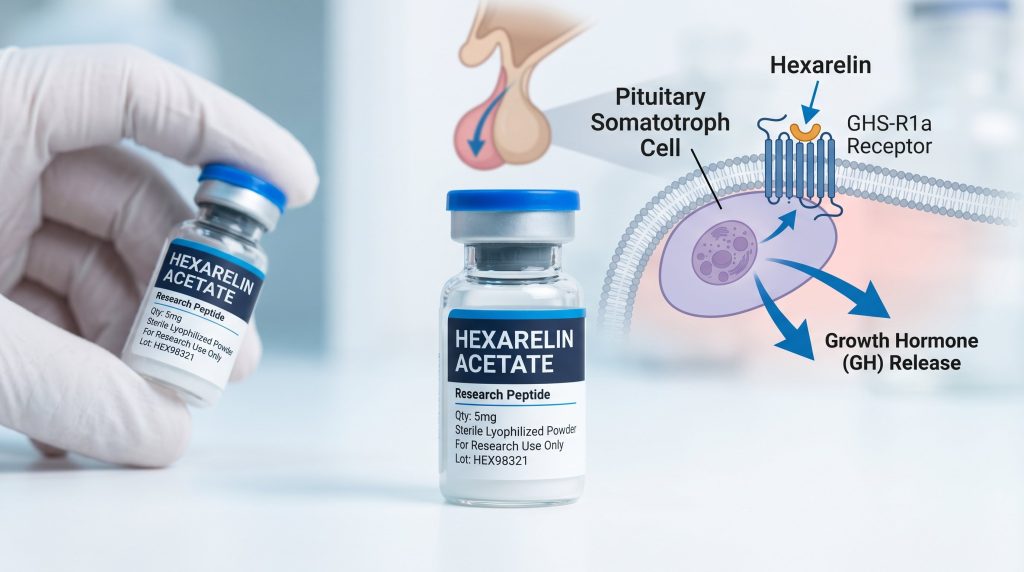
Hexarelin is a synthetic peptide with six amino acids. It belongs to the GHRP class, which stands for growth hormone releasing peptide. GHRPs mimic ghrelin, a stomach hormone that signals GH release. Hexarelin binds a receptor in the pituitary called GHS-R1a. When it binds, GH flows out of pituitary storage cells. According to a 1997 JCEM study on hexarelin GH secretion (1997), hexarelin made graded GH pulses in human subjects. It is one of the most cited synthetic GHRPs in print.
Next Level Pharm supplies research-grade hexarelin tested to at least 99% purity by HPLC and mass spec on every batch. A COA ships with every order for full lot tracking.
This post covers hexarelin structure, GHS-R1a binding, and GH pulse study data. It also reviews cardiac receptor findings, GHRP comparisons, and lab sourcing standards.
Key Takeaways
- What it is: Hexarelin is a six-amino acid GHRP peptide. It binds GHS-R1a in the pituitary and brain stem to trigger GH release in research models.
- Strong binding: Hexarelin binds GHS-R1a with high binding strength in published assays. This makes it a standard reference compound in GHRP binding studies.
- GH pulse data: Studies report graded GH peaks in animal and human models. Hexarelin makes the largest peaks of any GHRP studied.
- Heart cell finding: Hexarelin binds a receptor called CD36 in cardiac tissue. This pathway is studied apart from the GH axis.
- Tolerance pattern: Repeat hexarelin causes faster GH axis loss of response than ipamorelin. This makes it useful for studying GHRP tolerance in lab models.
- Purity standard: Research-grade hexarelin needs HPLC purity above 99% and mass spec near 887 daltons. A lot-exact COA is also required.
Here is a closer look at the hexarelin data behind each of these points.
What Is Hexarelin and Why Is It Studied?
Hexarelin is a synthetic peptide with six amino acids. Its mass is near 887 daltons. It belongs to the GHRP family. GHRPs mimic ghrelin, a stomach peptide that signals the pituitary to release GH. Hexarelin targets the same receptor as ghrelin. This is why it drives GH output in research models. The compound uses D-amino acid swaps in its sequence for added stability.
Lab teams first made hexarelin in the 1990s as a GH axis probe. It became a reference compound in GHRP binding assays. Studies showed it binds GHS-R1a more strongly than GHRP-6. Later work found effects in heart tissue at a receptor called CD36. As shown in a 2001 Endocrine Reviews review of GHRP biology (2001), hexarelin acts at both pituitary and brain stem GHS-R1a sites. This two-site activity has been confirmed across many study models in print.
How Does Hexarelin Bind the GHS-R1a Receptor?
GHS-R1a is a cell surface receptor on pituitary and brain stem cells. Its natural signal is ghrelin, a stomach peptide that drives GH release. Hexarelin binds this receptor with high binding strength. It fires the receptor in a pattern close to ghrelin. When hexarelin binds, it starts a Gq protein signal inside the target cell. This signal raises calcium levels in the cell. The calcium rise causes GH storage cells to release GH into the blood.
Hexarelin binds GHS-R1a more strongly than GHRP-6 in binding data. Its binding strength is at or above that of GHRP-2 in most head-to-head studies. As shown in a 1998 Molecular Pharmacology study on GHS-R1a binding (1998), hexarelin pushes ghrelin off GHS-R1a at very low levels. This strong binding is why hexarelin is a standard reference tool in GHS-R1a receptor research.
What Do GH Pulse Studies Show for Hexarelin?
GH pulse tests are the most cited use of hexarelin in research. In human subjects, hexarelin made large, graded GH peaks. These peaks beat GHRH alone in matched subjects. Per a 1997 JCEM study, giving hexarelin with GHRH raised GH output further. This added response shows both compounds act at shared pituitary sites.
In older subjects, GH response to hexarelin was lower than in young ones. This matches known age-linked drops in pituitary GH cell reserve. In rat models, GH output was high after first exposure. It then fell with repeat doses in long tests. After a rest, GH response partly came back, showing partial axis return. Lab teams use this pattern to study GHRP tolerance and GH axis control.
Browse fitness and GH peptides for COA-tested hexarelin and related research compounds.
What Does Cardiac Receptor Research Show?
A separate line of research found hexarelin effects in heart tissue not tied to GH. Hexarelin binds a receptor called CD36 in cardiac muscle cells. CD36 is also found in immune cells and blood vessel walls. It plays a role in fatty acid uptake and stress signals in heart tissue. This binding pathway is studied apart from the GH axis since GH is not a required step.
As shown in a 1999 PNAS study on hexarelin cardiac effects (1999), hexarelin cut tissue damage in isolated rat heart models. Later research tied these effects to CD36 binding in cardiac tissue. These findings placed hexarelin in two research domains: GH axis studies and cardiac cell science. Lab teams studying heart stress models use hexarelin alongside other CD36 ligands.
How Does Hexarelin Compare to Other GHRPs?
Hexarelin, GHRP-2, GHRP-6, and ipamorelin are the four GHRPs with the most data in print. Each has a different receptor profile and a different GH axis effect pattern. Hexarelin makes the largest acute GH peaks of the group in direct tests. But it also causes the most rapid GH axis loss of response with repeat exposure.
GHRP-6 and GHRP-2 both drive hunger-related ghrelin pathways in addition to GH release. Ipamorelin is more focused on GHS-R1a, with fewer off-target effects. Hexarelin sits between these profiles in receptor focus and off-target activity range. It also has a unique property not seen in the others: CD36 cardiac port binding. Lab teams choose among these compounds based on the receptor system the study aims to probe.
What Quality Standards Apply to Research-Grade Hexarelin?
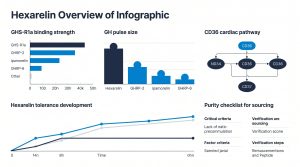
Research-grade hexarelin needs HPLC purity above 99% to be fit for receptor and cell studies. HPLC splits intact hexarelin from short forms and synthesis byproducts in one run. A reading above 99% means the intact compound accounts for over 99% of the peak area. Mass spec confirms the mass at near 887 daltons for the hexarelin acetate salt.
A lot-exact COA records HPLC purity, mass spec data, lot number, synthesis date, and storage terms. Hexarelin ships in lyophilized (freeze-dried) form and stores at -20 degrees Celsius. It is stable at room temp during standard transit windows when properly sealed. Next Level Pharm includes a COA with every order of hexarelin from its Fitness and GH catalog.
| Compound | Class | GHS-R1a Affinity | GH Pulse Size | CD36 Binding | Tolerance Rate |
| Hexarelin | 6-AA GHRP | Very high | Largest | Yes | Fast |
| GHRP-2 | 5-AA GHRP | High | Large | Not found | Moderate |
| GHRP-6 | 6-AA GHRP | Moderate | Moderate | Not found | Moderate |
| Ipamorelin | 5-AA GHRP | Moderate-high | Moderate | Not found | Slow |
| Sermorelin | GHRH analog | GHRHR only | Moderate | Not found | Slow |
Frequently Asked Questions
What is hexarelin?
Hexarelin is a synthetic peptide with six amino acids and a mass near 887 daltons. It belongs to the GHRP class, a group of compounds that signal the pituitary gland to release GH. Hexarelin binds GHS-R1a in the pituitary and brain stem, acting like the stomach hormone ghrelin. In research models, this binding causes GH release from pituitary storage cells. Hexarelin is also studied at the CD36 receptor in heart tissue. That cardiac pathway is separate from the GH axis.
How does hexarelin work in research?
Hexarelin binds GHS-R1a, a surface receptor on pituitary and brain stem cells. This binding starts a Gq protein signal inside the target cell. The signal raises calcium levels in the cell. High calcium causes GH storage cells to release GH into the blood. A second path involves CD36 binding in cardiac muscle tissue. That pathway does not need GH as an intermediate step. It is studied apart in heart tissue models.
Is hexarelin a peptide?
Yes. Hexarelin is a synthetic hexapeptide with six amino acids in a set sequence. Its mass is near 887 daltons for the acetate salt form used in research. It is made by solid-phase peptide synthesis in a lab setting. It ships in lyophilized (freeze-dried) form for stable transit and long-term storage. The freeze-dried form is stable at -20 degrees Celsius and during standard shipping.
How does hexarelin compare to GHRP-2?
Both hexarelin and GHRP-2 bind GHS-R1a with high binding strength and make large GH peaks. Hexarelin has six amino acids; GHRP-2 has five. Published tests show close GH peak sizes in head-to-head studies. Hexarelin may show slightly faster onset in some rodent test models. A key gap is CD36 binding in cardiac tissue, found in hexarelin but not in GHRP-2. Lab teams pick between them based on the receptor or tissue the study targets.
What does hexarelin do in research?
In research, hexarelin is used to study GHS-R1a binding, GH secretion, and GHRP tolerance. Its high GHS-R1a binding strength makes it a reference compound in receptor binding assays. Hexarelin is also used in cardiac cell studies focused on CD36 binding and heart tissue stress responses. Its dual-receptor profile makes it useful for both GH axis research and cardiac receptor science.
What is the GH pulse effect in hexarelin studies?
Published studies report graded GH peaks in animal models and human research trials. As shown in a 1997 JCEM study on hexarelin GH secretion (1997), hexarelin GH peaks beat GHRH alone in matched subjects. Pairing hexarelin with GHRH raised GH output further through an added effect. GH response was lower in older subjects than in young ones. This age gap matches known drops in pituitary GH reserve with aging. Lab teams use these patterns in GH axis aging studies.
Does hexarelin cause GH axis desensitization?
Yes. Repeat hexarelin exposure causes GH axis loss of response faster than ipamorelin does. GH output falls step by step with continued exposure in rodent tests. After a rest period, response partly returns, showing partial but not full GH axis return. Lab teams use this loss-and-return pattern to study GHRP tolerance and GHS-R1a receptor changes over time.
What is CD36 and why is it studied with hexarelin?
CD36 is a membrane receptor found on cardiac muscle cells, macrophages, and blood vessel walls. It plays a role in fatty acid uptake and stress-related signaling in heart tissue. Hexarelin binds CD36 in cardiac models, and this binding has been tied to cut tissue damage in rat heart studies. The CD36 pathway does not need GH as an intermediate. It is a distinct research line, separate from GHS-R1a.
What purity is needed for research-grade hexarelin?
Research-grade hexarelin needs HPLC purity above 99% for receptor and cell study use. Mass spec must confirm the mass at near 887 daltons for the hexarelin acetate form. A lot-exact COA records HPLC purity, mass spec data, lot number, synthesis date, and storage terms for full tracking.
Where does hexarelin ship from?
Research-grade hexarelin at Next Level Pharm ships to all 50 US states from a US-based warehouse. A COA with HPLC purity data, mass spec results, and lot number ships with every order. Orders over 150 dollars qualify for free shipping with average dispatch in about 48 hours.
Summary
Hexarelin is a six-amino acid GHRP peptide that binds GHS-R1a in the pituitary and brain stem. This receptor binding triggers GH release in published research models. Its high binding strength makes it a standard reference compound in GHRP binding assays.
A second pathway involves CD36 in cardiac tissue, studied apart from the GH axis. Hexarelin also shows more rapid GH axis loss of response than ipamorelin, making it useful for tolerance research.
Research-grade sourcing needs HPLC purity above 99%, mass spec near 887 daltons, and a lot-exact COA with full production tracking for lab records.
What Should You Do Next?
Browse research-grade hexarelin with COA-verified HPLC and mass spec data on every batch. The fitness and GH peptides catalog also has related secretagogue research compounds. Visit the shop to view all available research compounds with full COA documentation.
People Also Read
- What Is Ipamorelin? Mechanism of Action and Research Overview
- GHRP-2 Research: GH Secretagogue Mechanism and Selectivity Studies
About the Author
Next Level Pharm Research Team
Alex M covers peer-reviewed findings in peptide science for Next Level Pharm, a US-based supplier of research-grade peptides verified to >=99% purity via HPLC and mass spectrometry on every batch.
Disclaimer: The information provided on this page is for educational and research purposes only. Next Level Pharm’s products are intended for laboratory research use only. They are not intended for human consumption, diagnostic, therapeutic, or medicinal purposes. This content does not constitute medical advice. Always consult a licensed healthcare professional before making any health-related decisions.