
What Is Ipamorelin? Mechanism of Action and Research Overview

Last updated: May 2026
Ipamorelin is a five-amino-acid synthetic peptide. It belongs to the growth hormone releaser (GHS) family. GHS compounds trigger the ghrelin receptor (GHS-R1a) to trigger growth hormone (GH) release in model organisms. Ipamorelin is studied for its selective action: it boosts GH. It does this without the cortisol or prolactin increases seen with older GHS compounds. According to a study in the Journal of Endocrinology (1998). Ipamorelin produced strong GH pulses in animal models with high precision compared to other GHS peptides studied in the same studies.
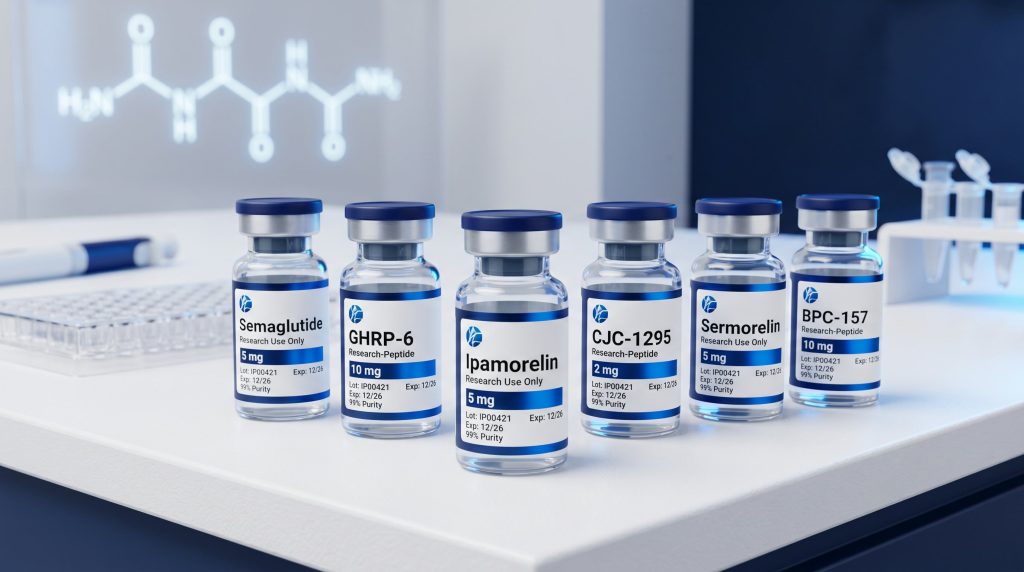
Next Level Pharm supplies research-grade Ipamorelin tested to at least 99 percent purity by HPLC. Mass spec on every batch. HPLC separates compounds to confirm purity levels. Mass spec confirms the molecule weight matches the five-amino-acid chain. A Certificate of Test ships with every lot.
The sections below cover ipamorelin’s structure, receptor pathway. What animal studies describe, how it compares to other GHS compounds. What to check when sourcing.
Key Takeaways
- What it is: Ipamorelin is a synthetic five-amino-acid pentapeptide. It only triggers the ghrelin receptor (GHS-R1a) to trigger GH release in research models.
- Precision: Published studies link ipamorelin to GH boost. It does this without the cortisol or prolactin increases seen with compounds like GHRP-2.
- Research base: Most published work used rat or pituitary cell models. Human trial-based data is limited as of 2024.
- Combined research: Ipamorelin is often studied alongside GHRH analogs such as CJC-1295. The goal is to examine combined GH axis effects.
- Sourcing standard: Research-grade ipamorelin needs HPLC purity above 99 percent, mass spec proof. A lot-exact Certificate of Test.
Here is a closer look at ipamorelin’s pathway, what studies describe. What experts should check before sourcing.
What Is Ipamorelin and How Was It Developed?
Ipamorelin is a synthetic pentapeptide designed to study selective growth hormone release. Experts at Novo Nordisk made it in the late 1990s. The goal is to examine how precision affects GH axis action in animal models. Earlier GHS compounds triggered GH but also raised cortisol and ACTH, adding lab noise.
The five-amino-acid chain (Aib-His-D-2-Nal-D-Phe-Lys) was chosen for stable, selective binding to GHS-R1a. According to a study in Regulatory Peptides (2000). Ipamorelin’s receptor link profile separated it from other peptide GHS compounds in controlled checks. This precision gave experts a cleaner model for studying GH pulse dynamics without confounding adrenal axis changes in the same test.
How Does Ipamorelin Activate the Ghrelin Receptor?
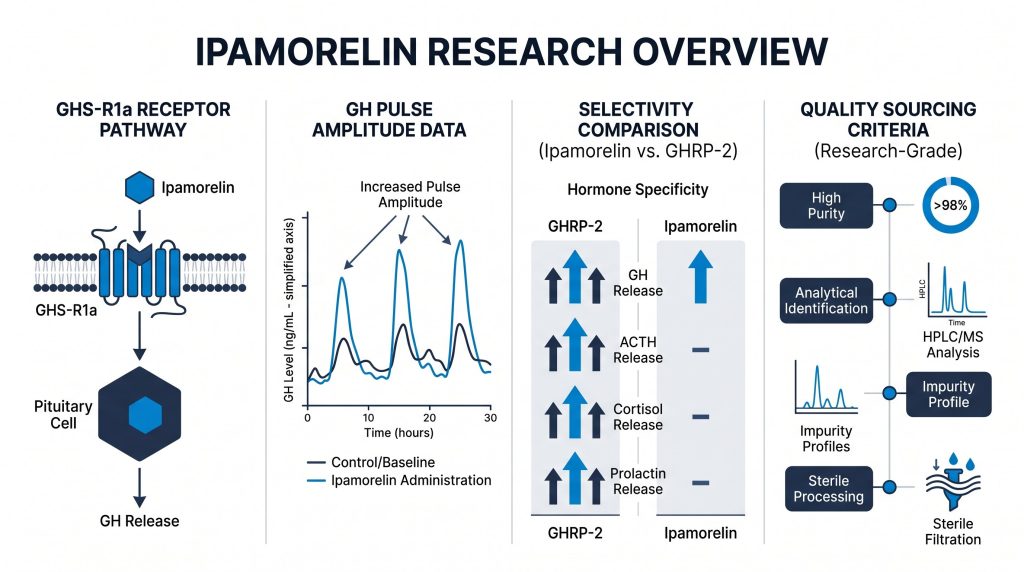
Ipamorelin binds the ghrelin receptor (GHS-R1a), which sits on somatotroph cells in the anterior pituitary. Ghrelin is a natural hunger-signaling peptide. GHS compounds mimic part of ghrelin’s action to boost GH release from these cells. Ipamorelin’s binding is considered selective since it does not greatly trigger cortisol or prolactin pathways.
When ipamorelin binds GHS-R1a, it triggers a protein kinase C. Calcium channel cascade inside the cell. This cascade increases GH release in a pulsatile pattern. The precision advantage is why experts use ipamorelin in study designs where cortisol changes would confound other outcome measures. Receptor link and trigger data for ipamorelin comes mainly from in vitro pituitary cell assays. Rodent model studies.
Browse fitness and GH peptides at Next Level Pharm for COA-tested ipamorelin. Linked GHS research compounds.
What Does GH Secretion Research Show for Ipamorelin?
According to a study in the Journal of Endocrinology (1998). Ipamorelin produced clear GH pulses in rat models with minimal effects on ACTH. Cortisol. This precision was a key finding in early GHS research since it allowed GH axis study without adrenal axis interference.
GH pulse data from ipamorelin research shows amplitude increases rather than frequency changes. Pulse amplitude refers to how high GH rises during each release event. This pattern differs from continuous GH rise. Downstream effects on IGF-1 follow a different profile when amplitude increases versus frequency increases. These pulse pattern differences are relevant for experts designing GH axis studies in rodent models.
How Does Ipamorelin Differ from GHRP-2 in Studies?
GHRP-2 is a six-amino-acid GHS compound that also triggers GHS-R1a. According to a comparison study in Peptides (2000). GHRP-2 produced greater GH boost than ipamorelin in some models. Also greatly raised cortisol and ACTH in the same studies. This co-rise makes GHRP-2 less suitable for study designs that need isolated GH axis effects.
Ipamorelin’s precision profile makes it the preferred GHS compound in research designs where cortisol or swelling-related markers are also being measured. raised cortisol from a non-selective GHS would introduce lab bias. The practical implication is. It is more often used in multi-marker study designs while GHRP-2 is used when experts mainly want combined GH. Adrenal axis action.
What Do Animal Studies Show for Ipamorelin?
Animal studies for ipamorelin used mostly rat models, with some pituitary cell culture data. Published work examined GH pulse patterns, IGF-1 levels, and receptor occupancy. According to a review in Growth Hormone. IGF Research (2003). Ipamorelin showed consistent GH pulse boost across many rodent model studies with low batch-to-batch variation.
Some animal studies reported changes in bone. Muscle tissue markers as secondary outcomes after ipamorelin use. These findings are early. They describe tissue growth markers in animal models only. Human extrapolation from these animal results is not supported by indexed trial-based trial data as of 2024. experts using ipamorelin in tissue science models should note. Its most mechanistic data comes from in vitro or rodent sources, not human subjects.
How Is Research-Grade Ipamorelin Sourced?
Research-grade ipamorelin needs three key records. First, an HPLC purity report at 99 percent or above. Second, a mass spec report confirming the molecule weight matches the Aib-His-D-2-Nal-D-Phe-Lys chain. Third, a Certificate of Test for the exact lot number in the order.
Ipamorelin is supplied as a lyophilized powder. Lyophilization is a freeze-drying process. It removes water under vacuum, extending shelf life and allowing room-temperature shipping. Products without lot-exact COA records cannot confirm batch quality. Lyophilized ipamorelin stays stable during room-temperature transit without cold-chain handling.
| Feature | Ipamorelin | GHRP-2 | GHRP-6 |
| Amino acids | 5 | 6 | 6 |
| Receptor target | GHS-R1a | GHS-R1a | GHS-R1a |
| Cortisol increase | Minimal | Significant | Moderate |
| Prolactin increase | Minimal | Significant | Significant |
| GH pulse effect | Amplitude increase | Amplitude increase | Amplitude + frequency |
| Research fit | Selective GH studies | GH + adrenal axis studies | GH + appetite research |
Frequently Asked Questions
What is ipamorelin?
Ipamorelin is a five-amino-acid synthetic pentapeptide. It only triggers the ghrelin receptor (GHS-R1a) to trigger growth hormone release in animal models. It was developed to study selective GH axis boost without cortisol or prolactin co-rise. All ipamorelin is for lab research only. It is not approved for human use. Purity is tested to at least 99 percent by HPLC and mass spec on every batch.
How does ipamorelin differ from GHRP-2?
Ipamorelin and GHRP-2 both trigger the ghrelin receptor, but their precision profiles differ. GHRP-2 produces stronger GH boost in some models but also greatly raises cortisol and ACTH. Ipamorelin boosts GH with minimal cortisol or prolactin changes. This precision makes ipamorelin useful in research designs where cortisol changes would affect other outcome measures. Published check data appears in the peptide GHS research from the late 1990s through the mid-2000s.
What does selective GH release mean in research?
Selective GH release means a compound triggers the GH release pathway without also activating adrenal cortex or prolactin release pathways. In research, this matters since cortisol and prolactin both affect downstream markers. A non-selective GHS compound changes many variables at once. Making it harder to isolate GH axis effects. Ipamorelin is studied as a selective model compound. Precision in this context refers to receptor link profiles described in vitro. Animal model studies.
Is ipamorelin the same as a ghrelin analog?
Ipamorelin is a ghrelin receptor agonist but not a ghrelin structural analog. Ghrelin itself is a 28-amino-acid peptide with an octanoyl change. Ipamorelin is a shorter synthetic compound designed to bind the same receptor (GHS-R1a) with high precision. The two compounds have different structures and how the body uses its profiles. Ipamorelin does not replicate ghrelin’s hunger signaling pathway. The shared receptor target is what classifies both in the GHS research category.
What GH pulse pattern has research described for ipamorelin?
Research in rat models has described ipamorelin as increasing GH pulse amplitude rather than pulse frequency. Pulse amplitude refers to how high GH levels rise during each release event. Amplitude-only increases produce a different downstream IGF-1 response than frequency increases. This distinction matters in GH axis research since amplitude and frequency changes affect tissue responses differently. Most published pulse pattern data for ipamorelin comes from rodent and pituitary cell model studies.
Can ipamorelin be studied alongside CJC-1295?
Research has examined ipamorelin in combination with CJC-1295, a GHRH analog. The combination is studied since ipamorelin acts at the ghrelin receptor while CJC-1295 acts at the GHRH receptor. These are two separate GH-boosting pathways. When both are active together, combined GH increases have been described in rodent models. Published synergy data comes from animal and in vitro studies. Human trial-based data on this combination is not available as of 2024.
What purity is needed for research-grade ipamorelin?
Research-grade ipamorelin is tested to at least 99 percent purity by HPLC. Mass spec confirms the molecule weight matches the five-amino-acid chain. A Certificate of Test for the exact lot number records both results. These three records are the minimum standard for reproducible lab research. Products without lot-exact COA records cannot confirm batch quality. Full lot records ships with every ipamorelin order within the United States.
How should ipamorelin be stored for research purposes?
Lyophilized ipamorelin is stable at room temperature during shipping. It is supplied as a freeze-dried powder sealed under an inert atmosphere. For long-term storage, refrigeration at 2 to 8 degrees Celsius is standard. Freezing at minus 20 degrees Celsius is acceptable for extended storage beyond six months. The exact storage guidance for each lot is listed on its Certificate of Test. Ipamorelin ships to all 50 states within the United States.
Summary
Ipamorelin is a five-amino-acid synthetic GHS compound. It only triggers the ghrelin receptor (GHS-R1a) to trigger GH release in research models. Its main research value is precision: GH boost without clear cortisol, ACTH, or prolactin co-rise.
Published animal studies describe strong GH pulse amplitude increases with minimal off-target effects. Combined research with CJC-1295 has shown combined GH output in rodent models. Research-grade sourcing needs HPLC purity above 99 percent, mass spec chain proof, and lot-exact COA records. All ipamorelin is for lab research only.
What Should You Do Next?
If you are studying ipamorelin for GH axis research, here is how to approach sourcing:
- Match the precision profile to your study design. For research that also measures cortisol or swelling-related markers, ipamorelin removes adrenal axis confounds. It introduces other GHS compounds.
- Review combination protocols with GHRH analogs if your study examines combined GH output across both receptor pathways.
- Browse research-grade Ipamorelin at Next Level Pharm for COA-tested options with full lot records.
People Also Read
- CJC-1295 Research: How This GHRH Analog Works in Lab Models
- What Is GHRP-2? Growth Hormone Secretagogue Research Overview
About the Author
Next Level Pharm Research Team
Alex M covers peer-reviewed findings in peptide science for Next Level Pharm, a US-based supplier of research-grade peptides verified to >=99% purity via HPLC and mass spectrometry on every batch.
Disclaimer: The information provided on this page is for educational and research purposes only. Next Level Pharm’s products are intended for laboratory research use only. They are not intended for human consumption, diagnostic, therapeutic, or medicinal purposes. This content does not constitute medical advice. Always consult a licensed healthcare professional before making any health-related decisions.