
Water for Injection Peptide Research: WFI Standards

Last updated: October 2026
A water for injection is a sterile, high-purity liquid that researchers use to dissolve freeze-dried compounds in lab settings. It keeps samples free from harmful particles and ensures clean conditions during peptide research studies. According to the United States Pharmacopeia (USP) (2023), this water must hold no more than 0.25 Endotoxin Units (EU) per mL.
Next Level Pharm offers high-purity lab compounds for researchers. The brand holds a 99.4% average purity across its last 100 batches. Each vial goes through dual checks with HPLC and mass spec.
HPLC (high-performance liquid chromatography) separates and measures compounds. Mass spec (mass spectrometry) confirms molecular weight.
All compounds are freeze-dried solids sealed under inert gas to stay stable. This process removes the need for cold shipping. Next Level Pharm stocks 70+ active peptide SKUs across 7 groups for varied research needs.
Safe solvents and stable compounds form the base for steady lab results. Precise volume steps are needed during mixing to ensure correct data. Full records let teams track test factors across many trials.
Key Takeaways
- Strict USP Standards: Water for Injection (WFI) meets USP rules for endotoxin, conductivity, and carbon levels. This ensures a clean solvent for sensitive lab work.
- Advanced Purification Methods: WFI is made through distillation or multi-stage reverse osmosis to remove nearly all impurities. These steps create a steady, pure liquid for precise tests.
- Inert Research Application: Researchers use WFI to dissolve freeze-dried powders without adding unwanted chemicals. It serves as a neutral base to protect peptide samples.
- Preservative-Free Formulation: Unlike bacteriostatic water, WFI has no benzyl alcohol or other preservatives. This profile is key for sensitive cell-based assays and focused lab studies.
- Aseptic Laboratory Handling: WFI has no germ-fighting agents and picks up germs fast after the seal breaks. Researchers must use strict clean methods to keep the liquid pure during use.
These key factors show the needs for keeping solvent purity in lab settings. The next sections give a closer look at how dilution methods shape test data and molecular stability.
What is Water for Injection (WFI)?
WFI is a sterile, pure solvent made to hold very low levels of endotoxins (toxins from bacterial cell walls), microbes, and ions. It is the main liquid used to dissolve freeze-dried compounds for sensitive lab tests. It gives an inert setting that stops unwanted reactions with research materials.
This purity is vital for keeping delicate peptide chains stable. These chains might break down in less clean liquids.
Researchers pick this solvent to protect the structure of their samples during testing. By removing ions and organic particles, the liquid allows precise reading of molecular traits. This level of purity is needed when testing sensitive materials that need strict controls.
Next Level Pharm also stocks bacteriostatic and acetic acid water for reconstitution in laboratory workflows. Every lot is verified by HPLC and mass spec. Using sterile water ensures that no outside substances affect the chemical activity under study.
How is WFI produced for research labs?
WFI is made for research labs through distillation and multi-stage reverse osmosis (RO, a filter method that pushes water through fine membranes). These methods strip out particles to create a pure solvent that meets strict quality rules. The process starts by treating a raw water source to remove large debris and minerals.
Pre-treatment often uses carbon filters to trap chlorine and organic compounds. Softening agents then remove calcium and magnesium. This step protects later equipment from mineral buildup.
The system then pushes water through RO membranes. These membranes use high pressure to force water through a fine barrier. This phase removes ions, bacteria, and larger organic particles.
Each stage works to cut total dissolved solids to near-zero levels. Makers track these values to ensure the output stays within USP (2023) purity ranges. This careful approach ensures the final liquid is free from substances that could change test results.
What purity standards must WFI meet?
WFI must meet specific quality rules set by the United States Pharmacopeia (USP, the official standard for drug-grade substances). These rules focus on removing chemical and biological particles that could affect lab work. Labs verify these rules by testing for bacterial endotoxins, Total Organic Carbon (TOC, a measure of organic matter in water), and conductivity limits.
| Metric | USP Limit | Purpose |
|---|---|---|
| Endotoxin | Below 0.25 EU/mL | Stops immune responses in cell models |
| TOC | Below 500 ppb | Tracks organic molecules |
| Conductivity | Below 1.3 µS/cm at 25 C | Tracks dissolved mineral ions |
These three metrics give a full picture of water purity. They cover biological, organic, and mineral levels.
How does WFI differ from bacteriostatic water?
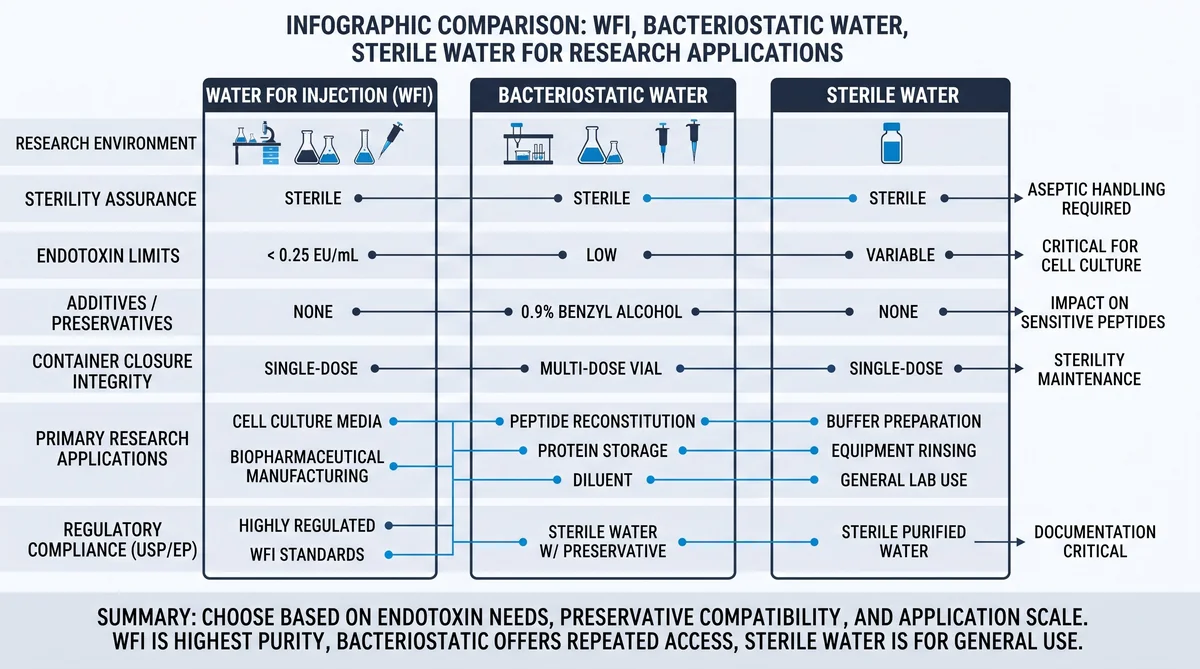
WFI differs from bacteriostatic water because it is pure, sterile water with no added ingredients. Bacteriostatic water holds 0.9% benzyl alcohol as a preservative to stop germ growth. This preservative allows repeated use from a single vial over time.
In contrast, WFI has no additives. It is meant for single-use only.
Benzyl alcohol in bacteriostatic water can affect certain lab assays or change peptide shape. In some cases, it causes cell damage in vitro (in the lab dish). For tests that need an inert solvent, researchers must use pure WFI so no chemical factors affect the sample.
Every vial ships with a certificate of analysis and full lot traceability to support lab records.
Why is WFI essential for peptide research?
WFI is key for peptide research because it gives a chemically inert, pyrogen-free setting for dissolving freeze-dried peptides. By removing all microbial and chemical noise, WFI lets researchers see the true effects of the peptide. Solvent particles do not cloud the results.
When dissolving peptides, the purity of the liquid is a main factor. Impurities in lower-grade water, such as trace ions or endotoxins, can break down the peptide or block active sites. These particles often trigger unwanted cell responses in lab models.
Using a liquid that meets USP rules for conductivity and endotoxin limits stops these issues. A clean, high-purity setting is needed to keep the structure stable through the test phase.
How should researchers handle WFI properly?
Handling WFI needs strict aseptic (germ-free) methods because the liquid has no preservatives. It picks up germs fast once the seal is broken. Researchers must treat opened vials as single-use to protect their samples.
Keep a sterile workspace by doing all transfers in a laminar flow hood. Before each draw, clean the vial cap with sterile alcohol to remove surface bacteria. Always use fresh, sterile needles and syringes for each access point.
BPC-157 is available as a COA-verified research peptide. Every lot is verified by HPLC and mass spec.
Frequently Asked Questions
What are the WFI quality specifications for research use?
According to PubMed (2024), this area continues to attract notable research interest.
WFI must meet purity rules from official standards to stay free from harmful particles. According to the United States Pharmacopeia (USP) (2023), this water must pass strict tests for conductivity, total organic carbon, and bacterial endotoxins. These rules ensure the water does not alter chemical or biological reactions during peptide studies.
Clean water forms the base for all valid lab work in this field.
How is water for injection produced for laboratory applications?
WFI is made through distillation or reverse osmosis paired with fine filtration to remove impurities. These methods target both dissolved minerals and tiny biological particles. The process takes place in a controlled setting to block new particles during collection or storage.
Steady checks ensure the final liquid meets high purity marks for lab research. Each step builds on the last to create a clean, stable solvent.
What endotoxin limits apply to WFI in research settings?
Endotoxins are harmful substances from bacterial cell walls that can hurt test data. According to the USP (2023), WFI must hold less than 0.25 endotoxin units per milliliter to count as non-pyrogenic. Research protocols need this low limit to stop unwanted immune responses in cell-based assays.
Keeping these tight limits protects the validity of results during active peptide research and analysis work.
How does WFI differ from purified water in peptide research?
WFI is made and tested for biological safety. General purified water may not meet the same endotoxin rules. Purified water is often distilled or deionized but may still hold trace impurities that affect sensitive work.
WFI removes these through stricter testing. In lab research, WFI gives more certainty for delicate steps. Researchers choose it when solvent purity is critical to their study.
What conductivity and TOC limits apply to WFI?
Conductivity and total organic carbon (TOC) are two key signs of water purity in a lab setting. According to the USP (2023), WFI must keep low conductivity to confirm no dissolved ions are present. The TOC limit ensures organic substances exist only in trace amounts.
These two tests work together to confirm the water is fit for high-precision lab research needs.
Can sterile water for irrigation be used for peptide research?
Sterile water for irrigation is processed to be free of germs. But it may not meet the same strict endotoxin limits as WFI. It can hold higher levels of non-living particles that could affect sensitive peptide assays.
Researchers prefer WFI because its production rules address the needs of delicate lab work. Using the wrong grade of water can create unknown factors in a data set.
What is the typical shelf life of an unopened WFI vial?
Unopened WFI vials are stable for long periods when stored per the maker’s rules. Shelf life depends on seal quality and storage conditions. These vials often stay good for several years if kept from direct heat or light.
Once a vial is opened, the contents should be watched closely. Airborne particles can build up fast and affect test results over time.
Why is WFI considered non-pyrogenic?
WFI is called non-pyrogenic because its making process removes bacterial endotoxins. Pyrogens are substances that cause fever in living systems. Their presence can ruin sensitive lab assay results and lead to false data.
Through special filtration and distillation, the water is cleaned of these triggers. This step ensures the final product is safe for delicate research work where even small amounts of pyrogens could skew test findings.
Is WFI the same as deionized or distilled water?
WFI often uses distillation or deionization in its making. But it is distinct from basic forms of these liquids. WFI must pass a specific set of tests that basic deionized or distilled water may not face.
These extra steps confirm the water is free from endotoxins and other biological markers. So WFI serves as a higher grade of lab reagent with better quality control.
Does WFI need to be refrigerated after opening?
Storage needs for WFI depend on whether it has preservatives and its planned use in the lab. WFI without preservatives is meant for quick use only. It should not be stored long after the seal breaks.
If the water stays in an open vial, it picks up germs no matter the temperature. For most lab uses, researchers use the full contents of a sterile vial at once.
Summary
Water for injection (WFI) is a sterile, pure liquid that plays a core role in peptide research. It meets strict USP rules for endotoxin, conductivity, and organic carbon levels. These rules keep it free from particles that could affect lab results.
Researchers rely on WFI to dissolve freeze-dried peptides in a clean, inert setting. Proper handling and single-use practices keep this liquid safe for sensitive assays. Choosing the right grade of water is a basic but vital step in any peptide research workflow.
What Should You Do Next?
Check your research needs against the solubility and storage needs of your chosen peptides. Review the certificate of analysis for each lot to confirm purity levels match your study protocols. Keep accurate logs of mixing dates and solvent types to ensure your lab data stays reliable over time.
Researchers sourcing these peptides can browse the catalog at Next Level Pharm. Every vial ships with a COA and full lot traceability.
Browse recovery peptides for COA-verified research compounds.
Browse research peptides for COA-verified research compounds.
Browse fitness peptides for COA-verified research compounds.
People Also Read
- Buffer pH Peptide Stability Research: Ionic Strength
- Arrhenius Model Peptide Stability: Accelerated Studies
About the Author
Next Level Pharm Research Team
The Next Level Pharm research team is made up of biochemists and lab scientists. Their goal is to give researchers the highest-purity, COA-tested compounds on the market. Every batch is HPLC and mass spec confirmed before dispatch.
Disclaimer: The information provided on this page is for educational and research purposes only. Next Level Pharm’s products are intended for laboratory research use only. They are not intended for human consumption, diagnostic, therapeutic, or medicinal purposes. This content does not constitute medical advice. Always consult a licensed healthcare professional before making any health-related decisions.