
Peptide Method Validation Research: ICH Q2R1 Guide

A peptide method validation is a structured process that confirms an analytical test gives accurate, repeatable results for a specific compound under set conditions. According to ICH (the International Council for Harmonisation) (2005), the Q2R1 guideline defines six core parameters that every method must satisfy. Labs must verify all six before they can report peptide purity data.
More than 80% of global regulatory filings cite this framework. HPLC (high-performance liquid chromatography) separates compounds by their chemical traits. ICH Q2R1 is the standard for proving HPLC results are reliable.
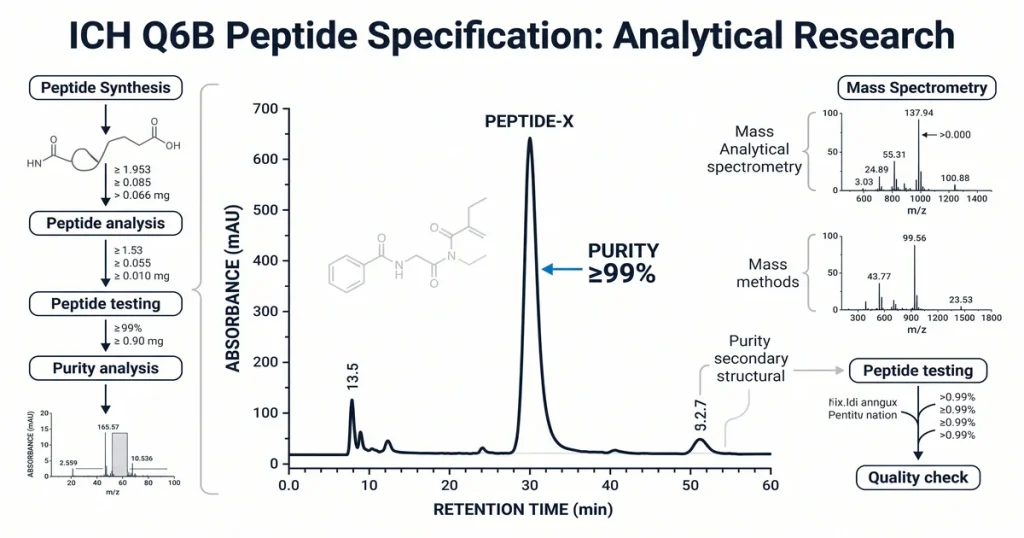
Next Level Pharm applies this principle to every batch it ships. Each vial passes HPLC and mass spec (mass spectrometry, a tool that identifies compounds by weight) testing before dispatch. A COA (Certificate of Analysis, a report listing verified purity data) confirms purity at or above 99% for each lot.
Analytical method validation matters when small changes in peptide purity affect research outcomes. The sections below break down each ICH Q2R1 parameter in plain terms. They explain what labs must prove and how results connect to research-grade peptide quality.
Key Takeaways
- Specificity Confirms Identity: The method must separate the target peptide from all impurities, solvents, and breakdown products in a single run.
- Linearity Proves the Range: A valid method shows a straight-line detector response (R squared at 0.999 or better) across the full concentration span.
- Precision Measures Consistency: Repeatability (same day) and intermediate precision (across days and analysts) must both meet RSD limits below 2%.
- Accuracy Ties Results to Truth: Spike-recovery tests must return 98% to 102% of the known amount to confirm real values.
- Stability Guards Against Drift: Small shifts in column temperature, flow rate, or mobile phase pH must not push results past set limits.
- COA Data Depends on Validation: Every purity value on a COA traces back to a validated method. The certificate is only as strong as the proof behind it.
These six parameters form a chain. Each one builds on the last. A weakness in any step breaks trust in the final purity number on a peptide COA.
What Is the ICH Q2R1 Framework for Analytical Validation?
The ICH Q2R1 guideline is the global standard for proving an analytical method works. ICH released it in 2005. It covers six core parameters: specificity, linearity, range, accuracy, precision, and robustness.
Every lab that tests peptide purity by HPLC must validate against these rules. According to ICH Q2(R1) (2005), validation proves that a test procedure is fit for its purpose.
For peptide research, the HPLC method must detect the target compound. It must also measure it correctly every time. Labs that skip validation risk reporting false purity values.
This puts downstream research data at risk. Next Level Pharm requires validated methods for all COA-tested peptides it ships.
What Validation Parameters Does ICH Q2R1 Specify?
ICH Q2R1 names six parameters that a method must satisfy. These are specificity, linearity, range, accuracy, precision, and robustness. Each one targets a different source of error.
Specificity asks if the method can tell the peptide apart from everything else. Linearity checks if the detector response is proportional to concentration. Precision checks if results stay the same on repeat testing.
According to USP General Chapter 1225 (2024), these parameters align with the ICH framework. They also add detail for peptide-class compounds.
| Parameter | What It Measures | Typical Acceptance Criterion |
|---|---|---|
| Specificity | Target peptide separated from impurities | No co-eluting peaks at peptide retention time |
| Linearity | Detector response vs. concentration | R squared 0.999 or better, 5 points minimum |
| Range | Validated concentration span | 80% to 120% of target level |
| Accuracy | Closeness to true value | Spike recovery 98% to 102% |
| Precision | Result consistency on repeat runs | RSD below 2.0% for repeatability |
| Robustness | Stability under small method changes | Results within limits at plus or minus 2% variation |
This table serves as a quick checklist. Labs confirm each row before reporting any research-grade peptide purity data.
How Is Linearity Validated for a Peptide HPLC Method?
Linearity testing proves that the detector response rises in step with peptide concentration. A lab prepares at least five standard solutions at known levels. These span the full working range, often 80% to 120% of the target.
The lab plots detector signal against amount. It then calculates R squared (the correlation coefficient, a measure of how well data fits a straight line).
According to a review in the Journal of Pharmaceutical and Biomedical Analysis (2019), peptide HPLC methods can reach R squared values above 0.9995. This requires well-chosen columns and mobile phases.
The residuals (the gap between each point and the fitted trend line) should show no pattern. A curved residual plot signals the method is not truly linear. Labs also check the y-intercept, which should sit close to zero.
A large intercept suggests a bias that skews low-level results. This principle applies across every batch tested.
How Is Method Precision Defined Under ICH Q2R1?
Method precision measures how close results stay when the same sample is tested more than once. ICH Q2R1 splits precision into three levels.
Repeatability tests the same analyst, same day, same instrument. Intermediate precision changes the analyst or the day. Reproducibility changes the lab entirely.
Each level must meet a set RSD target. RSD (relative standard deviation) measures how spread out results are.
According to ICH Q2(R1) (2005), repeatability requires a minimum of six runs at 100% concentration. The RSD across those runs must fall below 2.0% for most peptide assays. Intermediate precision adds at least two more variables, such as a different day or analyst.
Labs report both sets of RSD values on their validation records. A high RSD at any level tells the lab to investigate before release. Common causes include column aging, mobile phase drift, or poor sample prep.
Fixing these protects every COA that ships with a vial.
Browse the full catalog of COA-verified, research-grade peptides.
What Specificity Tests Does ICH Q2R1 Require?
Specificity confirms that the HPLC method measures only the target peptide. It must not confuse the target with impurities, breakdown products, or solvent peaks.
Labs test this by running forced degradation samples alongside the pure standard. Forced degradation means exposing the peptide to acid, base, heat, light, and oxidation stress. The target peak must resolve cleanly from every stress peak.
According to USP General Chapter 621 (2024), peak purity testing adds a second check. PDA (photodiode array, a detector that reads full UV spectra) compares the spectrum at three points on the peak. These points are the front, apex, and tail.
Matching spectra confirm a single compound. A mismatch flags a hidden impurity that co-elutes with the target. For complex peptide samples, labs may add mass spec as a third layer.
Every lot gets paired HPLC and mass spec testing. This dual method meets the specificity standards of ICH Q2R1.
Frequently Asked Questions
What does ICH stand for in peptide testing?
ICH stands for the International Council for Harmonisation of Technical Requirements for Pharmaceuticals for Human Use. It is a global body that sets quality guidelines for compound testing.
ICH Q2R1 is the specific guideline for analytical method validation. Peptide research labs follow it to prove their HPLC and mass spec methods deliver reliable purity data. The guideline applies to any lab that needs to show its method is fit for peptide assay work.
How many linearity points does ICH Q2R1 require?
ICH Q2R1 requires a minimum of five concentration levels for linearity testing. Most peptide labs prepare five to seven standards across 80% to 120% of the target level. Each standard is run in triplicate to reduce noise.
The data must produce an R squared of 0.999 or higher. A regression line with a near-zero y-intercept confirms proportional detector response across the full working range.
What is an acceptable RSD for peptide method precision?
For most peptide HPLC assay methods, an RSD below 2.0% is the standard repeatability target. Intermediate precision allows a slightly wider limit, often up to 3.0%. This accounts for day-to-day and analyst-to-analyst variation.
ICH Q2R1 does not name a fixed RSD cutoff. It asks labs to justify limits based on the method and compound. Peptide purity assays at the 99% level typically reach RSD values well below 1.0%.
What is forced degradation in specificity testing?
Forced degradation (also called stress testing) exposes a peptide sample to harsh conditions on purpose. These include acid, base, oxidation, heat, and UV light. The goal is to create breakdown products.
The validated method must then separate every breakdown peak from the main peptide peak. This proves the method can tell the target apart from breakdown products in real samples stored under normal conditions.
Does ICH Q2R1 apply to research-grade peptides?
ICH Q2R1 was written for pharmaceutical-quality testing. However, research-grade peptide labs adopt the same framework to prove their methods are sound.
A lab that validates its HPLC method under ICH Q2R1 can show its purity results are accurate and repeatable. This builds confidence for researchers who rely on COA data. It also sets the lab apart from suppliers that report purity without method-level proof.
What is the difference between accuracy and precision?
Accuracy measures how close a result is to the true value. Precision measures how close repeated results are to each other. A method can be precise but not accurate, meaning consistent but wrong.
It can also be accurate on average but imprecise, meaning right overall but scattered. ICH Q2R1 requires both. Spike-recovery tests check accuracy, while replicate runs check precision.
What role does robustness play in method validation?
Robustness testing checks if small, deliberate changes in method conditions shift results. Labs adjust column temperature by plus or minus 2 degrees Celsius. They shift flow rate by plus or minus 0.1 mL per minute.
They also change mobile phase pH by plus or minus 0.2 units. If the method still passes all limits under these shifts, it is stable. A stable method is less likely to fail during routine lab work.
How does method validation connect to a COA?
Every purity number on a COA comes from a specific analytical method. If that method has not been validated, the number has no proven basis. ICH Q2R1 validation shows that the method is specific, linear, accurate, precise, and stable under small changes.
This chain of proof gives a COA its value. Without validated methods behind the data, a COA is just a number on a page. The validation record is the evidence that supports every result.
Summary
ICH Q2R1 is the global benchmark for proving an analytical method works as intended. It defines six parameters: specificity, linearity, range, accuracy, precision, and robustness. Each one targets a different source of measurement error.
For peptide HPLC methods, these parameters confirm that purity values are real, repeatable, and specific to the target compound. Every COA traces back to the validated method behind it.
This standard applies across all batches at Next Level Pharm. HPLC and mass spec verification, backed by third-party testing, confirms purity at 99% or higher. This is the threshold researchers expect.
What Should You Do Next?
Start by reviewing the ICH Q2R1 guideline alongside your current analytical workflow. Compare your method’s linearity, precision, and specificity data against the acceptance criteria above.
If your research depends on verified peptide purity, choose a supplier that validates to ICH standards. Check that every lot includes a COA with traceable HPLC and mass spec data.
Shop research-grade, COA-tested peptides here.
People Also Read
- ICH Q6B Peptide Specification: Analytical Research
- Good Laboratory Practice Peptide Research: GLP Guide
About the Author
Next Level Pharm Research Team
The Next Level Pharm research team is made up of biochemists and lab scientists. Their goal is to give researchers the highest-purity, COA-tested peptide compounds on the market. Every batch is HPLC and mass spec confirmed before dispatch.
Disclaimer: The information provided on this page is for educational and research purposes only. Next Level Pharm’s products are intended for laboratory research use only. They are not intended for human consumption, diagnostic, therapeutic, or medicinal purposes. This content does not constitute medical advice. Always consult a licensed healthcare professional before making any health-related decisions.