
Notch Pathway Peptide Research: Cell Differentiation

Last Updated: October 2026
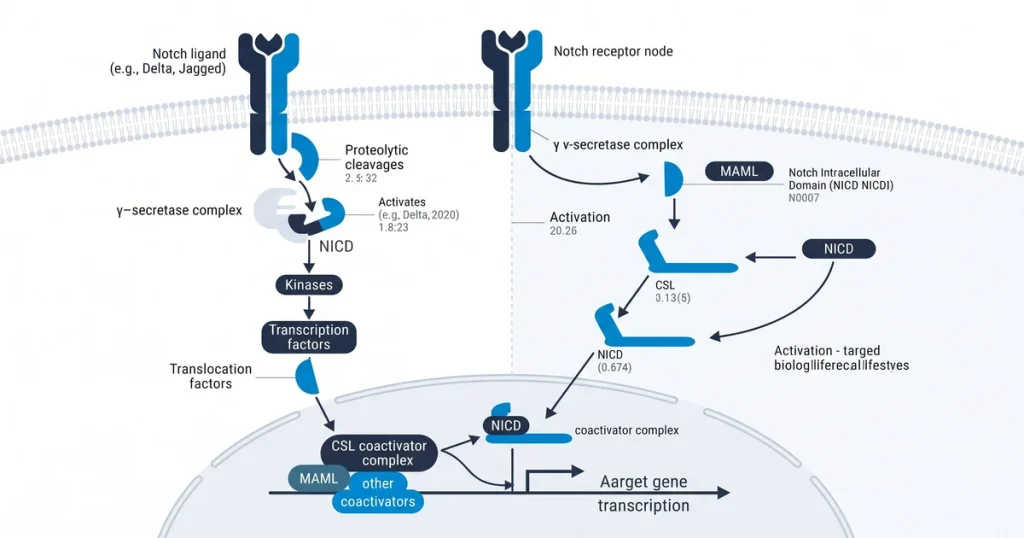
A Notch signaling pathway peptide research study is an investigation of how molecules affect ligand-induced receptor cleavage and downstream gene activation. The Notch receptor undergoes 3 sequential cleavages after ligand binding. The third cleavage by gamma-secretase releases the Notch intracellular domain (NICD). NICD then enters the nucleus to activate Hes and Hey gene transcription. Lab models track each cleavage step to study cell differentiation signaling.
Next Level Pharm gives high-purity peptides to labs for these studies. The average purity across the last 100 batches is 99.4%. This exceeds the standard 99% threshold. Every vial undergoes dual-method testing using HPLC and mass spectrometry. Researchers receive a Certificate of Analysis with every order. Every batch is third-party tested.. All compounds are lyophilized and sealed under an inert atmosphere for stability.
The sections below examine how lab teams use these tools to track signaling responses. These studies offer a view into cell contact within controlled models. Peptides that interfere with or stimulate this pathway are a priority. Teams focus on cell differentiation and signaling dynamics. Researchers can now test these processes with these validated compounds.
Key Takeaways
- Basic Signaling Cascade: The Notch pathway is a basic cell-to-cell signaling system that controls cell fate and differentiation. It acts as a primary control for tissue growth and cellular structure.
- Contact-Dependent Onset: Signaling requires direct physical contact between a receptor. A ligand on nearby cells. This binary process ensures precise control over localized cellular development and progenitor cell populations.
- Peptide Change Research: Scientists use synthetic peptides to interfere with specific receptor. Ligand binding events in lab models. These agents act as either inhibitors or activators to study signaling responses.
- Stem Cell Homeostasis: The pathway maintains stem cell pools. Directs their transition into set tissue types. Researchers observe these changes to better define lineage choice in various organ systems.
- Signaling Model Investigation: Notch change is a key focus in cell biology. Neurobiology research due to its signaling role. Laboratory studies examine how altering this pathway affects progression in controlled models.
The sections below examine the technical approaches used to probe these signaling networks. These details give a framework for testing Notch pathway dynamics through molecular change.
What is the Notch signaling pathway?
The Notch signaling pathway is a stable cell-to-cell system. It controls cell fate decisions in multi-celled organisms. This process relies on direct cell-to-cell contact to transmit information. The NIH (2020) shows this system plays a key role in cell development. It is active in early growth and adult tissue maintenance.
The pathway uses four Notch receptors, known as Notch1-4. These span the plasma membrane of the receiving cell. Onset occurs when these receptors bind to Delta-like or Jagged ligands on a nearby cell. This binding triggers cleavage of the receptor. The Notch intracellular domain is then released into the cytoplasm. This domain moves to the nucleus to modify gene expression.
Notch Signaling Peptides are available as a COA-verified research peptide. Every lot is verified by HPLC and mass spec. By changing these interactions, researchers examine how cells determine their set roles. This helps keep the balance of cell types within tissue structures. Understanding these triggers lets labs run a refined study of how signals dictate cell behavior.
How can peptides modulate this pathway?
Peptides modulate Notch signaling by targeting the receptor-ligand binding. This binding dictates the onset of downstream signaling. Teams design these sequences to either block or enhance ligand binding to the Notch receptor. This lets scientists monitor the resulting change in cell output. By altering the receptor, these peptides shift the signaling state of the cell.
Direct block occurs when a synthetic peptide binds to the Notch receptor or its ligand. It occupies the site needed for natural interaction. This blocks the receptor from receiving onset signals from nearby cells. Alternatively, allosteric change involves a peptide binding to a remote site on the receptor. This changes the receptor’s shape. The shift alters the receptor’s affinity for its ligand. It may reduce or increase the success of gamma-secretase cleavage. This changes signaling output. Notch Signaling Peptides are available as a COA-verified research peptide. Every lot is verified by HPLC and mass spec. Using these agents, labs can isolate specific stages of signal transduction in various cell models.
Teams studying how specific sequences affect cell signaling often look for compounds. They target complex biological structures. Each vial contains pure, tested compounds to support your lab protocols.
What is Notch’s role in cell differentiation?
Notch is a key regulator of cell fate. It keeps progenitor cells in an early-stage state or guides them toward one lineage. This signaling system relies on direct cell contact to trigger binary fate decisions. By changing these pathways, scientists can observe how cells shift their identity.
This process often involves lateral inhibition. A cell expressing Notch blocks the same potential in its neighbors. For example, Notch onset during nerve cell growth promotes a glial fate. It also blocks neuronal development. Similarly, the pathway controls hematopoiesis. It affects whether a cell becomes a T-cell or a B-cell. Teams study these shifts to find the triggers for identity changes.
Notch Signaling Peptides are available as a COA-verified research peptide. Every lot is verified by HPLC and mass spec. Next Level Pharm gives these agents to ensure accuracy in observational studies. Teams rely on these high-purity tools to test specific hypotheses about how signals dictate cell structure in controlled lab settings.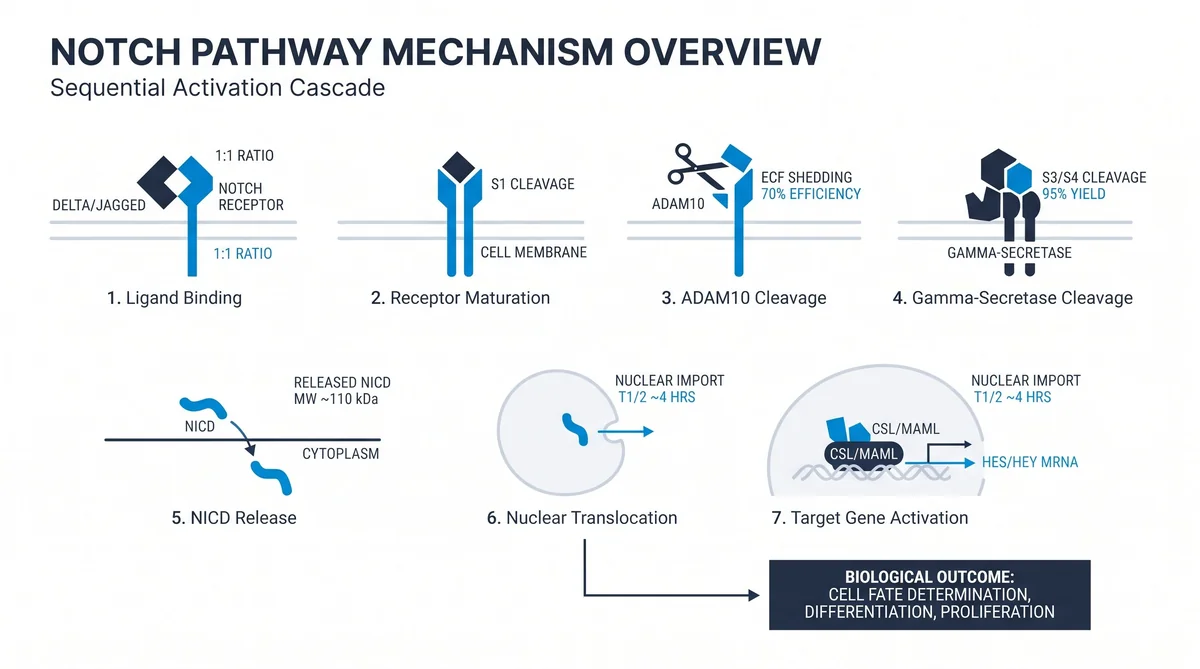
What are Notch-inhibiting peptides?
Notch-inhibiting peptides are synthetic molecules designed to block the signaling cascade. They disrupt the binding between receptors and their ligands. These compounds act as competitive antagonists. They are molecular decoys that prevent onset of the signaling pathway. By binding to specific protein domains, they block natural substrates from reaching their target.
Teams often introduce these agents into cell proliferation models. They observe the blockade of pathways that drive cell growth. Many cell proliferation models show signs of excessive Notch output. These peptides let scientists gather data on the resulting shift in cell outcomes. In cell fate studies, lab teams use these molecules to guide lineage commitment. They control the timing and strength of signaling events. By blocking specific receptors, researchers analyze how progenitor cells choose between rest and a lineage path.
What are Notch-activating peptides?
Notch-activating peptides boost or mimic natural pathway onset. They stabilize the receptor-ligand complex or act as synthetic ligands. These tools let scientists probe the signal transduction pathway. They do not require full-length protein constructs. By engaging membrane-bound receptors, these agents affect cleavage. They also affect nuclear movement. These steps drive gene expression.
Teams use these synthetic ligands to study stem cell growth. They keep cells in an early-stage state or guide their choice. This lets lab teams model growth processes in the lab. These agents also serve as vital probes in lab models of tissue signaling. The goal is to observe how signaling events impact tissue signaling dynamics. According to the NIH (2020), this pathway is essential for cell fate decisions in many organ systems. Next Level Pharm gives high-purity Notch-activating peptides as COA-verified research tools. Every lot is verified by HPLC and mass spec to ensure accuracy in lab assays.
What lab models study Notch peptides?
Lab models used to study Notch-changing peptides include in vitro cell culture systems and in vivo animal models. Teams rely on these models to map the molecular interactions that govern Notch signaling.
Scientists often use in vitro cell culture systems to gain tight control over the testing conditions. These setups let teams study these pathways without using a whole organism. Co-culture assays place ligand cell lines and receptor cell lines together. This lets researchers track how peptides disrupt or assist natural signaling. Also, luciferase reporter assays measure transcription output. They show when a signaling event has successfully initiated a target gene.
Notch Signaling Peptides are available as a COA-verified research peptide. Every lot is verified by HPLC and mass spec.
In vivo models like zebrafish are key for observing growth changes that only appear in whole systems. Zebrafish develop quickly and share key Notch genes with humans. They offer a clear window into how signaling shifts affect growth. Researchers monitor these models to see if peptide application changes tissue structure or cell lineage choice. These experiments confirm data gathered from simpler lab assays.
Frequently Asked Questions
What is the Notch receptor signaling pathway?
The Notch signaling pathway is a stable cell-to-cell system. It directs key decisions about cell fate, including differentiation, proliferation, and apoptosis. It works through direct contact between nearby cells. A ligand on one cell binds to a Notch receptor on another. This binding triggers a proteolytic cascade. The cascade releases the Notch intracellular domain, that domain moves to the nucleus to control gene expression. Research shows this system is essential for keeping stem cell pools.
How do peptides modulate Notch ligand binding?
Peptides modulate Notch ligand binding by acting as direct blockers or allosteric modulators. Research shows these sequences mimic natural ligands or receptors. They block the binding sites needed for onset. By occupying these domains, synthetic peptides prevent the receptor from undergoing shape changes needed for enzyme cleavage. Teams use these tools to dampen signaling in lab models. They observe how cell lines react to modified input.
What assays measure Notch transcriptional activity?
Scientists measure Notch gene output using reporter gene assays. Luciferase-based systems track onset of Notch-responsive promoters. Other methods track downstream target genes like HES or HEY families. These use quantitative PCR or western blotting. These tools let researchers document signaling strength changes after adding changing peptides. According to PubMed (2012), these reporter assays give a reliable way to observe the concentration-dependent effects of Notch pathway change.
How does Notch signaling differ from Wnt signaling?
Notch signaling relies on direct cell-to-cell contact. It uses short-range signal to trigger cell fate decisions. Wnt signaling, by contrast, involves secreted proteins that act over longer distances. These affect many cells within a tissue. Both systems manage differentiation and proliferation. But their processes of signal start differ. Notch relies on cleavage-dependent movement of the receptor fragment. Wnt signaling mainly involves the stability and nuclear entry of beta-catenin proteins.
What cell models are used for Notch pathway research?
Researchers use many cell models to probe Notch signaling. These include T-cell acute lymphoblastic leukemia lines and stem cell populations. Stable cell lines let consistent, high-throughput testing of changing peptides in a controlled lab setting. Researchers also use organoid models from tissue samples. These observe how the pathway works in complex, three-dimensional structures. According to the NCBI (2016), these models give a closer view of in vivo signaling. They surpass traditional two-dimensional cultures.
What is the role of gamma-secretase in Notch signaling?
Gamma-secretase is a multi-subunit protease complex. It performs the final cleavage of the Notch receptor after ligand onset. This cleavage releases the Notch intracellular domain from the plasma membrane. The domain can then move into the nucleus. Without this enzyme, the signaling cascade cannot progress. The intracellular portion stays tethered to the cell surface. Researchers study this complex to understand how its activity shapes Notch pathway output.
How is Notch signaling involved in angiogenesis research?
In angiogenesis research, Notch signaling is studied for its role in selecting tip cells and stalk cells. These cells form within developing blood vessels. The pathway manages vascular networks by controlling how endothelial cells respond to angiogenic cues. High Notch output blocks sprouting. This helps stabilize vessel growth. Scientists examine how changing this pathway affects vessel formation and branching. These studies use lab models of tissue development.
What are the four different Notch receptors in mammals?
Mammals have four distinct Notch receptors: Notch1, Notch2, Notch3, and Notch4. Each shows unique expression patterns and roles in different tissues. They share a common structural process of onset. But their downstream targets vary by cellular context and ligand. Researchers study these receptors to define their roles to tissue homeostasis. They also examine distinct roles in differentiation and signaling models.
Summary
Review the molecular sequence documentation provided in your certificate of analysis to verify the purity. Batch specifications for your research needs. Confirm your lab setting supports the required inert atmosphere for storage before finalizing your project plan. If you require technical guidance on specific compound handling. You may schedule a consultation to speak with a staff biochemist.
Teams sourcing these controlled peptides can explore the diverse peptide catalog at Shop. Each vial ships with a full certificate of analysis. Complete lot traceability from our base in the United States.
People Also Read
- What Are Nootropic Peptides? Mechanisms, Research Review
- What Are Longevity Peptides? A Complete Research Review
About the Author
Next Level Pharm Research Team
The Next Level Pharm research team is composed of biochemists and laboratory scientists dedicated to providing researchers with the highest-purity, independently verified peptides available. Every batch is HPLC and mass spec verified before dispatch.
Disclaimer: The information provided on this page is for educational and research purposes only. Next Level Pharm’s products are intended for laboratory research use only. They are not intended for human consumption, diagnostic, therapeutic, or medicinal purposes. This content does not constitute medical advice. Always consult a licensed healthcare professional before making any health-related decisions.